
 Bitcoin
  Ethereum
  Tether
  XRP
XRP  BNB
BNB  USDC
USDC  Solana
  TRON
TRON  Lido Staked Ether
  Figure Heloc
Monday begins with the release of manufacturing PMI data for the Eurozone, the U.K., and the U.S. On Tuesday, the euro area will publish flash estimates for CPI y/y and core CPI y/y, while in the U.K., attention will focus on the annual budget release. Wednesday brings GDP q/q data from Australia and the CPI m/m from Switzerland. In the U.S., the ADP non-farm employment change and the ISM services PMI will be released. On Thursday, the U.S. will follow up with the weekly unemployment claims data. Friday will be busy in the U.S., with releases including average hourly earnings m/m, non-farm employment change, the unemployment rate, and the retail sales m/m figures. Throughout the week, several FOMC members are also expected to deliver their remarks. In the U.S., the consensus for the ISM manufacturing PMI is 51.7, down from 52.6 previously. Last month’s improvement in manufacturing figures was driven by a broadening recovery in durable goods orders, solid capital spending and inventory restocking following last year’s tariff increases. For this week’s release, expectations are less optimistic, though the index is still projected to remain in expansionary territory. Rising oil prices are adding pressure, particularly amid the Iran military operation. As a result, the prices paid component of upcoming manufacturing surveys is likely to remain elevated, reflecting persistent cost pressures rather than a meaningful easing in input inflation. The consensus for the core CPI flash estimate y/y is 2.2% and for the CPI flash estimate y/y is 1.7%, unchanged from the previous prints. That said, analysts from Wells Fargo expect the euro headline CPI to soften to 1.6% and the core inflation to stabilize. A stronger euro, weak global demand, and easing wage growth contribute to reduced price pressures. The ECB is expected to keep rates unchanged for now, with the next move tilted towards a cut, especially if inflation undershoots further or growth and credit conditions weaken. In Australia, the consensus for GDP q/q is 0.7% versus 0.4% previously. The Australian economy is expected to show improvement after a softer Q3, though the rebound may not be as strong as some anticipate. Westpac analysts note that the expected Q4 outperformance is largely a consumer-driven story, with household spending accelerating on the back of improving incomes. There are also signs of firmer business activity and construction. A key implication of “trend-like” quarterly growth is that the economy may be operating close to its long-run potential. This reduces the risk of a sharp growth slowdown but keeps the inflation debate in focus. Westpac highlights that nominal unit labour costs are still rising by around 1.2% q/q. With productivity growth running at roughly 1.0% y/y, this dynamic could keep the RBA alert to upside inflation risks. From a monetary policy perspective, the RBA is expected to deliver a rate hike at its May meeting, reflecting still-sticky inflation. However, if Q4 growth disappoints, it could be enough to reduce the likelihood of further hikes later in the year. In the U.S., the consensus for the ISM services PMI is 53.5, slightly down from 53.8 previously. Compared with manufacturing, the outlook for the services sector is somewhat more positive and continues to reflect resilient business activity, even as companies adopt a more cautious approach to hiring. The consensus for average hourly earnings m/m is 0.3% vs. 0.4% previously. Nonfarm payrolls are expected to rise by 58K, compared with 130K prior, while the unemployment rate is projected to remain unchanged at 4.3%. This week’s jobs report is expected to be modest. While hiring demand has stopped deteriorating, broader indicators such as job openings data and consumer perceptions of job availability continue to point to a gradual cooling rather than a rebound, according to Wells Fargo analysts. Payroll growth is seen slowing sharply, with weather-sensitive sectors like construction and leisure weighing on the headline figure. Some pullback is also expected following January’s outsized gains in healthcare. The unemployment rate is expected to hold steady, though risks are two-sided. Recent strength in the household survey leaves room for softer employment that could push joblessness slightly higher, while population adjustments tied to changing immigration trends could exert some downward pressure. Overall, labor market conditions appear balanced, consistent with steady wage growth that remains contained rather than inflationary. The consensus for U.S. retail sales m/m is -0.3% compared with 0.0% previously. The January retail sales are expected to show a modest decline, weighed down by severe winter weather, softer auto sales, and lower gasoline prices. However, underlying demand remains relatively intact, with spending excluding autos showing firmer momentum. Looking ahead, tax refunds and a stabilizing labor market are expected to provide support to discretionary consumer spending, Wells Fargo analysts said. This article was written by Gina Constantin at investinglive.com. 🔗 Source 💡 DMK Insight This week’s economic data could shake up forex trading, especially for the euro and pound. Manufacturing PMI figures are often leading indicators, and if they come in below expectations, we might see the euro and pound weaken against the dollar. The flash CPI estimates on Tuesday will be crucial; a higher-than-expected inflation rate could prompt the ECB to reconsider its interest rate stance, impacting euro valuations. Meanwhile, the U.K. budget release could introduce volatility, particularly if it signals fiscal tightening or spending increases. Traders should keep an eye on key support and resistance levels for EUR/USD and GBP/USD as these data points unfold. If the euro breaks below its recent support level, it could trigger further selling pressure. Also worth noting is how these events could ripple through related markets, like commodities and equities. A stronger dollar could weigh on gold prices, while a weaker pound might affect U.K. equities. Watch for immediate reactions post-release, especially on Wednesday with GDP data, as that could set the tone for the rest of the week. 📮 Takeaway Monitor the euro and pound closely this week; key data releases could trigger significant volatility, especially around CPI and GDP figures.

Switzerland February manufacturing PMI 47.4 vs 50.0 expected
Prior 48.8Hopes for a recovery in the Swiss industry were dashed with this being another contractionary reading in February. This marks a 38th straight month that Switzerland’s manufacturing sector recorded below the 50-point growth threshold. Of note, production slumped back lower with new orders also softening once again. The details:It reaffirms that the environment for the Swiss industry remains challenging. The only positive is that the Swiss economy relies much more on the services sector. However, the main focus right now is more on the inflation battle and that’s what the SNB is also finding it tough to work out amid a stronger Swiss franc currency. This article was written by Justin Low at investinglive.com. 🔗 Source

Italy February manufacturing PMI 50.6 vs 49.5 expected
Prior 48.1Key findings:Fresh growth in output and new orders, ending two-month run of decline Brightest 12-month outlook in just over five years Intensification of cost and charge inflationComment:Commenting on the PMI data, Jonas Feldhusen, Junior Economist at Hamburg Commercial Bank, said: “In February, we saw tentative signs of improvement in Italy’s manufacturing sector, but this is not yet a meaningful step forward. The recent uptick, following two weak months, still rests on a fragile foundation. Only if a more sustained recovery emerges over the coming months, marked by continuous growth in production and new orders, can we then speak of a genuine upswing in manufacturing. Until then, the situation remains strained. “In the latest month, a divergence has appeared between total new orders and export orders. While exports continue to suffer from the fragile global environment, total orders have edged slightly higher, supported by stronger market interest from both existing and new clients. The improvement in order intakes could be a factor that has boosted business confidence for the months ahead, which is now at its highest level since the post‑pandemic recovery. It is possible that deregulation initiatives from Brussels, such as those in the automotive sector, are contributing to this renewed optimism among manufacturing firms. “Input costs facing Italian manufacturers are rising, which could become a problem if the trend seen in recent months continues. Although cost pressures remain far below the levels of 2022, the Input Cost Index has now reached its highest level in 40 months and should therefore be taken seriously, especially since companies have also passed on more of these costs to customers. Raw materials, particularly metals, have been major drivers of increased expenses.” This article was written by Giuseppe Dellamotta at investinglive.com. 🔗 Source 💡 DMK Insight The recent PMI data indicates a shift in economic momentum, with fresh growth in output and new orders, which is crucial for traders to note right now. After two months of decline, this uptick suggests a potential rebound in economic activity, which could influence market sentiment positively. The brightest 12-month outlook in over five years signals that businesses are feeling more confident, which could lead to increased investment and spending. However, the intensification of cost and charge inflation is a double-edged sword. While growth is promising, rising costs could squeeze profit margins, particularly in sectors sensitive to input prices. Traders should keep an eye on related assets, especially commodities and equities that may react to these inflationary pressures. Key levels to watch include the PMI threshold of 50, which separates growth from contraction, and any significant movements in inflation-linked securities. As we move into the coming weeks, monitor how these trends develop, especially in the context of central bank policies that may respond to inflationary pressures. The real story is how sustainable this growth will be amidst rising costs. 📮 Takeaway Watch for PMI levels around 50 as a key indicator of economic growth; rising inflation could impact market sectors differently.

France February final manufacturing PMI 50.1 vs 49.9 prelim
Prior 51.2The final estimate is a slight nudge up to the initial reading, so it at least sees back-to-back months of increase in French manufacturing activity at the start of 2026. That being said, the February reading is rather marginal as production expanded in the absence of new order growth. On the price front, inflationary pressures picked up across France’s manufacturing sector as higher prices for metals and metal products drove a quicker rise in input costs.HCOB notes that:”The French manufacturing sector continues to struggle to generate meaningful momentum. The HCOB Manufacturing PMI declined slightly, but several underlying indicators offer cautious optimism. Production increased in the first two months of the year, a development that several surveyed firms attribute to improved conditions in the automotive and aerospace industries. Both sectors are likely to benefit in the coming months from deregulation and sustained public-sector demand. “As long as incoming orders in France’s manufacturing sector remain in decline, it is premature to declare the downturn in the sector as over. That said, the index for order books is only marginally below the expansion threshold, and significantly better than the average level recorded from 2023 to 2025. However, export markets continue to provide little support, as foreign orders have fallen again since the start of the year, with February seeing weaker new business from Europe, Asia, South America, and parts of Africa. “Against the backdrop of rising output and declining orders, inventories of finished goods increased in February. Conditions around purchasing and stocks of purchases also appear to be shifting. After three years of continuous destocking, manufacturing firms are once again expanding their holdings of purchases to meet higher production needs. “Business expectations have stagnated in recent months, though they remain at a level clearly above that of previous years. Confidence among manufacturers therefore appears to be improving. This is partly driven by expectations of rising demand from the public sector.” This article was written by Justin Low at investinglive.com. 🔗 Source 💡 DMK Insight French manufacturing activity is showing a slight uptick, but here’s the catch: it’s happening without new order growth. For traders, this could signal a potential stagnation in demand despite the positive production figures. If manufacturers are ramping up output without a corresponding increase in orders, it raises questions about sustainability. This scenario might lead to inventory build-ups, which could impact future production decisions. Keep an eye on related sectors, especially those tied to manufacturing inputs like commodities or industrial stocks, as they may react to these signals. Also, watch for any shifts in economic indicators that could suggest a broader trend, particularly in the Eurozone. The flip side is that this marginal growth could be seen as a positive sign of resilience in the French economy, which might attract bullish sentiment. However, without new orders, the risk of a downturn looms larger. Traders should monitor the upcoming economic releases for any shifts in order growth or broader manufacturing sentiment, as these will be crucial for positioning in related markets. 📮 Takeaway Watch for upcoming economic indicators that could signal shifts in order growth, as this will impact manufacturing sustainability and related asset performance.

Germany February final manufacturing PMI 50.9 vs 50.7 prelim
Prior was 49.1Key findings:Business expectations reach highest since February 2022Comment:Commenting on the PMI data, Cyrus de la Rubia, Chief Economist at Hamburg Commercial Bank, said: “It finally looks like things are turning around for Germany’s manufacturing sector. For the first time in over three-and-a-half years, the headline PMI has climbed back above 50. That’s thanks to faster growth in output, a solid jump in new orders – helped a bit by stronger export demand – and longer delivery times, which usually signal rising demand. Most of the gains came from makers of intermediate and capital goods. For a sector that hasn’t had much to celebrate in recent years, this is already a pretty upbeat development. “Input prices shot up in February, rising much faster than the month before. From what people in the industry are saying, costs have been rising from all kinds of directions – metals, energy, wages, electronic components, and even the newly introduced Carbon Border Adjustment Mechanism (CBAM). Companies did manage to pass some of these higher costs on to customers, but margins likely still took a hit. “Companies kept trimming their staff, although not as sharply as in January, probably because demand has picked up a bit. With output growing for eleven of the past twelve months while employment has been cut significantly during the same period, manufacturers seem to have boosted their productivity. That could set a solid foundation for more sustainable growth in the months ahead. “Optimism about future production has risen from an already high level. A lot of that confidence likely comes from government infrastructure stimulus and the big jump in defence spending, both of which are driving domestic demand. There really does seem to be a structural shift underway, as over the past five months total orders have consistently outpaced export orders. We expect domestic demand to be the main driver of manufacturing growth this year.” This article was written by Giuseppe Dellamotta at investinglive.com. 🔗 Source 💡 DMK Insight Germany’s manufacturing PMI hitting its highest since February 2022 is a game changer for traders. This uptick signals a potential recovery in the Eurozone’s largest economy, which could lead to increased demand for the euro against other currencies. Traders should keep an eye on related assets, especially EUR/USD, as a sustained PMI improvement could push the pair higher. If the PMI continues to rise, we might see a shift in ECB policy, impacting interest rates and further strengthening the euro. However, it’s worth noting that this optimism could be short-lived if global economic conditions falter or if inflation pressures resurface. Watch for the next PMI release and any comments from ECB officials for clues on future monetary policy shifts. Immediate resistance levels for EUR/USD to monitor are around 1.10, while support sits near 1.08, making these critical points for potential trading strategies. 📮 Takeaway Keep an eye on the EUR/USD pair; a sustained PMI rise could push it above 1.10, while support at 1.08 is crucial.

Eurozone February final manufacturing PMI 50.8 vs 50.8 prelim
Prior 49.5Germany’s improvement is the main story driving the recovery in the euro area manufacturing sector to start the new year. Hopes of a sustained return to growth is making for a more optimistic picture at the moment. The headline reading is a 44-month high with the manufacturing output index also moving up to 51.9, its highest in six months.The only slight concern is that the latest survey data signalled an intensification of inflationary pressures. That as input prices rose sharply to a 38-month high while output charges registered a back-to-back monthly rise for only the second time in almost three years.HCOB notes that:“This seems to be a broad-based recovery of the eurozone manufacturing sector, with six out of the eight surveyed countries now in growth territory. Germany’s industry, which experienced a big jump in the headline PMI, has returned to growth for the first time in three-and-half years. Among the four economic powerhouses of Europe, Germany is showing the fastest growth rate in manufacturing. To be sure, we are not talking about a boom, but a moderate recovery coming from a low activity level amid persisting structural challenges like high energy prices, intense competition from China and US tariffs, among other things. “Input price increases have now accelerated for four straight months and even picked up sharply in February. Several survey participants pointed to higher energy and metal prices, as well as the carbon capture adjustment mechanism that kicked in at the start of the year. Companies were able to pass part of these cost increases on to customers, but it’s likely that their margins still took a bit of a hit. “Companies of the manufacturing sector are quite optimistic about their ability to sell more goods in the future and their expectations for production are even higher than they were one month before. This good mood comes especially from Italy and Germany. In Germany, this is most probably to do with higher public spending in infrastructure and defence, from which Italy, as one of the main trading partners of Germany, may also take some advantage. A similar development can be seen in the context of new orders. They have increased in the eurozone and this is driven by Germany and Italy, while factories in France and Spain are faced with fewer new orders.” This article was written by Justin Low at investinglive.com. 🔗 Source 💡 DMK Insight Germany’s manufacturing recovery is a big deal for traders, especially with the output index hitting a 44-month high. This uptick signals potential strength in the euro area, which could lead to a stronger euro against the dollar. Traders should keep an eye on how this affects the EUR/USD pair, particularly if it breaks above key resistance levels. A sustained rally could attract institutional interest, pushing the euro higher. But here’s the flip side: if this optimism doesn’t translate into actual growth or if inflation concerns resurface, we might see a quick reversal. Watch for any economic data releases in the coming weeks that could either support or undermine this bullish sentiment. For now, the focus should be on the euro’s performance against the dollar, especially if it approaches recent highs. A breakout could signal a shift in market sentiment, while failure to maintain momentum might lead to profit-taking. 📮 Takeaway Monitor the EUR/USD pair closely; a breakout above recent highs could signal a bullish trend, while any economic data could shift sentiment quickly.

Crypto technical analysis today
Crypto futures are navigating a heavy geopolitical backdrop, but the price response so far has been more controlled than many would have expected after an intense weekend. Rather than a straight-line liquidation, both Bitcoin and Ether are showing two-way trade with clear areas where participation has concentrated and where follow-through has repeatedly stalled.This write-up follows the investingLive order flow framework.Crypto market snapshot today (02 March 2026)Bitcoin futures are trading near 66,150, with the most recent medium-term session printing roughly 66,450 high – 65,835 low – 66,150 close. Today’s range shown on the platform sits around 65,000 to 67,440, while the broader multi-session window includes a visible swing high near 68,560.Ether futures are near 1,940 to 1,942. The latest medium-term session traded about 1,952 high – 1,931 low – 1,942 close, while the latest short-term hour printed approximately 1,946.5 high – 1,937 low – 1,940 close. The platform’s day range shows 1,919.5 to 1,996.Performance context helps frame the tone: Bitcoin is still down about 25% year-to-date, while Ether is down about 36% year-to-date, with deeper drawdowns for Ether across recent multi-month windows. This means buyers are trying to stabilize price from a weaker starting point.Participation context: the instrument panels show Bitcoin volume around 3.0K with open interest near 18.3K, while Ether volume is around 3.1K with open interest near 23.9K. Ether continues to show heavier positioning through futures on this read.Bitcoin futures: what the recent sessions are really sayingInstead of repeating one level over and over, the clean way to read Bitcoin here is as a sequence of attempts to move away from balance, followed by repeated pullbacks into the same demand zone.1) The push toward the upper 68k area lacked staying powerEarlier in the window, Bitcoin pushed toward the 68,100 to 68,560 area. Participation was active, but the market struggled to hold those highs. That matters because when price visits a higher zone and cannot stay there, it often signals that supply is comfortable meeting demand up there.In practical terms, that creates an overhead reference zone. Even if price rebounds, that region can act as a decision point where buyers must prove they can hold higher ground.2) The breakdown was not a single event – it was a step-downAfter failing to sustain the upper range, Bitcoin rotated lower through the mid levels:67,700 to 67,300 acted like a transition area rather than a durable floor.As price slipped into 66,900 to 66,500, selling attempts found more traction and price started spending less time at each higher level.This is a subtle but important behavioral shift: when a market begins to move lower in steps, it is often because buyers are less willing to defend each prior reference, forcing the auction to search for a level where demand becomes more assertive.3) The heaviest participation came during the drop, then again during stabilizationOne of the most useful tells in this Bitcoin sequence is where activity increased.During the decline into the mid-65k area, per-session traded volume expanded meaningfully compared with earlier consolidation.After that, the next burst of participation did not produce clean continuation lower. Instead, price began to rotate and compress.That combination often points to absorption dynamics: selling is being met, but sellers are not being rewarded with sustained downside follow-through.4) The latest session: bounce off lows, but not a trend reversalThe most recent medium-term bar is a good example of “resilient but not liberated” price action:It probed down toward 65,835.It recovered back above 66,100 and settled around 66,150.That is constructive in the sense that buyers did not allow the lows to turn into immediate acceptance. But it is still not decisive enough to claim momentum has flipped.Bitcoin key areas this weekPrimary support zone: the mid-65k region (with 65,000 as the day’s visible extreme and 65,300 to 65,700 as the “work area” where buyers have repeatedly responded).First upside checkpoint: 66,500 to 66,900 (price must hold here more consistently to stop the step-down behavior).Upper resistance zone: 67,300 to 67,700, then 68,100 to 68,560 as the broader swing reference.Ether futures: medium-term structure plus what the 1-hour view addsEther is where the extra short-term perspective really helps, because the hourly sequence shows the tug-of-war more clearly: an early rebound, a failed breakout, then a controlled pullback and stabilization.Medium-term (recent sessions): from 2,000+ rejection to a lower-base attemptIn the medium-term view:Ether previously traded up into the 2,060 to 2,072.5 area and could not sustain it.It then rotated down through 2,020 and 2,000, and selling pressure intensified as price moved into the 1,970 to 1,946 band.The most aggressive participation showed up into the 1,922 to 1,913 region, where the decline met its clearest response.The important read is not just that price bounced, but that the bounce did not instantly reclaim prior “control levels” like 1,980 to 2,000. That keeps Ether in a recovery attempt, not a confirmed reversal.The latest medium-term bar reinforces this: 1,931 low – 1,952 high – 1,942 close. Sellers could not push the market into a clean breakdown, but buyers also have not built enough acceptance above the mid-1,950s to pressure the upper range.Short-term (1-hour): a detailed timeline of today’s auctionEarly session dip and rebound (around the day’s low)Ether printed the day’s visible low near 1,919.5, then snapped back quickly.That rebound came with higher participation relative to later hours, suggesting the low attracted responsive demand rather than being ignored.Rally attempt into the upper band, then immediate rejectionBuyers pushed price up toward 1,990 to 1,996.The key detail is what happened next: price could not stay there. The market rotated down through 1,982 to 1,974 soon after, signaling that supply was active in the upper band.In other words, the market tested the top of the day’s range, found sellers, and returned to balance.Mid-session balance and compressionAfter the failed push, Ether spent time chopping between roughly 1,966 and 1,982, with more moderate participation.This is typical “auction repair” behavior after a fast move: both sides transact, but neither side gains decisive control.Late-session pullback and stabilization near the mid-1,940sEther drifted lower into 1,958 to 1,950, then probed into the 1,942 to 1,934.5

UK February final manufacturing PMI 51.7 vs 52.0 prelim
Prior 51.8Key findings:New export orders rise at quickest pace in four and-a-half years Business sentiment stays close to January’s recent highComment:Rob Dobson, Director at S&P Global Market Intelligence “UK manufacturing has made an encouraging start to 2026. Output rose at the quickest pace in 17 months during February, building on a solid upturn in January, as companies enjoy rising intakes of new work from both the home and overseas markets. Growth of new export business hit a four-and-a-half year high, as improving client confidence in markets such as North America, mainland China, the EU and Middle East led to new contract wins. “The outlook also remains positive. Business optimism among manufacturers stayed close to January’s recent high, with close to three-fifths of all companies expecting to expand production during the coming year. New product launches, rising client confidence and planned investments are all forecast to help generate growth over the next year, offsetting some of the caution companies are still exhibiting due to recent government policy changes and ongoing geopolitical uncertainty, especially in relation to US tariffs. “Although the promising start to the year and positive expectations for the future are not yet fully reflected in the labour market, there are signs of stabilisation on the jobs front too. The rate of decline in staffing levels was only mild in February and eased to the weakest during the current 16-month jobs downturn. This article was written by Giuseppe Dellamotta at investinglive.com. 🔗 Source 💡 DMK Insight UK manufacturing is showing signs of recovery, with output rising at the fastest rate in 17 months. This uptick in production, coupled with a significant increase in new export orders—the quickest in four and a half years—could signal a shift in economic momentum. For traders, this matters because stronger manufacturing data often correlates with increased demand for commodities and can influence currency valuations, particularly the British pound. Look for potential impacts on related assets, especially if this trend continues. A sustained rise in manufacturing could bolster GBP against major pairs, especially if it leads to improved economic forecasts. Traders should keep an eye on key levels for GBP/USD, particularly if it approaches resistance near recent highs. Additionally, monitor the broader market sentiment as this data could influence central bank policy discussions, especially regarding interest rates. If business sentiment remains robust, it could lead to more aggressive monetary policy adjustments, impacting forex positions significantly. 📮 Takeaway Watch for GBP/USD resistance levels as UK manufacturing data strengthens; a sustained uptrend could signal further bullish momentum.

EU reportedly says that there is no immediate impact to oil security from US-Iran conflict
The European Commission is said to have sent an email to EU governments, in noting that it sees no immediate impact on the bloc’s security of oil supply from the situation in the Middle East. That according to Reuters, who has glanced over the email details with it stating that:”At this stage, we do not foresee an immediate oil SOS (security of supply) impact.”That being said, the EU is considering to convene an ad-hoc meeting of its oil coordination group later this week. Adding that it has requested member states to share their oil security of supply assessments by the end of today.Well, I would say that the situation is rather fluid at the moment. With all eyes still resting on how long the conflict may endure in the Middle East and also the prolonged impact on the Strait of Hormuz, it won’t be easy to assume or forecast anything.So far, oil prices have still yet to reclaim the opening gap high with WTI crude seen up 7% on the day to $72.05 currently. The opening gap high saw it climb over 13% to above $75 before quickly retreating in Asia trading with the low earlier touching $69.43. This article was written by Justin Low at investinglive.com. 🔗 Source 💡 DMK Insight The European Commission’s assessment that there’s no immediate threat to oil supply security from the Middle East is significant for traders right now. This statement could stabilize oil prices, which have been volatile due to geopolitical tensions. If traders were anticipating a supply shock, this news might lead to a short-term sell-off in oil futures, particularly if prices were already elevated. However, it’s worth noting that while the EU may feel secure, the situation can change rapidly. Traders should keep an eye on key technical levels in oil markets; for instance, if Brent crude breaks below a certain support level, it could trigger further selling. Additionally, watch for any shifts in sentiment from major oil-producing nations, as their reactions could ripple through related markets like natural gas and even equities tied to energy stocks. In the coming days, focus on the weekly inventory reports and any updates from OPEC, as these could provide further insights into supply dynamics. Also, monitor how the market reacts to this news—if oil prices remain stable, it could indicate a stronger bullish sentiment among traders. 📮 Takeaway Watch for oil price movements around key support levels this week, especially in response to OPEC updates and inventory reports.
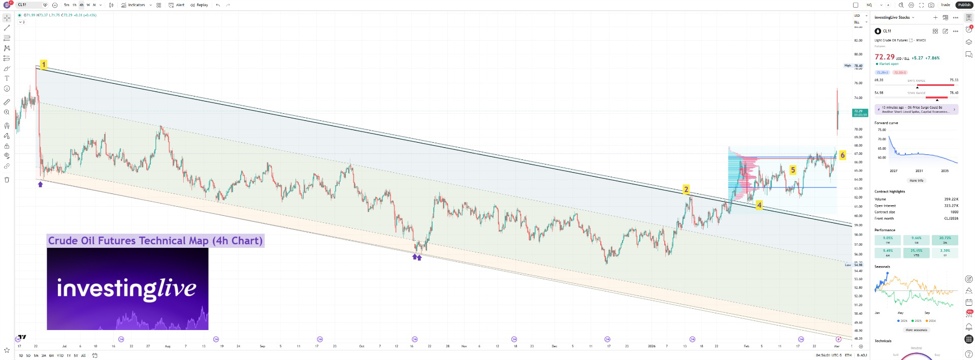
This Technical Map Shows Oil's Technical Analysis Before and After the War
Some of you have already seen this bull flag in oil in my previous oil technical analysis article, well before the war started over the weekend. But here it is again with a detailed technical explanation. Remember, there is no “one single way” to do “technical analysis”. I use broad perspectives such as the ones belw with other technical analysis methods, including, for example volume profile analysis, order flow, and others. This is one perspective, not a crystal ball.Technical Analysis Primer: The Anatomy of a Reversal (Crude Oil)To fully grasp why this crude oil move matters, it helps to zoom out and recognize a simple idea: strong reversals and breakouts rarely happen “out of nowhere.” They usually develop in stages, where the market first builds structure (a map), then tests it (a vote), and only then expands (a decision). Below is a clean educational breakdown of the most common patterns and principles traders and investors will see in this type of setup.1) The Macro Bull Flag and Descending Channel (Points 1 and 2)A bull flag is a continuation pattern that looks like a flag on a pole. First you get the flagpole (a sharp, impulsive rally). Then price cools off in a tight, downward-sloping channel (the “flag”), typically defined by two parallel trendlines.What you are seeing on the chartPoint 1 marks the peak that starts the consolidation.Point 2 and subsequent touches confirm that sellers are defending the upper boundary, while buyers keep stepping in on dips.The psychologyThis downward channel is usually not “bearish selling” in the bigger sense. It is often profit-taking and rebalancing after a strong advance. The reason bull flags can be powerful is that the pullback is controlled: price drifts lower, but does not collapse. That is the market catching its breath.Extra context that helps tradersThe “healthiest” bull flags tend to show shrinking volatility inside the channel (smaller swings, smoother drift).A key tell is whether the market stops making fresh lows easily. If each push down gets bought faster, the flag is tightening like a coil.Breakouts tend to be more meaningful when the flag occurs after a strong impulse move, not after a choppy grind.2) The Cup and Handle Formation (Point 3)The cup and handle is a classic bullish continuation pattern. The cup forms when selling pressure fades and the market rounds out a bottom, and the handle is a brief pullback or sideways pause just below resistance.What you are seeing on the chartPoint 3 is where the rounded recovery becomes obvious, and the market starts pressing into the same ceiling again and again.The handle typically forms just under the breakout level, often as a smaller channel, a tight range, or a shallow drift lower.The psychologyThe cup is the market transitioning from distribution to stabilization to accumulation. The handle is the final cleanup: it shakes out late buyers who entered too early and it invites short sellers to lean against resistance one last time.A subtle but important detail: a “good” handle is usually shallow and controlled. Instead of being rejected hard from resistance, price hesitates and holds near the ceiling. That often signals seller fatigue and buyer confidence.Extra context that helps tradersHandles that retrace too deeply often weaken the setup because they suggest sellers still have real control.A “clean” handle tends to form with less urgency on the downside (less panic, fewer sharp sell bars).3) Breakout and Retest: The Principle of Polarity (Point 4)In technical analysis, the Principle of Polarity is a core rule: once a meaningful resistance level breaks, it often flips into support (and vice versa). Traders sometimes call this “old resistance becomes new support.”What you are seeing on the chartPrice breaks above the channel or the key ceiling, then returns to test that level (the retest, Point 4).The retest is the market checking: “Do buyers still defend this level now that it is above?”The psychologyMany traders avoid chasing breakouts and wait for a retest because it answers a simple question: was the breakout real, or was it just a spike? A successful retest is basically the market confirming that the breakout level is now a floor.What tends to separate strong retests from weak onesStrong retests often show quick rejection of lower prices (buyers step in fast).Weak retests often show price accepted back inside the old range (the breakout fails and traps late buyers).4) Volume Profile and Point of Control (POC) (Point 5)Unlike standard volume bars (volume per time), Volume Profile shows volume traded at each price level. The Point of Control (POC) is the price where the most business was done in the chosen period.What you are seeing on the chartA sideways consolidation forms.The POC develops and sits near the top of the range, close to resistance (Point 5).The psychologyA POC near the top of a range is often bullish because it suggests the market is not rejecting higher prices. Instead, it is accepting them as fair value. Put simply: buyers are willing to transact heavily near the ceiling, which can mean accumulation is happening without needing a deep pullback.Extra context that helps tradersWhen volume builds at higher prices, it can create a “platform” of support. If the market breaks out, that platform can later act as a strong area for dip-buyers.If the POC keeps migrating upward over time, it is often a sign that the market’s perceived fair value is rising.5) The Breakout Expansion (Point 6)A true breakout is not just a price poking above a line. It is usually an expansion phase, where price escapes the old balance area with urgency. This is often where gaps, strong momentum candles, and follow-through show up.What you are seeing on the chartPrice accelerates out of the consolidation zone (Point 6).The move may include a gap (opening significantly above the prior close) and fast continuation.The psychologyBreakout expansions happen when multiple groups are forced to act at the same time:Breakout buyers enter on confirmation.Short sellers cover (a squeeze effect).Momentum systems trigger as volatility expands and structure breaks.Fundamental headlines or weekend events can amplify this by forcing