 Bitcoin
  Ethereum
  Tether
  BNB
BNB  XRP
XRP  USDC
USDC  Solana
  TRON
TRON  Lido Staked Ether
  Figure Heloc
Inflation pressures are weighing on the economyFirms are having a hard time planning for the futureMonetary policy is appropriately positioned at mildly restrictive levelsInflation is too high, and was too high even before the war startedThe US is on track to continue modest growthConsumers are spending but at a slower paceHouseholds and firms are cautious about the outlook amid uncertaintyJobless rate right around full employmentThe base case is that job market remains stableInflation is too high due to multiple forcesThe pace of economic activity not adding materially to inflation pressuresLong run inflation expectations are in a good placeCurrent Fed policy is helping temper higher inflationThe current stance of monetary policy is appropriateMonetary policy is well positioned for outlookHolding rates steady gives Fed space to weigh dataHealthy for markets to shift to tighter monetary policy outlookI don’t see structural changes in inflation, instead it’s been a series of shocksFed’s Paulson said inflation remains uncomfortably high despite signs of moderating economic activity, arguing that the central bank’s current policy stance is appropriately positioned to guide inflation lower while allowing the economy to continue expanding at a modest pace.She acknowledged that households and businesses are facing a challenging environment marked by persistent price pressures and elevated uncertainty. While economic growth has slowed from earlier peaks, he stressed that the economy continues to show resilience.According to Paulson, inflationary pressures continue to weigh on economic decision-making across the country. Businesses are finding it increasingly difficult to plan for the future as they navigate uncertainty surrounding costs, demand, and broader economic conditions.Despite these concerns, Paulson painted a relatively stable picture of the labor market. She described the unemployment rate as remaining near levels consistent with full employment and said her baseline expectation is for labor market conditions to remain broadly stable in the months ahead.She argued that price pressures remain too high and emphasized that inflation was already elevated before the outbreak of the Middle East conflict, suggesting that recent geopolitical developments are only one factor among several contributing to the problem.Paulson attributed inflation to multiple underlying forces. While acknowledging that demand remains solid, she noted that the current pace of economic activity is not materially adding to inflationary pressures, indicating that supply-side factors and other structural influences continue to play an important role.At the same time, she expressed confidence that long-term inflation expectations remain well anchored. She defended the central bank’s current policy stance, describing monetary policy as “mildly restrictive” and well positioned to address the challenges facing the economy. She argued that current interest-rate settings are helping temper inflation while avoiding excessive pressure on employment and growth.Paulson also emphasized the benefits of patience. Holding interest rates steady gives policymakers valuable time to evaluate incoming data and better understand how inflation, labor markets, and global developments are evolving before making additional policy adjustments.Addressing financial market expectations, Paulson suggested that investors have been right to adjust toward a less accommodative outlook for monetary policy. As inflation remains above target and economic growth continues, she argued that it is healthy for markets to recognize the possibility that interest rates may remain elevated for longer than previously anticipated. This article was written by Giuseppe Dellamotta at investinglive.com. 🔗 Source 💡 DMK Insight Inflation’s grip on the economy is tightening, and here’s why that matters for traders: With inflation still elevated, firms are struggling to forecast effectively, which can lead to volatility in stock and forex markets. A mildly restrictive monetary policy suggests that the Fed is cautious but not overly aggressive, leaving room for potential interest rate adjustments depending on economic indicators. Traders should keep an eye on consumer spending trends, as slower growth could signal a shift in market sentiment. If inflation persists, we might see increased volatility in related assets, particularly in commodities and currencies tied to economic performance. Here’s the flip side: while inflation is a concern, the US economy is still on a path of modest growth. This could provide a buffer against more drastic market corrections. Watch for key economic reports that could influence the Fed’s next moves, particularly consumer spending data and inflation reports. If inflation shows signs of easing, it could stabilize markets, but if it remains stubbornly high, expect heightened volatility and potential shifts in trading strategies. 📮 Takeaway Monitor consumer spending and inflation reports closely; sustained high inflation could trigger volatility in stocks and forex markets.
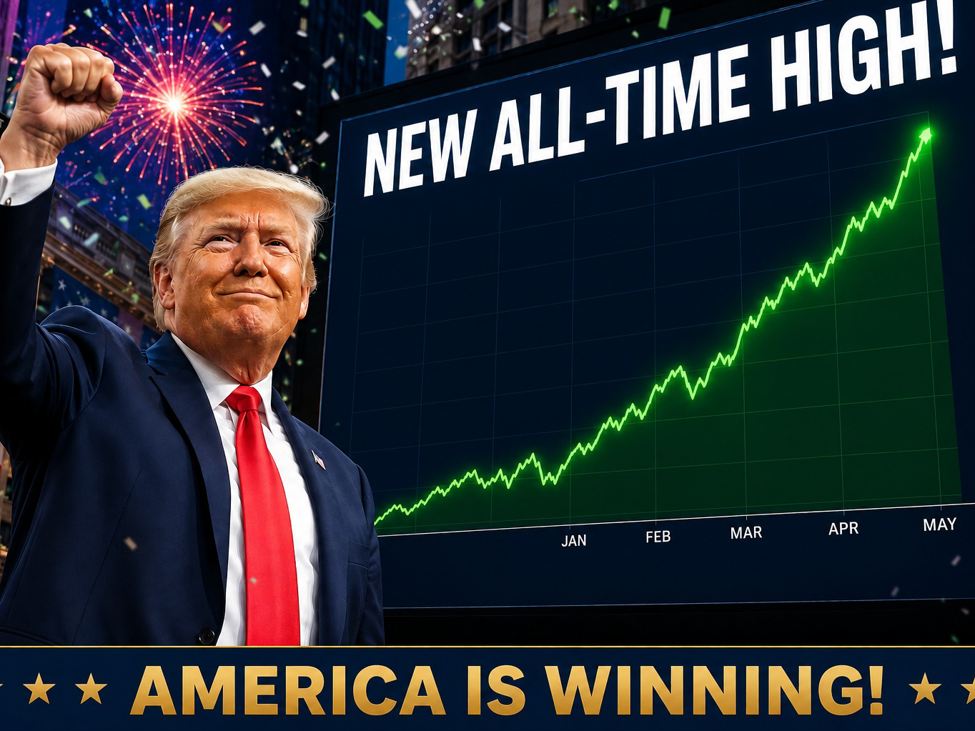
Major US stock indices extend gains to new record highs on US-Iran deal optimism
S&P 500 +0.44%Nasdaq Composite +0.58%The latest catalyst for the push into new all-time highs was yesterday’s Axios report saying that US and Iranian negotiators have reached an agreement on a 60-day memorandum of understanding to extend the ceasefire and launch negotiations on Iran’s nuclear program, but President Trump has yet to give his final approval.The most important thing in terms of economic outlook is the Strait of Hormuz. There’s still lots of confusion on how and when it’s going to reopen. Just now, Iran’s Foreign Minister Aragchi said in a post on X that he discussed the Hormuz and its future administration in line with their sovereign responsibilities and international law. Iran has been pushing for a toll system with Oman, and the US has repeatedly said that it would be unacceptable.The main risks for the stock market at the moment are Fed rate hikes and a new US-Iran military conflict. For now, the fact that diplomacy continues to be the main driver, has been keeping the market supported as neutral Fed policy continues to indirectly ease financial conditions. If the situation in the Strait of Hormuz doesn’t change before the June FOMC meeting, there’s a risk that the Fed delivers a more hawkish than expected decision and could trigger a nasty correction given the overstretched positioning. This article was written by Giuseppe Dellamotta at investinglive.com. 🔗 Source 💡 DMK Insight The S&P 500 and Nasdaq are climbing, but here’s why traders should be cautious. The recent Axios report about a potential 60-day ceasefire agreement between the US and Iran is boosting market sentiment, pushing the S&P 500 up 0.44% and the Nasdaq Composite by 0.58%. While this news could signal a temporary easing of geopolitical tensions, the market’s reaction might be overblown. Traders need to remember that these negotiations are often fraught with complications and can unravel quickly. If the talks stall or if President Trump decides to take a hardline stance, we could see a sharp reversal. Watch for key technical levels: the S&P 500 is approaching its all-time high, and a failure to break through could trigger profit-taking. Additionally, keep an eye on related assets like oil, which could react to any shifts in sentiment regarding Iran. The next few weeks will be critical; if the ceasefire holds, we might see sustained bullish momentum, but if it falters, expect volatility to spike. Monitor the market closely for any updates on the negotiations or shifts in political rhetoric. 📮 Takeaway Traders should watch the S&P 500’s all-time high closely; a failure to break through could lead to profit-taking and increased volatility.

Trump administration wants autos under USMCA to be at least 50% made in the US – WSJ
Full report hereThe Trump administration is preparing a proposal that would significantly tighten automotive sourcing requirements under the US-Mexico-Canada Agreement (USMCA), potentially requiring that half of all components and materials used in a vehicle originate from the United States in order to qualify for the trade pact’s preferential tariff treatment, according to a report by The Wall Street Journal.The proposal, which is being developed ahead of formal negotiations over the future of the North American trade agreement, would mark one of the most substantial revisions to the automotive rules of origin since the USMCA replaced NAFTA in 2020.Under the current agreement, vehicles must contain at least 75% North American content by value to qualify for lower tariffs. However, the existing rules do not require any minimum level of US-specific content, allowing automakers to meet the threshold through a combination of parts and materials sourced from the United States, Mexico, and Canada.The administration’s new proposal would introduce a distinctly American content requirement, mandating that 50% of a vehicle’s components and materials come directly from US suppliers.Supporters of the measure argue that it would encourage manufacturers to expand production within the United States, strengthen domestic supply chains, and create additional jobs in the American automotive sector. The proposal is consistent with President Donald Trump’s long-standing emphasis on reshoring manufacturing and reducing reliance on foreign production networks.The move could have significant implications for the highly integrated North American auto industry, where vehicles often cross borders multiple times during the manufacturing process. Over the past three decades, automakers have built extensive supply chains that distribute production among facilities in the United States, Mexico, and Canada based on costs, specialization, and logistics.Industry analysts say a US-specific content mandate would likely require manufacturers to rethink sourcing strategies and potentially increase investment in American parts production. At the same time, critics warn that stricter content rules could raise production costs, complicate compliance requirements, and reduce some of the efficiency gains created by regional integration.The proposal comes as the three USMCA partners prepare for a scheduled review of the agreement. The pact includes a six-year review mechanism designed to assess its effectiveness and determine whether changes are needed before the agreement’s longer-term renewal deadlines.According to the Wall Street Journal report, the administration developed the proposal ahead of negotiations over restructuring the agreement. A US delegation is currently in Mexico City for an initial round of formal discussions with Mexican officials regarding the future of the trade pact.The automobile sector remains the largest and most economically significant manufacturing industry governed by the USMCA, making any changes to sourcing requirements particularly consequential for manufacturers, suppliers, workers, and consumers across the region.For Mexico and Canada, the proposal could represent a challenge to the agreement’s original objective of promoting a fully integrated North American production platform. For the US, however, the measure would align with broader efforts to ensure that a greater share of the economic benefits from regional trade accrue directly to US workers and manufacturers. This article was written by Giuseppe Dellamotta at investinglive.com. 🔗 Source 💡 DMK Insight The proposed tightening of automotive sourcing under USMCA could ripple through markets, impacting supply chains and costs. For traders, this matters because if implemented, it could increase production costs for automakers, potentially leading to higher vehicle prices. This might affect consumer demand and, in turn, the broader economy. Keep an eye on automotive stocks and related sectors, as they may react negatively to these changes. Additionally, if the proposal gains traction, it could influence the USD’s strength against other currencies, particularly in the context of trade balances. Watch for any updates on this proposal as they could create volatility in the automotive sector and related markets, especially if key companies report earnings that reflect these increased costs. The real story here is how this could shift market sentiment towards US manufacturing and trade policies, which are already under scrutiny. Traders should monitor automotive stocks closely and consider potential short positions if the proposal moves forward, especially around earnings reports in the coming months. 📮 Takeaway Watch for developments on the USMCA proposal; it could impact automotive stocks and the USD significantly in the near term.
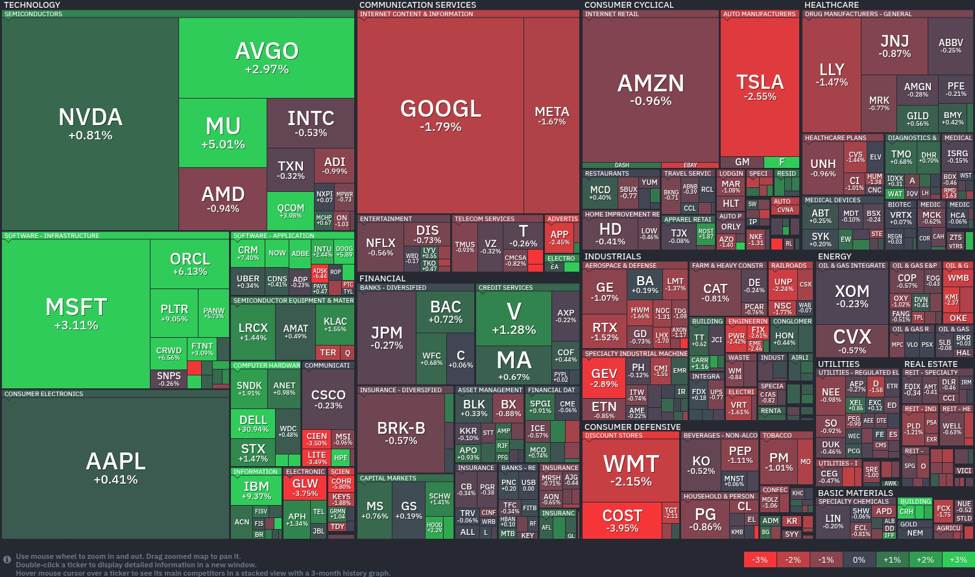
Tech sector surges while communication services face downturn
Sector OverviewToday’s stock market heatmap reveals a divergent performance across sectors, with notable strength in technology and pronounced weakness in communication services.📈 Technology: Leading the charge, the technology sector showcases robust figures. Nvidia (NVDA) gains 0.81%, Micron Technology (MU) soars by a significant 5.01%, and Oracle (ORCL) impresses with a 6.13% rise. Microsoft (MSFT) also enjoys a healthy increase of 3.11%, reflecting strong investor confidence in tech giants.📉 Communication Services: In contrast, this sector struggles, with Google (GOOGL) down 1.79% and Meta (META) dropping by 1.67%. This decline highlights investor skepticism about future earnings potential or impact from regulatory pressures.📊 Financials: A mixed bag here as Visa (V) gains 1.28%, while JPMorgan Chase (JPM) sees a slight decline of 0.27%.🛍️ Consumer Cyclical: Amazon (AMZN) slips by 0.96%, reflecting potential profit-taking or concerns about consumer spending. Meanwhile, Tesla (TSLA) experiences a sharp fall of 2.55%, indicating market caution.🏥 Healthcare: The sector faces challenges with Eli Lilly (LLY) down 1.47%, as investors reassess their positions amid ongoing industry shifts.Market Mood and TrendsThe market sentiment is cautiously optimistic for tech, buoyed by substantial gains in several big names. However, pervasive concerns linger in communication services, as major players face downward pressures. This divergence emphasizes a market searching for direction amid mixed signals.Strategic RecommendationsIn light of the current market dynamics, investors might consider increasing exposure to technology stocks, particularly in semiconductors and software infrastructure, which demonstrate robust momentum. Conversely, investors should exercise caution with communication services, potentially waiting for more stable signs before reallocating investments. Monitoring emerging trends and maintaining a balanced portfolio remains crucial, ensuring agility in responding to sudden market shifts. For continual insights and data-driven strategies, visit InvestingLive.com for detailed analysis and updates. 📊💡 This article was written by Itai Levitan at investinglive.com. 🔗 Source 💡 DMK Insight Tech stocks are on fire, but communication services are lagging—here’s why that matters: The tech sector’s strength, highlighted by Nvidia’s 0.81% gain and Micron’s impressive 5.01% jump, suggests a robust demand for innovation and growth. This could signal a broader market trend where investors are favoring growth-oriented sectors over more traditional ones like communication services, which are struggling. If this divergence continues, it could lead to a rotation where funds flow out of underperforming sectors and into tech, potentially driving prices higher. But don’t overlook the risks. If the tech rally is driven by speculative trading rather than fundamentals, we could see a sharp correction. Keep an eye on key technical levels in the tech stocks—if Nvidia breaks above its recent highs, it could attract more buyers, while a failure to hold current gains might trigger sell-offs. Watch for earnings reports and economic indicators that could impact these sectors, especially as we approach the end of the quarter. 📮 Takeaway Monitor Nvidia and Micron for breakout levels; a sustained rally could signal further investment into tech while communication services remain under pressure.

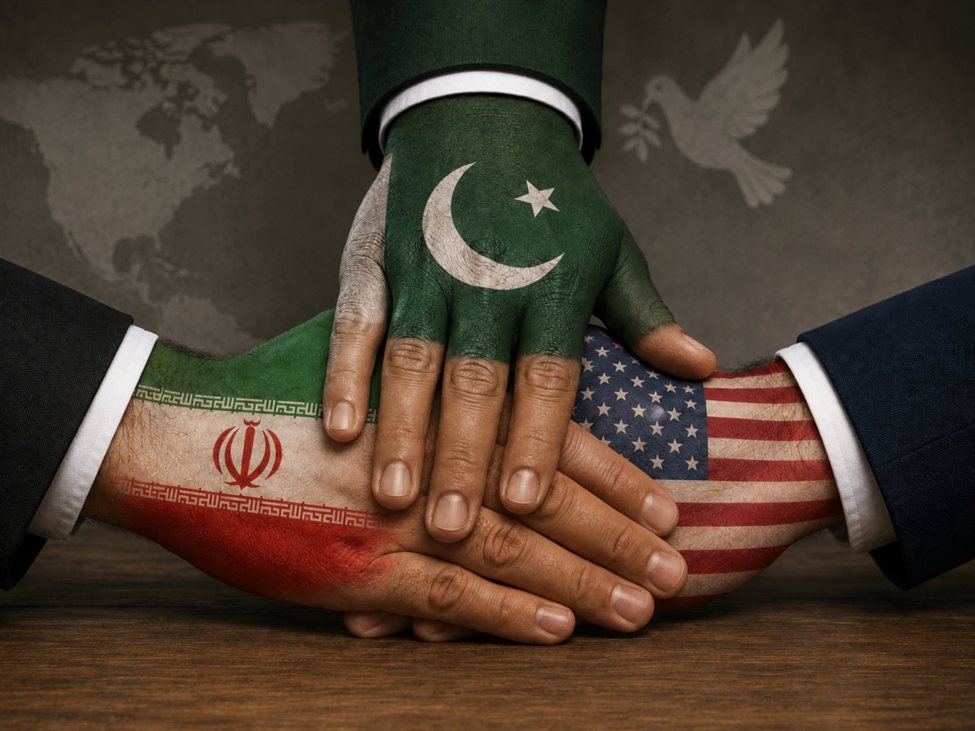
Trump: The US naval blockade will now be lifted
Iran must agree that they will never have a Nuclear Weapon or BombThe Hormuz Strait must be immediately open, no tolls, for unrestricted shipping traffic, in both directionsAll water mines, if any, will be terminated The US naval blockade will now be liftedUranium will be unearthed by the US in coordination with Iran, plus the International Atomic Energy Agency, and destroyedNo money will be exchanged until further noticeOther items, of far less importance, have been agreed toI will be meeting now, in the Situation Room, to make a final determinationPresident Trump indicated that a potential agreement with Iran may be nearing completion, outlining a series of conditions related to Tehran’s nuclear program, maritime security in the Strait of Hormuz, and the disposal of enriched nuclear material in a lengthy post on Truth Social.Trump said Iran must formally agree that it will “never have a nuclear weapon or bomb” and called for the immediate reopening of the Strait of Hormuz to unrestricted commercial shipping traffic in both directions.The president also said that any naval mines remaining in the strategic waterway must be removed or destroyed, asserting that US forces had already destroyed numerous mines during recent operations in the region. Trump claimed that vessels stranded in the strait due to what he described as an “amazing and unprecedented Naval Blockade” would be allowed to resume transit shortly.Trump asserted that uranium enriched by Iran and stored deep underground, at facilities allegedly damaged during a U.S. B-2 bomber operation conducted nearly a year earlier, would be excavated and destroyed under a joint effort involving the United States, Iran, and the International Atomic Energy Agency.According to Trump, the United States would take the lead in recovering the material because it possesses specialized engineering capabilities required for the operation. He also suggested that China would be one of the few countries with comparable technical capacity.The proposal, if implemented, would represent one of the most intrusive nuclear-disarmament arrangements ever negotiated with Iran. Previous agreements, including the 2015 nuclear accord, focused primarily on limiting enrichment activities, reducing stockpiles, and expanding international inspections rather than physically excavating and destroying material buried at damaged facilities.Trump also indicated that financial issues remain unresolved, stating that “no money will be exchanged, until further notice.” While he suggested that several additional provisions had been agreed upon, he characterized them as being of lesser importance than the nuclear and maritime provisions.The president concluded the post by saying he was heading to the White House Situation Room to make a “final determination,” implying that a key decision regarding the proposed arrangement may be imminent.Trump’s statement represents the clearest indication yet that the administration believes it may be approaching a major diplomatic breakthrough with Iran after months of military tensions, economic pressure, and negotiations over the country’s nuclear program.The fact that Trump suggests the US will lift the naval blockade is good news for markets as that’s been one of the main reasons for which Iran has been keeping the Strait of Hormuz closed. Earlier in the session, Iran’s top negotiator Ghalibaf said “no action will be taken before the other side acts”, so we can expect Iran to follow suit and reopen the Strait too. This article was written by Giuseppe Dellamotta at investinglive.com. 🔗 Source
Iran's Fars News says Iranian sources deny Trump's latest comments
Fars News Telegram link hereFrom Fars News Telegram channel: Informed sources have rejected recent claims by US President Donald Trump regarding a possible agreement with Iran, describing his statements as a “mixture of truth and falsehood” and an attempt to portray a fabricated victory. According to these sources, it has become clear to almost everyone that these claims lack credibility.According to the report, the agreement text, drafted under the framework of “commitment in exchange for commitment”, is in the final stages of approval in Iran, and no final decision has yet been made. Meanwhile, Trump, who reportedly sees himself as unable to walk away from the deal, has made statements that contradict the contents of the agreement text, while simultaneously announcing that he is ending the blockade immediately.Distortion of the Agreement’s Main Provisions by Trump1. Strait of Hormuz: Trump has claimed that Iran is obligated to open the Strait of Hormuz without collecting any fees. However, according to the sources, no such provision exists in the agreement. Iran has emphasized that once the blockade is lifted, it will reopen the strait according to its own predetermined arrangements. These arrangements could include monitoring and inspecting vessels, providing services, and ensuring security. According to information obtained by a Fars News Agency reporter, Iran is currently preparing the infrastructure for these arrangements.2. Dismantling Nuclear Material: Trump has claimed that Iran will dismantle or destroy its nuclear materials. Informed sources stress that not only is there no such provision in the memorandum of understanding, but the claim itself is fundamentally baseless.Key Elements of the Agreement That Trump Omitted1. Immediate $12 Billion Payment: The most important part of the agreement, which Trump did not mention, is the requirement for the immediate release of $12 billion from Iran’s frozen assets. According to the agreement text, this amount must be paid immediately, and Iran will not enter any subsequent stage of negotiations until the payment is made. Failure to implement this provision would constitute a violation of U.S. commitments.2. Ceasefire in Lebanon: Another issue is the establishment of a complete ceasefire in Lebanon in accordance with the position of Hezbollah.According to informed sources, only after these issues are resolved will Iran enter discussions on the lifting of all sanctions and the nuclear issue, in line with its own red lines.At the same time, Iranian officials have emphasized that any final agreement will be based on the principles and red lines of the Islamic Republic of Iran and structured around a policy of complete distrust toward the United States, in such a way that any breach of commitments would trigger an immediate reciprocal response.This is getting tiresome… This article was written by Giuseppe Dellamotta at investinglive.com. 🔗 Source 💡 DMK Insight Trump’s claims about a deal with Iran are being called into question, and here’s why that matters: geopolitical tensions can heavily influence market volatility. When leaders make bold statements about international agreements, it often leads to knee-jerk reactions in forex and commodities markets, particularly oil. If traders believe there’s a genuine thaw in US-Iran relations, we could see a dip in oil prices as supply concerns ease. Conversely, if the situation escalates, expect oil to spike, impacting related assets like the USD and emerging market currencies. Watch for any shifts in sentiment that could push oil prices through key resistance or support levels. But here’s the flip side: skepticism around Trump’s narrative could lead to increased volatility, especially if the market senses a lack of genuine progress. Traders should keep an eye on the daily charts for oil and the USD, looking for breakout patterns that could signal the next move. Keep an ear out for any official statements or developments that could shift the narrative further. 📮 Takeaway Monitor oil prices closely; any significant moves could signal broader market shifts, especially if geopolitical tensions escalate.
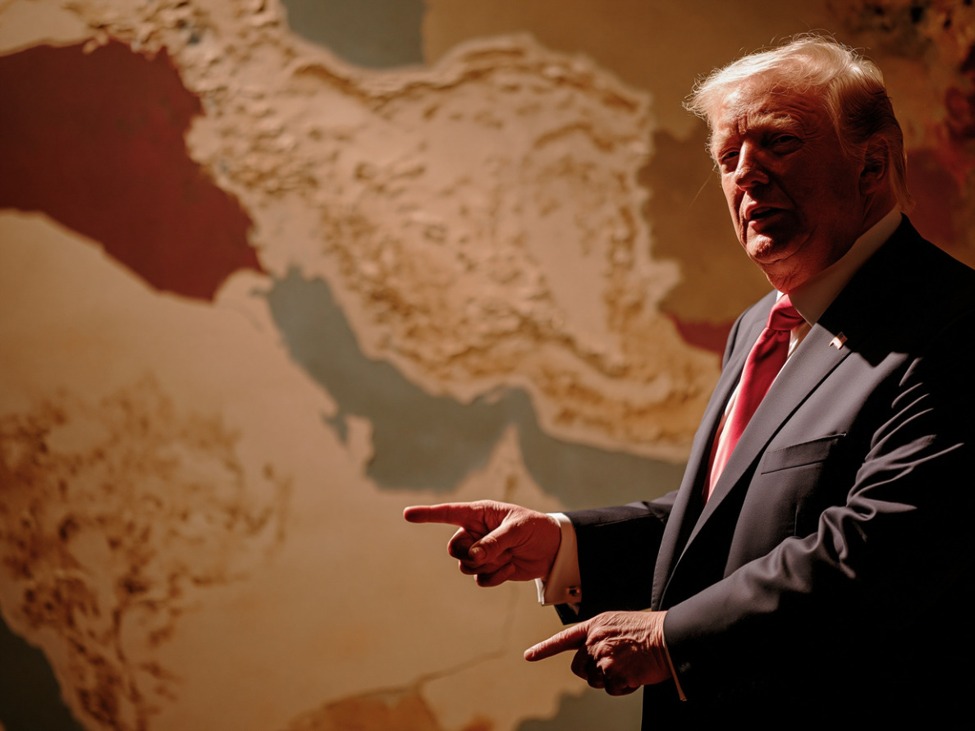
Blockade lift announcement by Trump seen as first step toward broader US-Iran agreement
Al Jazeera reporter, Ali Hashem, posted on X:”A highly informed source tells me that Trump’s post on the “Truth Social” platform regarding lifting the siege was actually the first condition before moving on to the rest of the agreement steps. And according to the source, Tehran insisted on an official and public announcement first. It seems that Trump tried to present the matter as a secondary detail among larger files, while Iran considers it an essential step to build trust before entering the more sensitive files. So far, direct discussions on the nuclear file itself have not been opened. The path is expected to proceed gradually through a memorandum of understanding (MOU), with each step met by a reciprocal step. The source adds that the announcement of a ceasefire between Hezbollah and Israel is within the framework that was agreed upon.”In other news, an Iranian source is saying that Trump’s claim about Iran’s highly enriched uranium stockpile is not true as a possible MoU between Tehran and Washington does not include any nuclear-related issues. Another senior Iranian source is saying that a political understanding has been reached between US and Iran but it has not yet been finalised. This article was written by Giuseppe Dellamotta at investinglive.com. 🔗 Source 💡 DMK Insight Trump’s recent post on “Truth Social” about lifting the siege is more than just a political statement—it’s a potential game-changer for market sentiment. If Tehran’s insistence on an official agreement is met, we could see significant shifts in oil prices and geopolitical stability, which traders need to monitor closely. The energy sector, particularly crude oil, is highly sensitive to such developments, and any positive movement could lead to a rally in related stocks and commodities. But here’s the flip side: if negotiations falter or if the market perceives this as mere posturing, we might see a sharp sell-off. Traders should keep an eye on key resistance levels in oil, particularly around $80 per barrel, as a break above that could signal bullish momentum. Conversely, a failure to sustain above this level might trigger profit-taking. Watch for updates from both U.S. and Iranian officials in the coming days, as these could provide clearer signals for market direction. 📮 Takeaway Monitor crude oil prices around $80 per barrel; a breakout could signal bullish momentum, while failure to hold may lead to a sell-off.

Fed's Daly says she doesn't see mass unemployment or displacement from AI
I don’t see mass unemployment or displacement from AIBarriers to getting sustained productivity growth from AI are largely regulatoryI see green shoots for productivity growth from AIThere’s a lot of promise in AII’m cautiously optimistic about the economyPolicy is in a good placeIt’s important for the Fed to restore price stability, but not at the expense of harming the economyProductivity growth is an important way for growth to expand, allowing companies to hire more workersFed’s Daly expressed optimism about the economic potential of AI, arguing that the technology is more likely to drive productivity gains and support growth rather than trigger widespread job losses.Daly said she does not currently see evidence that the technology will cause mass unemployment or large-scale worker displacement, pushing back against some of the more pessimistic forecasts surrounding rapid advances in automation.Instead, Daly pointed to what she described as early signs that artificial intelligence is beginning to improve efficiency across sectors of the economy. While the full effects remain uncertain, she said there are already “green shoots” suggesting AI could contribute to stronger productivity growth in the years ahead.Productivity growth has long been viewed by economists as one of the most important drivers of sustainable increases in living standards and economic output. Higher productivity allows businesses to produce more with the same resources, supporting wage growth, profits, and employment without necessarily generating inflationary pressures.She argued that AI holds considerable promise in this regard, describing the technology as a potentially transformative force for the economy. However, she suggested that the greatest obstacles to achieving sustained productivity gains may not be technological but regulatory.Optimists argue that AI could unleash a new wave of productivity growth similar to previous technological revolutions, while critics warn that adoption challenges, workforce disruptions, and regulatory hurdles could slow its impact.Beyond her comments on AI, Daly offered a generally constructive assessment of the broader economic outlook. She said she remains cautiously optimistic about the US economy, citing ongoing resilience despite uncertainty surrounding inflation, interest rates, and global developments.On monetary policy, Daly indicated that she believes the Federal Reserve is currently well positioned. She described policy as being in a good place and reiterated the central bank’s commitment to restoring price stability while avoiding unnecessary damage to economic activity. This article was written by Giuseppe Dellamotta at investinglive.com. 🔗 Source 💡 DMK Insight The current optimism surrounding AI’s potential for productivity growth is noteworthy, especially as traders navigate a complex economic landscape. With regulatory barriers being the primary concern, the market’s focus should be on how these regulations evolve and their impact on tech stocks. If the Fed maintains a balanced approach to monetary policy, it could foster an environment where AI-driven companies thrive, potentially leading to significant gains in sectors like tech and automation. However, it’s essential to remain skeptical about the pace of AI adoption. While there are green shoots, the reality is that widespread implementation takes time and investment. Traders should watch for any regulatory announcements that could either hinder or accelerate AI integration into businesses. Key indicators to monitor include tech sector earnings reports and any shifts in Fed policy that could signal changes in interest rates or inflation targets. These factors will likely influence market sentiment and trading strategies in the coming weeks. 📮 Takeaway Keep an eye on regulatory developments affecting AI and tech stocks, as they could significantly impact market dynamics and trading strategies in the near term.
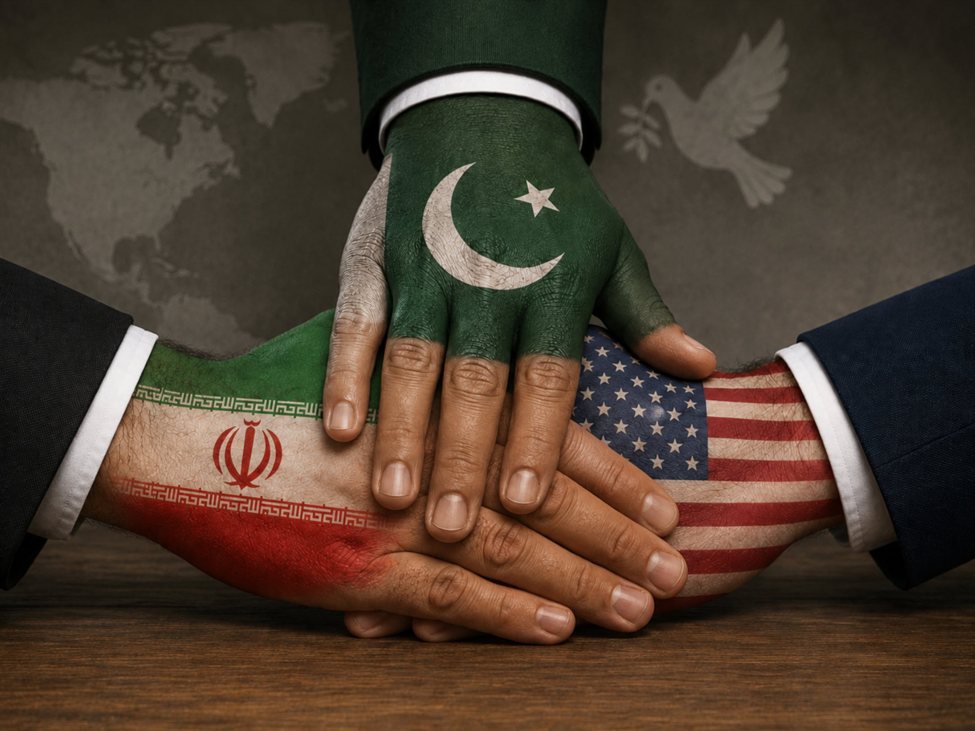
Iran's Baghaei: No agreement has been finalised with the United States so far
No agreement has been finalised with the United States so farThe management of the Strait of Hormuz must be decided by Iran and OmanAt this stage, we are focused on ending the war; we are not negotiating over Iran’s nuclear programIran’s Foreign Ministry spokesperson Esmaeil Baghaei said no final agreement has yet been reached with the United States, pushing back against growing speculation that Washington and Tehran are on the verge of formalizing a broader understanding over nuclear-related issues.Baghaei emphasized that discussions remain ongoing and that reports suggesting a finalized deal are premature. Iranian officials have repeatedly stated in recent days that while conclusions have been reached on parts of a potential memorandum of understanding, significant issues remain outstanding.Baghaei also rejected suggestions that the United States should have a role in determining the future management of the Strait of Hormuz.The remarks come after a series of statements from US officials and President Trump regarding the reopening of the strait and broader negotiations aimed at stabilizing the region. Baghaei’s comments suggest Tehran is seeking to frame the issue as a regional matter to be handled by the countries directly bordering the strait rather than through arrangements dictated by the US. Iranian officials have previously argued that security in the Persian Gulf and the Strait of Hormuz should be managed by regional states.Perhaps most notably, Baghaei indicated that Iran is not currently engaged in negotiations over its nuclear program, despite repeated statements from US officials linking any future agreement to restrictions on Iranian nuclear activities.The statement highlights a continuing gap between the priorities publicly outlined by Tehran and those emphasized by Washington. US officials have consistently described Iran’s nuclear activities, uranium enrichment levels, and stockpile management as central components of any long-term agreement.Iran, however, has repeatedly maintained that current discussions are primarily centered on ending the conflict and securing broader regional understandings before moving to more contentious issues such as sanctions relief and nuclear restrictions. This article was written by Giuseppe Dellamotta at investinglive.com. 🔗 Source 💡 DMK Insight The lack of a finalized agreement regarding the Strait of Hormuz is a significant concern for traders, especially in the oil market. This region is a critical chokepoint for global oil supply, and any instability can lead to price spikes. With ongoing tensions and no negotiations on Iran’s nuclear program, traders should brace for potential volatility in crude oil prices. Look, if Iran and Oman can’t reach a consensus, we might see disruptions that could push oil prices higher. Traders should keep an eye on Brent crude futures, particularly if we see any geopolitical escalations. Additionally, watch for reactions from major oil producers and how they might adjust their output in response to these developments. The real story is that while the focus is on ending the war, the implications for energy markets could be profound. In the short term, monitor any news from the region closely, as it could trigger rapid price movements. A break above key resistance levels in oil could signal a bullish trend, while any signs of de-escalation might provide a short-term bearish outlook. 📮 Takeaway Watch for news from Iran and Oman regarding the Strait of Hormuz; any instability could spike oil prices significantly.

How have interest rate expectations changed after this week's event?
Rate hikes by year-endRBNZ: 75 bps (79% probability of rate hike at the next meeting)ECB: 52 bps (89% probability of rate hike at the next meeting)BoJ: 42 bps (71% probability of rate hike at the next meeting)BoE: 32 bps (94% probability of no change at the next meeting)BoC: 28 bps (99% probability of no change at the next meeting)RBA: 18 bps (93% probability of no change at the next meeting)Fed: 13 bps (99% probability of no change at the next meeting)SNB: 11 bps (97% probability of no change at the next meeting)The main theme of this week has been US-Iran deal optimism as several reports since the weekend have been pointing to an imminent breakthrough. That breakthrough hasn’t come yet, but it still led to a sizeable drop in oil prices and a dovish repricing in interest rate expectations for most central banks.The biggest changes were seen in the RBA and RBNZ pricings. For the RBA, the market continues to scale back rate hike expectations, with traders not seeing any more rate hikes coming this year. This is due to meaningful softening in Australia’s economic data recently, with the unemployment rate jumping to the highest level since 2021 and monthly headline inflation slowing way below RBA’s forecasts. For the RBNZ, the central bank held its Official Cash Rate steady at 2.25% but delivered a hawkish surprise. The central bank revealed that its decision was split 3-3, forcing a casting vote, and explicitly warned that interest rates will likely need to be increased sooner and more aggressively than previously forecasted. Traders rushed to price in a rate hike coming already at the next meeting in July with probabilities now standing at 79%. This divergence between RBA and RBNZ has also led to the largest single-day decline in the AUD/NZD pair since 2022.Notably, the market is still pricing in a 71% chance of a BoJ rate hike in June, which is way out of touch with the reality. BoJ Governor Ueda made it pretty clear that they will wait for the second half of 2026, and they will want to see the US-Iran conflict to end before delivering a rate hike that could just unnecessarily weigh on economic activity. The Japanese inflation data hasn’t been calling for urgent rate hikes at all. This article was written by Giuseppe Dellamotta at investinglive.com. 🔗 Source 💡 DMK Insight Central banks are gearing up for rate hikes, and here’s why that matters for traders: The RBNZ, ECB, and BoJ are all signaling potential increases, with the RBNZ showing a 79% probability of a 75 bps hike at their next meeting. This tightening cycle could lead to stronger currencies against the USD, particularly if the Fed remains on hold. Traders should watch how these rate expectations influence forex pairs like NZD/USD and EUR/USD, as they could experience volatility around the announcements. The BoE’s low probability of change, however, suggests a divergence that could weaken the GBP against stronger currencies. Look for key resistance levels in these pairs—if NZD/USD breaks above recent highs, it could signal a bullish trend. Conversely, if the Fed surprises with a hike, it might strengthen the dollar, impacting all these currencies negatively. Keep an eye on economic indicators leading up to these meetings, as they can shift market sentiment quickly. The immediate focus should be on the next RBNZ and ECB meetings, as they could set the tone for the rest of the year. 📮 Takeaway Watch for the RBNZ and ECB meetings; a rate hike could strengthen NZD and EUR against the USD, impacting forex trading strategies.