
 Bitcoin
  Ethereum
  Tether
  BNB
BNB  XRP
XRP  USDC
USDC  Solana
  TRON
TRON  Lido Staked Ether
  Figure Heloc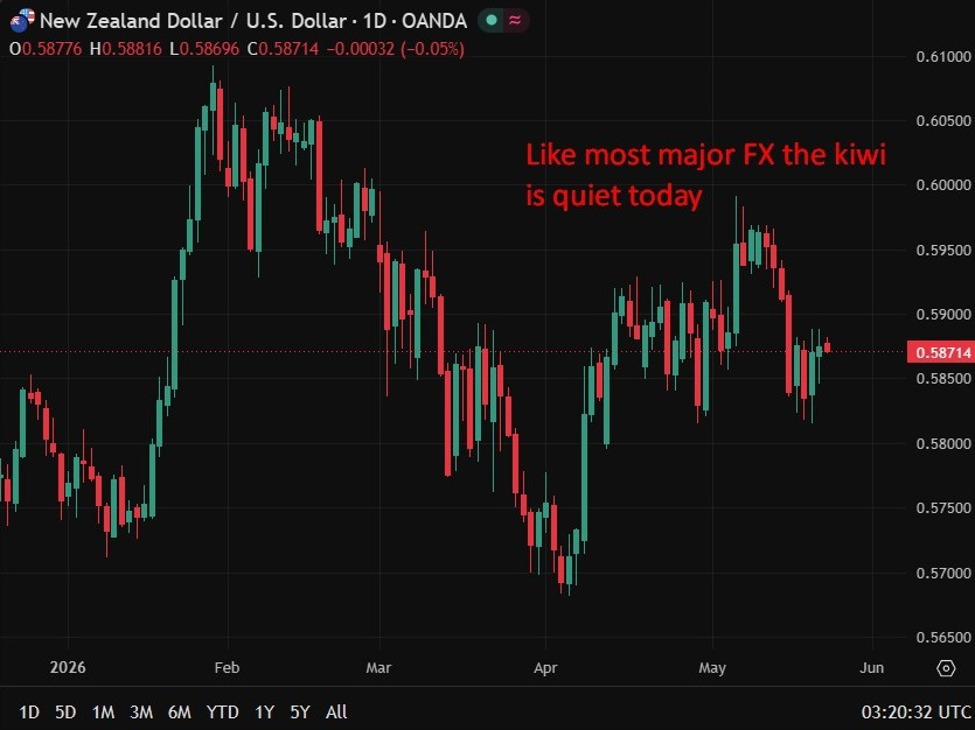
A Reuters poll shows 28 of 29 economists expect the RBNZ to hold rates at 2.25% on May 27, but a slim majority now see at least one hike by end-September as Iran war inflation risks build.Summary:
Source: Reuters poll of 29 economists, conducted May 18-2228 of 29 economists expect the RBNZ to hold its official cash rate at 2.25% at the May 27 meetingJust over half of respondents, 14 of 27, now expect the OCR to reach 2.50% or higher by end-Q3, a sharp shift from April when only 8 of 30 foresaw a hike by that pointThe end-year median OCR forecast has risen to 2.75%, up from 2.50% in the April pollNew Zealand inflation rose 3.1% last quarter, again breaching the top of the RBNZ’s 1-3% target band; oil above $100 a barrel for most of the past two and a half months is seen as a key upside risk to expectationsASB Bank chief economist Nick Tuffley expects the RBNZ to begin lifting rates from July, citing highly skewed upside risks to the inflation outlook and the danger of price pressures spreading from fuel into services and wagesMajor bank forecasts diverge sharply: Kiwibank sees one hike by end-March 2027, while Westpac forecasts 125 basis points; ASB and BNZ project 100 basis points; ANZ sees 75 basis pointsFrom the May meeting, the RBNZ will publish individual committee member votes when consensus is not reached, a new transparency measure aimed at improving public understanding of its decisionsThe Reserve Bank of New Zealand is all but certain to leave its official cash rate unchanged at 2.25 percent when it meets on Wednesday, but a significant shift has taken place in the outlook beyond that decision, with a slim majority of economists now expecting the central bank to resume tightening before the end of September.A Reuters poll of 29 economists conducted between May 18 and 22 found that 28 expected the RBNZ to hold on May 27. The near-unanimous view on the immediate decision masks a more divided picture on what comes next. Just over half of respondents, 14 of 27, forecast the official cash rate rising to 2.50 percent or above by the end of the third quarter, a striking reversal from the April poll in which only eight of thirty economists held that view.The end-year median forecast for the OCR has moved to 2.75 percent, up from 2.50 percent in April, with poll medians pointing to a further rise to 3.00 percent by the end of the first quarter of 2027. Around three quarters of all respondents expect at least one rate increase this year, though there is little agreement on the precise timing.The catalyst for the shift is not hard to identify. The Iran war has kept oil prices above $100 a barrel for most of the past two and a half months, feeding into broader inflationary pressure across the New Zealand economy. Consumer prices rose 3.1 percent in the most recent quarter, again pushing through the top of the RBNZ’s one to three percent target band. The risk, as ASB Bank chief economist Nick Tuffley articulated it, is not just the current level of fuel costs but the possibility that inflation expectations become entrenched and that price pressures spread from the pump into services and wages, a dynamic that would be considerably harder to contain.The comparison with Australia is instructive. The Reserve Bank of Australia, the RBNZ’s closest regional peer, has already delivered three rate increases this year after inflation proved more persistent than its models anticipated. The fear that New Zealand may be on a similar trajectory is clearly informing the shift in economist expectations.Major bank forecasts reflect genuine disagreement about how far and how fast the RBNZ will ultimately need to move. Kiwibank sits at the cautious end, projecting a single hike by end-March 2027, while Westpac is at the other extreme with 125 basis points of tightening over the same horizon. ASB and BNZ both forecast 100 basis points, and ANZ sits at 75.Wednesday’s meeting also introduces a new dimension to how the RBNZ communicates its decisions. For the first time, the central bank will publish individual votes cast by monetary policy committee members in cases where consensus is not reached, a transparency reform designed to give markets and the public clearer insight into the internal dynamics of its deliberations. —
The shift in RBNZ rate expectations is a meaningful development for the New Zealand dollar, with a slim majority of economists now pricing at least one hike before the end of September against just eight of thirty doing so in the April poll. The NZD may draw support from the repricing, particularly against currencies where central banks remain in wait-and-see mode. The divergence in major bank forecasts, ranging from Kiwibank’s single hike to Westpac’s 125 basis points by end-March 2027, reflects genuine uncertainty about the pace of tightening, which could keep the currency volatile around each policy meeting. The RBNZ’s new transparency measure, publishing individual committee votes when consensus is not reached, adds a further market-moving dimension to future decisions.
This article was written by Eamonn Sheridan at investinglive.com.
💡 DMK Insight
The RBNZ’s potential rate hike could shake up the Kiwi dollar and broader forex markets. With 28 out of 29 economists anticipating the Reserve Bank of New Zealand to maintain rates at 2.25% on May 27, the focus shifts to the implications of rising inflation risks tied to the Iran war. A majority now foresee at least one rate increase by the end of September, which could signal a shift in the RBNZ’s stance towards tightening monetary policy. For traders, this is crucial as it could lead to a stronger NZD against its peers, especially if inflation continues to rise and economic data supports the need for a hike. Keep an eye on the NZD/USD pair, particularly if it approaches key resistance levels. A break above recent highs could trigger bullish momentum. Conversely, if the RBNZ holds off on hikes longer than expected, we might see a pullback in the Kiwi. Monitoring inflation data and geopolitical developments will be essential in shaping trading strategies in the coming months.
📮 Takeaway
Watch for any shifts in RBNZ policy by September; a rate hike could strengthen the NZD significantly against major currencies.