 Bitcoin
  Ethereum
  Tether
  BNB
BNB  XRP
XRP  USDC
USDC  Solana
  TRON
TRON  Lido Staked Ether
  Figure Heloc
The main talk of the town yesterday was US president Trump looking to broker a ceasefire between Israel and Lebanon. He confirmed that by saying that “all shooting will stop”, allowing for the US to at least try and negotiate with Iran again on a broader framework agreement.As mentioned before, the Israel-Hezbollah ceasefire is a key precondition that Iran wants as part of the terms for the memorandum of understanding. However, the key question here is whether Israel will abide by that ceasefire. And as we have seen from a few hours ago here, it may not really be the case.If it cannot last a day, how is it expected to carry through for the next 60 days when the US-Iran deal is finalised?As a reminder, these are the other key terms that need to be agreed upon. Otherwise, the whole deal/memorandum of understanding may fall apart at any time once signed.For now, markets are still waiting on the US and Iran to strike a compromise on all fronts. Then, we’ll see how things go with nuclear discussions.But as the wait continues, market players are pretty much being put on edge in the meantime. After pushing up yesterday, US futures are now pointing lower with S&P 500 futures down 0.4% on the day. Tech shares are leading declines with Nasdaq futures down 0.6%. The overnight comments by OpenAI CEO, Sam Altman here are perhaps worth looking over if anything else.Besides that, oil prices also posted its best daily showing since late April yesterday with WTI crude nearly touching $95. That fizzled late on and we’re seeing a slight pullback now with prices down 1% to $91.20 on the day.In other markets, the US dollar continues to remain little changed in the major currencies space. There’s no real conviction here as traders continue to wait on US-Iran developments before really committing to any moves.That being said, USD/JPY continues to hold at 159.70 and nearby intervention strike range so that is one to keep an eye out for.Besides that, bond yields are also being pushed down with 10-year Treasury yields now at 4.44% and 30-year yields at 4.96%. It’s a cooling sign but it won’t take much to reignite the flames, especially if any deal comes to naught between the US and Iran.And looking to precious metals, gold is back up today by 0.5% to $4,508. The push and pull in gold continues amid a mix of US-Iran optimism and worries about inflation, with the latter signaling a more hawkish outlook for major central banks. After so much action, gold is just down 0.7% when benchmarked to close from the last two weeks i.e. 15 May. This article was written by Justin Low at investinglive.com. 🔗 Source 💡 DMK Insight Trump’s push for a ceasefire between Israel and Lebanon is more than just a diplomatic gesture; it could significantly impact oil prices and geopolitical stability. If successful, this ceasefire might ease tensions in the Middle East, potentially leading to a drop in crude oil prices as fears of supply disruptions lessen. Traders should keep an eye on WTI and Brent crude benchmarks, especially if prices start to move below key support levels. Additionally, a more stable geopolitical environment could bolster risk appetite, leading to a shift in capital flows towards equities and away from safe-haven assets like gold. However, there’s a flip side: if negotiations falter or violence escalates again, we could see a sharp spike in oil prices, which would ripple through global markets. Watch for any developments in the next few days, particularly how the market reacts to any news from Iran or further statements from the U.S. administration. Immediate focus should be on oil price movements and any shifts in investor sentiment in the equity markets. 📮 Takeaway Monitor WTI and Brent crude prices closely; a successful ceasefire could push prices lower, while renewed tensions might trigger a spike.

OpenAI Florida Lawsuit: What AI Stock Investors Should Watch Next
Key takeaways for equity investorsFlorida has filed the first state-led lawsuit against OpenAI and CEO Sam Altman, alleging ChatGPT caused or contributed to harms involving minors, self-harm, violence, addiction, and deceptive safety claims.The immediate investment risk is not simply a court judgment. The larger risk is that AI becomes framed as a consumer safety and child protection issue, similar to the public backlash around social media addiction.OpenAI is not directly listed, but public-market exposure runs through Microsoft, cloud providers, chipmakers, data-center companies, cybersecurity vendors, enterprise software firms, and the broader AI valuation trade.Previous terrorism-related lawsuits against Google, Twitter, and Facebook were mostly unsuccessful because courts treated those platforms as general-purpose intermediaries hosting third-party content. Generative AI may be different because the system can produce personalized responses rather than merely display existing content.Investors should monitor whether this remains a contained legal headline or develops into a multi-state regulatory wave, discovery risk, product restrictions, age-gating rules, higher compliance costs, or slower consumer AI adoption.What happened?Florida Attorney General James Uthmeier filed a lawsuit against OpenAI and CEO Sam Altman on June 1, 2026, alleging that the company knowingly released and marketed ChatGPT while concealing serious safety risks. Firstpost described the lawsuit as a landmark state-led challenge accusing OpenAI of prioritizing growth over safety while ChatGPT allegedly contributed to violence, self-harm, and youth addiction.The Florida Attorney General’s office said the case is the “first-in-the-nation state-led lawsuit” against OpenAI and Altman, alleging that OpenAI aggressively marketed ChatGPT to the public, including children, while suppressing internal safety warnings and deceiving users about the product’s risks.Reuters reported that Florida is seeking damages that could reach billions of dollars, along with a court order requiring OpenAI to change how ChatGPT interacts with young users. The lawsuit also cites alleged connections to a 2025 Florida State University shooting and other incidents where ChatGPT allegedly provided harmful information. OpenAI’s response is that ChatGPT is a general-purpose tool used by hundreds of millions of people for legitimate purposes, and that the company works to detect harmful intent, limit misuse, and cooperate with law enforcement where appropriate. OpenAI has also rolled out age-prediction systems, teen safeguards, parental controls, and human review escalation for certain high-risk cases. Why this matters for the AI equity landscapeFor investors, this case should be viewed as a risk-premium event, not a single-company legal story.The AI trade has been powered by three major assumptions:Demand for AI compute will keep rising.AI software adoption will move faster than regulation.Legal and reputational risks will remain manageable relative to growth.The Florida case challenges the second and third assumptions. It does not invalidate the AI growth thesis, but it introduces a new question: What if consumer-facing AI becomes regulated more like social media, youth safety platforms, financial advice, medical triage, or addictive digital products?That matters because equity valuations are not built only on revenue growth. They also reflect legal uncertainty, regulatory friction, margin durability, and public trust.Which public stocks could be affected?OpenAI is private, so most public investors do not own it directly. The market exposure is indirect.The distinction is important: AI infrastructure may still grow even if consumer AI apps face more regulation. However, if the legal narrative changes from “AI productivity boom” to “AI safety crisis,” the highest-multiple application-layer names could see the largest sentiment impact.How this differs from past Google terrorism-liability casesInvestors may remember cases where plaintiffs tried to hold technology platforms liable after terrorists used Google, YouTube, Twitter, or Facebook. Those cases generally did not create broad platform liability.In Twitter v. Taamneh, the U.S. Supreme Court declined to impose secondary liability on tech platforms for allegedly failing to prevent ISIS from using their services. The Court required more than broad allegations that platforms could have acted more aggressively against terrorists. (White & Case)In Gonzalez v. Google, the Supreme Court avoided a sweeping Section 230 ruling and instead concluded that much of the Anti-Terrorism Act complaint would likely fail under Taamneh. (Covington & Burling)The OpenAI case may be different in four ways:First, generative AI is not merely hosting third-party content. A chatbot can generate its own responses in real time. That makes the liability question more complicated than a search engine returning existing pages.Second, the product is conversational and personalized. Plaintiffs may argue that repeated chatbot interactions create a more direct relationship than a user passively reading search results or social media posts.Third, Florida’s case focuses heavily on minors, self-harm, addiction, and product design. That overlaps with the legal trend against social media platforms, where plaintiffs increasingly focus on allegedly addictive features rather than only third-party speech.Fourth, this is a state attorney general action. A private lawsuit can be dismissed quietly. A state-led case can produce subpoenas, discovery, political pressure, copycat lawsuits, and consent-decree negotiations.That does not mean Florida will win. It means the investment risk is broader than the final verdict.Public sentiment risk may matter before the court rulingCourt cases move slowly. Public sentiment can move much faster.The biggest risk for AI investors is that this lawsuit becomes part of a larger narrative: that AI companies rushed emotionally persuasive tools into homes, schools, and workplaces before fully solving safety, privacy, and mental-health risks.This is where the social-media precedent matters. Reuters reported that a Los Angeles jury found Meta and Alphabet negligent in a social-media addiction case, awarding $6 million in damages. Reuters also reported that the U.S. Supreme Court declined to hear Meta’s challenge to a Vermont social-media addiction lawsuit, allowing that case to proceed. For AI, even a legal win may not fully remove the overhang. If parents, schools, regulators, and enterprise customers start viewing AI assistants as potentially addictive or unsafe for minors, companies may face stricter age gates, mandatory warnings, parental controls, audit obligations, and restrictions on memory, voice, personalization, or companion-like behavior.That could reduce engagement, slow rollout cycles, and raise compliance costs.The AI capex story is still alive, but scrutiny is risingThe AI investment landscape is not only about lawsuits. It is also about the scale of spending required to stay competitive.Alphabet’s latest move
FX option expiries for 2 June 10am New York cut
There are just a couple of expiries to take note of on the day, as highlighted in bold below.The first ones are for EUR/USD layered between 1.1600 to 1.1625. The expiries don’t tie to any technical significance but could act as a floor level in keeping price action more in check during the session ahead. That especially the ones at the figure level at 1.1600.That region looks to be the floor for EUR/USD price action over the past two weeks and the expiries above are likely to help reinforce that, barring any new developments from the US-Iran deal.The geopolitical factor remains the number one driver of trading sentiment of course, so headline risks are still the most important thing to note. But unless there are fresh leads, the market mood will stay as it is since last week with major currencies caught in a bind awaiting the deal to be announced.Then, there is one for USD/JPY at the 160.00 level. As much as there is interest surrounding the key psychological level, the expiries are not the biggest influence here. It is all about intervention risks.The fear for traders in pushing USD/JPY to the figure level is that Japan’s ministry of finance could lay down the hammer and intervene once more. So, that is the more important factor at play when it comes to viewing the currency pair at the moment.The expiries should not offer much of any impact as such, with traders already being rather guarded in not wanting to incur the wrath of Tokyo officials. That especially without any further US-Iran developments to back them up for now.For more information on how to use this data, you may refer to this post here. This article was written by Justin Low at investinglive.com. 🔗 Source 💡 DMK Insight With EUR/USD expiries clustered between 1.1600 and 1.1625, traders should watch for potential price stability or volatility. These expiries might not align with major technical levels, but they can create a temporary floor, influencing short-term trading strategies. If the pair approaches this range, expect market participants to react, potentially leading to a bounce or a breakdown depending on broader market sentiment. Keep an eye on economic indicators and geopolitical news that could sway the euro or dollar, as these factors could amplify price movements around the expiry times. Also, consider how correlated assets like EUR/GBP or USD/JPY might respond, as shifts in EUR/USD can have ripple effects across the forex market. Watch for price action around these levels in the coming sessions, particularly on the daily charts, as traders adjust their positions ahead of the expiries. 📮 Takeaway Monitor EUR/USD closely as it approaches the 1.1600-1.1625 expiry range; it could dictate short-term price action and volatility.
Iran reportedly still discussing final text of agreement, no response sent to US yet
The report cites a source familiar with the situation, in saying that Iran’s final text of the deal is still being discussed in Tehran at this juncture. Adding that there is no response yet that is sent to the US on that.There has been so much back and forth on the text/terms of the deal that it is easy to lose track of what is happening. However, the bottom line is that there is still some differences that require sorting out. And that has been the case for well over two weeks already.A reminder on what needs to be agreed between the two sides so that the deal can be signed off:And even then, all this does is to allow for nuclear discussions to take place next. In that lieu, the US is also demanding that Iran provide some baseline promises on nuclear/uranium. The language of it all will be tricky but I wouldn’t expect Iran to abide to any “promises” no matter what. This article was written by Justin Low at investinglive.com. 🔗 Source 💡 DMK Insight So the Iran deal negotiations are still in limbo, and here’s why that matters: uncertainty in geopolitical agreements can lead to volatility in oil prices, which directly impacts forex markets. Traders should keep an eye on how this situation unfolds, as any breakthrough or setback could trigger significant price movements in crude oil and related currencies like the Canadian dollar and the Russian ruble. Right now, the lack of a clear response from Iran to the US could mean continued market indecision. If tensions escalate or if a deal is struck, expect sharp reactions. For oil traders, watch the $80 per barrel level closely; a break above could signal a bullish trend, while a drop below could indicate bearish sentiment. Additionally, keep an eye on the USD/CAD pair, as fluctuations in oil prices often correlate with movements in this currency pair. In the short term, monitor news updates from Tehran closely—any hints of progress or setbacks could lead to immediate trading opportunities. 📮 Takeaway Watch for oil prices around the $80 level and stay alert for news from Iran, as it could trigger significant market movements.
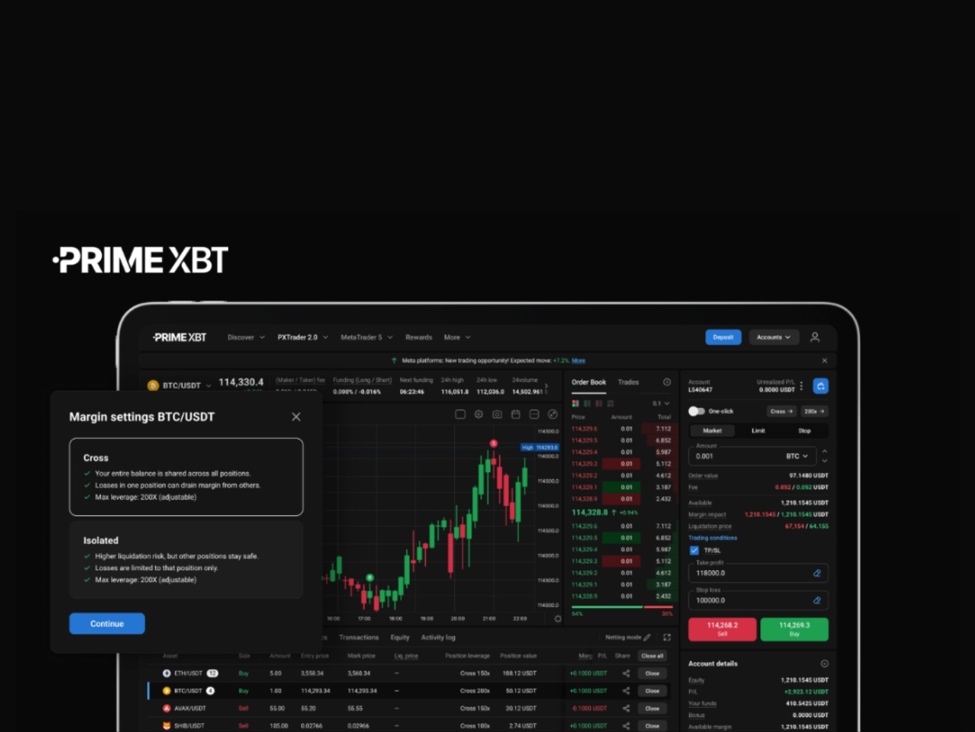
PrimeXBT: Why Successful Traders Focus on Leverage Control, Not Maximum Leverage
Ask most traders how they chose a platform and they will mention leverage ratios, spreads, or market access. Ask them six months later what actually cost them money and the answer is almost always different: they did not understand margin, they had no exit plan, or they did not realise how one bad position was affecting the rest of their account.A trader using 10x leverage on EUR/USD with a defined stop risks a fixed amount. A trader using the same leverage with no stop risks the entire margin on that position, and often doesn’t realise it until the liquidation notice arrives.That distinction is why the matter of safety for active traders is less about what the platform offers and more about how clearly it lets traders control what they are doing. PrimeXBT is built around multi-asset access across Crypto Futures, Crypto CFDs, Forex, commodities, indices, and shares. But its approach to trader protection is heavily centred around the practical risk-management tools integrated into its platform, PXTrader 2.0.The mistake behind most trading lossesThe most common pattern behind retail trading losses is rarely a single event. More often, it is a series of positions opened without a defined exit strategy. The trade moves against the trader, they wait for a recovery, the loss grows, and eventually the position is closed at a far worse level than they would have accepted at entry.Bracket orders on PXTrader 2.0 are designed to interrupt that pattern at the source. When a trader opens a position, bracket orders allow a stop-loss and take-profit to be attached at entry, before the order is placed. The risk plan becomes a part of the trade from the start rather than something added later when the market is already moving against them.For example, a trader opening a gold CFD position can define the entry level, the maximum acceptable loss with a stop, and the target price with a take-profit, all in the same order form. If gold moves sharply on a Fed statement, the platform automatically manages the exit conditions already set by the trader.The exact levels still need to make sense for prevailing market conditions. A stop placed too tightly may be triggered by normal volatility, while a stop placed too wide may expose the trader to larger losses than intended. But the platform provides a structured framework for managing those decisions more systematically.Cross margin versus isolated marginChoosing between cross margin and isolated margin is one of the most important risk-management decisions a trader makes, and also one of the least understood.Cross marginCross margin uses the full available account balance to support open positions. If one trade moves against the trader, remaining account equity can help absorb the drawdown and reduce liquidation pressure. This provides positions with more flexibility but also means one poorly managed trade can affect the entire account.Isolated marginIsolated margin limits the margin assigned to a specific position. If that position is liquidated, only the margin allocated to that position is lost and the rest of the account is not affected. This approach is often used when a trader wants to ring-fence risk on a single trade, particularly in volatile markets where one position can behave differently from the rest of the portfolio.Neither mode is inherently better. Cross margin may suit traders who actively manage overall portfolio exposure, while isolated margin is often preferred by traders who want stricter limits on individual positions. PXTrader 2.0 allows traders to switch between both modes when trading Crypto Futures, preview the impact before confirming changes, and align margin allocation with their strategy.Real-time margin visibilityOne of the major weaknesses across many trading platforms is that margin information is not visible in real time, or it is visible but hard to interpret. Traders often discover they are close to liquidation only after receiving a margin call, by which point the market may already have moved further against them.PXTrader 2.0 provides real-time margin tracking and liquidation visibility, allowing traders to monitor how changing market conditions affect account equity while positions remain open. That visibility supports more proactive decisions, whether adding margin, reducing exposure, or closing positions earlier.This becomes particularly important in crypto markets, which operate 24/7 and can experience significant price swings outside traditional market hours. A position opened during London trading hours can look very different by 3am Tokyo time, and a trader who cannot see live margin data during that window is flying blind. A trader without live margin data does not manage a position, they just find out what happened to it.Adjustable leverage capsMaximum leverage reflects what the platform allows. Appropriate leverage, however, is what a specific trader should use for a specific market and specific conditions at that moment. The two are rarely the same number.PXTrader 2.0 allows traders to set adjustable leverage caps, enabling them to lower the maximum leverage on their account to match their actual risk tolerance and trading approach, rather than operating at the ceiling. This is particularly useful for traders who have a tendency to overtrade or who are testing a new strategy on unfamiliar markets.Hedge and netting modes: Which one matches how you trade?Most traders naturally think about positions in one of two ways: as separate trade ideas (this trade is long, that trade is short), or as a combined net exposure (what my overall direction on this instrument is right now).Hedge mode is for the first type. It allows traders to hold long and short positions on the same instrument simultaneously as separate trades. This can be useful when managing two different strategies on gold, for example, or when opening a short-term hedge without closing a longer-term position you still believe in.Netting mode is for the second type. New positions on the same instrument are combined into one net exposure. Instead of tracking multiple entries separately, traders see a consolidated position and overall P&L, which some traders prefer for simplicity and cleaner exposure management. So, if you’re long 2 lots and add a 1-lot short, you’re just long 1 lot, one

Gold nudges back up today but still caught in a bit of a technical bind
The push and pull continues for gold, as traders are still trying to make sense of what to do with the US-Iran situation. Deal or no deal? That remains the question.The longer that the whole saga drags on, there’s also a negative undercurrent that looks set to run over gold prices in the bigger picture.Oil prices may have come off the boil but the fact remains that the Strait of Hormuz is closed. In that lieu, the threat to inflation pressures remain amid higher input costs to business with supply chain disruptions also still persisting. As such, a more hawkish view to major central banks will stay as a big threat to the structural outlook for gold.But in the meantime, the precious metal will still be subject to US-Iran developments for the most part.While there hasn’t been any fresh leads, we’re still seeing some swingy movement in gold over the past week or so. We saw price dip down to a two-month low last week, only to be arrested by a key technical support level. The 200-day moving average (blue line) remains a key line in the sand for now. That was the same level that held the drop during March trading.Despite that, there isn’t much appetite to be chasing a bounce either. With the recovery to around $4,533 now, gold prices are just 0.15% lower than the close set out on 15 May. In just a little over two weeks, the precious metal hasn’t really done much besides facing some constant pushing and pulling.The US and Iran supposedly moving closer to a deal looks to be a good thing for gold. However, they have been at this juncture for well over two weeks now.On the flip side, gold will also have to contend with a more hawkish take by major central banks in dealing with the fallout from the Middle East war. The most particular one will be the Fed outlook, with traders continuing to gradually expect more hawkish connotations for the central bank as the conflict drags on.The question remains, can the short-term optimism eventually tide over the long-term skepticism? That will ultimately decide which direction gold breaks out to next. But with each passing day that this continues, it’s getting harder and harder to say with the same conviction that gold need not worry about central bank actions and/or the inflation picture. This article was written by Justin Low at investinglive.com. 🔗 Source 💡 DMK Insight Gold’s current volatility is tied to the US-Iran situation, and here’s why that’s crucial for traders: As uncertainty looms over potential deals, gold’s safe-haven appeal could be tested. If tensions escalate, we might see a spike in demand, pushing prices higher. However, if negotiations progress, gold could face downward pressure. Traders should keep an eye on geopolitical developments and their impact on market sentiment. The longer this situation drags on, the more likely we are to see fluctuations in gold prices, potentially breaking key support or resistance levels. Watch for any news that could shift sentiment quickly, as this could lead to rapid trading opportunities. On the flip side, if traders are overly optimistic about a resolution, they might overlook the risks of continued instability. This could create a buying opportunity for those looking to capitalize on short-term price swings. Keep an eye on gold’s performance against the backdrop of the US dollar and broader market trends, as these correlations will be key in determining the next moves. 📮 Takeaway Monitor geopolitical news closely; a breakthrough in US-Iran talks could push gold lower, while escalating tensions may drive prices up significantly.
Palladium is looking good for the bulls. See where PA can go & where that might change
Palladium Futures Holds Bullish Repair Above $1397Prediction Score: +2 / +10Bias: Mildly bullish above 1397, but not yet a clean bullish takeoverPalladium futures, PA SEP26, are attempting to repair from the lower-zone damage seen in late May. The market has improved from the 1353-1372 area and is now pressing back above the 1397 region, which matters because it sits close to today’s developing VWAP and, more importantly, aligns with the value area high from two sessions ago.That makes 1397 the key line for this tradeCompass.Above 1397, the market holds a modest bullish repair bias. Below it, the picture becomes less attractive for bulls, but this article will avoid over-mapping the noisy short-term zone between 1376 and the 1400 round number. That area contains many intraday references that shorter-term traders and machines may react to, but for this broader trading map, the cleaner swing decision is lower.Key takeaway for commodity tradersPA SEP26 is mildly bullish while holding above 1397. The score remains only +2 / +10 because this is still a repair attempt inside prior damage, not a confirmed bullish takeover. For longer-term swing traders, the bearish map becomes more relevant below 1376, or more conservatively below 1370 for traders who want more confirmation and space.PA bullish above 1397The bullish threshold is 1397.This level is not chosen simply because it is a round or convenient number. It is close to the developing VWAP and lines up with an important prior value-area reference. When price holds above that type of area, it suggests buyers are doing more than producing a temporary bounce. They are beginning to defend a higher accepted zone.That said, the upside is still not wide open. PA still needs to deal with overhead resistance from the prior repair attempts.Bullish partial profit targets to considerIf PA continues to hold above 1397, bullish traders can consider partial profit targets at:1416-1422 – first major resistance and repair-confirmation zone1427.5-1429 – prior failed upside area1436-1439 – next resistance cluster1445-1452 – wider upside zone if buyers maintain control1464-1471 – stretch target only if the market accepts above the prior repair highsThe first key test is 1416-1422. If price reaches that area but fails to hold, traders should be careful about assuming the bullish repair has become a breakout. This zone can still act as a rejection area.Consider a Long on Palladium? As you know, that would be only up to you. I never give financial advice, all I got are my opinions. But leaving a very inspiring runner, with lots of patience, all the way to $2720, is longer term target I am looking at. That would be closer to doubling the price now.Why is the Palladium score at investingLive.com now only +2 / +10The bullish case has improved, but it is still restrained.The positive side is that PA has repaired from a lower washed-out zone and is holding above an important value reference near 1397. That gives bulls a real argument.The limiting factor is that the broader structure is still damaged from the earlier decline. The market has not yet fully reclaimed the higher value zones, and previous repair attempts near the 1428-1429 area failed. That is why the current read is mildly bullish, not aggressively bullish.In simple terms: the market has repaired, but it has not yet proven control.PA bearish below 1376, or below 1370 for more confirmationFor longer-term swing traders, the cleaner bearish threshold is 1376.A break below 1376 would suggest that the bullish repair above 1397 has failed and that price is rotating back toward the lower balance area. This would be a meaningful deterioration because it would show that buyers could not defend the repaired structure.For traders who want more space and want to avoid some of the noise around the shorter-term levels, 1370 is the more conservative bearish trigger.Below 1370, the bearish case becomes cleaner because price would be moving below the lower part of the recent balance structure, rather than merely reacting inside the 1376-1400 intraday chop zone.Bearish partial profit targets to considerIf PA accepts below 1376, or more conservatively below 1370, downside targets to consider are:1360 – first deeper support test1353 – prior lower-zone reference1344-1337 – wider downside extension area1325 – stretch bearish target if selling pressure expandsThe important point is that this map intentionally avoids over-trading the noisy 1376-1400 area. That zone may offer plenty of scalping activity, but it is less useful for a clean tradeCompass decision map.The 1376-1400 zone: why this article avoids the scalper mapThere are many short-term levels between 1376 and 1400. Intraday traders, algorithms, and scalpers may find opportunities there.But for a broader investingLive.com tradeCompass, too many micro-levels can create false confidence and over-trading. The cleaner approach is to define the bigger decision zones:Above 1397: bullish repair remains activeBelow 1376: bearish pressure starts to matter againBelow 1370: bearish continuation becomes cleaner for traders who want more confirmationThis keeps the map practical and reduces the risk of reacting to every small move inside a noisy range.Practical tradeCompass map for Palladium futures (contract PA SEP26)How traders can use this palladium futures mapThis tradeCompass is a decision map, not a prediction that price must move in one direction.Bulls have the better case while PA holds above 1397. The next upside test is 1416-1422, followed by 1427.5-1429. A sustained push through those areas would improve the bullish case and may allow a move toward 1436-1439 and 1445-1452.Bears have a cleaner argument only if PA loses 1376, or 1370 for traders who want more confirmation. Below that, the market risks rotating back toward 1360 and 1353.After TP1 is reached, and certainly after TP2, traders should consider moving the stop to entry or reducing risk aggressively. From there, a runner can be left to work, but the trade should no longer be allowed to turn into a full loss if price reverses sharply.How can I trade Palladium?Traders should also remember that palladium exposure is not limited to PA futures. In the U.S., one of the more direct exchange-traded examples is PALL, the abrdn Physical Palladium Shares

The Japanese yen extends losses as June rate hike bets continue to look wrong
FUNDAMENTAL OVERVIEWUSD:The US dollar has been mostly rangebound for the past months with bouts of weakness on positive US-Iran headlines, and strength on negative developments. Last week, it gained ground in the first part of the week on heightened tensions in the Strait of Hormuz as US and Iran continued to exchange fire but then lost it all on expectations of an imminent deal after Axios reported on Thursday that US and Iran had reached a 60-day memorandum of understanding (MoU) and the agreement required final approval from Trump. Yesterday, the greenback got a boost after Tasnim reported that Iran will stop message exchange with the US in protest against Israeli strikes on Lebanon but eventually gave back the gains as Trump said on Truth Social that there would be no troops going to Beirut, and that he had a very good call with Hezbollah which agreed that all shooting will stop. Now, amid all this noise, the signal is that nobody wants to restart the war, which is good, but the Strait of Hormuz will remain closed until there’s a deal. Trump looks in no hurry whatsoever with the stock market trading at record highs, and that’s going to keep oil prices persistently elevated. We are approaching the June FOMC meeting and it’s now almost assured that the Fed is going to abandon the easing bias. If nothing changes before then, we might get a more hawkish than expected decision which is going to reverberate across markets and give the US dollar a strong boost.Therefore, in the short-term, a resolution and the reopening of the Strait will likely weigh on the greenback on falling oil prices and increased rate cut bets. But if the Strait remains closed for longer and oil prices stay elevated, the risk of the Fed being forced to hike anyway increases, which should keep supporting the greenback.JPY:On the JPY side, nothing has changed fundamentally as the macro backdrop remains negative for the yen amid below target inflation and economic headwinds stemming from the US-Iran situation. On Friday, we got the latest Tokyo CPI report where core inflation fell further below the 2% target. The market is still pricing in a 68% chance of a rate hike at the upcoming meeting, but these expectations look out of touch with reality and could weigh on the JPY further as rate hike bets get unwound. As a reminder, the BoJ left interest rates unchanged at 0.75% as widely expected at the last meeting but the highlight of the decision weren’t the three dissenters voting for a rate hike, but Governor Ueda adopting a less hawkish stance. He mentioned that they expect underlying inflation to be around 2% from second half of 2026 but admitted that he doesn’t know how many months it would take to gauge timing of their next rate hike. USDJPY TECHNICAL ANALYSIS – DAILY TIMEFRAMEOn the daily chart, we can see that USDJPY continues to slowly edge higher and it’s getting closer to erase the entire drop since April. The natural target should be the cycle high around the 162.00 handle. If we get there, we can expect the sellers to step in with a defined risk above the cycle high to position for a correction into the major trendline. The buyers, on the other hand, will look for a break higher to increase the bullish bets into new highs. USDJPY TECHNICAL ANALYSIS – 4 HOUR TIMEFRAMEOn the 4 hour chart, we can see the price broke out of a consolidation last week and pulled back to retest it before rallying into new highs. If we get another pullback into the support where we have now a minor upward trendline for confluence, we can expect the buyers to step in with a defined risk below the trendline to keep pushing into new highs. The sellers, on the other hand, will look for a break lower to pile in for a drop into the 158.60 level next.USDJPY TECHNICAL ANALYSIS – 1 HOUR TIMEFRAMEOn the 1 hour chart, the price seems to be breaking below the minor upward trendline that’s been defining the bullish momentum on this timeframe. The sellers will likely pile in on the break to position for a pullback into the 159.30 support next. From a risk management perspective, the buyers will have a better risk to reward setup around the support zone, but more aggressive buyers will likely keep leaning on the minor trendline to keep pushing into new highs. The red lines define the average daily range for today. UPCOMING CATALYSTSToday, we get the US Job Openings data. Tomorrow, we have the US ADP report and the US ISM Services PMI. On Thursday, we get the latest US Jobless Claims figures. On Friday, we conclude the week with the Japanese wage data and the US NFP report. This article was written by Giuseppe Dellamotta at investinglive.com. 🔗 Source 💡 DMK Insight The US dollar’s recent rangebound behavior is a signal for traders to stay alert. With ongoing tensions in the Strait of Hormuz affecting sentiment, the dollar’s fluctuations are tied closely to geopolitical developments. Traders should note that positive headlines regarding US-Iran relations have historically led to dollar weakness, while negative news tends to strengthen the currency. This dynamic suggests that any escalation in tensions could provide short-term trading opportunities, especially for those employing swing trading strategies. Keep an eye on key levels; if the dollar breaks above recent highs, it could signal a shift in momentum. Conversely, a drop below established support could trigger further selling pressure. Monitoring these geopolitical developments is crucial, as they can create volatility not just in the forex market but also ripple through commodities and equities. For those trading the dollar, watch for any sudden news releases or shifts in sentiment that could impact the currency’s trajectory in the coming days. 📮 Takeaway Stay vigilant on US-Iran headlines; a breakout above recent highs could signal a dollar rally, while support breaks may lead to further

BoJ taper debate heats up as rising yields complicate exit strategy
The Bank of Japan’s latest Summary of Opinions from meetings with market participants revealed differing views on the future pace of Japanese government bond (JGB) purchase reductions, highlighting the difficult balancing act the BoJ faces as bond yields continue to climb.Several participants argued that the need for additional tapering remains limited. One participant stated that the current pace of bond purchases, approximately ¥2.1 trillion per month, should be maintained, while another emphasized that the BoJ should continue purchasing a meaningful amount of JGBs to ensure sufficient liquidity is supplied to the economy as it expands.Others advocated for a more gradual reduction path. One participant suggested reducing purchases by ¥100 billion per quarter, which would bring monthly buying down to roughly ¥1.7 trillion over time.More hawkish views were also expressed. One participant argued that the BoJ’s bond-buying program has already fulfilled its monetary policy objectives and that purchases should eventually be reduced to around ¥1.3 trillion per month. Another suggested that the central bank should continue tapering until bond purchases reach zero, while carefully monitoring market functioning throughout the process.The BoJ began reducing its massive bond purchases in 2024 as part of its broader normalization process following the end of negative interest rates and yield curve control.Under the current plan, the central bank is gradually reducing monthly JGB purchases by approximately ¥200 billion per quarter. The objective is to lower monthly purchases from around ¥5.7 trillion before the tapering process began to roughly ¥2.1 trillion by the first quarter of 2027.At its upcoming policy meetings, the BoJ is expected to review the tapering framework and determine the pace of reductions beyond fiscal 2026. The latest investor feedback suggests market participants remain divided between those favoring a cautious approach and those supporting a faster normalization of the BoJ’s balance sheet.The debate comes at a time when Japanese government bond yields have risen sharply across the curve.Long-term yields have been pushed higher by several factors:Expectations that the BoJ will continue normalizing monetary policy.Reduced central bank demand as bond purchases are scaled back.Rising global bond yields.Concerns over Japan’s large government debt issuance and fiscal outlook.Higher yields create a dilemma for policymakers. On one hand, continued tapering is necessary if the BoJ wants to restore normal market functioning and reduce its dominant presence in the government bond market. The central bank still owns more than half of all outstanding JGBs, a legacy of years of ultra-loose monetary policy.On the other hand, reducing purchases too aggressively risks triggering further increases in yields. A rapid rise in borrowing costs could tighten financial conditions, increase government financing costs, and potentially destabilize parts of the bond market.Recent episodes of volatility in Japan’s super-long bond sector have heightened these concerns. Weak demand at some bond auctions and sharp moves in 20-year, 30-year, and 40-year yields have reinforced the argument of more cautious policymakers and investors who believe the BoJ should slow the pace of tapering.Overall, the opinions lean slightly dovish. While some participants favored eventually reducing purchases toward ¥1.3 trillion or even zero, several others argued that further tapering is not urgently needed and that the current pace of around ¥2.1 trillion per month should be maintained. This reinforces expectations that the BoJ may adopt a more gradual tapering path than some investors had anticipated, particularly given the recent surge in long-dated JGB yields. This article was written by Giuseppe Dellamotta at investinglive.com. 🔗 Source 💡 DMK Insight The Bank of Japan’s mixed signals on JGB purchases are crucial for traders right now. With bond yields rising, the BoJ’s struggle to balance tapering and economic support could lead to volatility in the yen and Japanese equities. If tapering accelerates, we might see a stronger yen, impacting forex pairs like USD/JPY. Traders should watch the 10-year JGB yield closely; a breakout above recent highs could trigger further market reactions. On the flip side, if the BoJ maintains its current pace, it could signal a prolonged period of low yields, keeping pressure on the yen and potentially boosting risk assets. Keep an eye on upcoming economic data releases that could influence the BoJ’s decisions and market sentiment. 📮 Takeaway Watch the 10-year JGB yield closely; a breakout could signal significant shifts in the yen and related forex pairs.

European Parliament votes to remove import duties on US goods to comply with trade deal
The European Parliament committee just voted in favour of the legislation to remove duties on many US goods and imports, essentially steering clear of another clash with the US on trade – such as the one last year.As a reminder, US president Trump set a deadline of 4 July for the EU to sort this out or risk incurring a further butting of heads on trade/tariffs once again.With the passing of the vote here, we are at least seeing the EU avoid another trade conflict with the US. And that’s good news especially at a time when the fallout from the Middle East conflict is set to dampen the economy significantly in the coming months.Just a note though that the legislation above still needs to be approved by the full EU assembly. That is expected some time around mid-June but it should just be a mere formality. This article was written by Justin Low at investinglive.com. 🔗 Source 💡 DMK Insight The European Parliament’s recent vote to eliminate duties on various US goods is a significant move that could stabilize transatlantic trade relations. This decision comes at a time when global markets are already jittery due to inflationary pressures and geopolitical tensions. By avoiding another trade clash, Europe is signaling a willingness to cooperate, which could bolster investor confidence and lead to a more favorable trading environment for both regions. For traders, this development might influence currency pairs like EUR/USD, especially if the Euro strengthens on the back of improved trade sentiment. Keep an eye on the 1.10 level for EUR/USD; a sustained break above could indicate bullish momentum. Additionally, commodities tied to US exports may see increased demand, potentially impacting prices in sectors like agriculture and manufacturing. However, it’s worth noting that while this vote is a step in the right direction, underlying tensions remain, and any sudden shifts in US policy could still create volatility. Watch for market reactions over the next few weeks as traders digest this news and assess its implications for broader economic indicators, including inflation and employment figures. 📮 Takeaway Monitor the EUR/USD pair closely; a break above 1.10 could signal bullish momentum as trade relations improve.