
 Bitcoin
  Ethereum
  Tether
  BNB
BNB  USDC
USDC  XRP
XRP  Solana
  TRON
TRON  Lido Staked Ether
  Figure Heloc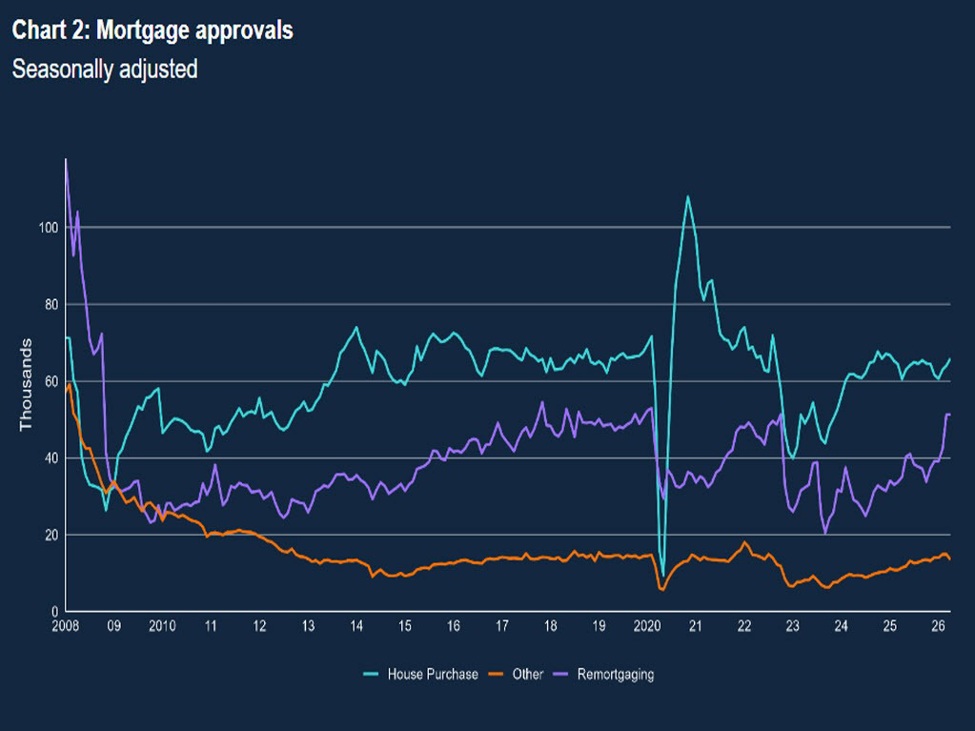
The latest money and credit data from the BOE shows that net borrowing of mortgage debt by individuals decreased to £4.4 billion in April. That follows from the £6.8 billion recorded in March. As for net mortgage approvals, that is seen increasing to 65,900 as compared to 64,000 in the month before. The figure is holding above an average of around 63,100 over the previous six months.Overall, that continues to indicate a solid benchmark for future borrowing. And if anything, it continues to suggest some added resilience in the housing market so far this year.And that comes despite the ‘effective’ interest rate – the actual interest paid – on newly drawn mortgages having increased to 4.08%.Looking to net consumer credit, that is seen mostly unchanged at £1.9 billion and keeping with the six-month average. The annual growth rate did slow to 8.8% in April, suggesting some tapering in overall economic momentum. Of note, the annual growth rate for credit card borrowing decreased to 11.8% (down from 12.3%) while the annual growth rate for other forms of consumer credit remained unchanged at 7.4%. This article was written by Justin Low at investinglive.com. 🔗 Source 💡 DMK Insight Mortgage borrowing’s drop to £4.4 billion is a red flag for the housing market’s health. This decline signals tightening credit conditions, which could lead to reduced consumer spending and impact economic growth. With net mortgage approvals rising slightly to 65,900, it suggests that while some buyers are still entering the market, the overall trend is concerning. Traders should keep an eye on how this affects related sectors, particularly real estate stocks and consumer goods. If borrowing continues to decline, expect potential ripple effects in the housing market and broader economy, possibly leading to increased volatility in related assets. Watch for key support levels in housing-related ETFs and stocks, as a sustained downturn could trigger sell-offs. The next BOE meeting will be crucial; any hints at further tightening could exacerbate these trends. 📮 Takeaway Monitor the housing market closely; a continued decline in mortgage borrowing could signal broader economic issues, affecting related assets and sectors.

Gold analysis shows it repaired higher. See my targets.
Gold futures technical analysis: GC repairs higher, but traders should not chase into upper-range resistancePrediction Score: +3 / +10Reliability / Confidence: Medium-lowMarket state: Bullish repair with upper-range congestionGold futures have shifted from bearish pressure into a constructive bullish repair phase, but the market is now testing the upper side of a broader trading range. The key practical takeaway is simple: GC is mildly bullish above 4540, but after a sharp five-bar rally into the upper range, the better long-side opportunity may come from a pullback that holds 4540-ish, not from chasing price near 4564-4571 resistance.The broader auction remains a trading range, roughly 4480-ish support to 4570-ish resistance. This is not yet a clean bullish breakout trend. Buyers have improved the structure, but they still need acceptance above the upper-value zone to prove stronger control.Why the GC outlook improvedThe earlier part of the chart showed clear bearish pressure. Price spent meaningful time below VWAP, value migrated lower, and sellers repeatedly accepted price under prior value references.The important change came after the market defended the 4479-4480 area. From there, buyers repaired the auction structure, reclaimed the 4497 area, built higher value above 4517.6, and eventually pushed through the important 4531.4 reference.That repair is the main reason the score has moved into positive territory.The late rally toward the 4564 POC and 4570.8 VAH is constructive, but traders should be careful with context. Price is already near the top of the current value area after a sharp move. That makes the next reaction more important than the move itself.Why 4540 is the better bullish-above thresholdA more practical tradeCompass threshold is 4540, not 4560 or 4564.The reason is that 4540 sits near a cluster of important references:This creates a practical 4531-4543 support cluster, with 4540 acting as the cleaner public-facing threshold.As long as GC holds above 4540, buyers still have a tactical edge. That is especially true if price retraces into the 4540 area and rejects lower prices.tradeCompass map for GC futuresKey upside levels for gold traders today, 02 June 2026If GC holds above 4540, the next upside references are:4559-4564 – first upper reaction area4570-4571 – range-top and upper value area test4590-4596 – larger upside magnet only if price accepts above the current range highThe key point is that 4570 is not the place to start calling gold bullish. It is more likely the area where existing longs should be cautious, consider partial profits, or wait for clear acceptance before assuming a breakout.What would upgrade the bullish case?A sustained hold above 4570.8 would upgrade the read toward +5 / +10, especially if the next bars keep value and high-volume activity near the upper area without quickly falling back below 4564.In practical terms, traders should look for acceptance above 4571, not just a brief push or wick. A quick rejection from that area would keep GC inside the broader range.What would weaken or invalidate the repair?The first warning would be a move back below 4564, especially if that turns the upper-value test into a failed repair.A stronger bearish warning appears below 4531, because that would put price back under the prior value area high and under the main repaired support cluster.If GC accepts below 4531-4536.7, the bullish repair weakens and the score would likely move back toward neutral or mildly bearish. Below 4517.6, sellers regain stronger control, with 4497 and 4480-ish becoming the next downside areas to watch.Practical read for gold futures tradersGC has repaired meaningfully from the lower range and remains mildly bullish above 4540. However, after a strong move into the 4564-4571 upper-value zone, traders should avoid treating the chart as a clean breakout before the market proves acceptance above the range high.The better long-side setup may be a controlled pullback into the 4531-4543 cluster that holds, rather than chasing price into resistance. Above 4571, bulls can attempt a breakout toward 4590-4596. Below 4531, the repair starts to fail and the focus shifts back toward 4517-4514, then 4497-4480. This article was written by Itai Levitan at investinglive.com. 🔗 Source 💡 DMK Insight Gold futures are in a bullish repair phase, but chasing the upper resistance could be risky right now. The market’s shift from bearish to bullish is a positive sign, yet the current test of upper-range resistance indicates potential volatility. Traders should be cautious as this congestion zone can lead to false breakouts. If gold futures push past this resistance, it could open the door for a more sustained rally, but if they fail, we might see a pullback that could shake out overzealous buyers. Keep an eye on the daily chart for signs of rejection at these levels, which could signal a shorting opportunity. Also, watch for correlated assets like the U.S. dollar and Treasury yields, as their movements can impact gold prices. If the dollar strengthens, it might put additional pressure on gold, making it crucial to monitor these relationships closely. The key levels to watch are the upper resistance points; a break above could target higher prices, while a failure could lead to a retest of lower support levels. 📮 Takeaway Traders should avoid chasing gold futures at upper resistance; monitor for a breakout or rejection to inform your next move.

Euro area inflation continues to pick up in May, core prices nudge up as well
CPI +3.2% vs +3.2% y/y expectedPrior +3.0%Core CPI +2.5% vs +2.4% y/y expectedPrior +2.2%The headline estimate moves up in May, as expected, with energy price inflation being the standout once again. Even though energy prices were down 1.1% on the month, it is still up by 10.9% year-on-year (up from 10.8% in April). Besides that, the monthly estimates show a broadening in the increase in price pressures across the region.Of note, services inflation was up 0.4% on the month. Meanwhile, inflation for non-energy industrial goods also increased by 0.2% on the month. Food price inflation was flat in May compared to the month before.Overall, services inflation jumped up to 3.5% (previously 3.0%) with food price inflation holding at 2.0%. The mix sees core annual inflation move back up to 2.5%, in a worrying sign for the ECB.If the trend continues down this path in the months ahead, rate hikes will definitely have to be put on the table as policymakers have to deal with potential spillover risks from second-round effects. As mentioned before, interest rates in Europe are now still in neutral territory. And even with 50 bps of rate hikes, it barely puts policy into being marginally restrictive.So if the ECB really wants to bring down inflation, they will have to move more aggressively. The key risk in doing that though is that policymakers risk sinking the economy further. That especially since the US-Iran conflict is already raising the stakes and inviting stagflation risks, especially in the likes of France. This article was written by Justin Low at investinglive.com. 🔗 Source 💡 DMK Insight CPI hitting 3.2% aligns with expectations, but core CPI’s uptick to 2.5% raises eyebrows. For traders, this data is crucial as it signals persistent inflation pressures, particularly in core sectors. The market’s reaction could hinge on how the Federal Reserve interprets these numbers. If they view the core CPI increase as a sign to maintain or even tighten monetary policy, we could see volatility in equities and a strengthening of the dollar. Watch for potential resistance levels in the S&P 500 around recent highs, as any hawkish Fed commentary could trigger a sell-off. Conversely, if the Fed remains dovish, risk assets might rally. Energy prices, despite a monthly dip, are still up significantly year-on-year, indicating that inflation isn’t just a fleeting issue. This could lead to increased scrutiny on commodities, particularly oil and gas. Traders should keep an eye on the energy sector for potential opportunities or risks, especially if geopolitical tensions flare up, impacting supply chains. Overall, the next Fed meeting will be pivotal, so mark your calendars and prepare for potential market shifts. 📮 Takeaway Monitor the Fed’s response to the CPI data; a hawkish stance could trigger volatility in equities and strengthen the dollar.

Marvell Technology stock soars as Nvidia CEO says it's "the next trillion-dollar company"
At Computex Taipei, one of the world’s largest and most influential technology trade shows, held annually in Taipei (Taiwan), Marvell Technology CEO Matt Murphy said that as AI models evolve into increasingly complex AI agents, the next major challenge facing data centers may no longer be computing power or memory capacity, but the ability to move vast amounts of data efficiently between chips and servers.The highlight of the event came when Nvidia CEO Jensen Huang made a surprise appearance and said “ladies and gentlemen, the next trillion-dollar company” as he introduced Marvell, drawing loud applause from attendees and becoming one of the most talked-about moments of the conference. Marvell Technology stock ($MRVL) jumped by more than 20% in pre-market on Huang’s endorsement. The appearance highlighted the increasingly strategic relationship between Nvidia and Marvell as hyperscale cloud providers race to build larger and more powerful AI clusters. While Nvidia dominates AI computing through its GPUs, Marvell has become a critical supplier of custom AI chips, optical networking solutions, and high-speed interconnect technologies that enable those systems to function at scale.Huang and Murphy argue that connectivity is becoming the defining factor for overall system performance. Modern AI models require tens of thousands of GPUs to work together across massive data center networks. As clusters grow larger, the speed and efficiency with which information moves between processors becomes increasingly important.This shift is fueling demand for advanced networking technologies, optical interconnects, custom switches, and silicon designed specifically to handle the enormous data flows generated by AI workloads.Marvell Technology stock has been on fire since the company announced a strategic partnership with Nvidia in late March which included a $2 billion investment. The stock has rallied more than 200% since the start of the year. This article was written by Giuseppe Dellamotta at investinglive.com. 🔗 Source 💡 DMK Insight AI’s evolution is shifting the focus from just computing power to data management, and here’s why that matters for traders: as data centers adapt, companies like Marvell Technology could see increased demand for their solutions. This could impact not just tech stocks but also related sectors like cloud computing and semiconductors. If AI models require more sophisticated data handling, firms that provide these technologies might experience a surge in revenue, making them attractive for investment. Traders should keep an eye on Marvell’s stock performance and any related tech stocks that might benefit from this shift. Look for technical indicators around key support and resistance levels, especially if the stock approaches its recent highs. Additionally, monitor the broader market sentiment towards AI and tech, as fluctuations could create trading opportunities. The real story here is how quickly companies can pivot to meet these new demands, and that could lead to volatility in the sector. Watch for earnings reports and guidance from major players in the coming quarters, as these will provide insights into how well they’re adapting to the changing landscape. 📮 Takeaway Keep an eye on Marvell Technology’s stock and related tech firms as AI’s evolution could create new trading opportunities; watch for earnings reports for insights.

ECB policymaker Rehn says June rate move would be an "insurance" hike
ECB’s Rehn said that an interest rate increase at the ECB’s June meeting should be viewed as an “insurance” move to guard against future inflation risks, even if current inflation expectations remain well anchored.The characterization of a June rate move as an “insurance hike” indicates that policymakers are unlikely to deliver a back-to-back rate hike in July as some analysts have been suggesting without a strong signal from the data. The ECB is most likely to frame the move as an insurance and then wait at least until September to see how the data and the US-Iran situation evolves over the summer. This article was written by Giuseppe Dellamotta at investinglive.com. 🔗 Source 💡 DMK Insight The ECB’s potential June rate hike as an ‘insurance move’ is a signal for traders to reassess their positions. This suggests that while current inflation is stable, the ECB is preparing for future risks, which could impact the euro and related assets. Traders should keep an eye on the EUR/USD pair, especially if it approaches key support or resistance levels. If the euro strengthens ahead of the meeting, it might indicate market confidence in the ECB’s proactive stance. Conversely, any signs of hesitation could lead to a sell-off. It’s also worth noting that this move could ripple through the forex market, affecting other currencies tied to European trade. Watch for volatility in the euro as the June meeting approaches, and consider adjusting your strategies based on how the market reacts to these hints from the ECB. 📮 Takeaway Monitor the EUR/USD pair closely as the June ECB meeting approaches; a strong euro could signal market confidence in the ECB’s inflation strategy.

Gold slips below $4,500 as US-Iran stalemate and strong Dollar cap XAU/USD
Gold (XAU/USD) kicks off the week with a negative bias as slow progress toward a US-Iran ceasefire extension deal and fresh attacks in the Middle East keep buyers cautious. 🔗 Source 💡 DMK Insight Gold’s negative bias signals caution among traders, and here’s why that matters: The ongoing geopolitical tensions, particularly the stalled US-Iran ceasefire negotiations, are weighing heavily on gold prices. Traders often flock to gold during times of uncertainty, but with fresh attacks in the Middle East, the usual safe-haven demand might be tempered. This could lead to a short-term bearish trend, especially if gold fails to hold key support levels. If XAU/USD breaks below its recent lows, we could see further selling pressure, which might trigger stop-loss orders for long positions. On the flip side, if any positive news emerges regarding the ceasefire, we could see a rapid reversal, pushing gold back toward resistance levels. Traders should keep an eye on the $1,800 mark; a decisive move below this could open the door for a deeper correction. Conversely, a rebound above $1,850 could signal renewed buying interest. Watch for volatility spikes as market sentiment shifts with news updates. 📮 Takeaway Monitor gold closely; a break below $1,800 could trigger further downside, while a move above $1,850 may indicate a bullish reversal.

Dow Jones Industrial Average slips as Iran severs talks and Oil surges
The Dow Jones Industrial Average traded around 0.4% lower Monday, shedding roughly 200 points to sit near 50,800 after pulling back from the record-area highs above 51,100 set last week. 🔗 Source 💡 DMK Insight The Dow’s drop of 200 points signals potential volatility ahead, especially after recent highs. Traders should note that this pullback comes after the index flirted with record levels above 51,100, suggesting a possible resistance zone. A sustained move below 50,800 could trigger further selling pressure, especially if broader market sentiment shifts. Keep an eye on economic indicators this week, as they could influence the Dow’s trajectory. If the index breaks below 50,500, it might invite more aggressive short positions. On the flip side, if it manages to reclaim 51,100, we could see a renewed bullish momentum, but that seems less likely given the current trend. Watch for any news that could impact investor sentiment, particularly around inflation or interest rates, as these factors could exacerbate volatility in the coming days. 📮 Takeaway Monitor the Dow closely; a break below 50,800 could lead to increased selling, while reclaiming 51,100 might signal renewed bullishness.

Japanese Yen: Stabilisation expected as BoJ tightens – BNP Paribas
BNP Paribas sees Japan’s Gross Domestic Product (GDP) growth slowing to 0.5% in 2026 from 1.1% in 2025 as the energy shock weighs on activity. Inflation is expected to stay above the 2% target through at least 2028. 🔗 Source 💡 DMK Insight Japan’s GDP growth forecast drop to 0.5% in 2026 is a red flag for traders. With inflation projected to remain above 2% through 2028, this economic slowdown could lead to tighter monetary policy from the Bank of Japan. Traders should keep an eye on the Japanese yen, as a weaker growth outlook often translates to currency depreciation. If the yen weakens, it could impact related assets like Japanese equities and commodities priced in yen. Additionally, the energy shock mentioned could affect sectors reliant on energy imports, further complicating the economic landscape. Here’s the kicker: while mainstream analysis might focus solely on GDP, the real concern is how persistent inflation could force the BoJ to adjust its ultra-loose monetary policy sooner than expected. Watch for any statements from the BoJ in the coming months, as they could provide clues on future interest rate movements. Key levels to monitor include USD/JPY resistance around recent highs, which could signal a breakout if the yen continues to weaken. 📮 Takeaway Monitor the USD/JPY levels closely; a breakout above recent highs could signal further yen weakness amid slowing GDP growth and persistent inflation.

Polish Zloty: NBP pause keeps Zloty in tight range – BBH
Brown Brothers Harriman’s (BBH) Elias Haddad expects the National Bank of Poland (NBP) to keep its policy rate at 3.75% and sees its easing cycle as effectively over. 🔗 Source 💡 DMK Insight The NBP’s decision to maintain a 3.75% policy rate signals a shift in monetary strategy, and here’s why that matters: With BBH’s Elias Haddad suggesting the easing cycle is over, traders should brace for potential stability in the Polish zloty (PLN) against major currencies. This could impact forex pairs like EUR/PLN and USD/PLN, especially if the market was anticipating further cuts. A stable rate might attract foreign investment, bolstering the zloty, but it also raises questions about growth prospects in Poland. If inflation remains a concern, the NBP’s stance could lead to increased volatility in related assets, particularly Polish government bonds. Traders should keep an eye on economic indicators like inflation rates and GDP growth, as these will influence future monetary policy decisions. On the flip side, if the market perceives this as a signal of stagnation, we might see a bearish reaction in PLN pairs. Watch for any shifts in sentiment around upcoming economic data releases, as these could provide clues on how the NBP’s decision is being interpreted by investors. 📮 Takeaway Monitor the PLN’s performance against major currencies; a stable 3.75% rate could strengthen the zloty, especially if inflation data supports this stance.

Australian Dollar falls as strong US manufacturing data boosts Greenback
The AUD/USD pair trades near the 0.7160 region on Monday as the United States Dollar (USD) strengthens following upbeat manufacturing data, while renewed geopolitical tensions and cautious market sentiment weigh on the Australian Dollar (AUD). 🔗 Source 💡 DMK Insight The AUD/USD pair’s struggle around 0.7160 highlights a critical tug-of-war between USD strength and AUD weakness. With the recent uptick in US manufacturing data, traders are likely to see continued support for the USD, especially if this trend persists. On the flip side, geopolitical tensions are casting a shadow over the AUD, which could lead to increased volatility. If the AUD/USD breaks below 0.7150, it could trigger further selling pressure, opening the door for a deeper correction. Conversely, a rebound above 0.7200 might indicate a short-term recovery for the AUD, but that seems less likely given the current sentiment. Keep an eye on upcoming economic releases from both Australia and the US, as they could provide additional catalysts for movement. The market’s reaction to these data points will be crucial in determining the next direction for this currency pair. 📮 Takeaway Watch for a break below 0.7150 in AUD/USD for potential downside, while a move above 0.7200 could signal a recovery attempt.