
 Bitcoin
  Ethereum
  Tether
  XRP
XRP  BNB
BNB  USDC
USDC  Solana
  TRON
TRON  Lido Staked Ether
  Figure Heloc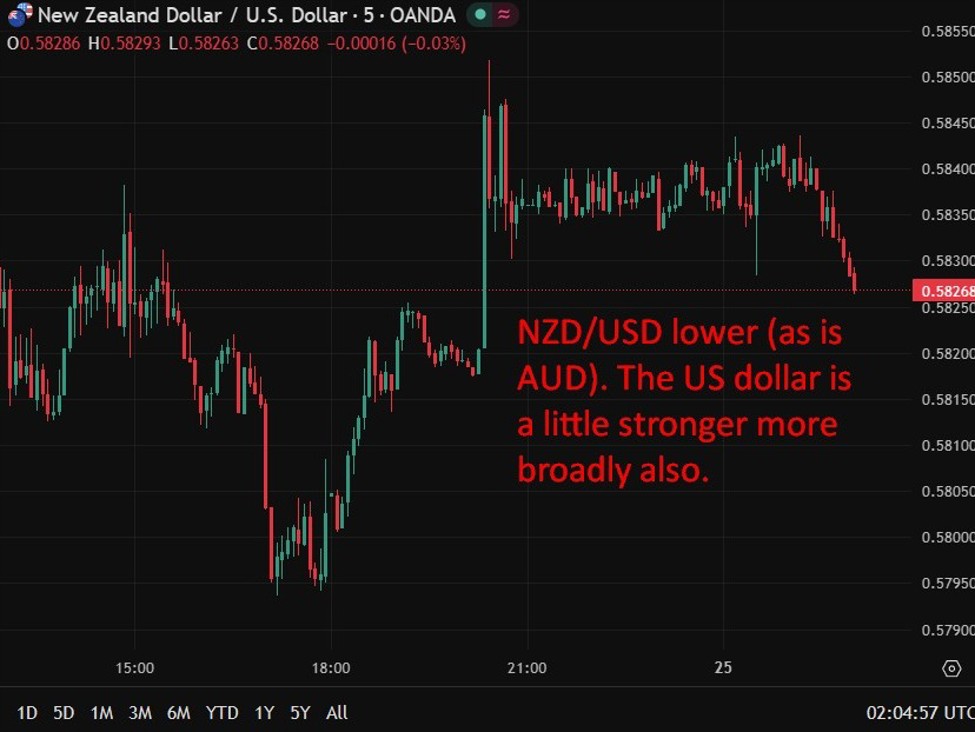
Summary:Conway frames cost of living as purchasing power, not just inflation, with NZ prices structurally high vs OECD Pandemic inflation lifted price levels ~26%, while income growth only just kept pace Real wages modestly higher, but purchasing power still only around OECD average Middle East conflict flagged as a new inflation risk via energy and shipping costs Monetary policy can anchor inflation but cannot fix affordability alone — productivity is key- Westpac warns Q2 GDP contraction, rising unemployment and weak sentiment RBNZ faces a stagflation-style squeeze → likely hold near-term before later normalisation NZD outlook skewed softer near-term on growth hit, with policy path uncertain Reserve Bank of New Zealand Chief Economist Paul Conway struck a measured but cautionary tone on the country’s economic outlook, arguing that the cost-of-living debate is being misunderstood and that structural weaknesses—not just inflation—are at the heart of New Zealand’s affordability challenges.In a speech focused on purchasing power, Conway emphasised that the true issue facing households is not simply the pace of price increases, but what incomes can buy. While inflation has moderated significantly from its pandemic peak above 7%, the cumulative rise in prices—around 26% since 2020—has permanently lifted the cost base of the economy. Income growth has broadly kept pace with that surge, but only just, leaving purchasing power largely unchanged. Real wages have risen modestly, supported in part by job switching and labour shortages, but broader income growth has slowed sharply compared to pre-pandemic trends. Crucially, Conway highlighted that New Zealand remains a structurally expensive economy, with prices for many goods and services sitting well above OECD averages, particularly in housing, utilities and construction. This means that even stable inflation does not resolve affordability pressures.On policy, the message was clear: monetary policy can deliver low and stable inflation, but it cannot meaningfully lift purchasing power on its own. Instead, sustained improvements require stronger productivity, better structural settings, and more competitive markets.The near-term outlook, however, has become more complicated. Conway acknowledged that the Middle East conflict is already pushing up global energy and shipping costs, creating fresh upside risks to inflation and forcing a reassessment of the central bank’s outlook ahead of the April review. This aligns with private sector views. Westpac now expects New Zealand’s economy to contract in Q2 2026 as higher fuel costs weigh on activity. The bank sees unemployment rising, house prices falling, and sentiment deteriorating sharply, leaving the RBNZ caught between elevated inflation and weakening growth.That combination points to a difficult policy trade-off. While inflation risks argue against easing, the growth outlook suggests the current stimulatory stance will need to be maintained in the near term. Westpac expects the central bank to hold the OCR steady for now before eventually moving toward normalisation later in the year.For markets, this reinforces a near-term stagflationary backdrop for New Zealand—where external shocks, rather than domestic demand, are driving inflation dynamics. This article was written by Eamonn Sheridan at investinglive.com. 🔗 Source 💡 DMK Insight Conway’s perspective on purchasing power versus inflation is crucial for traders right now. With New Zealand’s prices structurally high compared to OECD averages, the recent 26% pandemic-driven price increase could signal a shift in consumer behavior. Traders should be aware that while real wages have seen modest growth, purchasing power remains stagnant, which could impact spending and economic growth. This context is vital for those trading NZD pairs, as a weaker purchasing power might lead to a bearish sentiment in the currency. Additionally, the mention of Middle East conflict adds another layer of geopolitical risk that could influence market volatility. Keep an eye on NZD/USD and related pairs for potential breakouts or breakdowns, especially if economic data releases show further strain on purchasing power. Watch for upcoming economic indicators that could reveal shifts in consumer sentiment or spending patterns, as these will likely affect currency valuations and trading strategies. 📮 Takeaway Monitor NZD/USD closely for volatility, especially in light of economic data that may reflect changing purchasing power and consumer behavior.
PBoC adds liquidity with CNY 500bn MLF, extends net injection streak (450bn mature)
PBoC extends liquidity support with 13th straight MLF net injectionSummary:PBoC to inject CNY 500bn via 1-year MLF, vs CNY 450bn maturing Results in CNY 50bn net liquidity injection Marks 13th straight month of net injections Conducted via variable-rate, multiple-price auction Signals continued policy support for liquidity and credit Reinforces accommodative but measured easing stanceChina’s central bank is set to extend its run of liquidity support, announcing a CNY 500 billion one-year medium-term lending facility (MLF) operation aimed at maintaining stable funding conditions in the banking system.The People’s Bank of China (PBoC) said the operation will take place on Wednesday and will be conducted via a variable-rate tender with a fixed quantity, using a multiple-price auction format. The structure gives policymakers flexibility in managing funding costs while ensuring a set amount of liquidity is injected.With CNY 450 billion in MLF funds maturing this month, the operation results in a net injection of CNY 50 billion. This marks the 13th consecutive month in which the PBoC has added net liquidity through the facility, highlighting a sustained effort to support credit conditions.The MLF, introduced in 2014, is a key policy tool that allows commercial and policy banks to borrow from the central bank using collateral, effectively anchoring medium-term funding costs and guiding broader lending rates in the economy.ImplicationsThe continued net injection signals that policymakers remain focused on ensuring ample liquidity rather than tightening conditions, even as headline growth data has shown pockets of resilience. It suggests underlying concerns about demand, credit transmission, or external risks are still present.Rather than deploying aggressive rate cuts, the PBoC continues to rely on targeted liquidity tools like the MLF to fine-tune financial conditions. This reflects a preference for measured, controlled easing while avoiding excessive pressure on the currency or financial stability risks.For markets, the move is modestly supportive for domestic liquidity and risk sentiment, particularly equities and credit. However, the relatively small net injection means the signal is more about policy stance than scale.For the yuan, the impact is likely limited, as the operation does not represent a significant shift in interest rate policy. Instead, it reinforces the view that China is maintaining an accommodative bias while calibrating support carefully amid a complex global backdrop. This article was written by Eamonn Sheridan at investinglive.com. 🔗 Source
Oil retraces a touch as Iran demands cast doubt on ceasefire and US boosts troop presence
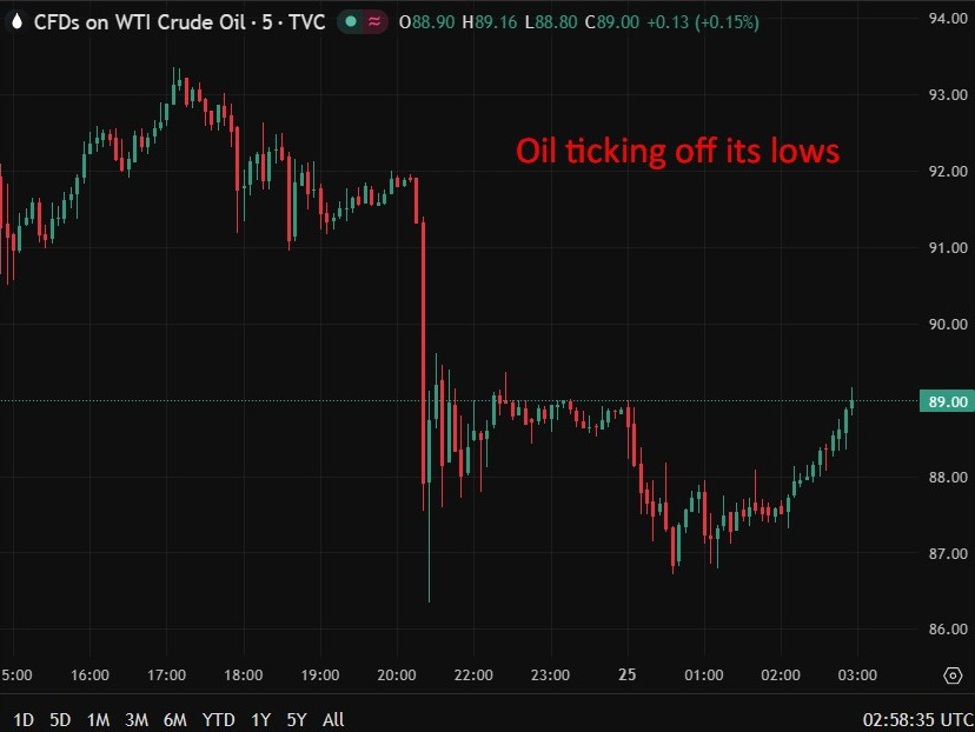
Oil finds some bids as Iran’s maximalist ceasefire demands clash with US military buildup.Summary:Iran responds to ceasefire proposal with maximalist demands (US bases closure, sanctions removal, Hormuz fees) US officials view terms as unrealistic, reducing likelihood of near-term deal Trump simultaneously pursuing diplomacy and military escalation US to deploy ~10,000 additional troops, including 82nd Airborne and MEUs Reports suggest 2–3 more weeks of war likely, even with talks Drone strike hits fuel tank at Kuwait airport; sirens across Gulf Oil ticks higher as markets grow increasingly sceptical on de-escalationIran’s response to US ceasefire proposals is being viewed by markets as a major obstacle to de-escalation, with a set of demands that officials have characterised as unrealistic and unlikely to gain traction in Washington.According to reporting from the Wall Street Journal, Tehran has called for the closure of all US military bases in the Gulf, the removal of all sanctions, an end to Israeli operations against Hezbollah, and the establishment of a new framework for the Strait of Hormuz that would allow Iran to charge transit fees. The proposal also excludes any negotiations over its ballistic missile program.Taken together, the conditions far exceed what would typically be considered a starting point for negotiations, reinforcing market doubts that a ceasefire can be reached in the near term.That scepticism is being compounded by developments on the ground. The United States is moving ahead with a significant military buildup, with elite units including the 82nd Airborne Division and two Marine Expeditionary Units expected to add roughly 10,000 troops to the region. This would bring total US forces in the Middle East to around 60,000.Officials suggest the dual-track approach remains in place, with President Trump keeping both diplomatic and military options open. However, reports indicate that even if talks proceed, planning assumptions still allow for another two to three weeks of conflict, underscoring the limited near-term prospects for de-escalation.Meanwhile, tensions continue to spill into regional infrastructure. CNN reported that drones struck a fuel tank at Kuwait International Airport, sparking a fire, while air raid sirens were activated in both Kuwait and Bahrain amid fresh Iranian attacks.For markets, the combination of maximalist demands, continued military escalation, and direct strikes on energy-related infrastructure has shifted sentiment back toward caution. Oil prices, which had briefly eased on hopes of diplomatic progress, are now moving higher again as traders reassess the likelihood of a prolonged disruption to Gulf energy flows.The evolving situation reinforces a key dynamic: even as diplomatic channels remain open, the balance of risks continues to skew toward escalation, keeping geopolitical risk premia firmly embedded across energy markets. This article was written by Eamonn Sheridan at investinglive.com. 🔗 Source 💡 DMK Insight Oil prices are reacting to geopolitical tensions, and here’s why that matters right now: Iran’s maximalist demands for a ceasefire, including the closure of US bases and sanctions removal, are raising the stakes in the region. This situation is critical for traders as it adds volatility to oil prices, which are already sensitive to geopolitical events. With the US military buildup, including the deployment of around 10,000 troops, the potential for conflict increases, which could lead to supply disruptions. Traders should keep an eye on key resistance levels in oil, as any escalation could push prices higher, while a diplomatic breakthrough might lead to a pullback. The broader market context shows that oil has been trading in a tight range, and these developments could be the catalyst for a breakout. On the flip side, if the US and Iran manage to find common ground, it could lead to a significant drop in prices. So, watch for any news on negotiations or military movements. The next few weeks are crucial, and traders should monitor the situation closely, especially around key economic indicators that could affect oil demand. 📮 Takeaway Keep an eye on oil prices as geopolitical tensions rise; watch for key resistance levels and any news on US-Iran negotiations.
investingLive Asia-Pacific FX news wrap: Ceasefire hope up, but distance between US & Iran
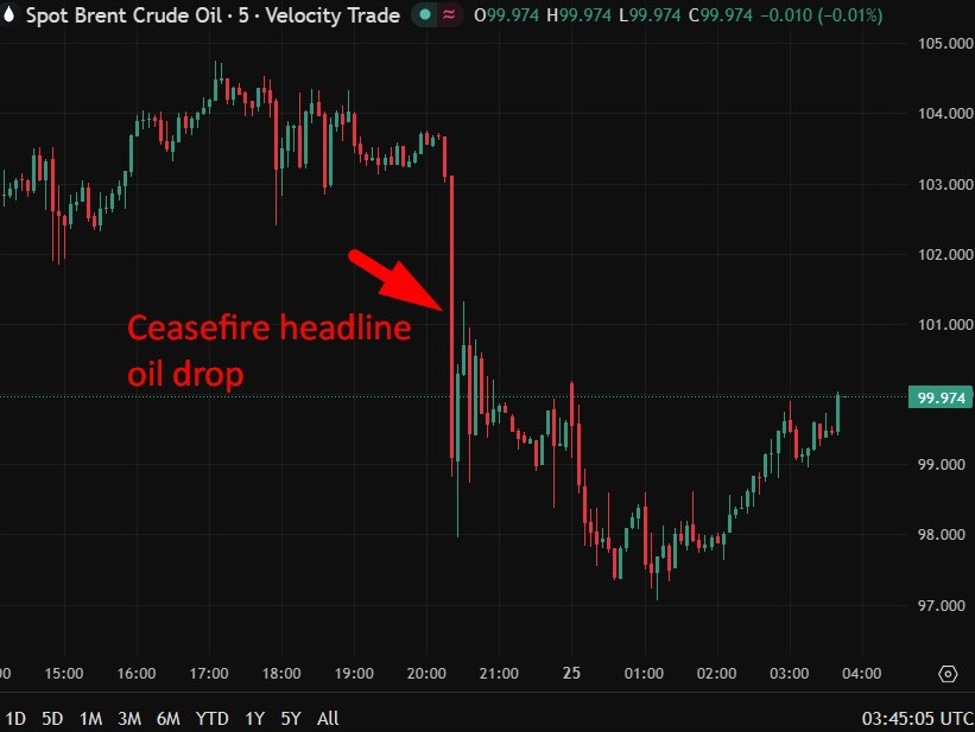
Oil retraces a touch as Iran demands cast doubt on ceasefire and US boosts troop presencePBoC adds liquidity with CNY 500bn MLF, extends net injection streak (450bn mature)RBNZ’s Conway warns on purchasing power as Iran shock clouds NZ outlook, GDP 4cast slashedIran distrusts Trump ceasefire peace push as US pairs diplomacy with military pressure.Iran proposes regional military alliance excluding US and Israel. Again.Iran prefers JD Vance for talks, over Witkoff or Kushner, highlighting trust issuesPBOC sets USD/ CNY mid-point today at 6.8911 (vs. estimate at 6.8819)Australia February CPI cools slightly, but energy shock clouds inflation outlookSpaceX IPO filing imminent, report says deal could raise over $75bnAustralian February CPI: Core (trimmed mean) 3.3% y/y (vs. expected 3.4%)PBOC is expected to set the USD/CNY reference rate at 6.8819 – Reuters estimateBoJ minutes signal gradual rate hikes as inflation nears target and oil risks riseCanada discusses Keystone XL revival with US amid rising energy security risksFed’s Goolsbee warns energy shocks cloud rate outlook, echoing Barr stanceFed’s Barr says rates may stay on hold “for some time” as inflation and oil risks persistICYMI: Iran allows conditional Hormuz transit as thousands of ships remain stalledIran warns of mining the entire Persian Gulf if US launches ground invasionUS to deploy 3,000 82nd Airborne troops to Gulf amid Iran warIsrael expands conflict footprint with strike on key Russia–Iran Caspian supply route.Oil steady as US-Iran ceasefire talks face Israel uncertainty and broader Iran demandsUS-Iran ceasefire proposal is complex, 15 points need to be agreed. Hormuz would open.Oil falls on report of possible one-month ceasefire under Witkoff-Kushner planStock market rollercoaster: Tech falters, energy shines in mixed Wall Street sessionThere was a brief glimmer of optimism during the US session after Iran indicated that non-hostile vessels may be allowed to transit the Strait of Hormuz under coordination, raising hopes that energy flows could stabilise eventually.That optimism strengthened after the US close when Israeli Channel 12 reported a potential one-month ceasefire framework being developed by Witkoff and Kushner. The headline prompted a modest easing in geopolitical risk premium, with oil prices falling, equities moving higher and gold also gaining.However, markets remained cautious, with several factors quickly tempering the initial relief. The US is continuing to expand its military presence in the region, with plans to deploy around 10,000 additional troops, including elements of the 82nd Airborne Division and two Marine Expeditionary Units. This would take total US forces in the region to roughly 60,000.The dual-track strategy has not gone unnoticed. Iranian officials and some analysts have questioned whether diplomacy is being used tactically to buy time while military positioning continues. At the same time, others argue the approach reflects a deliberate effort by President Trump to preserve optionality between negotiation and escalation. Reports suggest planning assumptions still allow for a further two to three weeks of conflict even if talks proceed.On the ground, hostilities continued. Iran’s Revolutionary Guard said it launched missiles targeting Israel as well as Kuwait, Jordan and Bahrain, while drones struck a fuel tank at Kuwait International Airport, causing a fire. Air raid sirens were also reported across Kuwait and Bahrain, and Saudi Arabia said it intercepted additional drones.Focus later shifted to Iran’s response to US ceasefire proposals, which included demands for the closure of US bases in the Gulf, the removal of all sanctions, an end to Israeli operations against Hezbollah, and a new framework allowing Iran to charge fees for vessels transiting the Strait of Hormuz. US officials reportedly dismissed the terms as unrealistic, highlighting the wide gap between the two sides.As markets digested these developments, the earlier risk-on moves partially reversed, with oil prices edging higher again as traders reassessed the likelihood of a near-term de-escalation.Separately, Federal Reserve Governor Barr said interest rates may need to remain on hold for some time, noting that inflation is still above target and warning that higher oil prices stemming from Middle East tensions could delay any move toward rate cuts, even as the labour market shows signs of stabilising. Chicago Fed President Goolsbee echoed similar sentiments. Australia’s February CPI showed modest cooling but remained above target, with the data predating the latest energy shock and leaving inflation risks skewed higher. The USD firmed, with AUD, NZD, EUR, CAD and GBP softer, while USD/JPY and USD/CHF edged up. This article was written by Eamonn Sheridan at investinglive.com. 🔗 Source 💡 DMK Insight Oil’s recent retracement highlights geopolitical tensions that could shake up markets. With Iran’s skepticism towards the U.S. ceasefire efforts, traders should brace for volatility in oil prices. The U.S. troop increase in the region adds another layer of uncertainty, which could lead to supply disruptions. This is especially relevant as oil prices often react sharply to geopolitical news. Keep an eye on key levels; if prices break below recent support, we might see a deeper pullback. Meanwhile, the People’s Bank of China’s liquidity injection signals a different kind of market intervention, which could impact currency pairs like USD/CNY. The RBNZ’s warning about purchasing power also suggests that New Zealand’s economic outlook is under pressure, potentially affecting the NZD. Traders should monitor these developments closely, as they could create trading opportunities in both oil and related currency markets. Watch for oil prices around key support levels and any further developments from Iran or the U.S. that could escalate tensions. 📮 Takeaway Keep an eye on oil support levels and geopolitical developments, as they could trigger significant price movements in the coming days.

Oil holds near the lows for the week though the drums of war continue to beat
It’s a testing moment for markets as we await the outcome of talks between the US and Iran. Trump’s message on Monday was a bit out of the blue but the playbook looks to be one that we have seen before. It is a very similar one to how he went about on the trade/tariffs war with China.The fact of the matter looks to be that we look to be moving on to a new phase of the war. One that likely could see some thawing in tensions and potential for things to de-escalate. As things stand, the key thing to watch for markets remains what will happen with regards to the Strait of Hormuz. And if this latest headline is any indication, there is some hopeful optimism.Come what may, Iran still holds significant leverage considering their control of the strait. That makes it hard to envisage a major compromise in negotiations. But we’ll just have to wait and see for now.Overall, broader markets are keeping cautiously optimistic since Monday. That despite the constant back and forth rhetoric of Iran denials and murmurs that talks will not be successful. Wall Street might have eased back yesterday but S&P 500 futures are now up 0.8% on the day again.The big one to watch remains the oil market. WTI crude oil is falling back under $90 and is keeping near the lows for the week, around the levels after Trump’s bombshell on Monday.If Iran is serious about partially opening up the Strait of Hormuz, that will be good news. It will still likely need time for commercial vessels to trust in the process and slowly get back into the groove. But in all likelihood, we should just see a slow trickle in passage flows rather than a rush back to normality.And even if the conflict slowly settles down, it might still take weeks or even months for some key energy facilities in the Gulf region to get back on track. Kuwait already warned yesterday that it would take 3 to 4 months to restore production to full capacity even if the war were to end today. So, just keep that in mind. This article was written by Justin Low at investinglive.com. 🔗 Source 💡 DMK Insight Markets are on edge as US-Iran talks loom, and here’s why that matters: geopolitical tensions can create volatility across asset classes. Traders should keep an eye on oil prices, which often react sharply to news from the Middle East. A breakdown in negotiations could send crude prices soaring, impacting not just energy stocks but also currencies tied to oil exports like the Canadian dollar. Additionally, the broader market sentiment can shift dramatically based on these developments. If tensions escalate, we might see a flight to safety, boosting gold and the US dollar while pressuring riskier assets. It’s worth noting that similar situations in the past have led to short-term spikes in volatility, so traders should be prepared for potential whipsaws. Keep an eye on key levels in oil—if it breaks above recent highs, it could signal a strong bullish trend. For now, watch the news closely and consider positioning for volatility, especially in energy and currency markets. The next few days could set the tone for the rest of the month. 📮 Takeaway Monitor oil prices closely; a breakout could signal significant volatility across related markets, especially if US-Iran talks take a turn for the worse.

FX option expiries for 25 March 10am New York cut
There are just a couple to take note of on the board for the day, as highlighted in bold below.The first being for EUR/USD at the 1.1605 level. The expiries don’t tie to any technical significance but could help lock price action a little in the session ahead, though the impact is likely to be minimal. That as trading sentiment continues to be largely dictated by headline risks and the general mood surrounding the Middle East conflict.The latest headline we’re seeing comes from Iran with its armed forces spokesperson saying that the US is “negotiating with itself”. That adds to the continued rhetoric from overnight already.For now, markets are sensing some cautious optimism but we’re seeing the dollar hold a little firmer in the major currencies space. There’s still lots of back and forth going on so far this week, so just keep that in mind.Besides the larger one for EUR/USD above, there are also notable expiries for AUD/USD at the 0.6950 and 0.6990 levels. That is currently helping to bookend the spot price and could help to keep price action more contained for just a bit. As mentioned above, there are bigger drivers of trading/dollar sentiment currently and that will factor more into play than the expiries impact today.Still, we could see some scope for impact in holding price action if we do get a bit more of a quieter session in European morning trade. That until US president Trump wakes up to stir up more headline risks for markets to deal with.So, that is the state of play going into the session ahead at least.For more information on how to use this data, you may refer to this post here.Head on over to investingLive (formerly ForexLive) to get in on the know! This article was written by Justin Low at investinglive.com. 🔗 Source 💡 DMK Insight EUR/USD is hovering around 1.1605, and here’s why that matters: expiries at this level could create a temporary price lock, affecting short-term volatility. While these expiries don’t align with any major technical levels, they can still influence trading behavior. Traders might see reduced movement as positions are adjusted ahead of the expiry, which could lead to a tighter range in the session. If the pair breaks above or below this level, it could signal a shift in momentum, so keep an eye on the 1.1600 and 1.1620 levels for potential breakout points. However, don’t overlook the broader context—any shifts in sentiment around the Eurozone or U.S. economic indicators could quickly override these expiries. Watch for upcoming data releases that could impact the euro or dollar, as they might create unexpected volatility despite the current stability around 1.1605. 📮 Takeaway Watch the 1.1605 level in EUR/USD; expiries could stabilize price action, but a breakout above 1.1620 or below 1.1600 may signal a shift.
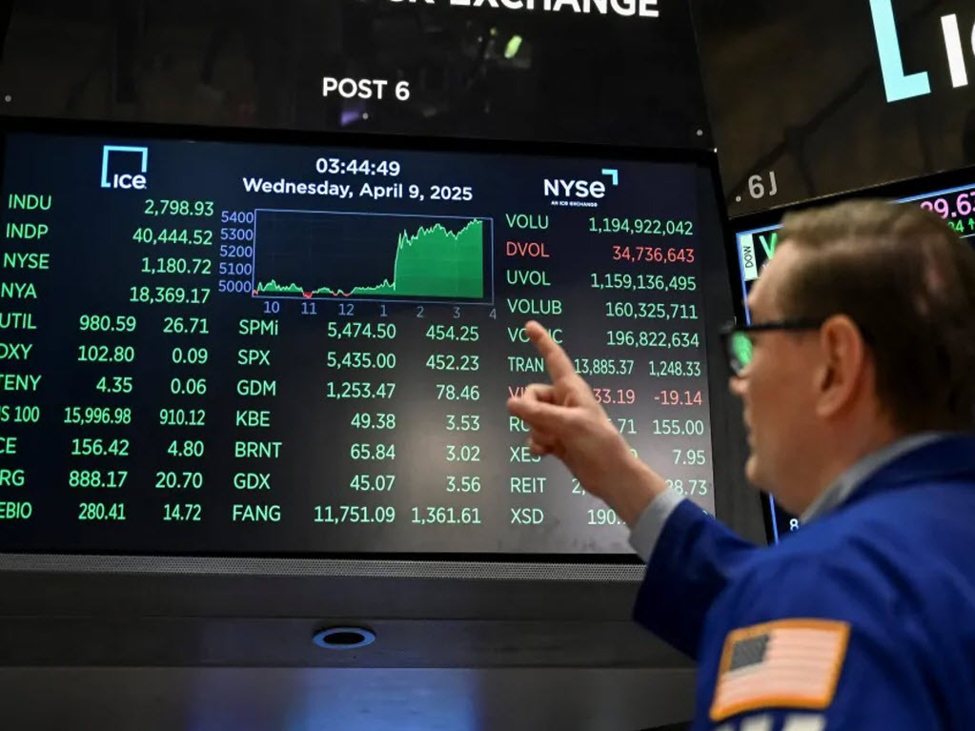
US futures push higher so far today, technical breakdown on hold for now
Tech shares bore the brunt of the pain in trading yesterday but the losses in Wall Street just ate a little bit into the gains on Monday. That of course followed the technical scare from Friday last week, which set up a rather gloomy mood early this week before US president Trump came to the rescue.The timing of Trump’s message is rather uncanny, as US stocks looked like they were on the verge of a major technical breakdown. And it could have been one that got really ugly, really fast. I don’t want to say it is a coincidence but it is a little naive to think Trump isn’t watching the stock market. After all, the stock market slumping is arguably the number one thing that he really hates most – among other things with regards to the US-Iran conflict.So far today, US futures are bouncing back again on hopes that we could see better developments on the Strait of Hormuz. From earlier: Iran allows conditional Hormuz transit as thousands of ships remain stalledThat’s keeping markets hopeful and we’re seeing S&P 500 futures be up 0.8% with Nasdaq futures up 0.9% currently. There’s been some pushing and pulling to start the week but overall, we’re not seeing a technical breakdown in Wall Street just yet. The risk is still there after the Friday drop threatened that but dip buyers are keeping the faith amid the mix of headlines in the past few days.On Friday, both the S&P 500 and Nasdaq fell to fresh lows since September last year. And things were looking dicey early on Monday before Trump talked up hopes for a deal amid “very productive” talks with Iran. That changes the name of the game and puts the technical driver aside in favour of headline-driven risks at the moment.While the Nasdaq traded back below the low from November last year, the S&P 500 is at least still holding the line from the October and November lows in trading yesterday. And that tees up the mood for today, with investors looking for another bounce to try and invalidate the technical breakdown from Friday.Headline risks may be the key driver of trading this week, but just be wary that the technicals are also a key factor in consideration for US stocks at this juncture. This article was written by Justin Low at investinglive.com. 🔗 Source 💡 DMK Insight Tech stocks are feeling the heat, and here’s why that matters: the recent sell-off could signal deeper market corrections. With Wall Street’s losses chipping away at Monday’s gains, traders should be wary of the tech sector’s volatility. The technical scare from last Friday has set a bearish tone, and if this trend continues, we might see a more significant pullback. Watch for key support levels in major tech indices; a breach could trigger further selling. Additionally, if the broader market sentiment remains negative, it could spill over into related sectors, affecting everything from consumer discretionary to growth stocks. Keep an eye on earnings reports this week, as any disappointing results could exacerbate the current trend and lead to a cascading effect across the market. On the flip side, this could present buying opportunities for those looking to capitalize on oversold conditions. If tech stocks hit critical support and bounce back, it might be a signal to enter positions. So, monitor those levels closely and be ready to act if the market shows signs of recovery. 📮 Takeaway Watch for key support levels in tech stocks; a breach could lead to further selling, while a bounce might present buying opportunities.
Japan reportedly calls on IEA to coordinate release of additional oil stockpile
As a reminder, Japan is one of the most heavily impacted nations by the US-Iran conflict. That as it is unable to secure oil supply from the Middle East amid the de facto closure of the Strait of Hormuz. And for a country ever so reliant on energy imports, it’s a massive blow to the economy.Japan prime minister Takaichi and IEA chief Birol held talks today and it is being reported that she has called for an additional coordinated release of oil stockpile.This will add to the already roughly 80 million barrels that Japan has released in the past two weeks. For added context: Japan says to release about one-month supply of crude oil reserves nextAs for the initial total release from IEA coordinated nations, it is believed to be around 400 million barrels. That’s the most in history and even dwarfs the action taken during the Russia-Ukraine conflict back in 2022. So, that really puts things into perspective here.Circling back to Japan, they are one to have a massive buffer of around 254 days’ worth of oil in its reserve capacity heading into this crisis. So, they still have much room to work with but it remains to be seen if other nations will have a similar appetite or not considering that they are less impacted than Japan is by the war.It would be a bit odd if the next one were to be that Japan carries out on its own. However, desperate times call for desperate measures. And I reckon not too many countries would be opposed to that, definitely not the US at least. This article was written by Justin Low at investinglive.com. 🔗 Source 💡 DMK Insight Japan’s energy crisis is escalating, and here’s why that matters for traders: the ongoing US-Iran conflict is tightening oil supplies, particularly through the Strait of Hormuz, a critical chokepoint. With Japan heavily reliant on Middle Eastern oil, any disruptions could lead to significant price spikes in crude oil, impacting not just energy stocks but also broader market sentiment. Traders should keep an eye on oil futures, as a sustained rise could trigger inflationary pressures that ripple through equities and forex markets, particularly affecting the Japanese yen. But it’s not just about oil; this situation could also affect related assets like natural gas and alternative energy stocks. If Japan struggles to secure energy, we might see a shift in investment towards renewables, which could create opportunities in that sector. Watch for key resistance levels in crude oil prices—if they break above recent highs, expect increased volatility across markets. The immediate impact could unfold in the coming weeks, so traders should monitor geopolitical developments closely and adjust their positions accordingly. 📮 Takeaway Watch for crude oil prices; a breakout could signal broader market volatility, especially affecting the Japanese yen and energy stocks in the coming weeks.

UK February CPI +3.0% vs +3.0% y/y expected
Prior +3.0%Core CPI +3.2% vs +3.1% y/y expectedPrior +3.1%To preface the report, it is one that doesn’t matter all too much since it is before the US-Iran conflict took place. Still, it does provide a bit of backdrop of what kind of benchmark UK inflation is sitting at before the spike in energy prices.Core annual inflation remains sticky above 3% with services inflation continuing to be a pain point. That despite it easing from 4.4% to 4.3% in February.Looking at the monthly breakdown, the biggest contributor to inflation in February came from clothing and footwear prices. That was seen up 0.6% on the month with ONS noting that “prices normally rise in February as the spring product ranges start to enter the shops following the new year sales period”.Besides that, there’s not too much else to note here as we now have to just wait and see what the US-Iran conflict has done to energy developments and its overall impact to prices globally. The UK will definitely feel the impact of higher prices in the months ahead. So, be on the lookout for that as said sentiment has already shifted the BOE outlook.As things stand, traders are pricing in nearly three 25 bps rate hikes by the central bank by year-end now. The odds of a rate hike in April are at ~86% as of yesterday. This article was written by Justin Low at investinglive.com. 🔗 Source 💡 DMK Insight Core CPI data just came in slightly higher than expected, and here’s why that matters: While the 3.2% year-over-year figure is above the anticipated 3.1%, traders should be cautious about reading too much into this report. With the ongoing US-Iran conflict, market sentiment is likely to be swayed more by geopolitical tensions than by inflation metrics. This could lead to volatility in both forex and crypto markets as investors react to news rather than fundamentals. If inflation continues to trend upwards, it might pressure central banks to adjust monetary policy sooner than expected, which could impact interest rates and subsequently affect asset valuations. Keep an eye on the correlation between the GBP and USD, especially as traders digest this inflation data against the backdrop of geopolitical risks. A breakout above key resistance levels in the GBP/USD pair could signal a shift in sentiment, while a failure to hold support might lead to a sell-off. Watch for reactions around these levels as the situation unfolds, especially in the coming week as more data and news emerge. 📮 Takeaway Monitor GBP/USD closely; a breakout above resistance could signal a shift, while geopolitical tensions may drive volatility in the coming week.

Oil price surge to $150 could spark global recession, says BlackRock CEO
He covered a bunch of topics in his interview with the BBC. Here’s his take on the Middle East conflict:If Iran remains a threat and higher oil prices hold, it will have “profound implications” to the global economyIt is too early to say what the outcome will be on the conflictHowever, it is likely to lean towards one of two extreme outcomesThe first being the war ending and Iran becomes a country that can be accepted again by the international communityThat will see oil prices fall back to below where it was before the war startedThe other, could lead to “years of above $100, closer to $150 oil”And that will probably trigger a stark and steep recessionIf oil prices keep closer to $150 for a few years, many countries would be rapidly moving to solar and maybe wind energyAs for the overall market feel and how equities are faring, he had this to say:There are zero similarities to the financial crisis in 2007-08Overall market and investment from institutions remain strong”I do not believe we have a bubble at all”There could be a few stumbling blocks with AI but “that I’m fine with”There is a race now for technology dominance, mandatory to build out AI capabilitiesHis comments aren’t ones that will move markets but they are worth noting generally. This article was written by Justin Low at investinglive.com. 🔗 Source 💡 DMK Insight The ongoing Middle East tensions, particularly with Iran, could significantly impact oil prices, and here’s why that matters for traders: higher oil prices often lead to increased inflation, which central banks might respond to with tighter monetary policies. This could create volatility in forex markets, especially for currencies tied to oil-exporting nations. Traders should keep an eye on crude oil futures and related ETFs, as any escalation in conflict could push prices above key resistance levels, triggering a ripple effect across global markets. Moreover, if oil prices rise sharply, we might see a shift in investor sentiment towards safe-haven assets like gold and the US dollar. This could lead to a stronger dollar, impacting forex pairs such as USD/JPY and EUR/USD. On the flip side, if the situation stabilizes, we could see a pullback in oil prices, which might create buying opportunities in riskier assets. Watch for oil prices around critical levels—if they break above a certain threshold, it could signal a sustained upward trend that traders need to react to quickly. 📮 Takeaway Monitor crude oil prices closely; a breakout above key resistance could trigger significant market shifts, impacting forex and commodities.