
 Bitcoin
  Ethereum
  Tether
  BNB
BNB  XRP
XRP  USDC
USDC  Solana
  TRON
TRON  Lido Staked Ether
  Figure Heloc
Prior was +2.6%GDP -0.2% q/q vs +0.6% priorReal GDP increased 1.7% in 2025Exports rose 1.5% in the fourth quarter, after increasing 0.9% in the third quarter.Imports rose 0.3% December GDP +0.2%The number might not be as bad as it looks as the fourth quarter decrease was largely due to withdrawals of business inventories following inventory accumulations in the third quarter.For the full year, Canada grew 1.7% in 2025 — the weakest pace since the pandemic year of 2020. The culprit? US-bound exports that never fully recovered after a rough Q2. This is a soft print on the surface and the annual growth figure will raise eyebrows, but the inventory story gives the Bank of Canada some cover to avoid reading too much into it. The BOC already cut four times in 2025, and with the household saving rate holding up at 4.9% for the year and compensation of employees still growing, it’s not a recessionary alarm bell.Watch the per capita number though — that was flat in Q4 after +0.5% prior.Other good news was in the December report. The manufacturing sector rose 1.2% in December. A rebound in machinery manufacturing (+6.6%) largely recouped the declines recorded in the two preceding months.USD/CAD is flat on the day at 1.3679 but rose about 10 pips on this report. The loonie had been higher on the day before the data in large part due to the jump in oil prices today (because of expectations of a US attack on Iran). This article was written by Adam Button at investinglive.com. 🔗 Source 💡 DMK Insight The latest GDP figures show a mixed bag, and here’s why that matters for traders: With real GDP increasing by 1.7% in 2025, the economy appears to be on a growth trajectory, albeit slower than expected. The fourth quarter’s 0.2% growth, while modest, is better than the previous quarter’s contraction. This suggests resilience, but the underlying details—like the 1.5% rise in exports—indicate that trade dynamics are shifting. Traders should watch how these figures affect currency pairs, especially if the dollar strengthens on positive sentiment. However, the increase in imports by 0.3% could signal rising domestic demand, which might pressure inflation. If inflation expectations rise, we could see volatility in forex markets, particularly in USD pairs. Keep an eye on key technical levels; if the dollar index breaks above recent highs, it could trigger further bullish momentum. Conversely, if GDP growth stalls, risk-off sentiment could lead to a flight to safety in assets like gold or the yen. Watch for upcoming economic reports that could provide more clarity on these trends. 📮 Takeaway Monitor the dollar index closely; a break above recent highs could signal bullish momentum, while stalled GDP growth may trigger risk-off sentiment.
Software slump leads pre-market retreat
U.S. equity futures are under pressure this morning, with the Nasdaq (NQ) and S&P 500 (ES) both down 0.9%, while the Russell 2000 (RTY) is lagging further with a 1.3% drop. While the “Magnificent 7” are seeing modest declines led by Microsoft (-2.5%), the real story is a violent resumption of selling in the software sector.Investors are increasingly wary of companies transitioning their business models toward AI, punishing any signs of slowing growth or margin compression in exchange for long-term AI positioning.On CNBC this morning, they ran a pair of comments from software markers highlighting how “something changed” in December with regards to the capability of models in replacing coders. One of those was Block, which is up 15% today after laying off 40% of staff. Everyone is taking that as a sign of what’s to come.The software sector is seeing some of its sharpest single-day declines of the year, driven by a “show-me” attitude from investors regarding AI monetization.Duolingo (DUOL) -27%: The language-learning giant is the morning’s biggest casualty. Despite beating Q4 numbers, the stock is cratering on weak 2026 guidance. Management is pivoting toward a “growth over profit” strategy, investing heavily in free-user experience and AI features (like Video Call) to scale to 100 million DAUs. The market, however, is fixated on the projected EBITDA margin compression (from 29.5% to 25%) and slowing bookings growth.Zscaler (ZS) -13%: Even a “beat and raise” wasn’t enough for the cybersecurity firm. While ZS topped estimates, investors were disappointed by the organic growth metrics. Much of the upside was attributed to the Red Canary acquisition rather than core organic acceleration, sparking fears of a “growth ceiling” in a crowded security market.Intuit (INTU) -3.1%: The financial software leader posted a robust quarter with 17% revenue growth, but a disappointing outlook for the upcoming quarter has weighed on shares. Investors are cautious about the high debt load used to fund AI initiatives and the slower-than-expected return to double-digit growth for the Mailchimp segment.While “SaaS” (Software as a Service) is struggling, the “Picks and Shovels” of AI continue to show diverging paths based on their balance sheets. Today’s winner is Dell, up 11% on stellar Q4 results fueled by a massive backlog in AI servers. Dell remains a primary beneficiary of the hardware build-out.On the flip side, CoreWeave is down 11.5% on a wider than expected loss and $30 billion capex plan.Finally, NFLX shares are up 8.6% after bowing out of the race for Warner Brothers and taking a $2.8 billion break fee. This article was written by Adam Button at investinglive.com. 🔗 Source 💡 DMK Insight U.S. equity futures are showing weakness, and here’s why that matters: a 0.9% drop in the Nasdaq and S&P 500 signals potential volatility ahead. The pressure on these indices, particularly with the ‘Magnificent 7’ stocks like Microsoft down 2.5%, suggests that investor sentiment is shifting. This could be a reaction to broader economic concerns or profit-taking after recent rallies. The Russell 2000’s 1.3% decline indicates that small caps are feeling the heat even more, which often precedes broader market corrections. Traders should keep an eye on support levels; for the Nasdaq, a break below its recent lows could trigger further selling. But here’s the flip side: if this downturn is short-lived, it could present a buying opportunity for those looking to capitalize on oversold conditions. Watch for key technical indicators like RSI and MACD to gauge momentum shifts. Immediate focus should be on the upcoming economic data releases that could sway market direction, especially if they miss expectations. 📮 Takeaway Watch for the Nasdaq to hold above its recent lows; a break could signal deeper declines, while a rebound might offer a buying opportunity.

USDCHF Technicals: USDCHF moves lower to a new low for the week
The USDCHF is moving lower in North American trading, pressured by a softer US dollar backdrop as risk sentiment deteriorates. US equities opened sharply lower, with the S&P 500 down 0.78% and the NASDAQ falling 1.08%. At the same time, US yields are declining despite higher-than-expected PPI data, signaling markets are looking past inflation strength for now. The 10-year yield is down 4.2 basis points, with the 2-year yield lower by a similar amount.Technical pictureFrom a technical perspective, today’s upside attempt stalled near the converged 100- and 200-hour moving averages around 0.7740, where sellers stepped in decisively. That rejection gave sellers the green light, with downside momentum beginning late in the European morning session and extending into early US trading.The pair is now testing a lower channel trendline and swing support near 0.7692. A sustained break below this level would increase the bearish bias and shift focus toward the February 12–13 swing lows near 0.7669. Below that, the next downside targets come in at the January 28 and February 10 swing lows around 0.7629.What would disappoint sellers?A move back above 0.7708, defined by swing lows from Monday and yesterday’s trading, would weaken the immediate bearish momentum. A break above that level could trigger short covering and open the door for a rotation back toward the converged 100- and 200-hour moving averages near 0.7740. This article was written by Greg Michalowski at investinglive.com. 🔗 Source 💡 DMK Insight The USDCHF’s decline reflects broader market anxieties, and here’s why that matters now: With US equities like the S&P 500 and NASDAQ opening sharply lower, traders should be alert to the risk-off sentiment permeating the markets. A softer US dollar typically boosts USDCHF, but the current trend suggests traders are fleeing to safety, which could lead to further downside for the pair. The decline in US yields, despite higher-than-expected PPI data, signals that investors are prioritizing safety over growth, which could continue to pressure the USDCHF. Watch for key support levels around recent lows; if they break, it could trigger a cascade of selling. On the flip side, if risk sentiment shifts and equities recover, the USDCHF could bounce back. Keep an eye on the correlation with US equities and yields; a reversal in either could provide a trading opportunity. For now, monitor the USDCHF closely, especially if it approaches significant support levels, as this could present a buying opportunity if the market sentiment shifts positively. 📮 Takeaway Watch the USDCHF for potential support around recent lows; a break could signal further declines, while a recovery in equities might reverse the trend.
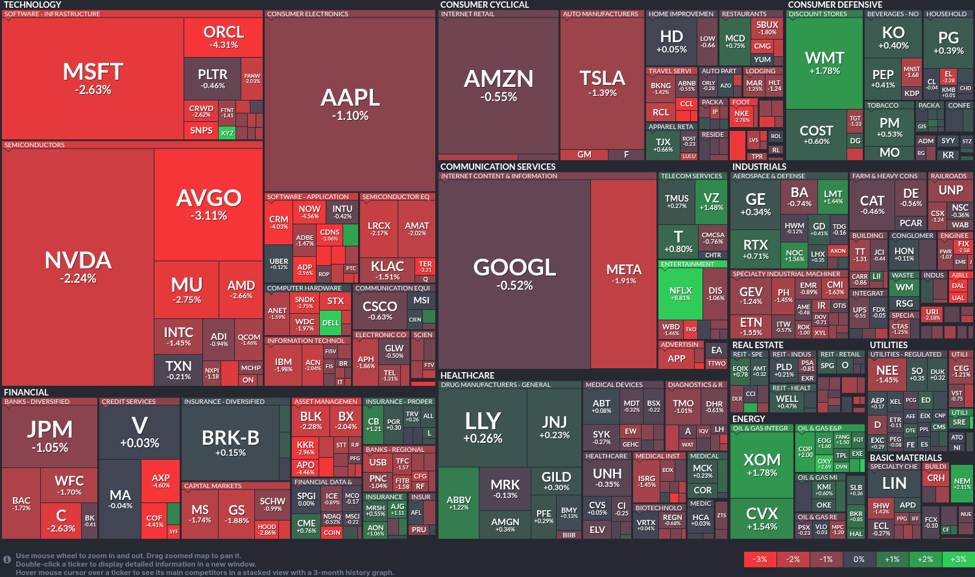
Tech sector under pressure: Energy and healthcare offer a safe haven
Sector OverviewThe stock market today showcases a complex tapestry of trends and fluctuations. The technology sector is under significant pressure, with major players like Microsoft (MSFT) down by 2.63% and Nvidia (NVDA) witnessing a 2.24% decline. Notably, Broadcom (AVGO) is also down by 3.11%, pointing towards a widespread downturn within the tech space.On a brighter note, energy stocks like Exxon Mobil (XOM) surged by 1.78%, and Chevron (CVX) rose by 1.54%, buoying investor sentiment toward this sector. The healthcare sector reflected some resilience with Eli Lilly (LLY) and Johnson & Johnson (JNJ) both inching upwards by 0.26% and 0.23% respectively.Market Mood and TrendsInvestor sentiment today is predominantly bearish across technology, with negative news driving the downturn. Meanwhile, stability in the healthcare and robust performance in energy stocks suggest investors are seeking refuge in traditionally “safer” sectors during volatile periods. Consumer confidence seems to waver, as highlighted by a 0.52% drop in Google (GOOGL) and a deeper 1.91% decline in Meta Platforms (META). However, Netflix (NFLX) bucks the trend, showing an impressive 8.61% gain, possibly reflecting strong quarterly performance or strategic announcements.Strategic RecommendationsGiven today’s dynamics, investors might consider re-evaluating exposure to the tech sector while looking to diversify within energy and healthcare. These sectors are currently displaying signs of stability and potential growth. Assessments of stocks like XOM and LLY could be favorable given their recent performance. Conversely, maintain caution around highly volatile tech stocks until clearer trends emerge. As always, staying informed with real-time data is crucial for navigating such a mixed market environment. Visit InvestingLive.com for continual updates and analysis. This article was written by Itai Levitan at investinglive.com. 🔗 Source 💡 DMK Insight Tech stocks are in a tailspin, and here’s why that matters for traders: With Microsoft down 2.63% and Nvidia at 2.24%, the tech sector’s struggles signal broader market concerns. This isn’t just a blip; it reflects investor anxiety over rising interest rates and potential economic slowdown. For day traders, this volatility could present short-term opportunities, especially if you’re looking at options or short positions. Keep an eye on correlated sectors like semiconductors, where declines could ripple through supply chains and impact earnings forecasts. But here’s the flip side: if these stocks hit key support levels, they could rebound sharply. For instance, if Nvidia approaches its recent lows, it might attract bargain hunters. Watch for the 50-day moving average as a critical indicator; if prices bounce off this level, it could signal a reversal. Conversely, a break below could lead to further selling pressure. So, monitor these levels closely and be ready to act based on market sentiment shifts. 📮 Takeaway Watch Nvidia’s 50-day moving average closely; a bounce could signal a buying opportunity, while a break could lead to further declines.

US December construction spending +0.3% vs +0.3% expected
Prior was +0.5%Private construction +0.5%Residential construction +1.5%Non-residential construction -0.7%Public construction -0.5% m/mPublic construction +3.6% y/yGiven the jumps in shares of CAT and DE, there better be some construction spending in the pipeline. The annualized rate in the report is $2,168.8 billion, which is down 0.4% from last December. Private construction was 2.9% below the 2024 level.All the AI spending is in the pipeline and that should boost this in time but you start to wonder if the tariffs and economic uncertainty is pulling down investment elsewhere. This isn’t a great report, though it’s rarely a market mover.US equities are making up some lost ground with the S&P 500 trimming the daily decline to 41 points, or 0.6%. This article was written by Adam Button at investinglive.com. 🔗 Source 💡 DMK Insight Construction spending is showing mixed signals, and here’s why that matters for traders: The latest report indicates a 0.4% decline in annualized construction spending, now at $2,168.8 billion. While private construction is up 0.5%, public construction has taken a hit, down 0.7% month-over-month. This divergence could impact companies like Caterpillar (CAT) and Deere (DE), which have seen share price jumps, suggesting traders are betting on future demand. If public spending continues to lag, it might dampen overall sector growth, affecting related stocks and ETFs. Traders should keep an eye on the upcoming economic indicators, particularly any shifts in government spending plans or infrastructure projects, as these could provide clarity on future construction trends. On the flip side, the resilience in private construction could indicate a strong housing market, which might support related sectors. Watch for any significant changes in residential construction metrics, as a sustained increase could signal a broader economic recovery. Key levels to monitor would be the performance of CAT and DE around their recent highs, as a pullback could present buying opportunities if the fundamentals support it. 📮 Takeaway Keep an eye on public construction trends and monitor CAT and DE for potential pullbacks around their recent highs.

USDCAD Technicals: USDCAD extends to new lows for the day and tests the low for the week
The USDCAD moved lower in the latest hourly bar, testing Monday’s low near 1.3649. The break lower has been modest so far, but sellers remain in control as downside pressure persists.Earlier in the session, the pair briefly moved higher following the PPI release, but that rally quickly faded after the price tested the 100-hour moving average at 1.3686, which was closely aligned with the 200-hour moving average near 1.3680. The failure against this moving average cluster reinforced resistance and helped trigger the renewed move lower.For buyers to regain control, the price must break and hold above both the 100- and 200-hour moving averages. Until that occurs, the technical bias remains tilted toward the downside.On the downside, a sustained move below Monday’s low at 1.3649 would open the door for further selling, targeting 1.3630 initially, followed by a broader swing support zone from mid-February surrounding the 1.3600 level.Sellers are now pressing their advantage. The key question is whether they can maintain momentum and expand what has been a relatively tight trading range for the week. This article was written by Greg Michalowski at investinglive.com. 🔗 Source 💡 DMK Insight The USDCAD’s recent dip towards 1.3649 signals a critical moment for traders: With sellers firmly in control, the pair’s struggle to maintain upward momentum post-PPI release hints at underlying weakness. The brief rally earlier in the session was short-lived, suggesting that market sentiment is leaning bearish. Traders should be cautious; if the pair breaks below 1.3649 decisively, it could open the door for further declines, potentially targeting the next support level. Keep an eye on broader economic indicators and market reactions, as they could amplify volatility. On the flip side, if USDCAD manages to reclaim ground above recent highs, it might indicate a shift in sentiment, but for now, the downside pressure is palpable. Watch for any significant news that could impact the CAD or USD, as these could serve as catalysts for movement in either direction. 📮 Takeaway Monitor the 1.3649 level closely; a break below could signal further downside, while a recovery above recent highs may shift sentiment.

Silver sprints higher, gains more than 5%
Silver is up nearly 6% as it looks to break out of a recent range.These are the best levels since the crushing rout on January 30. Notably, that was the final trading day of January and this is the final trading day of February. The chart suddenly looks more promising as it breaks above the early February highs.This will mark the 10th consecutive month of gains in silver as it benefits both from the USD debasement trade along with industrial electrification demand.The gains are impressive today given that we had so much volatility last month and what looked like a blow-off top. Instead, silver steadied early in February and is now marching back higher. That suggests insatiable demand for silver and previous metals. Gold prices were lower earlier but have turned around and are up $50 to $5236 in what will be the all-time highest weekly close for gold (if it holds).Today’s US PPI report raised some fresh questions about the Fed’s ability to cut rates. In addition, oil prices are up 3% today in a move that will add further inflation pressure to the March pipeline data (and beyond). The oil move is highly conditional on what happens in Iran so keep a close eye on that.Should the US get significantly involved in Iran — particularly if it looks like it be an operation for many months — then I would expect further large bids in gold and precious metals. “The idea that we’re going to be in a Middle Eastern war for years with no end in sight — there is no chance that will happen,” Vance told the Post. He described the range of options as strikes that would “ensure Iran isn’t going to get a nuclear weapon” or actions that could lead to a diplomatic solution.Just now, US Secretary of State Marco Rubio announced a March 2-3 trip to Tel Aviv and that looks like a sign that nothing is imminent, though with war nothing is certain. This article was written by Adam Button at investinglive.com. 🔗 Source 💡 DMK Insight Silver’s nearly 6% surge signals a potential breakout, and here’s why that’s crucial for traders right now: The recent price action suggests a shift in sentiment, especially as it approaches levels not seen since the January rout. This breakout could indicate a reversal in the trend, especially if it holds above key resistance levels. Traders should keep an eye on the $25 mark, which could serve as a pivotal point. If silver can maintain momentum above this level, it might attract more buying interest, potentially leading to a rally towards $26 or higher. However, if it fails to sustain this breakout, we could see a quick pullback, so risk management is essential. It’s worth noting that this movement in silver could have ripple effects on related assets like gold, which often moves in tandem. If silver continues to gain traction, it could bolster gold prices as well, creating opportunities for cross-asset trading strategies. Watch for volume spikes and any news that could influence precious metals, as these could provide additional context for your trades. 📮 Takeaway Monitor silver’s performance around the $25 level; a sustained breakout could lead to a rally towards $26, but be prepared for potential pullbacks.

Iran strikes loom large over today's trade
There is no sense over-analyzing price action today across markets. Yes, there is the usual software anxiety in stock markets but the overarching theme across bonds, FX, commodities and precious metals is simple — angst about US strikes on Iran.That thinking has US 10-year yields below 4% for the first time since November while oil prices are up more than 2%. It’s also lent a bid to precious metals and the US dollar, though (unsurprisingly) the loonie and Swiss franc are top performers. Now, no one really knows what will happen in the Middle East. Clearly, Trump is at least trying to put maximum pressure on negotiations via a massive US military build up in the region. Yesterday, various reports said negotiations were positive but we didn’t hear that from the only person who matters: Trump.At the same time, what people are saying matters much less than what they’re doing and the US has evacuated bases near Iran while moving massive amounts of steel to the region. I would highlight a pair of news items in the past hour or so, both of which have trimmed oil’s gain:1) US Secretary of State Marco Rubio announced a March 2-3 trip to Tel Aviv.Would he be doing that at the same time bombs were falling? I tend to think not and others might argue that the announcement of the trip is meant as a diversion to get Iran to lower its guard.2) JD Vance spoke to ABC and said any actions would be limited.”The idea that we’re going to be in a Middle Eastern war for years with no end in sight — there is no chance that will happen,” Vance told the Post. He described the range of options as strikes that would “ensure Iran isn’t going to get a nuclear weapon” or actions that could lead to a diplomatic solution.The nuclear bit is particularly notable as there is nothing there about regime change or about crippling Iran’s oil exports. Yes, Iran could be forced to shut in via circumstances and could try to shut the Strait of Hormuz but I don’t think they will take that course of action if they don’t sense a US effort to topple the regime.All that said, Trump is about the least-predictable person in history so this could go in any direction. I don’t fault those buying bonds in this environment but the long history of Middle East strikes and wars arguing for selling oil as the dust settles. This article was written by Adam Button at investinglive.com. 🔗 Source 💡 DMK Insight US strikes on Iran are shaking up markets, and here’s why that matters right now: With US 10-year yields dipping below 4%, traders are clearly reacting to geopolitical tensions. This drop in yields often signals a flight to safety, pushing investors towards bonds and away from riskier assets like stocks and commodities. For day traders, this could mean increased volatility in equities, particularly in sectors sensitive to geopolitical risks, like energy and defense. Keep an eye on how these tensions could ripple through the FX market as well, especially with the dollar potentially strengthening against currencies from regions affected by conflict. But don’t overlook the contrarian angle: if tensions escalate, we might see a temporary spike in oil prices, which could create trading opportunities in energy stocks. Watch for key levels in the S&P 500; a break below recent support could trigger further selling pressure. For now, monitor the news closely and be ready to adjust your positions based on how the situation unfolds. 📮 Takeaway Watch for US 10-year yields and S&P 500 support levels; geopolitical tensions could lead to increased volatility and trading opportunities in energy stocks.

Nasdaq Technicals: Nasdaq index failed to extend above key MAs. Bias is lower.
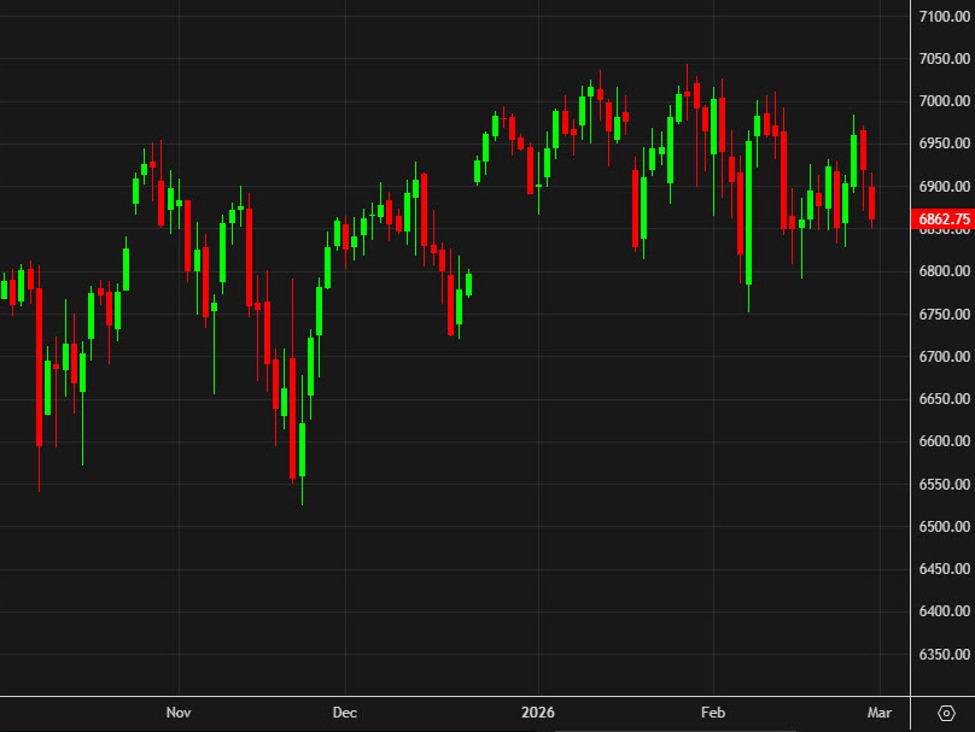
The NASDAQ index pushed to a high on Monday but failed to extend above its falling 100-hour moving average, a rejection that triggered a sharp move lower. The decline reached Tuesday’s weekly low near 22,193, aligning with the top of a key swing support area.A subsequent rebound carried the index back above the 100-hour moving average, briefly increasing the bullish bias. However, momentum stalled at the 200-hour moving average, where buyers turned into sellers, leading to another sharp decline yesterday. Today, downside pressure continues, with the index trading lower by roughly 0.8%.What comes next?For buyers to regain control, the price must move back above and hold the 100-hour moving average near 22,851. Even then, upside momentum would still need confirmation through a break above the falling 200-hour moving average at 23,117, which remains the key technical pivot.On the downside, initial support comes in near 22,461, the low from last week. Below that level lies a broader swing support zone between 21,949 and 22,461. The lower boundary of this area also aligns with the 38.2% retracement of the rally from the May 23, 2025 low, increasing its technical importance.Sellers hold the near-term advantage, but additional downside progress is still needed to strengthen the bearish bias. For now, the 200-hour moving average remains the key pivot, separating a more bearish outlook from a potential return to bullish momentum. This article was written by Greg Michalowski at investinglive.com. 🔗 Source 💡 DMK Insight The NASDAQ’s failure to break above the 100-hour moving average is a critical signal for traders right now. This rejection at a key resistance level suggests a bearish sentiment, especially as the index dipped to around 22,193, which aligns with significant swing support. Traders should be cautious; if the index can’t hold this support, we could see further declines. Look for volume spikes or changes in momentum indicators to gauge the strength of any rebound. On the flip side, a successful break above the 100-hour moving average could indicate a potential reversal, but that seems less likely given the current trend. Keep an eye on correlated assets like tech stocks, as they often move in tandem with the NASDAQ, and monitor for any shifts in market sentiment that could impact these levels. 📮 Takeaway Watch the NASDAQ closely; a drop below 22,193 could trigger further selling, while a break above the 100-hour MA might signal a reversal.

Atlanta Fed GDPNow growth estimate for Q1 3.0% versus 3.1% last
The Atlanta Fed GDPNow growth estimate for Q1 dipped to 3.0% from 3.1% last. In their own wordsThe GDPNow model estimate for real GDP growth (seasonally adjusted annual rate) in the first quarter of 2026 is 3.0 percent on February 27, down from 3.1 percent on February 24. After this morning’s releases from the US Census Bureau and the US Bureau of Labor Statistics, the nowcasts of first-quarter real gross private domestic investment growth and real government expenditures growth decreased from 8.5 percent and 1.6 percent, respectively, to 7.9 percent and 1.5 percent.The next GDPNow update is Monday, March 2. Please see the “Release Dates” tab below for a list of upcoming releases. This article was written by Greg Michalowski at investinglive.com. 🔗 Source 💡 DMK Insight The Atlanta Fed’s GDPNow estimate dropping to 3.0% signals potential economic cooling, and here’s why that matters: A decline from 3.1% to 3.0% might seem minor, but it reflects growing concerns about economic momentum as we head into 2026. Traders should keep an eye on how this impacts market sentiment, especially in sectors sensitive to economic growth like consumer discretionary and industrials. If growth expectations continue to wane, we could see a shift in investor behavior, potentially leading to a flight to safety in assets like gold or U.S. Treasuries. Additionally, this could influence the Federal Reserve’s monetary policy decisions, particularly if inflation remains stubbornly high while growth slows. Watch for any comments from Fed officials regarding this estimate, as they could provide clues on interest rate trajectories. On the flip side, a resilient labor market or strong consumer spending data could counterbalance this dip, so it’s crucial to monitor those indicators closely. Keep an eye on the 3% level in the GDPNow estimate; if it dips further, it may trigger broader market reactions. 📮 Takeaway Traders should watch the 3% GDPNow estimate closely; a further decline could signal economic weakness and impact market sentiment significantly.