
 Bitcoin
  Ethereum
  Tether
  XRP
XRP  BNB
BNB  USDC
USDC  Solana
  TRON
TRON  Lido Staked Ether
  Figure Heloc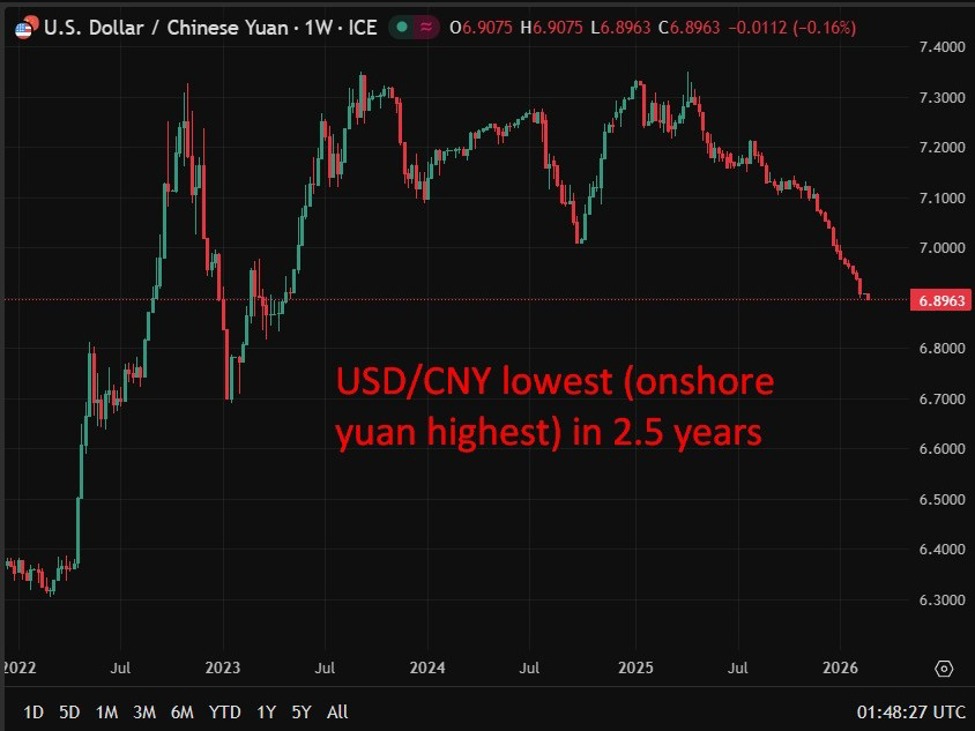
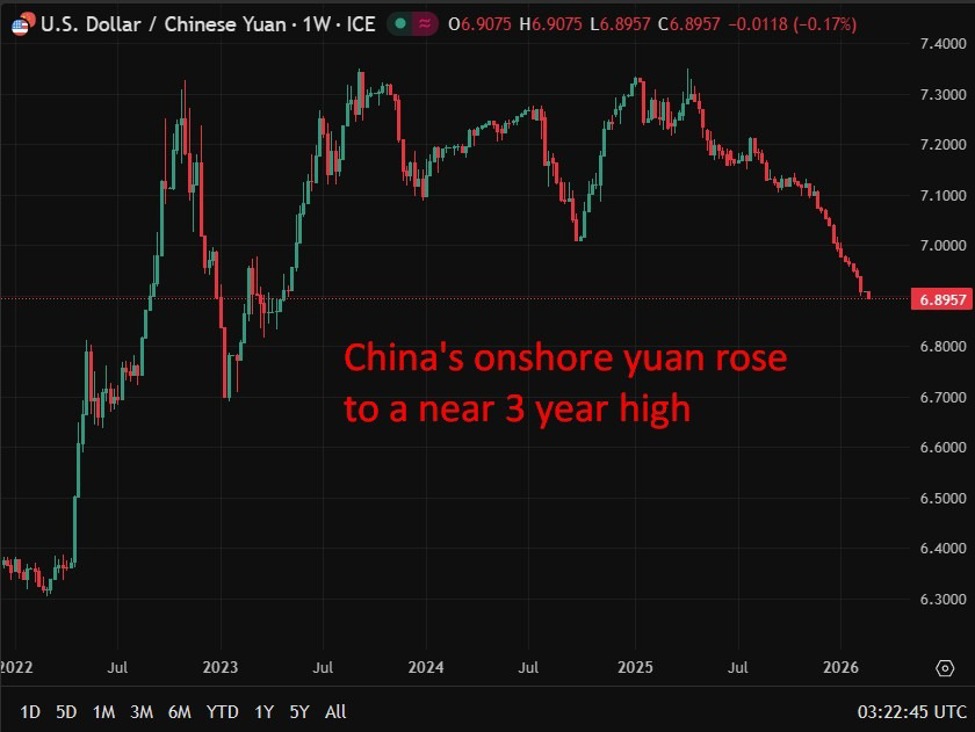
The onshore yuan hit a 2½-year high as USD/CNY fell below 6.90, with the PBOC signalling greater tolerance for strength.Summary:USD/CNY falls to 6.8954, lowest in 2½ years (since May 2023, so a bit longer)Onshore yuan (CNY) hits fresh multi-year highShanghai Composite rises 0.8% on market reopenPBOC sets firmer fix at 6.9414 with reduced dampingNarrower deviation from forecasts signals policy toleranceChina’s onshore yuan climbed to a fresh 2½-year high on Tuesday, with USD/CNY dropping to 6.8954 despite a slightly firmer official midpoint fix, underscoring growing momentum behind the currency’s appreciation trend.The move marks the strongest level for the onshore yuan (CNY) since mid-2023 and comes as China’s financial markets reopened after an extended holiday break. The Shanghai Composite Index rose 0.8%, reflecting a broader risk-on tone that may be helping the yuan outperform regional peers.The daily midpoint set by the People’s Bank of China came in at 6.9414, marginally firmer than the previous 6.9398. Notably, traders observed that authorities appeared to apply less “damping” in the fixing mechanism. The deviation between market forecasts and the official fix narrowed to around +250 pips from +350 previously, suggesting the central bank is allowing greater alignment with market pricing.The yuan is managed within a 2% trading band on either side of the daily midpoint. By setting a stronger reference rate and reducing the gap between model estimates and the official fix, the PBOC may be signalling increased tolerance for gradual currency appreciation.A firmer yuan reflects both domestic and external dynamics. Improved sentiment in Chinese equities, a softer U.S. dollar backdrop and renewed capital inflow expectations have contributed to the currency’s advance. The reopening of mainland markets also released pent-up positioning flows, amplifying the move.The break below the psychologically important 6.90 level could attract additional momentum-driven flows, particularly if the risk-positive tone in Chinese equities persists. However, policymakers will likely remain attentive to export competitiveness considerations, especially as global demand conditions remain mixed.For now, the 2½-year high underscores a shift in yuan dynamics, with the currency increasingly supported by market forces and a central bank appearing less inclined to lean aggressively against appreciation. This article was written by Eamonn Sheridan at investinglive.com. 🔗 Source 💡 DMK Insight The onshore yuan’s surge to a 2½-year high is a game changer for forex traders right now. With USD/CNY dropping below 6.90, the People’s Bank of China (PBOC) is clearly signaling a shift in its currency policy, showing more tolerance for yuan strength. This could lead to a stronger yuan in the near term, impacting trade balances and capital flows. Traders should watch for how this affects related markets, particularly commodities priced in dollars, as a stronger yuan could dampen demand for imports priced in USD. The Shanghai Composite’s 0.8% rise indicates bullish sentiment, but keep an eye on volatility as market participants adjust to this new dynamic. On the flip side, if the yuan continues to strengthen, it could pressure Chinese exports, which might lead to a broader economic slowdown. Watch for key levels around 6.85 and 6.80 for potential support, as well as any comments from the PBOC that could signal a reversal in policy. Immediate focus should be on how USD/CNY reacts in the coming days, especially if it tests those levels. 📮 Takeaway Watch USD/CNY closely; a break below 6.85 could signal further yuan strength, impacting commodities and trade dynamics.
China stocks jump as U.S. tariff ruling boosts export hopes
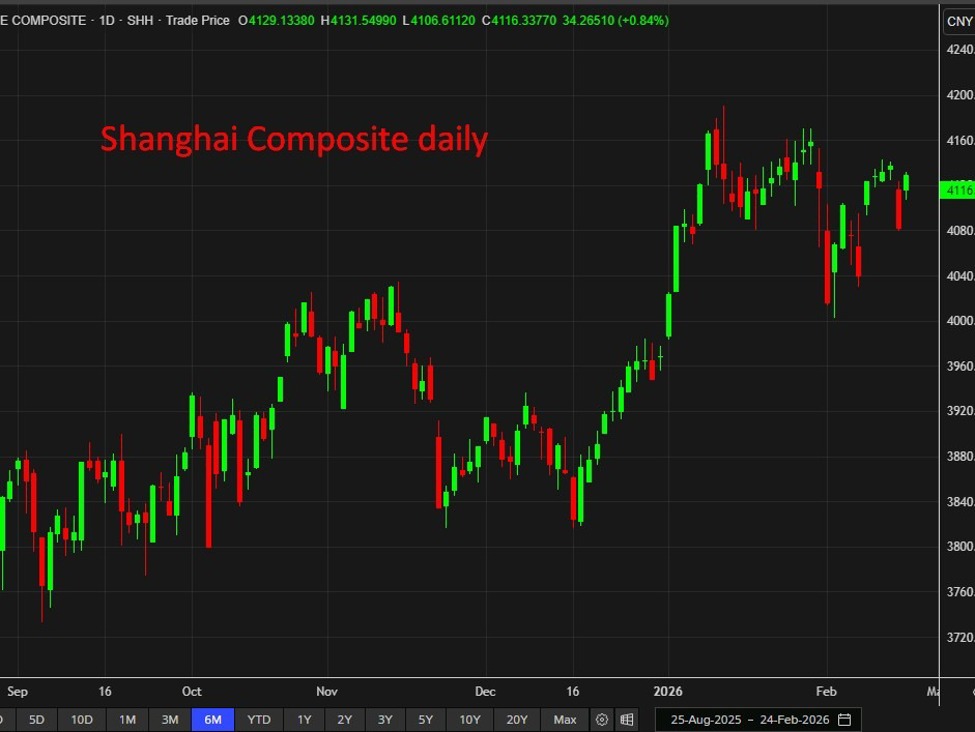
China’s CSI300 and Shanghai Composite rallied on reopen as investors cheered the U.S. tariff ruling’s potential export relief.Summary:CSI300 +1.4%, Shanghai Composite +1.2% at openRally follows nine-day mainland holidayInvestors cite U.S. Supreme Court tariff ruling as positive for exportsHang Seng reverses after Monday’s 2.5% surgeAnalysts see potential easing of U.S.–China tariff pressureChinese equities opened sharply higher on Tuesday as traders returned from a nine-day holiday break, buoyed by optimism that recent developments in U.S. trade policy could ease pressure on Chinese exports.The blue-chip CSI300 Index rose 1.4% at the open, while the Shanghai Composite Index gained 1.2%, with buying broad-based across sectors including consumer electronics and machinery.Market participants pointed to the U.S. Supreme Court’s decision to annul President Donald Trump’s “reciprocal” emergency tariffs as a catalyst for improved trade sentiment. Although Trump subsequently announced a temporary 15% global tariff, analysts say the reset may ultimately translate into relatively lower effective tariff rates for China compared with previous proposals.The legal ruling has injected fresh uncertainty into global trade policy. U.S. equity markets fell on Monday amid confusion over the future tariff framework. However, investors in mainland China appeared to interpret the development as potentially constructive for Beijing, particularly if it weakens Washington’s leverage in future trade negotiations.In Hong Kong, the mood was more cautious. The Hang Seng Index slipped more than 1% after rallying 2.5% on Monday in reaction to the tariff headlines. The pullback suggests some profit-taking following the prior session’s surge.The rebound in mainland shares also reflects pent-up positioning flows after the extended market closure. With global investors reassessing the implications of the U.S. court ruling, Chinese stocks may benefit from renewed expectations that export headwinds could moderate in coming months.Still, trade policy uncertainty remains elevated. While the Supreme Court decision curtailed certain emergency powers, the administration retains other legal avenues for tariffs, including national security provisions.For now, traders appear focused on the prospect that the latest shift in Washington could provide incremental relief to Chinese exporters and improve the tone of bilateral negotiations.China’s best friend! This article was written by Eamonn Sheridan at investinglive.com. 🔗 Source 💡 DMK Insight China’s markets are reacting positively to the U.S. tariff ruling, and here’s why that’s crucial for traders: The CSI300 and Shanghai Composite’s gains of 1.4% and 1.2% respectively signal a renewed investor confidence following a nine-day holiday. This uptick is largely attributed to the U.S. Supreme Court’s decision, which could ease some tariffs on Chinese exports. For traders, this is a pivotal moment as it may indicate a shift in trade dynamics that could bolster Chinese equities further. Watch for the Hang Seng’s performance, especially after its recent reversal post-surge; it could reflect broader sentiment in the region. However, it’s worth noting that while the initial reaction is bullish, the sustainability of this rally depends on how effectively these tariff changes translate into actual economic benefits. Traders should keep an eye on key resistance levels in the CSI300 around recent highs, as a failure to maintain momentum could lead to profit-taking. Monitor the next few trading sessions closely for any signs of volatility as market participants digest this news. 📮 Takeaway Watch the CSI300 for resistance around recent highs; a sustained rally could signal broader bullish sentiment in Chinese equities.
China adds 20 Japanese firms to export control list, tightening dual-use trade
China moved to restrict dual-use exports to 20 Japanese entities, a fresh escalation in trade frictions amid already strained bilateral ties.Summary:China’s Commerce Ministry adds 20 Japanese entities to an export control “watch list”Measures ban exports of dual-use items to listed entities without licencesOverseas parties also barred from re-transferring China-origin dual-use items to themBeijing cites inability to verify end-users/end-uses, and frames move as curbing Japan “remilitarisation”Includes names such as Subaru, Mitsubishi Materials, Sumitomo Heavy Industries and aerospace trading unitsChina’s Commerce Ministry said it will place 20 Japanese entities on its export control list, tightening restrictions on shipments of dual-use items in a move that underscores the chill in Japan–China relations and adds a new layer of uncertainty for sensitive supply chains.Under the measures, export operators are prohibited from exporting dual-use items to the named entities, while overseas organisations and individuals are also prohibited from transferring or providing dual-use items originating from China to those companies. Exporters will be required to apply for individual export licences, and entities may apply for removal from the watch list.Beijing said the entities were added because authorities were unable to verify end-users and end-uses for dual-use items—language typically used to justify tighter controls on goods with potential civilian and military applications. The ministry also framed the measures as aimed at curbing Japan’s “remilitarisation” and alleged nuclear ambitions, while insisting the steps are legitimate, reasonable and lawful.At the same time, China sought to ring-fence broader trade ties, saying the measures would not affect “normal” economic and trade exchanges, and adding that Japanese entities operating “in good faith” and complying with the law have no cause for concern.The watch list includes companies such as Subaru Corp, Mitsubishi Materials Corp, Sumitomo Heavy Industries, and aviation and aerospace-related firms including Fuji Aerospace, Itochu Aviation and Mitsui Bussan Aerospace—names that sit close to industrial, materials and aerospace supply chains where dual-use components can be embedded in otherwise commercial products.The decision lands against a backdrop of ongoing diplomatic strain, including simmering tensions since late 2025 after comments by Japan’s prime minister on Taiwan that drew sharp pushback from Beijing. Those remarks amplified longstanding Chinese concerns about Japan’s security posture and its alignment with U.S.-led regional deterrence efforts. This week’s export control action appears consistent with a pattern of using trade and regulatory tools to signal displeasure while attempting to avoid overt disruption to headline bilateral commerce.For markets, the key issues are scope and enforcement. The requirement for individual licences can slow procurement, raise compliance costs and encourage supply chain re-routing, especially where China-origin inputs are difficult to substitute in the near term. Even if Beijing maintains that “normal” trade will continue, the move raises the risk premium around Japan-facing shipments in sectors such as advanced manufacturing, materials processing and aerospace components. This article was written by Eamonn Sheridan at investinglive.com. 🔗 Source 💡 DMK Insight China’s new export restrictions on Japanese entities could shake up market dynamics significantly. This move is a clear escalation in trade tensions, which could lead to increased volatility in both the Chinese and Japanese markets. Traders should keep an eye on how this affects sectors reliant on dual-use technologies, particularly in defense and electronics. The restrictions could disrupt supply chains, leading to potential price spikes in affected commodities or stocks. If you’re trading in these sectors, watch for any immediate reactions in stock prices or shifts in trading volumes. On the flip side, this could create opportunities for companies outside of the affected list, as they may gain market share. Keep an eye on the broader implications for global trade, especially if other countries follow suit. Monitor key technical levels in related stocks and commodities, as any significant breakouts or breakdowns could signal larger trends. Watch for further announcements from both governments that could impact market sentiment. 📮 Takeaway Traders should monitor stock reactions in defense and electronics sectors closely, especially for any significant price movements following China’s export restrictions.
Apple to move some Mac mini production to Houston in 2026 – WSJ
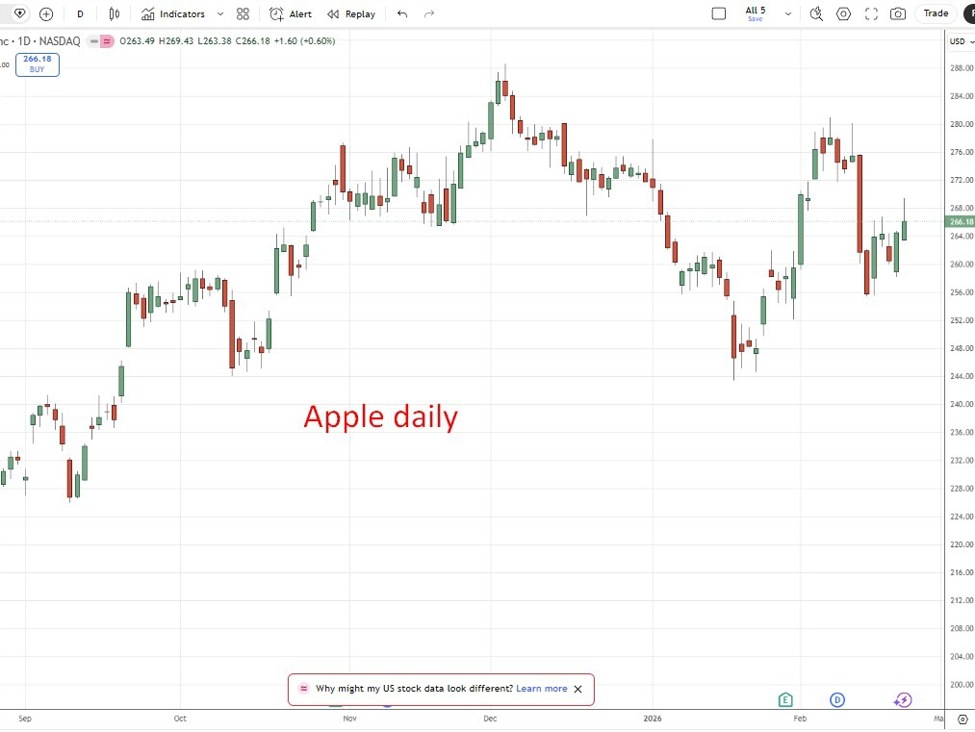
Summary:Apple to begin assembling some Mac mini units in Houston in 2026Production to take place at a Foxconn facilityMove aimed at meeting local U.S. demandMajority of Mac mini output to remain in AsiaPart of broader supply-chain diversification trendApple plans to shift part of its Mac mini production to the United States, with assembly set to begin in Houston later in 2026, according to comments by the company’s operating chief reported by The Wall Street Journal.(gated)The move will see some Mac mini units produced at a Foxconn facility in Texas, marking a modest expansion of U.S.-based manufacturing for the tech giant. The new assembly line is intended to meet local demand, while the bulk of Mac mini production will continue in Asia.The production shift underscores Apple’s ongoing efforts to diversify its supply chain geographically. While Asia remains the company’s core manufacturing base, Apple has in recent years taken steps to broaden its footprint in response to geopolitical tensions, trade policy shifts and supply-chain disruptions.By establishing a Houston assembly line, Apple can shorten delivery times for U.S. customers and potentially reduce exposure to tariff-related risks. The U.S. Supreme Court’s recent ruling reshaping elements of the U.S. tariff framework has added further uncertainty around trade costs, reinforcing incentives for partial localisation of production.The facility in Texas will operate in partnership with Foxconn, Apple’s long-time contract manufacturing partner. However, Apple’s operating chief made clear that the majority of Mac mini production will remain in Asia, suggesting the Houston operation will complement rather than replace existing supply chains.The Mac mini is one of Apple’s more compact and modular desktop offerings, and its assembly is less complex than that of larger devices, making it a practical candidate for regional manufacturing.The move reflects a broader industry trend toward supply-chain resilience and incremental reshoring of select production lines, particularly for products aimed at major end markets such as the United States. This article was written by Eamonn Sheridan at investinglive.com. 🔗 Source 💡 DMK Insight Apple’s decision to assemble Mac mini units in Houston by 2026 is a strategic move that reflects ongoing supply chain diversification efforts. This shift is significant for traders as it signals Apple’s intent to bolster its domestic production capabilities, likely in response to increasing U.S. demand and geopolitical tensions affecting global supply chains. While the majority of Mac mini production will still occur in Asia, the localized assembly could lead to reduced shipping costs and faster delivery times, potentially enhancing Apple’s competitive edge in the U.S. market. Traders should keep an eye on how this impacts Apple’s stock price and supply chain-related stocks, particularly those tied to Foxconn. However, it’s worth noting that this move might not drastically alter Apple’s overall production costs or margins in the short term. The real story is whether this will lead to a broader trend of reshoring in tech manufacturing, which could affect related sectors. For now, watch for any updates on production timelines and how they align with quarterly earnings reports, as these could serve as catalysts for stock movement. 📮 Takeaway Monitor Apple’s stock for potential volatility as production shifts to Houston, especially around earnings reports and supply chain updates in 2026.
investingLive Asia-Pacific FX news wrap: Tariff uncertainty persists, China rises
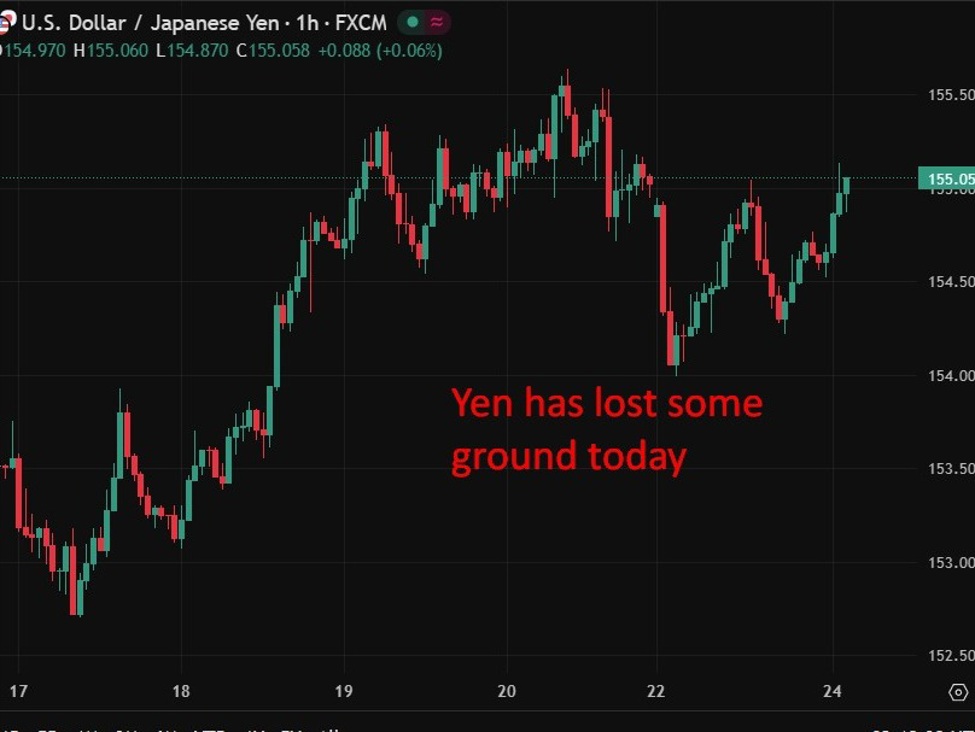
Apple to move some Mac mini production to Houston in 2026 – WSJChina adds 20 Japanese firms to export control list, tightening dual-use tradeChina stocks jump as U.S. tariff ruling boosts export hopesUSD/CNY drops to 2½-year low as onshore yuan surgesChina holds loan prime rates steady as growth slows and yuan firmsPBOC sets USD/ CNY reference rate for today at 6.9414 (vs. estimate at 6.9249)People’s Bank of China sets 1 and 5 year Loan Prime Rates (LPRs) unchangedBank of Korea meet Feb 26 – preview: To hold rates at 2.50% through 2026 (Reuters poll)Bessent led yen rate check amid Japan election volatility – NikkeiGoldman Sachs forecasts $5,400 gold on central bank demand and Fed cutsTrump considers new Section 232 tariffs after Supreme Court rulingAustralia January CPI preview: core inflation steady, electricity lifts headlineSwiss franc: Rabobank and UBS see CHF strength persisting (Rabo EUR/CHF 0.91 forecast)investingLive Americas FX news wrap 23 Feb: USD is mixed as markets react to tariff newsUBS targets USD 6,200 gold on Fed cuts and elevated geopolitical riskMajor US stock indices close lower as markets ponder uncertainty from tariffsAt a glance:Fresh Section 232 tariff talk adds marginal trade uncertaintyConfusion lingers over Trump’s 15% flat tariff vs 10% regulation levelPBOC holds LPRs steady at 3.0% (1Y) and 3.5% (5Y)China adds 20 Japanese firms to dual-use export watch listApple to shift some Mac Mini production to HoustonFedEx sues over Trump-era tariffsOnshore yuan hits strongest level in nearly three yearsChinese equities rally; USD slightly firmer; gold slips below 5200There was no shortage of headlines during the session, though market impact varied.Trade uncertainty ticked higher after reports that President Trump is considering expanded, sector-specific Section 232 tariffs. While the proposals add another layer of policy ambiguity, the broader trade framework remains fluid and the immediate market impact appears marginal for now. Confusion also persists around the administration’s touted 15% flat tariff, with reports suggesting regulations still reflect a 10% level.Japan is reportedly seeking assurances that the new tariff regime currently being drafted will not prove more punitive than existing arrangements, with other trading partners pursuing similar clarifications.In China, the People’s Bank of China left its one-year and five-year Loan Prime Rates unchanged at 3.0% and 3.5%, respectively. The steady policy stance underscores Beijing’s cautious balancing act between supporting growth and maintaining currency stability amid strengthening pressure.Meanwhile, China’s Commerce Ministry added 20 Japanese entities to an export control watch list, banning exports of dual-use items without licences, a move that adds to ongoing Japan–China tensions.Corporate headlines included Apple confirming it will move some Mac Mini production to Houston from Asia, part of a broader supply-chain diversification push. Separately, FedEx filed suit in the U.S. Court of International Trade seeking refunds for tariffs it argues were imposed illegally.In FX, China’s onshore yuan climbed to its strongest level against the dollar in nearly three years as traders returned from a nine-day holiday. The move was supported by renewed dollar softness and expectations that the U.S. Supreme Court’s tariff ruling could ease export pressures. Strong Q4 current account data also pointed to solid FX inflows.Chinese equities rose on the improved trade tone. The yen was volatile, with USD/JPY briefly reclaiming 155.00 before slipping back below that level. The broader dollar was slightly firmer overall.Gold eased back under 5200, consolidating after recent strength. This article was written by Eamonn Sheridan at investinglive.com. 🔗 Source 💡 DMK Insight China’s tightening of export controls and the U.S. tariff ruling are shaking up global trade dynamics right now. The addition of 20 Japanese firms to China’s export control list signals a more aggressive stance in dual-use technology, which could lead to increased volatility in related markets. For traders, this means keeping an eye on the USD/CNY pair, especially with the yuan hitting a 2½-year low. A weaker yuan could impact commodities and tech stocks, particularly those with significant exposure to China. If you’re trading in this space, watch for key levels around recent lows and highs in the USD/CNY to gauge market sentiment. On the flip side, while some might see this as a negative for global trade, it could also present buying opportunities in sectors that benefit from a more localized production strategy, like Apple’s move to Houston. This could shift supply chains and create new investment avenues, especially for U.S.-based tech firms. Keep an eye on how these geopolitical tensions evolve, as they could lead to sudden market shifts. 📮 Takeaway Watch the USD/CNY levels closely; a breakout could signal further volatility in tech and commodity markets, especially with ongoing trade tensions.

Swiss franc to stay favourable amid safe haven allure
The Swiss franc is not one that is talked about too often but as mentioned last week, it is certainly one key spot to take note of in the major currencies space. If not for geopolitical tensions, then at least in terms of added trade uncertainty now. That will just pile on the negativity to the overall risk landscape, keeping the franc as an attractive hedge.The key chart to watch remains EUR/CHF, with it having broken below key support at 0.92 at the start of the year. Is that a signal that the SNB is being more tolerant with regards to their intervention limits? Let’s take a look at what some analysts have to say.RBC”Over the last year CHF has behaved as the dominant risk-off currency in the G10. With Trump still in the White House for three more years, it is hard to imagine a period of geopolitical serenity emerging. This CHF strength is likely to endure in the near-term even though the economic data has been weak. We think FX intervention at some point over the next year is likely, but timing is a challenge. Instead of a spot trade a view on FX intervention may be better expressed through options, for example EUR/CHF call spreads.”Morgan Stanley”We argue that investors are underestimating and underpricing CHF strength. CHF is the most consistent and effective safe haven compared to its typical safe haven ‘peers’, and we think the SNB may be more tolerant of CHF strength than many investors think. We forecast EUR/CHF to fall to 0.87, below consensus and forwards, and see USD/CHF shorts as an attractive hedge for USD ‘bear case’ scenarios.”Credit Agricole”The CHF remains close to its strongest real levels since 2011. What is key is that EUR/CHF is holding up just above 0.91, about 1.5% lower than the averages of last October and January. While the SNB is surely watching those developments closely despite no stepping-up in anti-CHF jawboning, it may also have to consider the signalling effect of eventually defending a more important psychological level such as 0.90.” This article was written by Justin Low at investinglive.com. 🔗 Source 💡 DMK Insight The Swiss franc’s rising profile amid geopolitical tensions and trade uncertainty is worth watching closely. As traders, we often overlook the Swiss franc, but its safe-haven status could become increasingly relevant if global markets remain volatile. With geopolitical issues simmering, the franc might see inflows as investors seek stability. This could lead to a strengthening against major currencies like the euro and dollar, especially if risk appetite wanes. Keep an eye on key levels—if the franc breaks above recent highs, it could signal a broader trend shift. On the flip side, if trade uncertainties ease, we might see a reversal as traders flock back to riskier assets. So, monitor economic indicators from Switzerland and the EU, as well as any news on trade agreements. A strong economic report from Switzerland could further bolster the franc’s position, while negative news could trigger a sell-off. Watch for these dynamics as they unfold in the coming weeks. 📮 Takeaway Keep an eye on the Swiss franc’s movement against major currencies; a break above recent highs could indicate a shift towards safe-haven buying.
Japan mulls revising liquidity-support JGB auctions to ease market pressure – report
The report says that Japan’s ministry of finance is considering revisions to the framework of its existing liquidity-enhancement auctions for JGBs. This is a move that is said to be intended to ease supply pressures on the super-long end of the curve in the bond market.For some context, the liquidity-enhancement auctions are ones that are run to provide supply for bonds that are no longer the most recently issued for a specific maturity, having been superseded by newer issuances.In the case of Japan, the issuances are divided into three maturity buckets:Over 1 year to 5 yearsOver 5 years to 15.5 yearsOver 15.5 years to under 39 yearsBut starting from April, Tokyo officials are said to be mulling plans to narrow the mid-term bucket – which typically receives a relatively large allocation. The change will see that be switched to a bucket of “Over 5 years to 11 years” with the long-end bucket switching to “Over 11 years to under 39 years”.The sources note that the idea here is to fit this with a combination of reduced new issuance in super-long JGBs in order to bolster market confidence among investors and help ease yields in the secondary market.In other words, it is all about rebalancing supply to match that up against actual market demand. And by reducing the amount of new debt coming into the market while using these auctions to improve the trading of existing debt, that helps to reduce supply pressures that typically drives yields higher.That is essentially the goal here that Tokyo officials are trying to achieve. And at the same time of course, the narrowing of the mid-term bucket allows the ministry of finance to more precisely target the specific maturity zones where demand is highest. And that means not forcing supply to areas where demand is actually softening instead. This article was written by Justin Low at investinglive.com. 🔗 Source

It is shaping up to be another rough week for cryptocurrencies
That marks the lowest level in over two weeks for Bitcoin, as fatigue continues to set in following the sharp drop at the start of the month. The plunge back then saw dip buyers manage a strong bounce near $60,000. But ultimately, that is now fading as the downside momentum since the start of the year continues to drive forward.Bitcoin itself is now down just over 6% on the week, poised for a sixth consecutive weekly drop. And the technicals continue to look dicey for the cryptocurrency, after having broken back below its 100-week moving average (red line) for the first time since 2023 at the end of January trading.It’s tough to pick at support levels but the $60,000 mark is a big psychological one. That especially since it was also defended at the first attempt in the drop earlier this month.The 200-week moving average (blue line) will then be the next all important technical level to watch out for, sitting at around $58,495 currently. If that breaks, it opens up another door as the floodgates stay open for the selling to continue. After which, technical traders will be looking to the $50,000 level.Amid a more negative risk backdrop and traders actually preferring precious metals instead of “digital gold”, it has been a rough four months for cryptocurrencies. The drop to $63,000 now sees Bitcoin half its value from the all-time highs achieved in October last year. In that same timespan, gold is up over 30% instead. This article was written by Justin Low at investinglive.com. 🔗 Source 💡 DMK Insight Bitcoin’s drop to its lowest level in over two weeks signals waning bullish momentum. Traders should be wary as the recent bounce around $60,000 is losing steam, indicating potential further downside. This fatigue could lead to a test of lower support levels, particularly if selling pressure continues. Watch for how Bitcoin interacts with the $58,000 mark; a break below could trigger more aggressive selling, while a rebound might attract dip buyers again. The broader market sentiment is crucial here, as correlated assets like Ethereum may also feel the impact. If Bitcoin continues to struggle, expect a ripple effect across altcoins, potentially leading to a broader market correction. Keep an eye on trading volumes as well; declining volumes during this downturn could suggest a lack of conviction among buyers, heightening the risk of a more significant pullback. 📮 Takeaway Monitor Bitcoin’s $58,000 support level closely; a break could signal further downside, while a bounce might attract buyers again.

FX option expiries for 24 February 10am New York cut
There are a couple to take note of on the day, as highlighted in bold below.The first being a modest-sized one for EUR/USD at the 1.1765 level. It isn’t one that ties to any technical significance, so the impact of the expiries is likely to be less pronounced. If anything, it could just act as a mini-magnet in holding price action in European morning trade amid the lack of other key risk events during the session.But with the pair lingering below its key hourly moving averages since overnight trading, sellers are in near-term control. And that should see price action rest below the 100-hour moving average of 1.1791 barring any dollar selling bouts in European morning trade.Similarly, there is also a modest-sized one for GBP/USD at the 1.3500 level. That holds close by to the pair’s own 100-hour moving average of 1.3496. As such, the expiries could double up as a defensive layer in keeping a ceiling on any price extensions in the session ahead before we get to US trading.And lastly, there is one for AUD/USD at the 0.7025 level. The expiries don’t tie to any technical significance and so we could see a more muted impact on price action in the session ahead. The pair remains a bit choppy this week as the dollar recovers some ground after early losses in Asia trading yesterday.So, the push and pull is likely to keep price action more cagey for the time being. Adding to that, there is also going to be a handful of large expiries for AUD/USD tomorrow. So, that could also factor into play in keeping price action more contained. That especially in between 0.7000 to 0.7100 as seen with the above list for now.For more information on how to use this data, you may refer to this post here.Head on over to investingLive (formerly ForexLive) to get in on the know! This article was written by Justin Low at investinglive.com. 🔗 Source 💡 DMK Insight EUR/USD’s expiry at 1.1765 might seem minor, but here’s why it matters: While this level lacks technical significance, it can still influence short-term volatility. Traders often react to expiries, leading to potential price swings as positions are unwound. If we see a break below or above this level, it could trigger further movement, especially if combined with broader market trends or economic data releases. Keep an eye on correlated assets like the DXY index, as shifts there could amplify reactions in EUR/USD. Also, consider monitoring the 1.1750 and 1.1800 levels for additional support and resistance, respectively. These could serve as key pivot points in the coming sessions, especially if market sentiment shifts due to external factors like Fed announcements or geopolitical events. In the current environment, where traders are skittish about inflation and interest rate hikes, even minor expiries can create ripples. So, while 1.1765 might not be a major technical level, its expiry could still lead to unexpected volatility, making it worth watching closely. 📮 Takeaway Watch for potential volatility around the 1.1765 expiry in EUR/USD; key levels to monitor are 1.1750 for support and 1.1800 for resistance.
Japanese yen falls on report that Takaichi voiced concerns to Ueda on BOJ rate hikes
This relates to their meeting last week here: BOJ governor Ueda says had regular information exchange with Japan prime minister TakaichiIt was a short and quick meeting, with it lasting for less than 20 minutes at the time. Yet, it’s still enough for Takaichi to voice her concerns with Ueda on the matter. However, this view was not expressed at the time last week by both parties following the meeting.The report by the Mainichi Shimbun says that multiple sources have revealed that Takaichi conveyed her reluctance towards Ueda on the matter of the BOJ proceeding with further rate hikes. As such, this now puts the central bank in a spot where it has to “be forced to make a difficult decision given its relationship with the prime minister”.The headline sees USD/JPY catch a bid with the pair now climbing up to 155.80-90 levels with buyers eyeing the 156.00 mark. It’s a solid bump up as buyers look to try and shake off the 155.00 mark for good, having been plagued by the figure level in dragging down price action before the daily close since last week.A firm break here also solidifies a push above the 100-day moving average of 154.98. And that will allow buyers to gather more momentum for a renewed push up.That being said, just be wary that any notable moves above the 155.00 barrier is likely to draw the wrath of Japan’s finance ministry. Intervention risks are heightened and will remain a key factor in limiting any gains in USD/JPY still for now. This article was written by Justin Low at investinglive.com. 🔗 Source 💡 DMK Insight So, the BOJ’s recent meeting between Governor Ueda and Prime Minister Takaichi might seem brief, but it’s a signal worth watching. The fact that Takaichi expressed concerns indicates potential shifts in Japan’s monetary policy stance, especially as inflationary pressures persist globally. Traders should consider how this could impact the yen, particularly if the BOJ hints at any changes to its ultra-loose policy. A stronger yen could affect export-driven stocks and commodities priced in yen, creating ripple effects across the forex market. Keep an eye on the USD/JPY pair; if it breaks below key support levels, it could signal a stronger yen trend. On the flip side, if the BOJ maintains its current course, it might lead to further depreciation of the yen, which could benefit exporters but hurt importers. Watch for any upcoming statements from Ueda that could clarify the BOJ’s direction, especially in the context of global economic indicators like U.S. inflation data. Timing is crucial here; any shifts in sentiment could play out in the next few weeks as traders react to evolving economic conditions. 📮 Takeaway Monitor the USD/JPY pair closely; a break below key support could indicate a stronger yen and shift market dynamics.