
 Bitcoin
  Ethereum
  Tether
  BNB
BNB  XRP
XRP  USDC
USDC  Solana
  TRON
TRON  Lido Staked Ether
  Figure Heloc
The prediction market’s Dutch arm, Adventure One, allegedly offered illegal bets, including on elections in the Netherlands. 🔗 Source 💡 DMK Insight Illegal betting on elections in the Netherlands could shake up the crypto market, especially for platforms like ETH. As ETH hovers around $1,974.16, the implications of this news are twofold. First, regulatory scrutiny could increase, leading to potential volatility in crypto prices as traders react to news cycles. If authorities clamp down on prediction markets, it might create a ripple effect, impacting not just ETH but also other assets tied to decentralized finance (DeFi) platforms. Traders should keep an eye on how this unfolds, particularly in the context of broader regulatory trends in the EU. On the flip side, this could also present a buying opportunity if the market overreacts. If ETH dips significantly due to fear, it might be a chance to accumulate before a potential rebound. Watch for key support levels around $1,900; a break below that could signal deeper bearish sentiment. Conversely, if ETH holds above $1,950, it might indicate resilience against regulatory fears. 📮 Takeaway Monitor ETH closely; a drop below $1,900 could trigger further selling, while holding above $1,950 may signal strength amid regulatory concerns.
investingLive European markets wrap: Dollar steady on mixed markets, EU and UK PMI beat
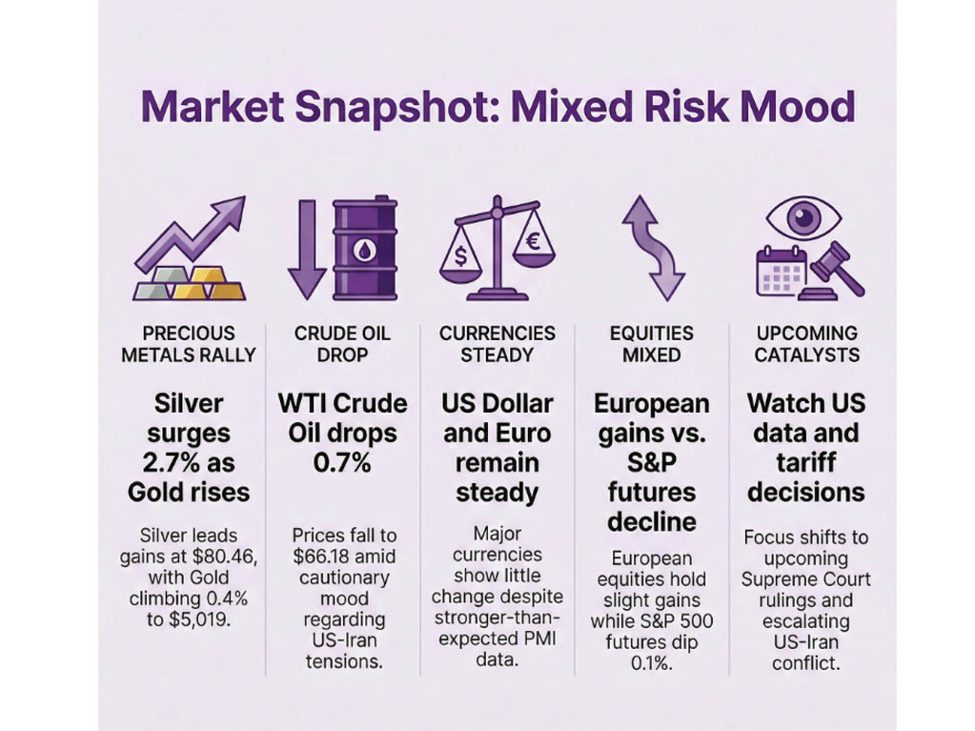
Headlines:USDJPY on track to revisit the intervention level as Japanese Yen lacks bullish catalystsSilver climbs back up to one-week highs but dip buyers still have work to doCrude Oil Breakout: What the Bull Flag Means for Oil Traders and UCO BuyersUS tariffs refund could top $175 billion if the Supreme Court rules against TrumpJapan prime minister Takaichi says will steadily restore fiscal sustainabilityGermany February flash manufacturing PMI 50.7 vs 49.5 expectedFrance February flash services PMI 49.6 vs 49.2 expectedEurozone February flash services PMI 51.8 vs 51.9 expectedUK February flash services PMI 53.9 vs 53.5 expectedUK January retail sales +1.8% vs +0.2% m/m expectedMarkets:US dollar steady across the boardGBP leads, NZD lags on the dayWTI crude oil down 0.7% to $66.18Gold up 0.4% to $5,019, silver up 2.7% to $80.46European equities hold slight gains, S&P 500 futures down 0.1%US 10-year yields down 0.8 bps to 4.067%Bitcoin up 0.8% to $67,417The market action in Europe today was a bit more mixed, with some key risk events still to watch before the weekend comes along.The major focus remains on US-Iran tensions, with traders and investors having to weigh up the risk of potential conflict ahead of the weekend break.That is keeping the overall risk mood on edge with a more mixed scene across broader markets. The dollar remains steady and is poised to wrap up a solid week of gains. EUR/USD is flattish around 1.1765 despite euro area PMI data beating on estimates. The most notable is German manufacturing perhaps turning the corner, posting its first growth in business activity in over three years.The UK also saw a similar PMI beat, allowing for GBP/USD to keep just marginally higher by 0.1% at 1.3475.Overall, the changes among major currencies are light with the dollar holding steadier mostly. USD/JPY is up 0.2% to 155.30 while AUD/USD is down 0.1% to 0.7050 on the day.In the equities space, it’s a mixed look with European indices posting slight gains on the session while US futures are down slightly. The DAX is seen up 0.2% with the CAC 40 up 0.8% on the day. Meanwhile, S&P 500 futures are down 0.1% currently amid some caution ahead of the Wall Street open.Looking to commodities, precious metals are staying underpinned in the second half of the week. Gold is up another 0.4% to $5,019 with silver up 2.7% to $80.46 on the day. However, there’s still much to be done in breaking free from the consolidative phase after the sharp retracement lower at the start of the month.As for the oil market, WTI crude is down slightly after touching its highest levels since August last year. We’re seeing price drop by 0.7% to $66.18 as traders are still weighing up US-Iran tensions ahead of the weekend.Coming up, we’ll have US PCE, GDP, and PMI data to work through alongside a potential Supreme Court decision on tariffs. Those will add to market anticipation of more US-Iran headlines in ending the week. This article was written by Justin Low at investinglive.com. 🔗 Source 💡 DMK Insight The USDJPY is gearing up to test intervention levels again, and here’s why that matters: With the Japanese Yen struggling for bullish momentum, traders should keep a close eye on the Bank of Japan’s potential responses. If the USDJPY approaches key intervention levels, it could trigger significant volatility, especially for those holding long positions in the Yen. The broader context of rising U.S. interest rates continues to weigh on the Yen, making it less attractive for investors. Meanwhile, silver’s bounce back to one-week highs indicates some dip-buying interest, but the lack of strong bullish catalysts suggests that traders need to be cautious about overcommitting. In the crude oil market, the bull flag pattern is a positive sign for UCO buyers, but they should monitor for breakout confirmation to avoid false signals. Overall, the interplay between these markets could lead to cascading effects, particularly if the USDJPY intervention occurs, which might also impact commodities like oil and precious metals. Watch for USDJPY approaching intervention levels around 150, as this could trigger market reactions. Also, keep an eye on silver’s ability to maintain its gains and crude oil’s breakout confirmation in the coming days. 📮 Takeaway Watch for USDJPY nearing intervention levels around 150, as this could spark volatility across related markets, especially commodities like oil and silver.
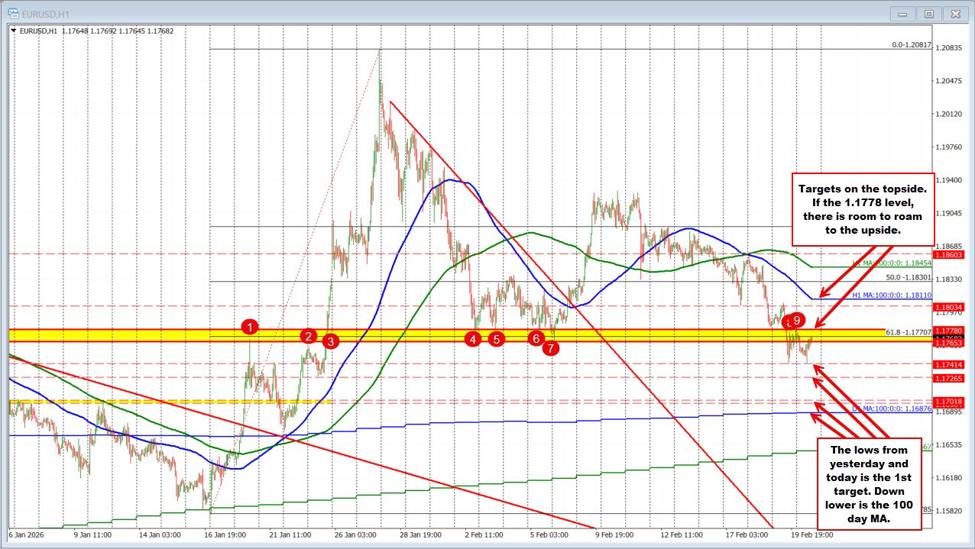
EURUSD Technicals: The EURUSD leans to the downside ahead of GDP
The EURUSD is keeping the bias lean to the downside ahead of the US GDP which will be released at 8:30 AM ET. The Q4 GDP is expected to show a rise of 3.0% with the following details:GDP Sales Advance 2.6% vs 4.5% priorDeflator 2.9%Core PCE price advances: 2.6%PCE Advanced 2.8%For the 3rd quarter:Personal Consumption (C): +2.34%Goods: +0.64%Services: +1.70 ppPrivate Investment (I): +0.03%Government Spending (G): +0.38%Net Trade (Exports − Imports): +1.66%Quick TakeConsumption was the primary growth engine in the quarter.Net exports were a large positive contributor (exports up / imports down).Government added modestly.Investment was essentially flat in terms of growth contribution.Also to be released at 8:30 will be:US personal income for December estimate 0.3% versus 0.3% last month.Personal consumption for December 0.4% versus 0.5% last month.PCE for December 0.3% vs 0.2% last monthPCE YoY 2.8% vs 2.8% last monthCore PCE 0.3% vs 0.2% last monthCore PCE YoY 2.8% vs 2.8% last monthThe EURUSD is trading modestly lower to start the US session as markets position ahead of the upcoming data release.From a technical perspective, the hourly chart shows that sellers were able to push the price below a key swing area between 1.1765 and 1.1778 yesterday — extending the downside move that began on Wednesday when the pair rotated lower from the 1.1860 area and moved away from its 100- and 200-hour moving averages. The decline reached a low of 1.1741 before buyers stepped in, prompting a corrective rebound that stalled at 1.17775 early in the Asian session.Selling pressure resumed through the Asian and into the early European session today, with the price dipping to 1.1744 — just three pips above yesterday’s low — before finding support once again. The pair has since bounced back into the prior swing zone, placing that 1.1765–1.1778 region back into focus heading into the US data.A move above this resistance area would shift short-term control back toward buyers and open the door for further upside momentum. Conversely, a break below the recent lows between 1.1741 and 1.1744 would reinforce the bearish bias, targeting 1.1726 next, followed by the 1.1700 level and the 100-day moving average at 1.1687. This article was written by Greg Michalowski at investinglive.com. 🔗 Source 💡 DMK Insight The EURUSD is poised for a potential drop as traders brace for the US GDP data release. With the Q4 GDP expected to rise by 3.0%, the market is likely pricing in a stronger economic outlook, which could bolster the dollar. The prior GDP sales advance of 4.5% and a deflator at 2.9% suggest inflationary pressures are still in play, impacting the Fed’s monetary policy stance. If the actual GDP figures come in lower than expected, we could see a rapid reversal in the EURUSD, especially if it breaks below recent support levels. Keep an eye on the 1.0500 mark; a breach could trigger further selling. On the flip side, if the GDP exceeds expectations, it might solidify the dollar’s strength, pushing EURUSD lower. Traders should monitor the PCE price index closely, as it could provide insights into future inflation trends. The immediate focus is on the GDP release at 8:30 AM ET—this could set the tone for the EURUSD in the coming hours and days. 📮 Takeaway Watch the 1.0500 support level in EURUSD closely; a break could signal further downside following the GDP release at 8:30 AM ET.
US Q4 advance GDP +1.4% vs +3.0% expected
Final Q3 GDP was +4.4%Consumer spending (PCE):+2.4%GDP final sales (excluding inventories) +1.2% vs +2.6% expectedGDP price index (GDP deflator): vs +2.9% expectedCore PCE (excluding food & energy): +2.7% vs +2.6% expectedBusiness investment (nonresidential fixed investment): 2025 annual GDP at about 2.23%Contributions to GDP in percentage points:Government -0.9 vs +0.38 priorNet exports +0.08 vs +1.62 priorInventories +0.21 vs -0.12 priorFixed investment +0.45 vs +0.15 priorServices +1.59 vs +1.7 priorGoods -0.01 vs +0.64 priorUSD/JPY was trading at 155.17 just before the release and 2-year yields were trading at 3.46%. The Fed funds futures market was pricing in 58 bps in easing through year end.From the release:The BEA estimates that this reduction in services provided by the federal government subtracted about 1.0 percentage point from real GDP growth in the fourth quarterOf course, economists knew there was a shutdown so that was at least somewhat factored in.Note the inflation numbers here but also note the December PCE report was released at the same time so we two readings on inflation.Trump was out just before this release saying that the government shutdown cost ‘at least’ 2 points in GDP. That was a hint he’d seen the number beforehand and that it wasn’t what he wanted. Yesterday, the Atlanta Fed GDPNow tracker fell to 3.0% after starting the week at 3.7%. The biggest part of the downgrade was yesterday’s trade balance number and I would suspect that most economists didn’t have that in their model. So in light of that and Trump’s comments, I see risks to the downside. Moreover, four major economic forecast firms — Morgan Stanley, Goldman Sachs, Wells Fargo and Barclays — all have had in the 1.5-1.7% range so maybe this wasn’t such a big surprise. This article was written by Adam Button at investinglive.com. 🔗 Source 💡 DMK Insight The final Q3 GDP growth of 4.4% is a double-edged sword for traders right now. While consumer spending is up 2.4%, the lower-than-expected GDP final sales growth of 1.2% suggests underlying weakness. This could lead to volatility in equities and the dollar as traders reassess the Fed’s interest rate trajectory. With core PCE at 2.7%, slightly above expectations, inflationary pressures remain a concern, potentially keeping the Fed hawkish. Watch for reactions in sectors sensitive to interest rates, like tech and real estate, as they could face headwinds if the Fed maintains a tighter policy stance. Additionally, the negative contribution from government spending (-0.9) could signal fiscal challenges ahead, impacting market sentiment. Here’s the thing: while the headline growth looks strong, the details reveal cracks that could lead to a market pullback. Keep an eye on the S&P 500; a break below recent support levels could trigger further selling pressure. Traders should monitor upcoming economic indicators closely, particularly any shifts in consumer sentiment or business investment trends, as these will be crucial in shaping market direction in the coming weeks. 📮 Takeaway Watch the S&P 500 for potential support breaks; a decline could signal broader market weakness as underlying economic indicators reveal cracks.

US December PCE inflation +2.9% vs +2.8% expected
Prior was +2.8% PCE M/M +0.4% vs +0.3% expectedPrior +0.2%Core PCE Y/Y +3.0% vs +2.9% expectedPrior +2.8%Core PCE M/M +0.4% vs +0.3% expectedPrior +0.2%Consumer spending and income for December:Personal income +0.3% vs +0.3% expectedPrior +0.3% (revised to +0.4%)Personal spending +0.4% vs +0.4% expected Prior +0.5% (revised to +0.4)Real personal spending +0.1% vs +0.3% priorThese are higher than expected numbers but not really surprising since Fed Chair Powell did mention they expected Core PCE for December to rise to 3.0%. Therefore, this report doesn’t change anything for the Fed. The market pricing is little changed after the economic data as traders continue to expect 58 bps of easing by year-end with the first rate cut coming in June at the earliest.I personally think the market is too sanguine on rate cuts given the improvement in the labour market data and inflation being closer to 3% than to the 2% target. WHAT IS THE PCE REPORT?The Personal Consumption Expenditures (PCE) report is a monthly economic release from the U.S. Bureau of Economic Analysis (BEA) that tracks how much consumers spend on goods and services. It serves as a primary pillar of the U.S. economy, as consumer spending accounts for approximately two-thirds of domestic economic activity.The report is most famous for its PCE Price Index, which the Federal Reserve considers its “gold standard” for measuring inflation. Unlike the more common Consumer Price Index (CPI), the PCE captures a broader scope of costs, including those paid on behalf of consumers (such as employer-provided healthcare). It also uses a “chain-type” formula that accounts for substitution behaviour, for example if beef prices skyrocket and shoppers switch to chicken, the PCE reflects that shift, whereas the CPI often lags in doing so.Investors and policymakers watch two versions: “Headline” PCE (or the deflator) and “Core” PCE, which excludes volatile food and energy prices to reveal long-term inflation trends. This article was written by Giuseppe Dellamotta at investinglive.com. 🔗 Source 💡 DMK Insight The latest PCE data shows inflation pressures are still present, and here’s why that matters: With core PCE coming in at 3.0%, slightly above expectations, traders should brace for potential volatility in both equities and forex markets. This could influence the Fed’s next moves, especially as they weigh interest rate hikes. If inflation remains stubborn, we might see a shift in sentiment, pushing traders to reassess their positions. Keep an eye on the S&P 500 and USD pairs, as they often react sharply to inflation data. The market’s current pricing suggests a cautious approach, but if inflation continues to exceed expectations, we could see a more aggressive stance from the Fed, impacting risk assets negatively. On the flip side, if consumer spending holds steady, it might provide a buffer against recession fears, which could stabilize markets temporarily. Watch for key levels in the S&P 500 around 4,000, as a break below could trigger further selling pressure. In forex, the USD’s strength will be tested against major pairs, particularly if inflation data leads to speculation about rate hikes. Traders should monitor upcoming economic indicators closely for further clues. 📮 Takeaway Watch the S&P 500 around 4,000 for potential breakdowns and monitor USD pairs for reactions to ongoing inflation data.

Canada retail sales for December -0.4% versus -0.5% expected
Prior 1.3% revised to 1.2%Retail sales ex auto – +0.1% versus 0.3% expected. Prior month revised to 1.6% from 1.7%Sales C$70.0bAdvance retail sale for January is expected at 1.5%Details:Retail sales fell -0.4% to $70.0B in December3 of 9 subsectors declined, led by motor vehicle & parts dealersCore retail sales (ex-gasoline & autos) decreased -0.3% in DecemberRetail sales volumes were unchanged in DecemberQ4 2025 retail sales rose +0.1%, marking the 7th straight quarterly increaseQ4 retail sales volumes fell -0.3%Full-year 2025 retail sales increased +4.0%, led by motor vehicle & parts dealersRetail sales volumes rose +2.3% in 2025Core retail sales fell -0.3% in December, after a +1.5% increase in NovemberBuilding material & garden equipment dealers sales declined -4.0% (after two consecutive monthly gains)Furniture, home furnishings, electronics & appliance retailers fell -1.7% (second straight monthly decline)Sporting goods, hobby, musical instrument, book & miscellaneous retailers rose +1.0% (largest core gain in December)Below is the breakdown of the winners and losers in graphical format. In other data of Canada PPI data for DecemberHeadline PPI 2.7% versus -0.9% last monthPPI YoY 5.4% vs4.3% last monthRaw Material Prices MOM 7.7% vs 0.3% last month Raw Material Prices YoY 8.0% vs 3.5% last monthDetails from the CanStatIndustrial Product Price Index (IPPI) – JanuaryIPPI rose +2.7% m/m (after -0.9% in December)Primary non-ferrous metals surged +18.2%, leading the monthly gainPrecious metals drove the move:Silver +40.7%Platinum group metals +25.3%Gold +9.9%Industrial metals also higher:Copper +10.3% (5th straight monthly increase)Nickel +19.5%Energy & petroleum products rose +1.7% (diesel +3.4%, gasoline +2.6%)Softwood lumber +3.7% on tight supply from winter conditions & mill closuresIPPI up +5.4% y/y (16th consecutive annual increase)Raw Materials Price Index (RMPI) – JanuaryRMPI rose +7.7% m/mMetal ores, concentrates & scrap +15.6% (9th straight monthly gain)Silver ores +41.8%Gold ores +9.5%Nickel ores +19.2%Copper ores +10.6%Crude energy products +4.6% (conventional +4.9%, synthetic +4.3%)RMPI up +8.0% y/y+25.7% y/y ex-crude energyAnnual gains led by:Gold, silver & platinum ores +109%Copper ores +35.4%Cattle & calves +13%Crude oil prices down y/y:Conventional -22.1%Synthetic -19.7%There were some eye-catching moves in the metals space in January, with gold, silver, and platinum all pushing to record highs as global geopolitical uncertainty fueled safe-haven demand. Since then, gold has pulled back from its January peak near $5598, trading currently around $5026, but notably remains well above the recent corrective low of $4402. At the same time, China’s implementation of silver export restrictions on January 1 has added another layer of support to the broader precious metals complex.Turning to USDCAD, the pair continues to trade within a defined range. On the topside, price action has remained capped below the 50% midpoint of the move down from the 2026 high at 1.37045. Buyers made an attempt to break above that level yesterday, but the move ultimately stalled. On the downside, the rising 100-hour moving average at 1.36654 is acting as near-term support. A sustained move below this level would be needed to strengthen the bearish bias.For now, the pair remains caught in a tug-of-war between resistance at the midpoint and support at the rising 100-hour MA — with the next directional push likely to be determined by which side gives way first. This article was written by Greg Michalowski at investinglive.com. 🔗 Source 💡 DMK Insight Retail sales data just came in weaker than expected, and here’s why that matters for traders: The December retail sales drop of 0.4% signals potential consumer weakness, which could impact economic growth forecasts. With SOL currently at $85.16, traders should be cautious as this data might lead to a risk-off sentiment across markets. If consumer spending continues to decline, it could trigger broader sell-offs in risk assets, including cryptocurrencies. Watch for SOL to hold above key support levels around $80; a break below could signal further downside. Additionally, the upcoming advance retail sales for January, expected at 1.5%, will be crucial. If that figure disappoints, it could exacerbate bearish sentiment. On the flip side, if SOL manages to maintain its position and the January data surprises positively, it could lead to a short-term rally. Keep an eye on market reactions to these economic indicators, as they could influence trading strategies significantly over the next few weeks. 📮 Takeaway Monitor SOL’s support at $80 closely; a break below could trigger further declines, especially if January retail sales disappoint.

US stocks mixed in early trading
The major US indices are opening mixed with the Dow industrial average down -0.37%. The S&P index trading above and below unchanged, and the NASDAQ index up around 0.20%.As a reminder The U.S. Supreme Court is expected to release opinions this morning, with announcements typically issued at 10:00 a.m. Eastern Time on scheduled opinion days. While there is no guarantee that the tariff decision will be included in today’s releases, markets will be closely watching that 10:00 a.m. ET window as the most likely time for any ruling if it is delivered today. If the decision is not issued, additional opinion release days are scheduled for next week.If the Supreme Court delivers a decision on tariffs, the implications could be meaningful across trade policy, inflation expectations.From a macro standpoint, a ruling that upholds the administration’s tariff authority would reinforce the use of tariffs as an active policy tool. That could:Support domestic pricing power, especially in protected industriesAdd to inflationary pressures at the margin via higher import costsComplicate the Fed’s disinflation path, potentially keeping rate-cut expectations pushed outLift U.S. yields, which tends to be USD-supportiveIn contrast, a ruling that limits or strikes down tariff authority would likely be viewed as:Disinflationary over time, by reducing trade frictions and input costsGrowth-positive globally, improving trade flows and supply chainsPotentially USD-negative, as it could ease inflation risks and lower the need for restrictive monetary policyFrom a market perspective, the decision could introduce:Sector-level volatility (industrials, autos, metals, agriculture)Equity rotation depending on tariff exposureCommodity price reactions, especially in metals and energyFX sensitivity, with trade-linked currencies (like CAD and MXN) reacting to changes in cross-border trade outlooks This article was written by Greg Michalowski at investinglive.com. 🔗 Source 💡 DMK Insight Mixed openings in major US indices signal uncertainty ahead of the Supreme Court’s decisions today. With the Dow down 0.37% and the NASDAQ up 0.20%, traders are clearly reacting to the broader market sentiment. The Supreme Court’s announcements at 10:00 a.m. Eastern could shift market dynamics significantly, especially if they touch on economic policies or regulations affecting key sectors. Keep an eye on how sectors like tech and finance respond, as they often lead the charge in market sentiment. If the S&P index continues to trade around the unchanged mark, it suggests indecision among investors, which could lead to increased volatility. On the flip side, if the Supreme Court’s decisions are favorable for businesses, we might see a quick rebound, particularly in the Dow. Watch for key resistance levels in the NASDAQ; a sustained move above recent highs could indicate bullish momentum. Conversely, if the news is negative, it could trigger a sell-off, especially in the Dow. Traders should monitor the immediate market reaction post-announcement for potential trading opportunities. 📮 Takeaway Watch the Supreme Court’s announcements at 10:00 a.m. Eastern; they could trigger significant volatility in the indices, especially in tech and financial sectors.
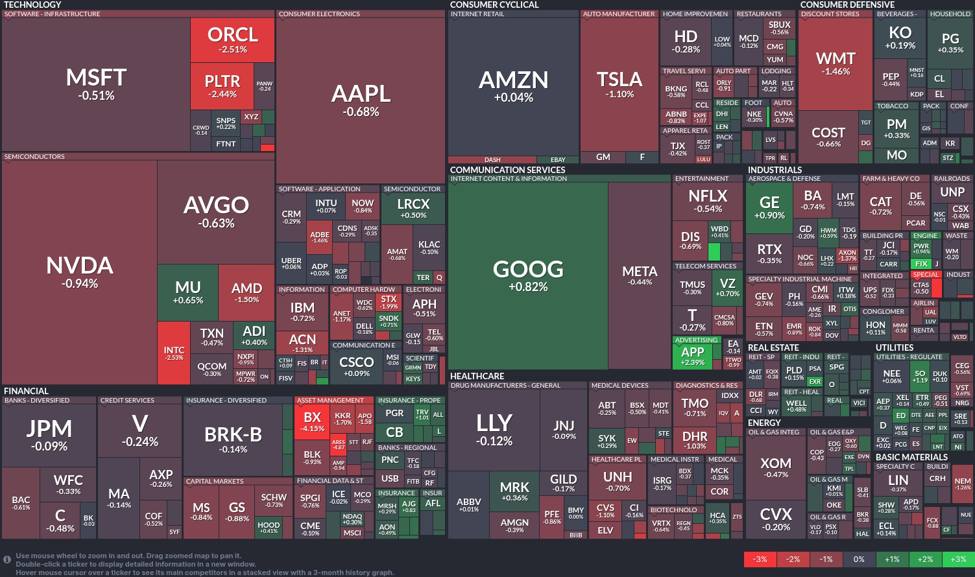
Tech struggles as communication services edge up: A mixed market day
Tech struggles as communication services edge up: A mixed market dayToday’s US stock market presents a dynamic landscape with tech giants faltering while the communication services sector displays resilience. Here’s a thorough breakdown of sector performances, significant movers, and the overall market mood shaping the day.📉 Technology Sector: Pulling BackSoftware and Semiconductors: The technology sector is showing signs of strain, with key players like Oracle (ORCL) dropping 2.51% and Nvidia (NVDA) sliding by 0.94%. Tech stalwarts such as AMD and Intel (INTC) are down by 1.50% and 2.53%, respectively, suggesting a broad sector retreat. Consumer Electronics: Major player Apple (AAPL) sees a decline of 0.68%, reflecting potential market concerns and profit-taking. 🚀 Communication Services: OutperformingInternet Content: A bright spot today, the communication services sector has shown positive momentum. Google (GOOG) is up by 0.82%, and Netflix (NFLX), while slightly negative at -0.54%, shows resilience amidst mixed sector signals. 🏛️ Other Sectors: Mixed SignalsConsumer Cyclical:Amazon (AMZN) shows a marginal increase of 0.04%, hinting at stability, whereas Tesla (TSLA) incurs a loss of 1.10%, indicating investor apprehension. Financials: The financial sector is experiencing varied outcomes. While JPMorgan Chase (JPM) remains relatively stable with a slight decline of 0.09%, companies like Bank of America (BAC) dip 0.61%. 📚 Overall Market AnalysisThe market today displays a patchwork of performances, with tech under pressure and communication services maintaining a defensive stance. Continued declines in leading tech names may raise caution, while growth in communication services might suggest a shift in investor interests. Investors should remain vigilant, exploring diversification opportunities across sectors, with an eye on communication services and selected consumer cyclicals for potential gains. As always, stay updated with real-time data to navigate this volatile environment. Visit InvestingLive.com for further insights and analyses to fortify your investment strategy. This article was written by Itai Levitan at investinglive.com. 🔗 Source 💡 DMK Insight Tech stocks are stumbling while communication services show surprising strength—here’s what that means for traders right now. The tech sector’s pullback could signal a broader market correction, especially if major players continue to falter. This shift might prompt day traders to reassess their positions in tech stocks, particularly those that have been overextended. Meanwhile, the resilience in communication services suggests a potential rotation into more defensive plays. Traders should keep an eye on key support levels in tech stocks; if they break, it could trigger further selling pressure. The divergence between these sectors highlights the importance of sector rotation strategies, as capital flows could shift rapidly. But don’t overlook the potential for a rebound in tech if earnings reports or macroeconomic indicators surprise positively. Watch for any news that could catalyze a reversal, and keep an eye on correlated assets like ETFs that track these sectors. The upcoming earnings season could be a pivotal moment, so be prepared for volatility as traders react to the latest data. 📮 Takeaway Monitor key support levels in tech stocks and watch for sector rotation into communication services as earnings season approaches.

Manufacturing PMI for February 51.2 vs 52.6 estimate
Manufacturing flash index 51.2 versus 52.6. Prior month 52.4Services PMI flash for February 52.3 versus 53.0 estimate. Prior 52.7.Composite 52.3 versus 53.0 last monthThe good news is that each of the a indices were above the 50.0 level indicating growth. The bad news is that each of the estimates were below the prior month and below estimates.Ahead, the University of Michigan sentiment indices for February will be released at the top of the hour with the sentiment expected at 57.3 unchanged from the preliminary. The current conditions is expected at 57.7 versus 58.3, and the expectations came in at 56.6 .The 1 year inflation came in at 3.5% last month with the 5 year inflation at 3.4%. The Supreme Court decision on tariffs may be released at 10 AM ET.US stocks are mixed ahead of the date with the S&P and the Nasdaq trading above and below unchanged. The US yields are also little changed:2 year yield 3.478%, +0.8 basis points10 year yield 4.076%, +0.2 basis points30 year yield 4.706% current +0.3 basis point Crude oil is down -0.23% after the sharp 4.36% rise yesterday. This article was written by Greg Michalowski at investinglive.com. 🔗 Source 💡 DMK Insight The recent manufacturing and services PMI data shows growth, but misses expectations, and here’s why that matters: With the manufacturing flash index at 51.2 and services PMI at 52.3, both indicators remain above the crucial 50.0 mark, signaling expansion. However, the underperformance against expectations could indicate a slowdown in momentum. For traders, this divergence suggests a cautious approach, especially for those in sectors sensitive to economic cycles. Watch for potential volatility in related assets like industrials and consumer discretionary stocks, which often react to such economic indicators. If the trend continues, we might see shifts in monetary policy expectations, impacting forex pairs like USD/EUR. Here’s the flip side: while the data is disappointing, it still reflects growth, which could keep the Fed on track with its current policy. Traders should monitor the upcoming economic releases closely, particularly any revisions to these figures or new data that could confirm or contradict this trend. Key levels to watch are the 50.0 threshold for growth and any significant moves in the USD as traders react to these indicators. 📮 Takeaway Keep an eye on upcoming economic data releases; a sustained trend below expectations could signal a shift in market sentiment and impact USD pairs.

University of Michigan sentiment index 56.6 versus 57.3 estimate
University of Michigan sentiment index for February final: Sentiment 56.6 versus 57.3current conditions 56.6 versus 57.7expectations 56.6 versus 56 6 preliminary 5 year inflation 3.3% versus 3.4% preliminary 1 year inflation 3.4% versus 3.5% preliminaryFrom Consumer Director Joanne HsuConsumer sentiment stagnated this month with very little change, just 0.2 index points higher than January. All index components posted insignificant movements this month; overall, consumers do not perceive any material differences in the economy from last month. About 46% of consumers spontaneously mentioned high prices eroding their personal finances; readings have exceeded 40% for seven months in a row. Sentiment is about 13% below a year ago and 21% below January 2025. That said, views vary considerably across the population. A sizable month-to-month increase in sentiment for the largest stockholders was fully offset by a decline among consumers without stock holdings. Similar divergences were seen across income and education, where higher-income or college educated consumers exhibited increases in sentiment while lower-income or less-educated counterparts did not. With their much stronger income prospects and investment porfolios, wealthier and higher-income consumers feel better insulated from any possible risks to the economy.Year-ahead inflation expectations fell from 4.0% last month to 3.4% this month, the lowest reading since January 2025. This month’s reading still exceeds those seen in 2024 and remains well above the 2.3-3.0% range seen in the two years pre-pandemic. Long-run inflation expectations held steady at 3.3%, just above the 2.8% and 3.2% range seen in 2024. In 2019 and 2020, long-run inflation expectations were consistently below 2.8%. Uncertainty, as measured by the middle 50% of expectations, is now its lowest since December 2024 for the short run and October 2024 for the long run. This article was written by Greg Michalowski at investinglive.com. 🔗 Source 💡 DMK Insight Consumer sentiment is flat, and here’s why it matters: stagnant sentiment can signal a slowdown in spending. The University of Michigan’s sentiment index for February shows no significant change, with a reading of 56.6, which is below expectations. This stagnation suggests that consumers are feeling uncertain about the economy, potentially leading to reduced spending. With current conditions also at 56.6, it indicates that consumers aren’t optimistic about their financial situations. Inflation expectations are slightly down, with the five-year inflation forecast at 3.3% and the one-year at 3.4%, but these numbers still reflect persistent inflation concerns. For traders, this could impact sectors sensitive to consumer spending, like retail and discretionary stocks. Watch for any shifts in these sectors, especially if sentiment continues to decline. On the flip side, if sentiment unexpectedly improves in the coming months, it could lead to a rebound in consumer stocks. Keep an eye on the sentiment index in March; a significant move above 57 could indicate a shift in consumer behavior. For now, monitor related assets like retail ETFs for any volatility as traders react to these sentiment readings. 📮 Takeaway Watch the March sentiment index closely; a rise above 57 could signal a shift in consumer behavior and impact retail stocks significantly.