
 Bitcoin
  Ethereum
  Tether
  BNB
BNB  XRP
XRP  USDC
USDC  Solana
  TRON
TRON  Lido Staked Ether
  Figure Heloc
Summary:Westpac says January’s jobs data show a stable unemployment rate at 4.1%, but participation declines are doing most of the work. Underlying hiring remains subdued, and a rebound in participation could lift unemployment back toward 4.5% in coming months.—Westpac says Australia’s January labour force report paints a steadier picture than the volatility of late 2025 suggests, but cautions that the apparent firmness in the unemployment rate is being driven more by falling participation than by renewed hiring momentum.Employment rose by 17,800 in January, broadly in line with market expectations for a 20,000 gain but below Westpac’s forecast of 40,000. The outcome follows choppy readings in recent months, including a 30,300 decline in November and a 68,500 rebound in December. Average hours worked increased 0.6% over the month, partly reflecting fewer people taking leave than is typical for January.The unemployment rate held at 4.1%, marking a break from the gradual uptrend seen through most of 2025, when joblessness rose from a quarterly average of 4.0% in late 2024 to 4.3% by September 2025. By December it had eased to 4.2%, and January’s print suggests it is tracking closer to a 4.1% average.However, Westpac argues the stability in unemployment masks soft underlying demand. On a three-month average basis, annual employment growth remains at 1.1%, well below the long-run average of 1.9%.The key driver of the lower unemployment rate has been a decline in labour force participation, which has fallen 0.6 percentage points over the past year. Growth in the labour force has been weaker than employment, effectively compressing the unemployment rate. Westpac estimates that had participation held steady over the past six months, the unemployment rate would be closer to 4.5%.The bank attributes much of the participation weakness to cyclical forces, including easing cost-of-living pressures reducing the urgency for marginal workers to seek employment. While this dynamic could reverse if inflation and interest rates rise, Westpac’s base case is for participation to lift over the year ahead — which would, in turn, push unemployment higher.For the Reserve Bank of Australia, the data complicates the outlook. While policymakers remain alert to inflation persistence and continue to characterise the labour market as tight, Westpac is hesitant to describe recent developments as a “re-tightening,” particularly given benign wages data. A participation-driven drop in unemployment, it argues, carries a very different inflation signal than one driven by accelerating hiring.This screenshot shows the dates of Reserve Bank of Australia policy meetings in 2026. This article was written by Eamonn Sheridan at investinglive.com. 🔗 Source 💡 DMK Insight Australia’s unemployment rate holding at 4.1% might seem stable, but here’s the catch: declining participation rates are masking underlying weakness. For traders, this could signal a potential shift in economic sentiment. If participation rebounds as Westpac suggests, we could see unemployment creep back up to 4.5%, which might impact consumer spending and overall economic growth. This is crucial for forex traders focusing on AUD pairs, as a weaker labor market could lead to a dovish stance from the Reserve Bank of Australia. Keep an eye on the upcoming employment data releases; any signs of increased participation could lead to volatility in the AUD. Conversely, if participation continues to decline, it could signal deeper economic issues, prompting traders to reassess their positions in AUD/USD and related assets. Watch for key levels around 0.6500 for AUD/USD, as a break below could indicate further bearish sentiment in the currency market. 📮 Takeaway Monitor Australia’s upcoming employment data closely; a rebound in participation could push unemployment to 4.5%, impacting AUD pairs significantly.

Lagarde signals intent to finish ECB term, amid politically sensitive succession chatter.
Lagarde told The Wall Street Journal she expects to complete her term as ECB president through October 2027, dampening speculation of an early departure that could allow France to influence the succession before its 2027 election.Summary:Christine Lagarde told The Wall Street Journal (gated) she expects to serve as ECB president until October 2027.Speculation has swirled that she could step down early.An early exit would give French President Emmanuel Macron influence over her successor before the April 2027 election.Lagarde declined to comment directly on an FT report of a possible early resignation.Two ECB executive board seats (Philip Lane, Isabel Schnabel) are due to open next year.Political sensitivities rising as France approaches a potentially pivotal election.European Central Bank President Christine Lagarde said her “baseline” expectation is to complete her term through October 2027, pushing back against renewed speculation that she could step down early.In an interview with The Wall Street Journal, Lagarde said she believes consolidating the ECB’s achievements in recent years will require her full term. “When I look back at all these years, I think that we have accomplished a lot,” she said, adding that the focus now is ensuring those gains are “solid and reliable.”Lagarde described her mission as safeguarding price and financial stability while protecting the euro and ensuring it remains “solid and strong and fit for the future of Europe.”The comments come amid market chatter that she could resign before her mandate ends, potentially allowing French President Emmanuel Macron to shape the succession process ahead of France’s April 2027 presidential election. While all 27 EU leaders formally appoint the ECB president, major economies such as France and Germany traditionally play an influential role in the negotiations, often alongside broader political trade-offs across EU institutions.Lagarde declined to comment directly on a Financial Times report suggesting she might step down early. The European Central Bank later said she had not made a decision regarding the end of her term, stopping short of explicitly denying the report.Political sensitivities are heightened given the possibility that France’s next election could shift power toward the far-right National Rally party, led by figures including Jordan Bardella. An early appointment of a successor could be seen as an effort to secure institutional continuity ahead of potential political upheaval, a move critics argue risks fuelling accusations of democratic manoeuvring.The succession debate is further complicated by upcoming vacancies on the ECB’s executive board, with the terms of Chief Economist Philip Lane and Isabel Schnabel set to expire next year.Lagarde has previously dismissed speculation about an early exit, including reports she might seek the top role at the World Economic Forum. On Thursday she said the WEF was “one of the many options” she might consider after leaving the ECB.Asked whether speculation about her tenure could undermine perceptions of ECB independence, Lagarde said the institution remains “very respected and credible,” expressing hope she has contributed to that standing. This article was written by Eamonn Sheridan at investinglive.com. 🔗 Source 💡 DMK Insight Lagarde’s commitment to her ECB term until 2027 is a game-changer for euro traders. By quelling rumors of her early exit, she stabilizes the eurozone’s leadership narrative, which is crucial as the ECB navigates inflation and interest rate decisions. This clarity could bolster the euro against the dollar, especially if the Fed continues its hawkish stance. Traders should keep an eye on the EUR/USD pair, particularly if it approaches key resistance levels. If the euro strengthens, it could impact related markets, like European equities and commodities priced in euros. On the flip side, any unexpected shifts in ECB policy or economic data could lead to volatility, so watch for upcoming inflation reports and central bank communications. In the coming weeks, focus on the 1.10 level for EUR/USD as a pivotal point; a break above could signal further gains, while a drop below might trigger selling pressure. 📮 Takeaway Watch the EUR/USD pair closely around the 1.10 level; Lagarde’s term stability could strengthen the euro if inflation data supports the ECB’s position.
investingLive Asia-Pacific FX news wrap: AUD and NZD down, INR up
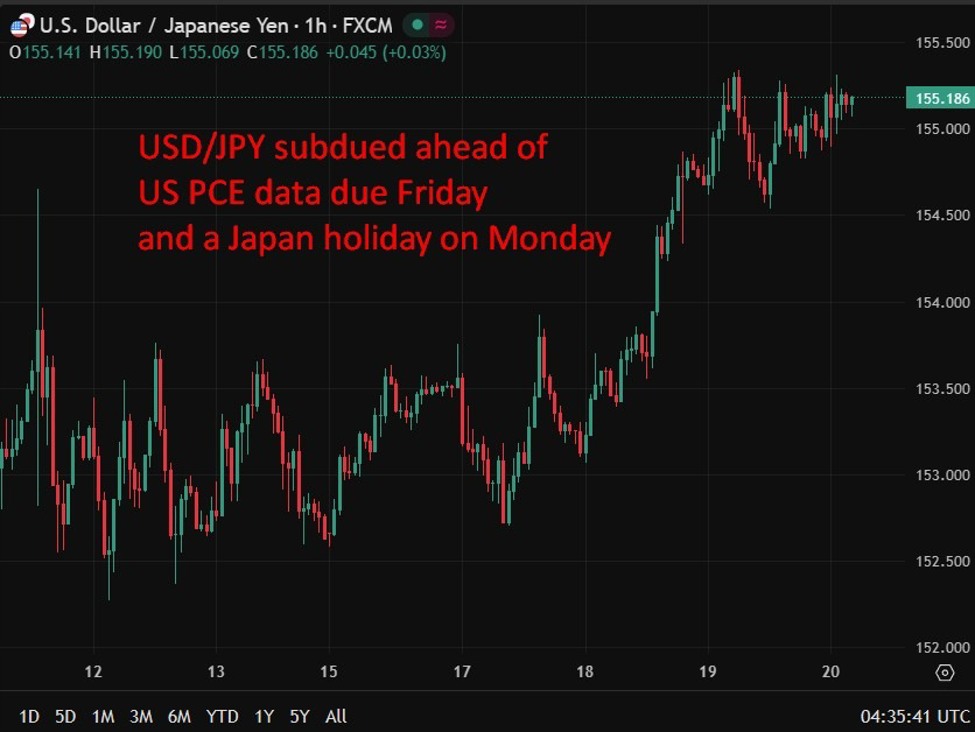
Lagarde signals intent to finish ECB term, amid politically sensitive succession chatter.Westpac warns Australia’s unemployment rate masks soft demand and falling participationFX INTERVENTION: Reports the Reserve Bank of India is selling USD/INR to support the rupeeGoldman: Gold to grind higher to $5,400/oz by end-2026 on strong demandNZD, AUD fall as RBNZ says inflation returning to target, no preset pathEl-Erian flags private credit ‘canary in the coal mine’ as fund freezes redemptionsUSD gains on strong US data unlikely to last; policy uncertainty, political risks to capSupreme Court tariff ruling nears; JPM maps S&P 500 swings across four scenariosJapan flash PMIs rise in February; composite hits 53.8, exports surgeJapan inflation slows to 1.5% in January, core measures ease. What will the BoJ think?Japan January 2026 Core CPI 2.0%, slowest since Jan 2024 (vs. 2.0% expected & 2.4% prior)Iran warns of decisive response if attacked as Trump weighs strike optionFed’s Daly says policy ‘in a good place’ as inflation cools & AI productivity impact loomsAustralia flash PMIs cool in February: composite 52.0 vs 55.7 as price pressures intensifyNew Zealand January 2026 trade data, exports and imports not as large as in DecemberTrump considers limited strike on Iran to force nuclear deal, Wall Street Journal reportsinvestingLive Americas market news wrap: Rising US trade deficit dims GDP forecastAt a glance:Fed’s Daly: Policy “in a good place” after 75bps of cuts; tone steady-to-mildly dovish.RBNZ: Inflation seen back inside target in Q1; no “trigger happy” hikes; NZD and AUD softer.ECB’s Lagarde (WSJ): Baseline is to complete term through 2027; declined to address FT exit report.RBI: Traders say central bank likely sold USD/INR to defend the 91 level pre-open.Japan CPI: Headline 1.5% y/y (2.1% prior), lowest since Mar 2022; core 2.0% (2.4% prior), lowest since Jan 2024.Japan PMIs: February flash composite strongest since May 2023.USD/JPY: Rangebound; Japan long weekend ahead (markets closed Monday).Plenty of central bank commentary today!San Francisco Fed President Mary Daly said monetary policy is “in a good place” following last year’s cumulative 75 basis points of rate cuts. Daly argued the labour market has stabilised and inflation should resume its downward path as tariff effects fade. The tone was steady-to-mildly dovish, reinforcing the view that the Fed is comfortable with current settings and not under pressure to move quickly in either direction.From New Zealand, RBNZ Governor Anna Breman said the path back to 2% inflation has been “bumpy,” but added inflation is expected to already be back within the target range in the first quarter of this year. She reiterated confidence that inflation will return to the 2% midpoint over the next 12 months. Chief Economist Paul Conway reinforced that policy is not on a preset path and that the Bank “won’t be trigger happy” with rate hikes. The tone weighed on the New Zealand dollar, with the Australian dollar slipping alongside.In Europe, ECB President Christine Lagarde, in an interview with the Wall Street Journal, said her baseline is to complete her term through October 2027. She declined to comment directly on a Financial Times report suggesting she could step down early.Staying with central banks, traders said the Reserve Bank of India likely sold USD/INR before the local spot open to prevent a cleaner break above the 91-per-dollar level.On the data front, Japan’s January CPI showed a marked cooling in inflation. Headline CPI rose 1.5% y/y (2.1% prior, 1.6% expected), the lowest since March 2022 and ending a 45-month run above the Bank of Japan’s 2% target. Core CPI (ex fresh food) slowed to 2.0% (2.4% prior), its lowest since January 2024. The core-core measure (ex fresh food and energy) eased to 2.6% from 2.9%.That softer inflation print was followed by solidly improving February flash PMIs, with the composite index posting its strongest growth since May 2023.USD/JPY remained rangebound through the session, with traders keenly awaiting the upcoming long weekend in Japan. Markets are closed on Monday. US PCE tonight also keenly awaited, of course 😉 .As a ps., China is back next week after being away on holiday this week. Asian markets should get back to normal! This article was written by Eamonn Sheridan at investinglive.com. 🔗 Source 💡 DMK Insight Lagarde’s commitment to her ECB term could stabilize the euro, but geopolitical tensions loom large. With the Reserve Bank of India’s intervention in the USD/INR, traders should be on alert for volatility in emerging market currencies. The RBA’s warning about Australia’s unemployment rate hints at underlying economic weakness, which could further pressure the AUD and NZD. If the ECB maintains its current course, expect the euro to react positively, especially if inflation data supports their stance. Watch for key levels around 1.05 for EUR/USD; a break could signal a stronger euro. Gold’s projected rise to $5,400/oz by 2026 reflects a long-term bullish sentiment, but short-term fluctuations could create trading opportunities. Keep an eye on gold’s performance against the backdrop of rising interest rates and geopolitical tensions, as these factors could lead to sudden shifts in demand. 📮 Takeaway Monitor EUR/USD around 1.05 for potential breakout opportunities, and stay alert for volatility in AUD/NZD due to economic signals from Australia.
It turns out not everyone has a bearish view on the Japanese yen
For months on end, it has been hard to ignore the political side of things when viewing the Japanese yen outlook. The snap election results earlier this month continued to put the focus on that, with intervention risks as high as ever at the moment. The general feeling is that the yen is ready to snap at any moment. And that will trigger Tokyo officials to step into the market.At least for now, USD/JPY continues to hover closer to the 155 level. That feels like the generally accepted ceiling threshold for Japan’s ministry of finance, with there being a lack of verbal warnings as of late. But a further climb from here towards 160, and we are likely to see Tokyo officials come out to reprimand markets. Or perhaps even skip all that and go with actual intervention, since we’ve already gone through with ‘rate checks’ previously.Considering all that, many analysts are still holding a more bearish view on the yen as such. The latest commentary from ANZ, Goldman Sachs, and BofA all point to a softer currency amid the ongoing macro picture. However, RBC is one to take on a more contrarian view in all of this. The firm argues that:”We maintain a bullish view on the JPY over the next few months. We highlight a JGB shift that would destabilise fixed income and USD/JPY flows. We believe we are now in the early innings of such a rotation – in both rates and FX.There are four parts to the Japanese rotation trade – incentives, breakevens, asset holdings, and expected flows. Two factors will determine the foreign JGB demand – duration equivalence and FX carry. Interest is rising. As the breakeven between the US and Japan falls in duration, significantly larger notional amounts will be applied to this trade – raising the FX impact. All point to a preferred habitat shift in rates – and a stronger yen. This is a long-cycle theme. We maintain USD/JPY for 147 end-26 and 135 end-2027.”The standout in their note is that there is no mention of intervention or fiscal/political risks at all, which are the two key drivers of trading sentiment as of late. So, it definitely is an interesting perspective to say the least. I can see their argument point but it’s hard to just focus solely on rates alone when there are also other key factors driving the broader market mood.I can imagine this being a good starting position in viewing the Japanese yen in the absence of other key drivers, or perhaps when markets adjust to stop punishing the currency. But in the short-term or until the next BOJ rate hike, it might be difficult to imagine that. This article was written by Justin Low at investinglive.com. 🔗 Source 💡 DMK Insight Political instability in Japan is shaking up the yen, and here’s why traders need to pay attention: The recent snap election results have heightened intervention risks, which could lead to significant volatility in the yen. With the Bank of Japan’s (BoJ) stance on monetary policy still uncertain, traders should be on alert for any signs of intervention that could impact USD/JPY trading. If the yen weakens further, it might trigger a response from the BoJ, making it crucial to monitor key levels around 150 for USD/JPY. A breach above this level could signal a more aggressive intervention, while a pullback could indicate a temporary stabilization. But here’s the flip side: if the yen strengthens unexpectedly, perhaps due to a shift in political sentiment or economic data, it could catch many traders off guard. Keeping an eye on upcoming economic indicators from Japan will be essential to gauge potential shifts in market sentiment. Watch for the next BoJ meeting and any statements regarding their intervention strategy, as these could provide critical insights into the yen’s trajectory in the coming weeks. 📮 Takeaway Monitor USD/JPY closely, especially around the 150 level, for potential intervention signals from the BoJ in response to political developments.

Japan prime minister Takaichi says will steadily restore fiscal sustainability
Will not pursue reckless fiscal policy that undermines market confidenceTo push bold investment through multi-year budgets and long-term fundsThe necessary spending will be funded through the initial budget as much as possibleWill steadily lower the debt-to-GDP ratio and restore fiscal sustainabilityTo maintain market trust and clarify concrete fiscal indicatorsWill ensure policy discipline is defined as one that is responsible and proactiveWell, all I can say is that actions speak louder than words. As a reminder, Takaichi’s policies are a mirror to Abenomics – which was designed to tackle deflation. And right now, Japan is squaring off against inflation pressures instead. Piling on debt to an already inflationary economy will force Japan’s debt to be far more burdening when rates move higher.And the other major point is that the math just doesn’t add up at the moment. This was a point already argued earlier this month here: Japan PM Takaichi says won’t resort to debt issuance to fund food sales tax suspensionAs mentioned then:”Even if Takaichi hides behind a tax surplus to fund this suspension of the food sales tax (instead of using it to pay down debt), it is effectively what one can describe as “shadow borrowing” as you are choosing to keep debt at a higher level than it would be. Essentially, this is also part of the Takaichi trade amid concerns that Japan’s national debt will explode higher.”So despite her calming words and her attempts to soothe markets, you can’t blame investors and traders for not buying into the gamble just yet. Essentially, Takaichi is trying to convince the naysayers that she can spend her way out this debt problem. However, history is not really on her side as this sort of solution has never worked out well for highly indebted economies in the past. This article was written by Justin Low at investinglive.com. 🔗 Source 💡 DMK Insight So, the government’s commitment to fiscal sustainability is a big deal for traders right now. By promising to lower the debt-to-GDP ratio and avoid reckless spending, they’re aiming to boost market confidence, which could stabilize currencies and influence interest rates. This is crucial for forex traders, especially those dealing with pairs sensitive to economic indicators like USD/EUR or GBP/USD. If the government sticks to its plan, we might see a stronger dollar as investors flock to perceived safety, impacting commodities and crypto markets as well. But here’s the flip side: if the spending cuts are too aggressive, it could stifle growth and lead to a recession, which would send markets into a tailspin. Keep an eye on upcoming fiscal reports and any shifts in monetary policy from the Fed. Watch for key levels in the dollar index; a break above recent highs could signal a stronger dollar trend. In short, monitor fiscal updates closely and be ready for volatility in related markets. 📮 Takeaway Watch for fiscal updates and dollar index levels; a stronger dollar could impact forex and crypto markets significantly.
Crude Oil Breakout: What the Bull Flag Means for Oil Traders and UCO Buyers
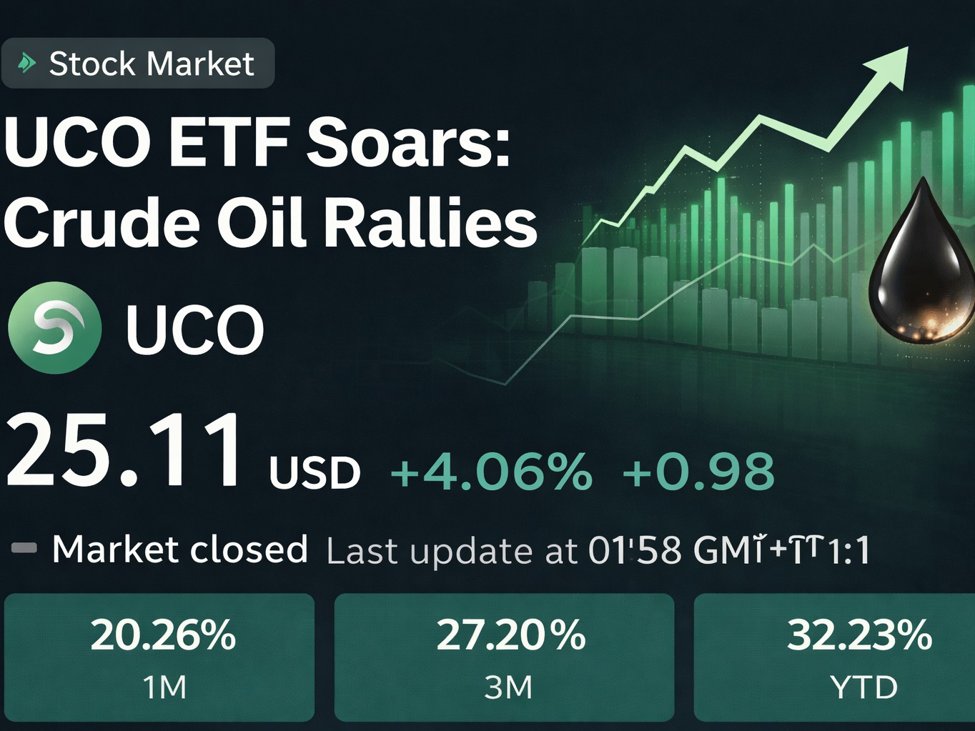
Key Points for crude oil traders and investors:Crude oil futures have broken out of a classic daily bull flag pattern.The $65 area on crude is now a key line that separates strength from failure.UCO is forming higher lows near $25, showing buyers are stepping in on dips.As long as support holds, the short term bias remains constructive.Energy has quietly started to attract attention again. While parts of the growth trade are cooling off, I’ve noticed steady rotation into oil. The daily chart of Crude Oil futures (CL1!) now reflects that shift with a clean technical breakout that beginners can understand.Let’s break it down in simple terms.Commodity markets are experiencing heightened volatility driven by escalating Middle East tensions and shifting supply dynamics. Geopolitical risks have taken center stage following reports that President Trump is considering an initial, limited military strike on Iran to pressure Tehran into halting uranium enrichment and accepting a new nuclear deal. In response, Iran warned the UN of a “decisive response” against all bases and assets of any hostile force if subjected to military aggression, significantly elevating the threat of a broader regional conflict. These mounting war fears triggered an immediate reaction in the energy sector, pushing WTI crude oil to break out and settle at its highest level since August.This bullish momentum in the oil market was further solidified by an unexpected supply crunch, as the latest EIA report revealed a massive crude oil inventory draw of over 9 million barrels, drastically defying expectations of a 2.1 million barrel build. Amidst this geopolitical uncertainty and a shifting macroeconomic backdrop, safe-haven assets are also commanding long-term confidence. Highlighting the structural bid for precious metals, Goldman Sachs expects gold to steadily grind higher to $5,400 per ounce by the end of 2026, a forecast driven by persistent central bank purchases and a cyclical pickup in private investor demand tied to the Federal Reserve’s rate easing cycleThe Big Picture in Crude Oil Technical Analysis: Crude Oil’s Daily Bull FlagOn the daily chart, crude oil first made a strong rally. After that move, price didn’t collapse. Instead, it drifted lower inside a controlled downward channel. That type of pause after a rally is called a bull flag.Why does that matter for oil traders?Because bull flags often act as continuation patterns. It means the market is resting, not reversing.Here is what happened step by step:The Breakout: Buyers pushed price above the top of the downward channel. That was the first signal momentum was shifting.The Retest: Price then pulled back to test that breakout area. Instead of falling apart, it held. That’s important. Former resistance acting as support is a healthy technical sign.Right now, the key level on crude futures sits just above $65.If crude continues to close daily above $65, the breakout structure remains valid.If price closes back below $65, the move risks turning into a failed breakout.That’s the simple framework.What UCO Is Showing Beneath the SurfaceFor traders who use ETFs instead of futures, the ProShares Ultra Bloomberg Crude Oil ETF (UCO) offers another clue.UCO is trading around $25, and its behavior has changed.Previously, when price dipped, sellers pushed it lower easily. That dynamic is fading. Now, dips are being absorbed faster. Sellers are struggling to extend moves down. At the same time, higher prices are being accepted rather than immediately rejected.Technically, UCO is forming a sequence of higher lows. That is a simple but powerful sign that buyers are gradually gaining control.Two tactical zones matter:Resistance: $25.20 to $25.50 If price accepts above this zone, continuation toward higher levels becomes more likely.Support: $24.40 to $24.60 As long as price holds above this band, the short term constructive structure stays intact.A sustained break below $24.40 would weaken the current thesis.How to Think About This as a New Oil TraderInstead of thinking “oil is going up,” or “is entering a Long on oil now too late?”, then consider to frame it like this:If crude stays above $65 and UCO holds above $24.40, the technical structure supports continuation.If those levels fail, the breakout scenario weakens and risk increases.That is how experienced traders manage uncertainty. We do not predict. We react to levels.At this stage, the overall read is moderately bullish, but conditional. And entry now is not early, so that influences the ‘moderately’ part. Still, oil is showing improving demand characteristics, yet it still needs to prove it can sustain above key thresholds. Technically, it might also decline for another retest on the bull flag shown above (and if it does so, it would be crossing down the Value Area High and the important $65 mark on Crude Oil Futures… Remember to watch that).This analysis is for educational and decision support purposes only. Markets are volatile and trading involves risk. This article was written by Itai Levitan at investinglive.com. 🔗 Source 💡 DMK Insight Crude oil futures just broke out of a bull flag, and here’s why that matters: The breakout signals a potential shift in momentum, with the $65 level now acting as a crucial support line. If prices hold above this mark, it could attract more buyers, especially with UCO showing resilience at $25. Higher lows suggest that buyers are indeed stepping in, which is a positive sign for bullish traders. However, if crude slips below $65, we might see a quick reversal, so keep an eye on that level. This breakout could also ripple through related markets, impacting energy stocks and ETFs that track oil prices. Watch for volume spikes as confirmation of this trend, as they can indicate stronger conviction among buyers. On the flip side, if geopolitical tensions or supply chain issues arise, they could derail this bullish sentiment. So, while the technicals look promising, external factors could introduce volatility. For now, monitor the $65 support closely and look for any signs of increased buying pressure in the coming days. 📮 Takeaway Watch the $65 support level closely; a hold above it could signal further bullish momentum in crude oil futures.
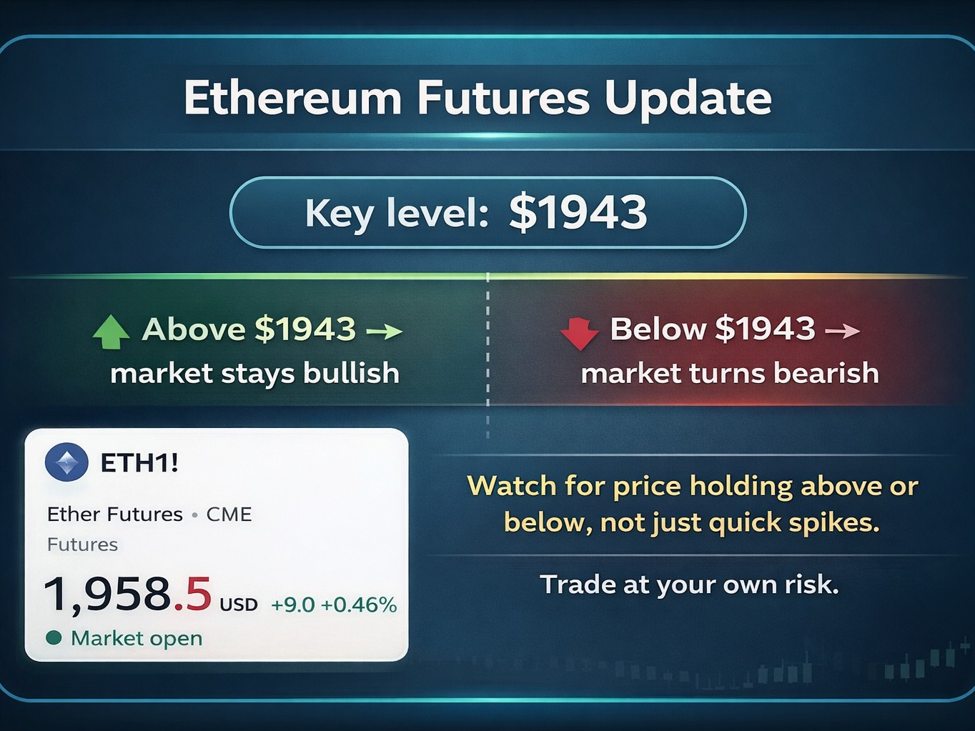
Ethereum Analysis Today
Ether futures analysis: medium-term structure stabilizing after heavy two-sided tradeEther futures are trading near $1,960 after a volatile stretch that saw sharp downside pressure followed by responsive buying. The broader crypto space remains sensitive to macro headlines and equity sentiment, but ETH is currently attempting to stabilize rather than extend lower.What underlying crypto activity suggestsBitcoin’s price action has been stuck in a tight range and technically biased lower, as noted in the Bitcoin Technicals piece from Feb 18 where price sits below the 100- and 200-hour moving averages and traders are watching support near ~$66,926 with a break below pointing toward ~$65,080. Resistance around the two moving averages and a key trendline near ~$70,000 must be convincingly overcome for the bias to shift bullish. That theme of compression and constrained range carried through from the prior day’s analysis in Bitcoin compresses below key resistance, which highlights repeated failure to clear the 38.2 % retracement near ~$71,551 and the flattening of moving averages as signaling a non-trending market that’s building energy for a directional breakout—likely down while beneath those key averages, but also capable of a sharp move up if momentum shifts.Turning to altcoins, Ethereum chops at the bottom of the range described ETH stuck near the lower bounds around ~$2,000 with price action carving out a range that looks weak and leaves the next move open but leaning downward given the broader risk backdrop and lackluster bounce off recent lows. The author paints a somewhat grim picture for crypto risk assets in general, referencing longer-term selloff patterns and ongoing weak sentiment as factors that could influence how both ETH and BTC resolve their respective consolidation structures.For Ether futures, in the recent sessions, sellers pushed aggressively lower, and participation expanded into the decline. However, despite that intensity, price did not continue cascading. Instead, lower levels began attracting demand.That shift is important.After the flush, buying activity began to respond more efficiently. Selling attempts started to produce less downside progress, while rebounds carried more follow-through. This suggests that supply is no longer moving price as easily as it did during the breakdown phase.In simple terms: Sellers were dominant earlier, but their control is no longer expanding.Longer-term vs recent behavior for EthereumFrom a medium-term perspective, ETH is still working through prior damage. The broader structure is not yet fully repaired, and overhead supply likely remains.However, in the most recent activity, there are early signs of stabilization:Downside pressure is being absorbed rather than accelerating.Rebounds are beginning to show more acceptance.Price is no longer reacting to heavy activity with persistent lower lows.This does not confirm a strong uptrend. But it does suggest that immediate downside momentum is cooling.Key areas to watch for ETH Futures$1,943–$1,950 zone: This area represents recent demand. Holding above it keeps the stabilization thesis intact.$1,985–$2,000 area: First meaningful overhead zone. Acceptance above this region would signal improving structure.Below $1,930: Sustained trade under this level would suggest sellers are regaining initiative.ScenariosBullish scenario for ETH futuresIf ETH continues to hold above the recent demand zone and rebounds begin to show clean follow-through, the path of least resistance shifts toward rotation higher into the $1,985–$2,000 area.A sustained move above that zone would suggest the market is accepting higher prices rather than simply short-covering.Bearish scenario for ETH futuresIf price begins to accept trade below $1,943 and selling pressure expands with follow-through, the stabilization narrative weakens. In that case, a retest of lower liquidity pockets becomes more likely.Market bias score for Ethereum TodayMarket bias score: +2 (slightly bullish).This reflects improving buyer responsiveness after a heavy selling phase, but not a confirmed upside expansion. The bias is modest because overhead supply is still nearby, and broader crypto volatility remains elevated.A clean acceptance above $2,000 would increase the score. A sustained break below $1,930 would shift it back toward neutral or bearish.What would change the viewSustained acceptance below $1,943Strong follow-through selling with expanding participationFailure of rebounds to hold above prior intraday demand zonesRisk note for crypto traders and investorsThis analysis is intended for educational and decision-support purposes only. It is not financial advice. Markets are inherently uncertain, and all trading and investing decisions carry risk.For real-time trade ideas, follow-ups, and market insights across stocks, indices, commodities, and crypto, check out the investingLive Stocks Telegram channel. Trade ideas are shared for educational purposes only and at your own risk.https://t.me/investingLiveStocks This article was written by Itai Levitan at investinglive.com. 🔗 Source 💡 DMK Insight ETH’s recent volatility is a classic case of market indecision, and here’s why that matters: Trading around $1,960, Ethereum futures are showing signs of stabilization after a turbulent period marked by sharp sell-offs and subsequent buying. This behavior suggests that traders are weighing macroeconomic factors heavily, particularly as the broader crypto market remains intertwined with equity sentiment. If ETH can hold above the $1,950 level, it might indicate a potential base forming, which could attract more buyers looking for a rebound. However, a failure to maintain this level could trigger further selling, especially with the looming uncertainty in macro headlines. It’s worth noting that the current price action reflects a broader trend where traders are increasingly cautious, leading to a two-sided market. This could mean that short-term traders might want to look for breakout opportunities above $2,000 or prepare for a potential drop if support at $1,900 fails. Keep an eye on volume trends and any shifts in sentiment from institutional players, as their moves could significantly influence ETH’s next direction. 📮 Takeaway Watch for ETH to hold above $1,950; a break below could signal further downside, while a push past $2,000 may attract buyers.

UK January retail sales +1.8% vs +0.2% m/m expected
Prior +0.4%Retail sales +4.5% vs +2.8% y/y expectedPrior +2.5%; revised to +1.9%Retail sales ex autos, fuel +2.0% vs +0.2% m/m expectedPrior +0.3%Retail sales ex autos, fuel +5.5% vs +3.6% y/y expectedPrior +3.1%; revised to +2.5%That’s an impressive beat in terms of the monthly figure, with the headline being the largest monthly rise since May 2024. The most notable thing about the jump is that UK retail sales volumes are now flat when compared to the pre-pandemic level in February 2020.Looking at the details, there were impressive jumps in food store sales (+1.2%), other non-food store sales (+5.3%), household goods store sales (+3.2%), and non-store retailing (+3.4%) on the month. That is offset slightly by a fall in department store sales (-1.3%).Overall though, the less volatile three-month growth rate in UK retail sales only reflects a 0.1% increase. And when you exclude autos and fuel, it actually shows a 0.1% drop in retail sales. As such, the report isn’t as impressive as it might indicate at first glance.Still, it is an impressive report nonetheless with ONS attributing the big jump in non-food store sales to strong sales volumes in commercial art galleries during January 2026. That is despite poorer weather conditions with UK seeing above average rainfall in the first month of the year, resulting in lower footfall in January 2026. This article was written by Justin Low at investinglive.com. 🔗 Source 💡 DMK Insight Retail sales just jumped 4.5%, and here’s why that matters: stronger consumer spending could shift market sentiment. This significant beat against expectations signals robust economic activity, which might prompt traders to reassess their positions in related markets. For instance, if consumer confidence continues to rise, we could see upward pressure on equities, particularly in consumer discretionary sectors. Additionally, a strong retail sales report often correlates with increased inflation expectations, which could impact forex markets, especially USD pairs. Traders should keep an eye on the upcoming Federal Reserve meetings, as this data could influence interest rate decisions. Watch for key resistance levels in related assets, particularly if the S&P 500 starts breaking above recent highs. But don’t overlook potential risks; if inflation spikes too quickly, it could lead to aggressive rate hikes, which might spook the markets. So, while the current sentiment is bullish, be prepared for volatility as the implications of this data unfold. 📮 Takeaway Watch for how this retail sales data influences the S&P 500 and USD pairs, especially if consumer confidence continues to rise.

Germany January PPI -0.6% vs +0.3% m/m expected
Prior -0.2%The much softer reading here owes a lot to base effects, in particular the impact of energy prices. That is also the main reason for the drag on the year-on-year reading, which was 3.0% lower than January 2025. When energy prices are excluded, producer prices in January 2026 rose by 0.6% compared with December 2025. And compared to January 2025, producer prices rose by 1.2% when excluding the impact of energy prices.Compared with December 2025, energy prices dropped by 3.2% on the month. And when paired against the same month from a year earlier, energy prices were down 11.8%. So, that is the biggest drag on the headline estimate.Looking at the breakdown for other components, there were increases in the price for capital goods (+0.6%), durable consumer goods (+0.7%), and intermediate goods (+0.9%) on the month. And that was slightly offset by a drop in prices for non-durable consumer goods (-0.4%). This article was written by Justin Low at investinglive.com. 🔗 Source 💡 DMK Insight So, producer prices are showing a notable dip, and here’s why that matters: a 3.0% year-on-year decline signals potential deflationary pressures that could impact market sentiment. This drop is largely attributed to base effects from energy prices, which can skew perceptions of inflation. When energy prices are stripped out, the underlying producer prices still rose, suggesting that core inflation might be more stable than the headline number indicates. For traders, this divergence is crucial. If energy prices stabilize or rebound, we could see a reversal in the current trend, impacting commodities and related markets. Watch for how this plays out in the next few weeks, especially as we approach key economic indicators like the upcoming CPI report. If core prices continue to rise, it could signal a shift in Fed policy, affecting forex pairs and equities alike. Keep an eye on technical levels around recent lows for commodities, as any bounce could trigger buying interest. In the current environment, it’s worth questioning whether the market is overreacting to the headline numbers. The real story is in the core data, which may not be as weak as it seems. Be prepared for volatility as traders digest these mixed signals. 📮 Takeaway Monitor the upcoming CPI report closely; if core prices rise, expect potential shifts in Fed policy and market reactions.

FX option expiries for 20 February 10am New York cut
There is just one to take note of on the board for the day, as highlighted in bold below.That being for USD/JPY at the 155.00 level. Similar to yesterday, the expiries may factor into play in acting as a magnet for price action during the session ahead. However, the impact of the one for USD/JPY may not be as robust compared to other major currencies. The trading context is important in this case.The currency pair remains locked in a battle as dip buyers are trying to push their agenda this week but facing up against intervention risks. The latter remains a key blockade in terms of limiting the pace of any gains, with some traders heeding caution amid potential for Tokyo officials to step in.The key threshold seems to be anywhere above 155 to 159 at this stage. So, that will keep trading sentiment on edge. That especially with the dollar side of the equation also having to depend on geopolitical risks amid the ongoing tensions between US and Iran. That will also be a key risk factor before the weekend comes along.For more information on how to use this data, you may refer to this post here.Head on over to investingLive (formerly ForexLive) to get in on the know! This article was written by Justin Low at investinglive.com. 🔗 Source 💡 DMK Insight USD/JPY is hovering around the critical 155.00 level, and here’s why that matters right now: With expiries at this level, traders should expect heightened volatility as the market reacts to these options. This could create a magnet effect, pulling prices towards 155.00, which may act as both support and resistance. If we see a break above this level, it could trigger a bullish momentum, potentially targeting higher resistance levels. Conversely, a failure to hold could lead to a quick sell-off, especially if the daily close falls below 154.50. Keep an eye on related pairs like EUR/JPY, as movements in USD/JPY often influence broader market sentiment in the forex space. Here’s the thing: while many traders might be focused solely on the technical aspects, it’s crucial to consider the broader economic context, including any upcoming U.S. economic data releases that could impact the dollar. Watch for any shifts in sentiment around the Fed’s monetary policy, as that could add another layer of complexity to trading decisions around this level. 📮 Takeaway Monitor the 155.00 level in USD/JPY closely; a break could lead to bullish momentum, while a drop below 154.50 may trigger selling pressure.