
 Bitcoin
  Ethereum
  Tether
  XRP
XRP  BNB
BNB  USDC
USDC  Solana
  TRON
TRON  Lido Staked Ether
  Figure Heloc
US January CPI +2.4% y/y vs +2.5% expectedFed’s Goolsbee sees encouraging and concerning parts of the CPI reportUS Supreme Court says next Friday will be a decision dayUS Treasury secretary Bessent says that metals tariffs decision will be up to TrumpOil prices dip on report that OPEC+ may resume oil output hikes from AprilThe haven from the AI disruption might be a HALOBoE’s Pill: Disinflation is not as rapid or convincing as hopedMarkets:Gold up $112 to $5032WTI crude oil down 24-cents to $62.60US 10-year yields down 5.4 bps to 4.05%Bitcoin up $3000 to $68,815GBP leads, AUD lagsS&P 500 flatUS equity futures were deeply negative ahead of the CPI report but rebounded to unchanged afterwards as the numbers mostly cooled. After the open, bids steadily picked up and the S&P rose nearly 50 points at the peak. But late in the day the bears took over again and sent it into negative territory before a last minute bounce to flat. Shares of Amazon fell for the ninth straight day.The reaction elsewhere to the data was typically dovish as the US dollar slid and bonds rallied. The strength in fixed income is increasingly noticeable as investors look for a safe haven away from the intense volatility. The pound led the way on the hawkish comments from BOE chief economist Pill. The initial push came in Europe as cable rose a quarter cent to 1.3625 but after some selling into the London fix there was a second wave of bids late and a finish above 1.3650. Elsewhere it was more of a choppy day in FX with small moves.Gold posted an impressive rebound following the mysterious gap down yesterday. The $150 straight-line drop has almost been completely recovered as it climbed $80 in North American trade.Note that Monday is a holiday in Canada and the USA; enjoy the long weekend. This article was written by Adam Button at investinglive.com. 🔗 Source 💡 DMK Insight The January CPI report showing a 2.4% increase year-over-year, slightly below expectations, is a mixed bag for traders. While the lower-than-expected inflation rate could ease pressure on the Fed to hike rates aggressively, it also raises questions about economic strength. Fed’s Goolsbee’s comments hint at a balancing act between encouraging signs and persistent concerns, which could lead to volatility in both equities and bonds. Traders should keep an eye on the upcoming Supreme Court decision next Friday, as it could influence market sentiment significantly. Additionally, the dip in oil prices due to OPEC+ potentially resuming production could impact energy stocks and inflation expectations. Watch for key levels in the S&P 500 and oil prices; a break below recent support could trigger further selling pressure. In this environment, day traders might want to focus on short-term volatility and consider options strategies to hedge against potential swings. The real story is how the market reacts to these mixed signals, so stay alert for any shifts in sentiment as we approach key decision dates. 📮 Takeaway Watch for the Supreme Court decision next Friday and key support levels in the S&P 500 to gauge market sentiment and potential volatility.
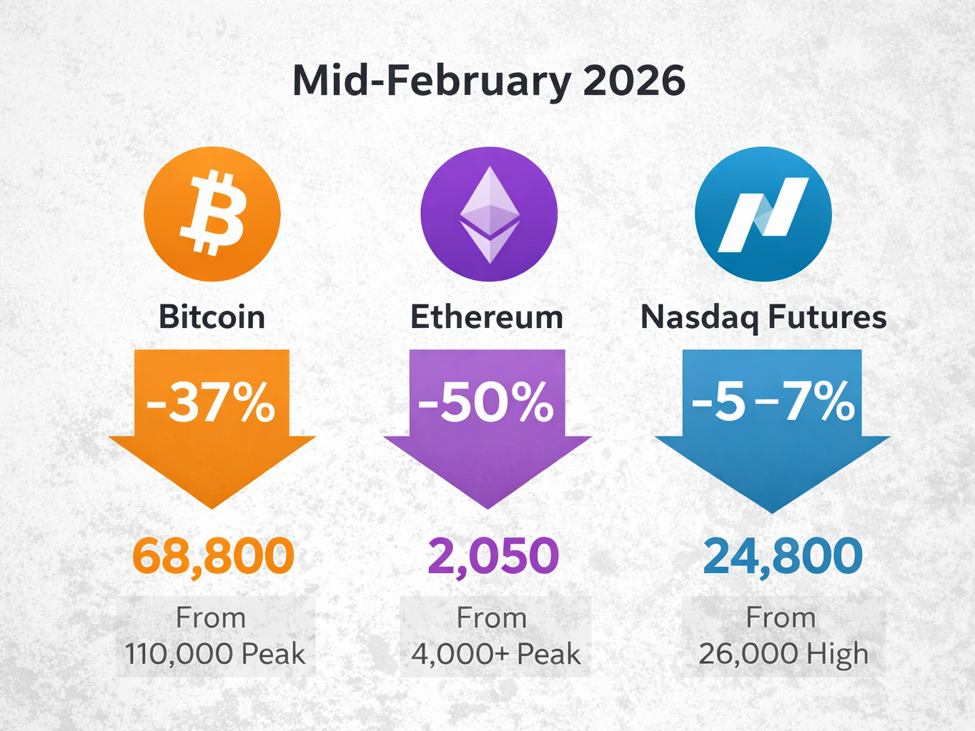
Bitcoin Holds $68.8K While Ethereum Slides Toward $2k as Nasdaq Cools in February 2026
Bitcoin Futures are hovering near $68,800 in mid-February 2026, attempting to stabilize after a sharp retracement from last year’s surge above $110,000. At the same time, Ethereum Futures are trading close to $2,050, nearly 50% below their prior highs above $4,000. While crypto appears to be “holding,” the broader backdrop tells a more complex story.Nasdaq Futures, which climbed above 26,000 during the late-2025 expansion phase, have cooled materially and are now trading closer to the 24,800 region. The index is no longer delivering clean upside momentum, and recent weeks show more rotational behavior than sustained expansion. That shift in macro tone matters because crypto’s recent stabilization is occurring within a softer risk environment.The key question for investors right now is whether Bitcoin’s consolidation near $68K represents early accumulation, or simply a pause within a broader distribution phase. Ethereum’s deeper retracement and weaker relative structure add another layer of caution. When cross-asset positioning is examined together rather than in isolation, the message is clear: crypto is not yet leading the next risk-on cycle.Nasdaq Futures: Cooling Momentum Without CapitulationThe broader macro backdrop is critical here.Since peaking above 26,000 in late 2025, Nasdaq Futures have pulled back roughly 5–7 percent. That may not sound dramatic, but the internal structure has shifted. Upside attempts over the past several weeks have required more effort and delivered less follow-through. Downside weeks, by contrast, have produced cleaner directional movement.This matters because crypto does not operate in isolation. When equities enter a rotational or cooling phase, high-beta assets typically require strong independent leadership to outperform. That leadership is currently missing.Importantly, this is not a panic environment. There is no evidence of forced liquidation across equities. Instead, participation has cooled. That subtle distinction changes the probability of what comes next.Rotation tends to produce choppy rallies, not sustained breakouts.Bitcoin: Stabilization After a 37% ResetBitcoin’s move from above $110,000 to the current $68,800 region represents a reset of roughly 37 percent. Historically, Bitcoin has experienced similar retracements within broader cycles, but what makes this phase notable is the nature of the rebound.Over the last several weeks:Bounce attempts have been moderate rather than explosive.Price has not reclaimed prior breakdown zones above $75,000–$80,000.Upside sessions have lacked sustained follow-through.The key structural detail many overlook is this: stabilization alone does not equal accumulation.True accumulation phases tend to show expanding participation alongside improving upward efficiency. What we are currently observing is compression — price holding, but not aggressively reclaiming lost ground.That distinction may determine whether Bitcoin forms a base in the coming months or drifts lower in alignment with broader macro softness.Ethereum: The 50% Drawdown Tells a Different StoryEthereum’s situation is more fragile.From highs above $4,000 to current levels near $2,050, ETH is down nearly 50 percent. That magnitude of drawdown exceeds Bitcoin’s retracement and reinforces Ethereum’s role as the higher-beta component of the crypto complex.More importantly, Ethereum has not demonstrated relative leadership during this stabilization period.In recent weeks:ETH has underperformed Bitcoin on rebound attempts.Upside moves have stalled below prior structural resistance.The asset remains closer to breakdown territory than breakout territory.This relative weakness is new information that often goes unnoticed. While headlines focus on “crypto holding,” the internal hierarchy shows Ethereum acting as the pressure point.Historically, when Ethereum underperforms Bitcoin during stabilization phases, it suggests caution rather than imminent upside acceleration.Relative Strength Hierarchy: The Market’s Hidden SignalWhen we rank the assets by structural strength as of February 2026:Nasdaq Futures – cooling but structurally intactBitcoin Futures – stabilizing but not leadingEthereum Futures – weakest and most fragileThis ranking is not based on price alone. It reflects directional efficiency, recovery quality, and relative performance across multiple timeframes.The absence of a leader is the key takeaway.In strong risk-on environments, one asset typically pulls ahead decisively. That is not happening right now. Instead, we see synchronized stabilization within a cooling macro regime.That combination reduces the probability of immediate upside acceleration.What Would Change the Narrative?For sentiment to shift meaningfully:Nasdaq Futures would need to regain sustained upside momentum and hold above recent consolidation levels.Bitcoin would need to reclaim the $75,000–$80,000 region with follow-through.Ethereum would need to outperform Bitcoin on a weekly basis, not just bounce alongside it.Until those developments occur, rallies may represent rotational rebounds rather than confirmed trend reversals.Why This Phase Is Different From Prior Crypto CorrectionsIn previous cycles, Bitcoin often decoupled from equities during critical turning points. In early 2026, that decoupling has not materialized.Instead:Crypto is stabilizing within a cooling macro regime.Ethereum is showing disproportionate weakness.Bitcoin is acting defensive rather than aggressive.This suggests the current environment is not one of panic liquidation, but neither is it one of renewed expansion.It is transitional.Transitional markets demand patience.Final Outlook: Rotation Before ExpansionAs of mid-February 2026:Bitcoin holds near $68,800 after a major reset.Ethereum trades near $2,050, down nearly 50 percent from highs.Nasdaq Futures remain below prior peaks, reflecting macro cooling.The data does not yet confirm accumulation across crypto. Instead, it points to stabilization within a broader rotational phase.For investors, that means monitoring relative strength and leadership, not just price bounces.For traders, it means recognizing that in cooling regimes, upside follow-through must prove itself.The next major move will likely begin with one asset breaking this hierarchy, not by bouncing, but by leading.Until then, the crypto market remains in reset mode rather than expansion mode. This article was written by Itai Levitan at investinglive.com. 🔗 Source 💡 DMK Insight Ethereum’s current price near $2,078 is a critical juncture for traders: With Bitcoin Futures around $68,800, the market’s attempt to stabilize after a significant drop from last year’s highs indicates a potential shift in sentiment. Ethereum, trading nearly 50% below its previous highs, suggests that traders are cautious but not entirely bearish. This price level could serve as a support zone, and a bounce here might attract buyers looking for a reversal. However, if ETH fails to hold above $2,050, it could trigger further selling pressure, pushing it closer to the $1,800 mark, which is a key psychological level. It’s also worth noting that the correlation between Bitcoin and Ethereum remains strong; any bullish momentum in

ETHZilla offers token tied to jet engine leases amid tokenization pivot
Crypto treasury firm ETHZilla recently sold some of its crypto to begin a tokenization push by buying two jet engines leased to a US airline. 🔗 Source 💡 DMK Insight ETHZilla’s move to tokenize jet engines signals a shift in crypto utility that traders need to watch closely. Selling crypto to fund real-world assets like jet engines could set a precedent for future tokenization efforts, potentially increasing demand for both ETH and SOL as they become more integrated into traditional markets. This could also attract institutional interest, especially if these assets prove to be stable and profitable. For day traders, the immediate reaction might be volatility in ETH and SOL prices, so keep an eye on support levels around $2,000 for ETH and $80 for SOL. If ETH breaks below these levels, it could trigger further selling pressure. On the flip side, this could also be a hidden opportunity. If ETHZilla’s tokenization proves successful, it might pave the way for other firms to follow suit, creating a new trend in crypto-backed assets. Watch for any announcements regarding the performance of these jet engines as they could influence market sentiment significantly. 📮 Takeaway Monitor ETH support at $2,000 and SOL at $80; ETHZilla’s tokenization could drive new demand and volatility in these assets.

Are quantum-proof Bitcoin wallets insurance or a fear tax?
Post-quantum Bitcoin wallets are already on sale, leaving investors to decide whether they’re buying insurance or paying up fear tax. 🔗 Source 💡 DMK Insight With post-quantum Bitcoin wallets hitting the market, traders need to assess the balance between security and speculative fear. The launch of these wallets suggests a growing concern over quantum computing’s potential to compromise current cryptographic standards. This could lead to a bifurcation in the market, where those prioritizing security might shift towards these wallets, while others may view them as an unnecessary expense. For ETH traders, the current price of $2,047.53 could be influenced by this sentiment, especially if fears of quantum threats drive a rush into more secure assets. However, it’s worth questioning whether this is a genuine risk or just hype. Historically, technological advancements have often been met with skepticism, and the actual threat from quantum computing remains largely theoretical for now. Traders should monitor the adoption rates of these wallets and any significant price movements in Bitcoin as a leading indicator for ETH. Keep an eye on the $2,000 support level for ETH; a break below could trigger further selling pressure as fear takes hold. 📮 Takeaway Watch for ETH’s reaction around the $2,000 level; a drop could signal increased fear-driven selling as quantum wallet adoption grows.

Digital gold or tech stock? Bitcoin’s identity crisis deepens
Bitcoin’s growing correlation with tech stocks challenges its digital gold narrative, as Ether treasuries, BlackRock and Polymarket make bold moves. 🔗 Source 💡 DMK Insight Bitcoin’s rising correlation with tech stocks is shaking up the crypto narrative, and here’s why that matters now: With Bitcoin trading at $2,047.53, its alignment with tech equities could signal a shift in how institutional investors perceive digital assets. If tech stocks continue to face headwinds, Bitcoin might follow suit, undermining its status as a safe haven. Meanwhile, Ether’s treasury management by firms like BlackRock and Polymarket indicates a growing institutional interest that could bolster ETH’s price stability. Traders should keep an eye on this dynamic, especially as tech earnings reports roll in, which could create volatility in both sectors. Watch for key support levels around $2,000 for Bitcoin and $1,800 for Ether; breaking these could lead to significant sell-offs. On the flip side, if tech stocks rebound, Bitcoin could benefit from renewed bullish sentiment, making it crucial to monitor market reactions closely. In the coming weeks, focus on the correlation metrics between Bitcoin and major tech indices, as well as any announcements from institutional players regarding their crypto strategies. 📮 Takeaway Watch Bitcoin’s support at $2,000 and Ether’s at $1,800; a break below these levels could trigger significant selling pressure.

ECB: Rates seen unchanged through 2026 – Nordea
Nordea’s Ole Håkon Eek-Nielsen and Jan von Gerich note that the ECB remains relaxed about lower inflation and FX moves, and is firmly on hold. 🔗 Source 💡 DMK Insight The ECB’s relaxed stance on inflation and FX movements is a green light for traders: With the central bank firmly on hold, this signals stability in the Eurozone, which could lead to a stronger Euro against other currencies. Traders should be aware that a lack of aggressive monetary policy could keep volatility low in the forex markets, making it an ideal environment for day traders looking to capitalize on smaller price movements. However, this also means that any unexpected shifts in inflation data or geopolitical events could trigger rapid reactions. Watch for key economic indicators like upcoming inflation reports or employment data, as these could influence the ECB’s future decisions. If inflation unexpectedly rises, it could force the ECB to reconsider its position, leading to potential volatility in the Euro. Keep an eye on the EUR/USD pair, especially around the 1.10 level, as a break above or below could signal a new trading range. 📮 Takeaway Monitor the EUR/USD pair closely around the 1.10 level for potential breakout opportunities, especially in light of upcoming inflation data.

The key trendline to watch on Internet Computer
Internet Computer Protocol (ICP) is a cryptocurrency that remains well off its prior highs, and the drawdown has been significant. From its highs in November, ICP is down over 76%. From the highs earlier this year, it is down more than 52%. 🔗 Source 💡 DMK Insight ICP’s steep decline of over 76% since November raises critical questions for traders looking for recovery opportunities. The significant drawdown indicates a loss of momentum and investor confidence, which could signal further downside risk. Traders should be cautious, especially if ICP fails to hold key support levels. If it breaks below recent lows, it could trigger additional selling pressure. On the flip side, if ICP manages to stabilize and reclaim some of its lost ground, it might attract buyers looking for a bargain. Keep an eye on broader market trends as well; if Bitcoin or Ethereum show strength, it could provide a lift for altcoins like ICP. Watch for any bounce around psychological levels, as these can often act as pivotal points for traders. For now, monitor ICP closely for signs of a reversal or continued weakness, particularly in the next few weeks as market sentiment evolves. 📮 Takeaway Watch ICP closely for potential support around recent lows; a break could signal further downside, while a bounce might attract buyers.

Equifax tests former support trendline after steep decline
Equifax, Inc. (EFX), one of the three major credit reporting agencies in the United States, just closed at $188.18 after a sharp decline that has traders questioning whether this is a bounce opportunity or the beginning of something worse. 🔗 Source 💡 DMK Insight Equifax’s recent drop to $188.18 raises red flags for traders: is this a buying opportunity or a signal of deeper issues? The sharp decline could be linked to broader economic concerns, particularly around consumer credit trends and potential regulatory scrutiny. Traders should keep an eye on the stock’s performance in relation to key support levels—if it breaks below $180, we might see a cascade effect that could drag it further down. Conversely, a bounce back above $200 could signal a recovery phase, attracting both retail and institutional buyers. It’s also worth noting how this impacts correlated sectors, like fintech and credit services, which could react to Equifax’s movements. Here’s the thing: while some might see this as a chance to buy the dip, the risks are significant. If the market sentiment shifts negatively, it could lead to a broader sell-off. Watch for volume spikes around these price points and any news related to credit policies that could influence market sentiment. 📮 Takeaway Monitor Equifax closely; a drop below $180 could trigger further declines, while a recovery above $200 might attract buyers.

NatWest shares slide despite beating on profits
NatWest followed up its announcement that it was buying wealth manager Evelyn Partners for £2.7bn earlier this week, with a solid set of full year results today. 🔗 Source 💡 DMK Insight NatWest’s acquisition of Evelyn Partners and its strong earnings could signal a shift in investor sentiment towards financial stocks. With SOL currently at $84.28, traders should consider how this news might ripple through the broader market, particularly in the financial sector. A robust performance from NatWest could indicate increased confidence in traditional banking, potentially leading to a bullish trend in related assets. If NatWest’s stock reacts positively, it may attract more institutional interest, which could spill over into cryptocurrencies like SOL, especially if traders view them as alternative investments. Watch for any price movements in the financial sector that could correlate with SOL’s performance. On the flip side, if the market reacts negatively to the acquisition due to concerns over integration or valuation, it could create volatility. Keep an eye on key technical levels for SOL, particularly if it approaches support or resistance zones in the coming days. The next earnings reports from major banks could also provide additional context for market direction. 📮 Takeaway Watch for NatWest’s stock reaction post-acquisition; a bullish trend could positively influence SOL, currently at $84.28, in the coming days.

USD/CAD remains bid despite weaker US inflation data
USD/CAD trades in a tight range on Friday, as the US Dollar (USD) holds firm despite softer-than-expected US inflation data. At the time of writing, USD/CAD is hovering near 1.3625, holding modest gains and remaining on the front foot for a third consecutive day. 🔗 Source 💡 DMK Insight USD/CAD is stuck in a tight range, and here’s why that matters: the US Dollar’s resilience amid soft inflation data suggests underlying strength. Traders should note that the USD’s performance is counterintuitive given the inflation figures, which typically would weaken the currency. This could indicate that market participants are pricing in a more hawkish stance from the Fed in the near term, despite the recent data. If USD/CAD can break above 1.3650, it might signal a stronger bullish trend, while a drop below 1.3600 could trigger selling pressure. Keep an eye on correlated assets like oil prices, as Canada’s economy is heavily influenced by crude movements, which could impact CAD’s strength. The flip side is that if inflation data continues to disappoint, we might see a shift in sentiment, leading to a potential reversal. So, watch for any comments from Fed officials that could sway market expectations. The next few sessions will be crucial for determining the direction of this pair. 📮 Takeaway Watch for USD/CAD to break 1.3650 for bullish momentum or drop below 1.3600 for potential selling pressure in the coming days.