
 Bitcoin
  Ethereum
  Tether
  XRP
XRP  BNB
BNB  USDC
USDC  Solana
  TRON
TRON  Lido Staked Ether
  Figure Heloc
FUNDAMENTAL OVERVIEWYesterday, out of the blue, we got a quick selloff in gold without any clear catalyst. The curious thing is that we saw the same price action across many other assets around the same time. It’s unclear what triggered those moves. Anyway, the focus now is on the US CPI report today. The market is pricing 58 bps of easing for the Fed this year, so there’s a high risk of a hawkish repricing in case the data comes out strong. In such a scenario, we will likely see gold selling off again and potentially reaching new lows.On the other hand, a soft report shouldn’t change much in terms of near-term Fed policy, but it will keep the dovish bets in place which should act as support for gold.GOLD TECHNICAL ANALYSIS – DAILY TIMEFRAMEOn the daily chart, we can see that gold is trading right in the middle between the all-time highs and the trendline. From a risk management perspective, the buyers will have a better risk to reward setup around the trendline to target new all-time highs, while the sellers will look for a break lower to extend the drop into the 4000 level next.GOLD TECHNICAL ANALYSIS – 4 HOUR TIMEFRAMEOn the 4 hour chart, we can see a strong resistance around the 5100 level where the price got rejected from several times in the past weeks. We got a break below the upward trendline yesterday which could be a signal of more downside to come. The sellers piled in on the break to target the 4656 level but if we get a retest of the broken trendline, the sellers will likely step in again near the resistance with a defined risk above it to position for a drop into new lows. The buyers, on the other hand, will want to see the price breaking above the resistance to pile in for a rally into new all-time highs.GOLD TECHNICAL ANALYSIS – 1 HOUR TIMEFRAMEOn the 1 hour chart, there’s not much else we can add but if the price were to fall below the recent low at 4878, we can expect the bearish momentum to increase as more sellers will likely pile into the selloff. Watch out for the US CPI report today as it could trigger big moves in the market. The red lines define the average daily range for today. UPCOMING CATALYSTSToday we conclude the week with the US CPI report. This article was written by Giuseppe Dellamotta at investinglive.com. 🔗 Source 💡 DMK Insight Gold’s sudden selloff signals potential market volatility ahead. Yesterday’s unexpected drop in gold prices, mirrored by other assets, raises questions about underlying market dynamics. This kind of synchronized movement often hints at broader risk-off sentiment or reaction to macroeconomic news, even if no immediate catalyst is apparent. Traders should keep an eye on the US economic indicators, particularly any upcoming data releases that could influence market sentiment. If the selloff continues, watch for key support levels in gold around recent lows, as breaking through these could trigger further declines across correlated assets like silver and even equities. On the flip side, if this selloff is short-lived, it might present a buying opportunity for those looking to capitalize on a rebound. Be cautious, though—monitoring volatility indicators and market sentiment will be crucial in determining the next steps. Keep an eye on the daily charts for any reversal patterns that could signal a shift in momentum. 📮 Takeaway Watch for gold’s support levels; a break could lead to broader market declines, while a rebound might offer buying opportunities.

IC Markets Global Named TradingView “Social Champion” at the 2025 Broker Awards
IC Markets Global has been recognised by TradingView as the “Social Champion” at the 2025 TradingView Broker Awards, highlighting the broker’s strong engagement and connection with the global trading community. The Social Champion award recognises brokers that stand out on TradingView through active participation, meaningful interaction, and consistent engagement with traders across the platform’s social ecosystem. Recognition driven by community engagement Unlike traditional broker awards that focus solely on volume or scale, the Social Champion award reflects how brokers show up for traders day-to-day: through educational content, timely market commentary, and genuine interaction within the TradingView community. The award is based on a combination of verified user feedback, engagement metrics, and platform activity, ensuring recognition is grounded in real trader experience. Building a dialogue with traders IC Markets’ presence on TradingView focuses on more than execution and pricing. The broker actively supports traders by: Sharing market insights and trade-relevant commentary Engaging directly with trader discussions and feedback Supporting transparency and education within the community This approach has helped IC Markets Global build a strong, trusted voice within TradingView’s global network of traders. “Being recognised as TradingView’s Social Champion is especially meaningful because it reflects how traders engage with us, not just how they trade,” said Tony Philip, CMO at IC Markets. “We see TradingView as more than a platform, it’s a community. This award reinforces our commitment to staying connected, transparent, and responsive to traders worldwide.”IC Markets Global also thanked its clients and partners, noting that ongoing feedback from the TradingView community continues to shape how the brand communicates, educates, and evolves. About IC Markets Global Founded in 2007, IC Markets Global is a globally recognised CFD broker offering access to FX, indices, commodities, stocks, and cryptocurrencies. Known for its institutional-grade infrastructure and trader-focused approach, IC Markets serves clients across multiple regions worldwide. Find out more about IC Markets Global at icmarkets.com/global This article was written by IL Contributors at investinglive.com. 🔗 Source

China holds roundtable meeting with big German companies in Beijing
The meeting was said to take place in Beijing on Thursday, with representatives from 60 German companies being in attendance. Of note, the list of German firms included the likes of BASF, BMW Group, and Bayer. The commerce ministry then reaffirmed that both China and Germany remain “committed to a fair and stable business environment”.Once again, this just brings up the narrative of the enemy of my enemy is my friend. With both China and Europe being pushed to the corner by US on trade and tariffs, they are finding themselves to be the unlikely allies at this point in time.That has been well reflected by Germany’s trade breakdown for last year as seen here. The deepening relationship between the two sides now sees China overtaking back the US to be Germany’s top trade partner.And considering that the trade conflict with the US looks set to extend further with even the potential for things to blow up further, both Germany and China will want to keep closer ties until Trump leaves office at least. It’s a long wait with three more years, including this one, to go. However, it will be in their best interests to keep with the status quo from last year.In the long-term though, Germany needs to be careful in their dealings with China on trade. China indirectly exporting deflation to Europe will be a key consideration in that regard.And if that starts to get embedded into German supply chains and how the economy is wired, there will be bigger problems to worry about than circumventing US tariffs. It’s something that German lawmakers and policymakers will have to be mindful of and not sleepwalk into.That’s the key risk if prevailing global trade conditions persist, and is already something that French advisors are warning about. This article was written by Justin Low at investinglive.com. 🔗 Source 💡 DMK Insight The upcoming meeting in Beijing involving 60 major German companies signals a significant commitment to Sino-German economic ties, which could impact global trade dynamics. For traders, this is crucial as it highlights potential shifts in supply chains and investment flows. Companies like BASF and BMW Group are key players in their sectors, and their strategies in China could influence commodity prices and automotive stocks. If these firms announce new investments or partnerships, we might see immediate reactions in related markets, particularly in industrial commodities and European equities. Keep an eye on how this meeting unfolds, as any positive developments could strengthen the Euro against the Yuan, while negative news might lead to volatility in both markets. Also, consider the broader context: if China continues to strengthen ties with Germany, it could signal a shift in global economic alliances, affecting currencies and commodities. Watch for any announcements post-meeting that could provide actionable insights into market movements. 📮 Takeaway Monitor the outcomes of the Beijing meeting closely; any announcements from major firms could shift commodity prices and impact Euro-Yuan exchange rates.

China January M2 money supply +9.0% vs +8.4% y/y expected
New yuan loans ¥4.71 trillion vs ¥5.00 trillion expectedChina’s new bank loans surged in January, as is typical of the new year. Looking back to 2025, this figure was ¥5.13 trillion in January last year. That said, the figure this time around misses on estimates but is still a big one in preparation of the Chinese New Year seasonal period.For some context, it is always the case that the PBOC and Beijing authorities will try to ramp up liquidity ahead of February where we will typically see peak seasonal demand in China. That especially also to ensure enough funds are flowing amid the longer holiday break. As a reminder, Chinese markets will be closed after today and will only return back to business on 24 February.Looking out to the year ahead, the big number to watch out for is ¥16.27 trillion as a cumulative total for the entire year. That was the total for new yuan loans in 2025, which already marked a second yearly decline since peaking in 2023. That will provide a better signal of credit conditions and domestic appetite, as Beijing continues to try and prop up the economy. This article was written by Justin Low at investinglive.com. 🔗 Source 💡 DMK Insight China’s new bank loans came in lower than expected, and here’s why that matters: While ¥4.71 trillion is a solid figure, it falls short of the ¥5.00 trillion forecast, signaling potential weakness in economic recovery. This could impact market sentiment, especially for commodities and currencies tied to Chinese growth, like copper and the Australian dollar. Traders should keep an eye on how this affects the yuan’s strength against the dollar, particularly if it leads to further easing measures from the PBOC. If the yuan weakens significantly, it could trigger a ripple effect in global markets, especially in emerging markets reliant on Chinese demand. On the flip side, the lower loan figure might be a temporary blip, as January often sees a surge in lending due to seasonal factors. Still, if this trend continues, it could raise concerns about the sustainability of China’s economic rebound. Watch for any comments from Chinese officials regarding monetary policy adjustments in response to this data, as they could provide clues on future market movements. 📮 Takeaway Keep an eye on the yuan’s performance against the dollar; a sustained weakness could signal broader market implications, especially for commodities and emerging markets.

What is the distribution of forecasts for the US CPI?
The ranges of estimates are important in terms of market reaction because when the actual data deviates from the expectations, it creates a surprise effect. Another important input in market’s reaction is the distribution of forecasts.In fact, although we can have a range of estimates, most forecasts might be clustered on the upper bound of the range, so even if the data comes out inside the range of estimates but on the lower bound of the range, it can still create a surprise effect.CPI Y/Y2.8% (2%)2.7% (2%)2.6% (2%) 2.5% (65%) – consensus2.4% (24%)2.3% (6%)CPI M/M0.4% (6%)0.3% (64%) – consensus0.2% (24%)0.1% (6%)Core CPI Y/Y2.7% (2%)2.6% (22%) 2.5% (67%) – consensus2.4% (8%)Core CPI M/M0.4% (22%)0.3% (61%) – consensus0.2% (16%)As always, the focus will be on the Core figures. We can notice that expectations are slightly skewed to the upside with forecasts clustered around 2.5%-2.6% for the Y/Y figure and 0.3%-0.4% for the M/M measure. Therefore, the biggest moves will likely be triggered by deviations from these figures as that would be in the very low consensus.The Fed doesn’t see the labour market contributing to inflationary pressures given the lower wage growth and higher productivity, so it could still cut rates solely based on more inflation easing (barring a quick deterioration in the labour market).If we get an in-line or soft CPI, there shouldn’t be much change in terms of market pricing as the two rate cuts expected by the market are already above the Fed’s projection. Nonetheless, we could see a dovish type of reaction, especially in the stock market with stabilising labour market and easing inflation.On the other hand, a hot report will likely trigger a stronger hawkish reaction following the hot NFP report on Wednesday. In this case, the US Dollar would likely rally across the board and precious metals would drop to new lows. The stock market could also come under pressure. This article was written by Giuseppe Dellamotta at investinglive.com. 🔗 Source 💡 DMK Insight Market reactions hinge on how actual data compares to forecasts, and here’s why that’s crucial right now: when data surprises, it can trigger significant volatility. Traders need to pay attention to the clustering of estimates, as a tight range can lead to a more pronounced market reaction if the actual figures deviate. For instance, if economic indicators come in well above or below expectations, we could see sharp moves in correlated assets like forex pairs or crypto. Look at the recent trends in volatility—if forecasts are clustered tightly, a surprise could lead to cascading effects across markets. This is especially relevant for day traders and swing traders who thrive on quick price movements. Keep an eye on key economic releases and their consensus estimates; if the actual numbers diverge, be prepared for rapid shifts in sentiment and price action. As we approach major data releases, monitor the forecast ranges closely. A surprise could not only impact the immediate asset but also ripple through related markets, creating opportunities for those ready to act. 📮 Takeaway Watch for upcoming economic data releases; a surprise deviation from clustered forecasts could trigger significant market volatility.
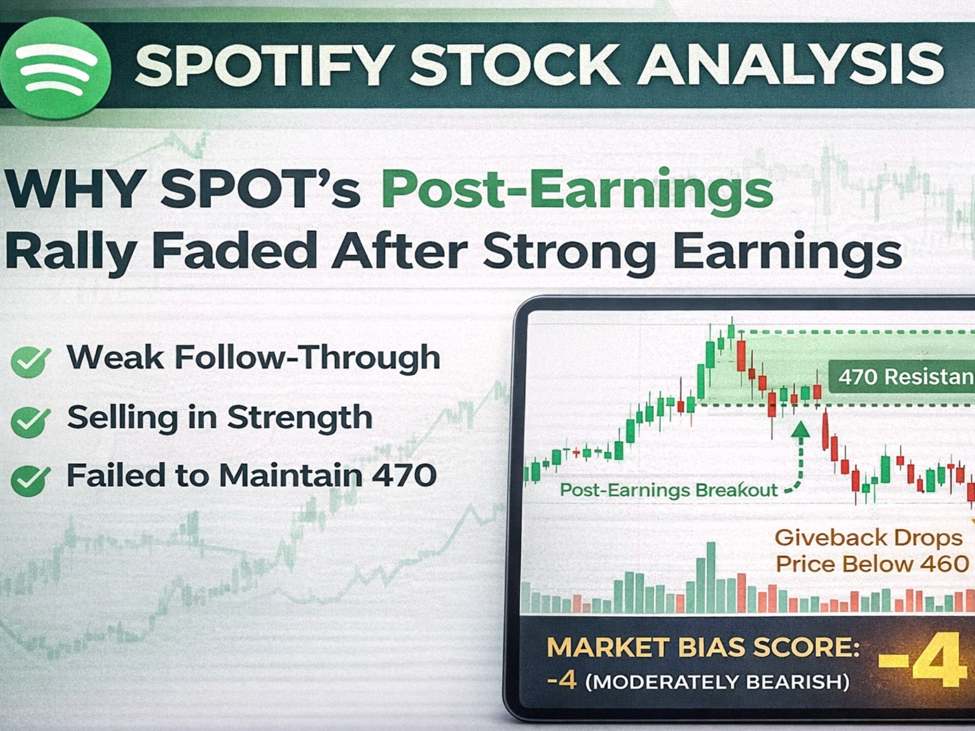
SPOT Stock Analysis After Earnings
Spotify Stock Analysis After Earnings: Why SPOT’s Post-Earnings Rally Faded and What Technical Structure Suggests NextSpotify (SPOT) delivered a strong earnings reaction, initially triggering a powerful upside move. However, much of that rally has since faded, leaving traders asking an important question:Was this a healthy pullback within a bullish shift, or early evidence of distribution?Market sentiment is currently defined by a “good news is good news” regime, where strong economic data supports equities provided inflation remains stable. While a recent robust non-farm payrolls report has bolstered the S&P 500’s consolidation below the 7,000 level, investors are now closely watching the distribution of US CPI forecasts to gauge the potential for a market surprise. A soft inflation report could propel indices to new record highs, whereas hot figures risk a sharp hawkish repricing and technical breakdowns.Despite the S&P 500 remaining within striking distance of record highs, US futures have recently dropped lower as a tech-driven rout creates a “vortex of volatility” near key moving averages. This fragility serves as a reminder that multiple compression can impact any company, even giants like Microsoft, if market confidence in their narrative wavers. As technical levels face testing, the combination of high valuations and shifting sentiment suggests that even a minor catalyst could trigger a more significant retracement to end the week.In this detailed Spotify stock analysis, I examine SPOT technical analysis from a structural and participation perspective, as we dip dive into order flow analysis and price action, to assess what the recent behavior suggests for a Spotify prediction after earnings.Spotify Analysis After Earnings: Strong Gap Higher, But Weak Follow-ThroughFollowing earnings, Spotify surged sharply. Historically, the reaction was significant, with a reported price effect of +14.8% and an opening gap of +13.8% (!)On the surface, that type of earnings expansion often signals aggressive accumulation.However, what matters more than the size of the move is whether higher prices are accepted.In SPOT’s case:The upside expansion bar was large.Follow-through buying did not persist.Price stalled near post-earnings highs.Subsequent sessions began to fade the move.That combination shifts the interpretation.Instead of a clean regime shift higher, the structure began to resemble distribution into strength.SPOT Technical Analysis: What the Underlying Structure RevealsWhen evaluating Spotify technical analysis after earnings, it is critical to separate price movement from participation quality.1. The Earnings Expansion for Spotify StockThe initial move higher was impressive in range terms. But structurally:Buying pressure into the highs struggled to extend.Selling interest appeared on strength.Higher levels were not firmly established as new value.This type of behavior often suggests inventory transfer rather than fresh institutional accumulation.In simple terms, stronger hands may have used the earnings enthusiasm to reduce exposure into strength.2. The Stock’s Giveback PhaseAfter the expansion failed to build, SPOT began retracing.Notably:The pullback unfolded without strong signs of aggressive new downside momentum.Buyers did not meaningfully defend higher levels.The unwind felt more like long liquidation than fresh short initiative.This nuance matters.It suggests the post-earnings rally may have been driven by short-term positioning rather than durable long-term demand.Longer-Term Context: Spotify Stock Still Within Broader Corrective StructureDespite the strong earnings reaction, Spotify stock remains within a broader corrective phase over recent months.The recent rally:Did not establish sustained higher value.Did not create a new multi-leg uptrend.Failed to build consistent follow-through above the breakout zone.From a longer-term perspective, that leaves SPOT in a transitional structure rather than a confirmed bullish regime.Key Technical Levels in This Spotify Stock AnalysisFor traders monitoring Spotify prediction after earnings, the following levels are critical:470 Zone – Post-Earnings Breakout AreaSustained acceptance above this level would signal buyers regaining structural control.460–470 Resistance BandIf rallies into this zone continue to stall, it reinforces overhead supply and weak positioning.Low 430s to High 420s SupportAcceptance below this area would likely shift SPOT from corrective pullback into a deeper bearish phase.SPOT Stock Technical Analysis: Why Traders Are Watching This Massive 2021 Pivot LevelThis monthly chart of Spotify highlights a critical retracement toward the February 2021 high (around $387), a major pivot point that previously capped the stock for nearly two years. Many market participants, including both discretionary traders and algorithms, are likely eyeing this area for a potential test of support as the price declines from its all-time highs. It is vital to understand that technical levels are rarely exact price points; rather, they act as “zones” of interest where liquidity often clusters, meaning a reaction can occur near the level without touching it perfectly.Educational Note: This scenario illustrates the technical concept of “Polarity” or “Role Reversal.” In market psychology, once a significant resistance level (like the Feb 2021 high) is decisively broken, it often flips its role to become support upon a retest. This happens because the “memory” of the market shifts: sellers who previously defended the level are gone, and buyers who missed the initial breakout often wait for a pullback to that price to enter, creating a floor for the stock.Spotify Prediction After Earnings: Two ScenariosBullish ScenarioIf SPOT reclaims and sustains above 470 with stronger upside participation, the recent decline would likely be classified as a post-event reset. That would move the structure toward neutral or modestly bullish.Bearish ScenarioIf rallies continue to fade beneath resistance and price begins accepting lower levels, the technical picture would tilt toward further downside continuation.Market Bias Score for SPOT StockMarket bias score: -4 (moderately bearish)This reflects:Distribution characteristics into strengthFailure of sustained post-earnings acceptanceLack of strong re-accumulation signalsIt is not extreme because we are not seeing accelerating multi-leg downside momentum or structural collapse. The bias reflects caution, not a breakdown thesis.What Would Shift the Spotify Technical Analysis View?The bias would improve toward neutral or bullish if:Price sustains above 470Upside moves show stronger participation qualityRelative performance vs peers improvesThe bias would deteriorate if:Rallies into resistance continue failingPrice accepts below recent supportDownside follow-through expandsSo Spotify Analysis After Earnings Signals Caution, Not Collapse (… but also not a buy yet)This Spotify stock analysis suggests that while the earnings reaction was strong, the structural follow-through was not convincing. The recent giveback leans toward distribution and inventory unwind rather than a clean bullish shift.For

Eurozone Q4 GDP second estimate +0.3% vs +0.3% q/q prelim
Prior +0.3%There’s no change to the initial estimate with the yearly figure confirmed at 1.3% as well. As mentioned before, this mainly reaffirms a more resilient showing by the euro area economy in ending last year.As for annual growth for 2025 as a whole, GDP is seen increasing by 1.5% for the year. So, it’s relatively solid. Germany managing to hold off the manufacturing recession while France coping well enough amid political instability helped to limit downside pressures. This article was written by Justin Low at investinglive.com. 🔗 Source 💡 DMK Insight Eurozone GDP growth holding steady at 1.3% signals resilience, but here’s why that matters now: With the annual growth forecast for 2025 at 1.5%, traders should consider how this stability impacts the euro and related assets. A resilient economy could lead to tighter monetary policy from the ECB, which might strengthen the euro against the dollar. Look for potential shifts in forex pairs, especially EUR/USD, as traders react to these growth figures. If the euro starts to gain traction, it could push the pair above key resistance levels, making it a prime candidate for long positions. But don’t overlook the flip side: if growth expectations falter, we could see a quick reversal, especially if inflation data comes in hotter than expected. Keep an eye on economic indicators in the coming weeks, particularly any shifts in ECB policy or inflation metrics, as they could create volatility in both the euro and broader markets. 📮 Takeaway Watch for EUR/USD movements around key resistance levels as Eurozone GDP stability could trigger a bullish trend if the ECB signals tighter policy.

EU trade surplus shrinks further in 2025 as US exports tumble while Chinese imports surged
This was already evident when we saw the German and French trade data last week. For some context: US tariffs impact show up in German and French trade numbers, but is there a bigger worry?Of note, German exports to the US last year plunged while French exports were steady at the balance after some frontrunning was done before the major hit on wines and spirits. Meanwhile, both countries also saw imports from China surge higher. And both those trends were once again the standouts in reading into the overall EU trade report.The bloc’s trade surplus for December fell to €12.9 billion, marking a drop from €14.2 billion in the same month a year ago. And as a whole for the year, the total trade balance for 2025 was €133.5 billion – down from €140.6 billion in 2024.The breakdown in terms of trading partners pretty much tell the whole story:The US remains the biggest export market for the EU. However, exports to the US declined considerably by 12.6% last year amid Trump’s tariffs. And as a whole, that pushed down the EU’s trade surplus with the EU by more than a third to just €9.3 billion.Meanwhile, the bloc’s trade deficit with China widened further amid a surge in imports by over 10%. The notional amount well covers the the over 11% surge in exports to China as well for last year.As exports to the US drop and tariffs make it harder for EU firms to find customers, the bloc has to explore other options and has diversified well in that regard. But in terms of imports, it is clear that China is having a big impact in terms of penetrating the EU market.That represents a bit of danger for the EU as net exports have been a key pillar for growth in the region but that will slowly lose its stature if prevailing trade conditions continue in the years ahead.Besides that, the EU also has to be wary of the big picture impact of having to lean on China in trying to get by in these tough times amid US tariffs. This article was written by Justin Low at investinglive.com. 🔗 Source 💡 DMK Insight The decline in German exports to the US signals potential economic strain, and here’s why that matters: With US tariffs weighing heavily, traders should be cautious about how this affects broader European economic health. If Germany’s export figures continue to drop, it could lead to a domino effect on the Eurozone, impacting the euro’s strength against the dollar. This situation might push traders to reconsider their positions in EUR/USD, especially if we see a break below key support levels. On the flip side, France’s steady exports could suggest resilience, but it’s worth questioning whether this can hold up if Germany falters. Keep an eye on upcoming economic indicators from both nations, as they could provide critical insights into future market movements. Watch for the EUR/USD pair around the 1.05 level; a breakdown could trigger further selling pressure, while a bounce might indicate a short-term recovery. The next few weeks will be crucial as traders digest these trade dynamics. 📮 Takeaway Monitor the EUR/USD around the 1.05 level; a breakdown could signal deeper bearish trends due to German export woes.

Pound Sterling Price News and Forecast: Climbs as jobless claims dent USD despite soft UK GDP
The Pound Sterling (GBP) rallies during the North American session on Thursday versus the US Dollar (USD) after new jobs data in the US contradicts a stellar Nonfarm Payrolls report released a day ago. 🔗 Source 💡 DMK Insight The GBP’s rally against the USD signals a potential shift in market sentiment following mixed US jobs data. Traders should note that the recent jobs report, while initially positive, may not reflect the underlying economic conditions accurately. This divergence could lead to increased volatility in the GBP/USD pair, especially as traders reassess their positions. If the GBP continues to gain traction, watch for key resistance levels that could emerge around recent highs. Conversely, if the USD strengthens, it might trigger a quick reversal. Keep an eye on upcoming economic indicators, as they could provide further clues about the USD’s trajectory and impact on GBP. The real story is how this mixed data could affect broader market dynamics, particularly in forex. If the trend continues, it might create opportunities for swing traders looking to capitalize on short-term fluctuations. Also, consider the potential ripple effects on related assets, like commodities or equities, which often react to currency strength. 📮 Takeaway Watch for GBP/USD resistance levels; mixed US jobs data could lead to volatility and trading opportunities in the coming days.

Silver retreats as US jobs data temper rate-cut expectations
Silver (XAG/USD) trades lower on Thursday, hovering around $82.85 at the time of writing, down 1.95% on the day. The white metal is correcting after posting a weekly high at $86.30, while the immediate bullish structure remains intact despite the current pullback. 🔗 Source 💡 DMK Insight Silver’s recent dip to $82.85 is a classic case of profit-taking after hitting $86.30 last week. Traders should note that while the current 1.95% drop may seem concerning, the bullish structure remains intact. This suggests that the pullback could be a buying opportunity for those looking to capitalize on the longer-term upward trend. Watch for support around the $80 level, which could serve as a key entry point if the price stabilizes. If silver can reclaim the $84 mark, it may signal a resumption of the bullish momentum, potentially pushing it back toward the recent highs. Keep an eye on broader market sentiment and any economic indicators that could impact demand for precious metals, as these factors could amplify price movements in the coming days. 📮 Takeaway Watch for silver to hold above $80; a bounce back above $84 could signal a renewed bullish trend.