 Bitcoin
  Ethereum
  Tether
  BNB
BNB  XRP
XRP  USDC
USDC  Solana
  TRON
TRON  Lido Staked Ether
  Figure Heloc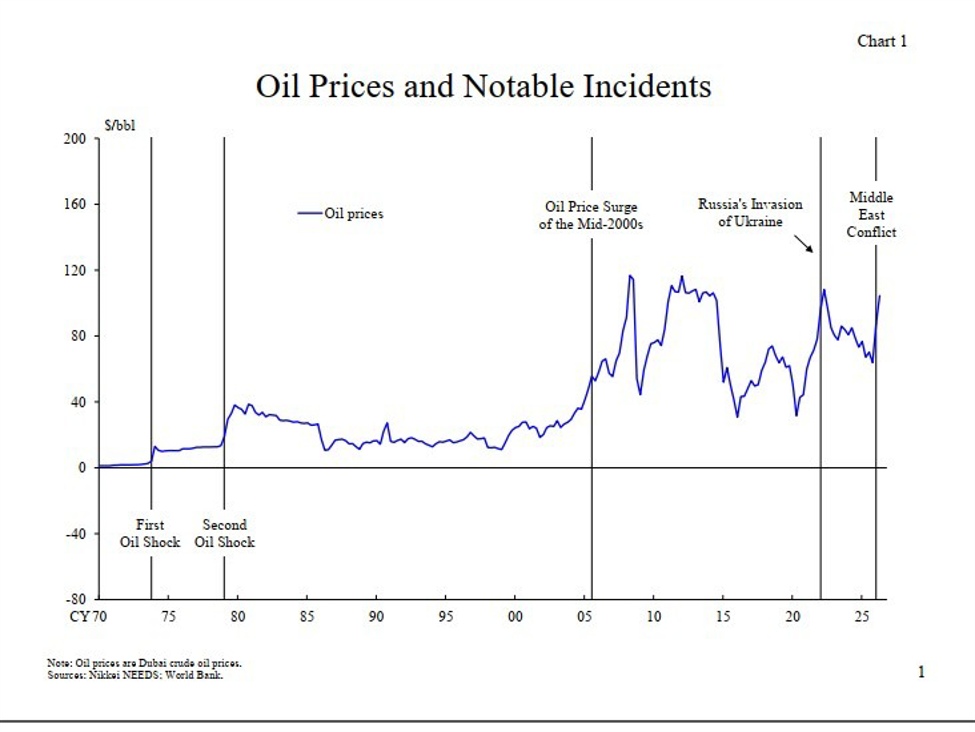
BOJ Governor Ueda says the current Middle East conflict represents Japan’s fifth major oil shock, warning that initial conditions including wages, expectations and exchange rates will determine whether it proves temporary or persistent.Summary:
Source: BOJ Governor Kazuo Ueda, opening remarks at the 2026 BOJ-IMES Conference, May 27Ueda identified five major oil price episodes since the 1970s, using Japan’s contrasting responses to frame the policy challenge posed by the current Middle East conflictThe first oil shock of 1973 produced a wage-price spiral with inflation and wages both reaching 20-30%, partly because monetary tightening came too late and was insufficientThe second oil shock of 1979 was contained by faster policy response, more restrained wage behaviour, prior yen appreciation, and firms having learned from the first episodeDuring the mid-2000s oil surge, Japan’s deflationary equilibrium meant higher energy costs acted as an income tax rather than triggering broader inflation; core CPI remained negative throughoutThe post-2021 episode was different: a broader shock spanning energy, food and logistics, combined with yen depreciation, tighter labour markets and shifting price norms, moved Japan away from its deflationary equilibrium without producing a 1970s-style spiralJapan’s medium to long-term inflation expectations have risen to a 1.5-2% range, leaving less buffer than in previous episodes; Ueda said the current shock is a direct test of what inflation regime Japan now inhabitsBank of Japan Governor Kazuo Ueda used his opening remarks at the 2026 BOJ-IMES Conference to place the current Middle East oil shock in the context of five decades of Japanese inflation history, delivering a pointed message to global policymakers: the same oil price increase can produce radically different outcomes depending on the economic regime it enters.Speaking in Tokyo on Wednesday, Ueda walked through four previous episodes of major energy price disruption, using Japan’s contrasting responses to illuminate the factors that determine whether a cost shock remains temporary or metastasises into a broader inflationary problem.The first oil shock of 1973 was the cautionary case. Japan entered that episode with inflation already running close to 10% and wage growth near 20%. The shock amplified existing momentum, producing a classic wage-price spiral in 1974. The BOJ tightened, but only after high inflation dynamics had already embedded, and the degree of tightening proved inadequate. The economy contracted sharply before recession and policy finally brought prices down, at considerable cost.The second shock of 1979 told a different story. Monetary policy moved more promptly, but Ueda was careful to note that this was not the whole explanation. Firms and unions had absorbed the lesson of the first episode and resisted the temptation to fully compensate for energy costs through wage increases. Prior yen appreciation had cushioned import prices, and Japanese industry had begun reducing oil dependence. The shock slowed growth and raised inflation, but the spiral did not repeat.The mid-2000s episode illustrated the opposite extreme. By then Japan had settled into a deflationary equilibrium, and even a substantial rise in oil and commodity prices could not break it. Firms would not raise prices; wages stagnated; expectations remained anchored near zero. Higher energy costs functioned as a drag on real income without generating any self-reinforcing inflation dynamic.The post-2021 episode was more complex and, Ueda argued, more instructive for the present. A shock that was broader in scope, amplified by yen depreciation, tightened labour markets and changing price norms combined to shift Japan away from its deflationary equilibrium. Medium to long-term inflation expectations have moved up to a 1.5-2% range. Yet Japan has not revisited the 1970s. That, Ueda suggested, reflects how far expectations had to travel from near-zero before reaching dangerous territory, a buffer that the United States and Europe did not have when their own shocks arrived.The policy conclusion Ueda drew was deliberately open-ended but carried a clear analytical weight. Central banks should not assess oil shocks in isolation. The critical variables are wages, inflation expectations, demand conditions and exchange rates. A temporary shock can become permanent if those channels activate; a large shock can remain contained if they do not. With Japan now facing what Ueda called a fifth oil shock, the question of which inflation regime the country currently inhabits is, he said, exactly the right one to be debating.—Ueda’s framing of the current Middle East conflict as a fifth oil shock carries direct policy implications for the BOJ’s rate path. His emphasis on initial conditions as the decisive variable signals that the central bank is watching wage growth, inflation expectations and exchange rate dynamics as closely as the oil price itself. The observation that Japan’s medium to long-term inflation expectations have shifted to a 1.5-2% range, up from near-zero, means the BOJ is now operating in a regime where a cost shock carries materially more second-round risk than it did during the mid-2000s episode. Any acceleration in spring wage negotiation outcomes or further yen weakness would tighten the BOJ’s room to remain accommodative. Markets should read the speech as a governor carefully laying the analytical groundwork for a policy response that is data-dependent but not passive.
This article was written by Eamonn Sheridan at investinglive.com.
💡 DMK Insight
Japan’s oil shock could ripple through global markets, and here’s why traders need to pay attention: With ETH currently at $2,079.96, the implications of rising oil prices could affect not just energy stocks but also cryptocurrencies, as inflationary pressures mount. If the BOJ’s Ueda is right about the persistence of this shock, we might see a shift in monetary policy that could strengthen the yen against other currencies, impacting forex pairs like USD/JPY. Traders should keep an eye on how this affects risk sentiment across markets. A sustained rise in oil could lead to increased volatility in crypto, especially if ETH breaks below key support levels. Watch for ETH to hold above $2,000 to maintain bullish momentum; a drop below could trigger sell-offs. On the flip side, if the market perceives the oil shock as temporary, we might see a quick rebound in risk assets, including cryptocurrencies. The real story is how traders react to these macroeconomic signals. Keep an eye on wage growth and inflation indicators in Japan, as they could dictate the BOJ’s next moves and influence global market dynamics.
📮 Takeaway
Monitor ETH’s support at $2,000; a break below could trigger significant sell-offs amid rising oil prices.