
 Bitcoin
  Ethereum
  Tether
  BNB
BNB  XRP
XRP  USDC
USDC  Solana
  TRON
TRON  Lido Staked Ether
  Figure Heloc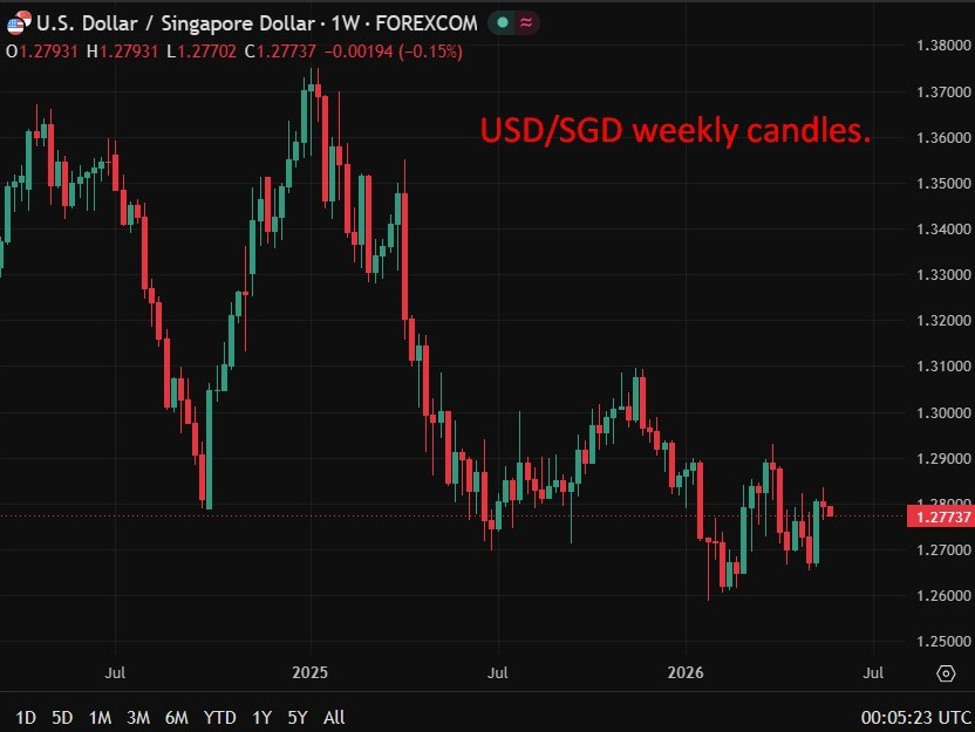
Singapore’s economy grew 6.0% year-on-year in Q1 2026, well above the advance estimate of 4.6%, though the trade ministry kept its full-year forecast at 2.0% to 4.0% amid Iran war risks. (Summary:
Source: Singapore Ministry of Trade and IndustryQ1 GDP came in at 6.0% year-on-year, well above both the advance estimate of 4.6% and the Reuters poll consensus of 5.1%; the quarter-on-quarter seasonally adjusted reading was 1.0%, reversing an advance estimate of a 0.3% contractionThe MTI held its full-year 2026 growth forecast at 2.0% to 4.0% but said the Middle East conflict has significantly raised downside risks and weakened the external demand outlook compared to its February assessmentNon-oil domestic exports are forecast to grow 3.0% to 5.0% for 2026, per Enterprise SingaporeThe MAS tightened monetary policy in April over Iran war inflation risks, its first move after three consecutive holds, and raised core and headline inflation forecasts to 1.5% to 2.5% from 1.0% to 2.0%Core inflation ran at 1.7% year-on-year in March; April inflation data is due Monday afternoonSingapore’s economy expanded at a far stronger pace than initially estimated in the first quarter of 2026, delivering a year-on-year growth rate of 6.0% against an advance estimate of 4.6% and well ahead of the Reuters poll consensus of 5.1%. On a seasonally adjusted quarter-on-quarter basis, GDP grew 1.0%, a sharp turnaround from the 0.3% contraction flagged in the preliminary reading.The Ministry of Trade and Industry chose to hold its full-year growth forecast unchanged at 2.0% to 4.0%, a decision that signals caution rather than confidence. The ministry was explicit that the ongoing conflict in the Middle East has significantly raised downside risks to that range and that Singapore’s external demand outlook has weakened materially since its February assessment. For a city-state whose prosperity is tightly coupled to global trade flows and energy price stability, the Iran war represents a structural headwind that a strong quarterly print cannot fully offset.Singapore has already begun adjusting its policy settings accordingly. The Monetary Authority of Singapore tightened in April, its first such move after holding steady across three consecutive meetings, citing the risk that the conflict would push inflation higher. At the same time, it raised both its core and headline inflation forecasts for 2026 to a range of 1.5% to 2.5%, up from the previous 1.0% to 2.0% band. Core inflation was running at 1.7% year-on-year as of March, and economists expect a similar reading when April data is released later on Monday.The Q1 beat offers a degree of buffer. Growth running ahead of expectations gives policymakers more room to absorb external shocks without an immediate policy response, and reduces the risk that the MAS needs to ease into a deteriorating trade environment. But with global growth and interest rate trajectories both unsettled by the Middle East conflict, Singapore’s strong opening quarter may prove a difficult act to follow.—The upside surprise removes near-term recession fears for Singapore but is unlikely to shift the Monetary Authority of Singapore’s policy stance given the inflation risks the Iran conflict continues to generate. The MAS already tightened in April and raised its inflation forecasts for the year; Monday’s strong print gives it room to hold without appearing behind the curve. For regional risk sentiment, a robust Singapore number is a broadly supportive signal, though the trade ministry’s explicit warning on downside risks tempers any straightforward bullish read.
This article was written by Eamonn Sheridan at investinglive.com.
💡 DMK Insight
Singapore’s Q1 growth at 6.0% is a surprise, but the full-year forecast remains cautious. This divergence highlights the tension between strong initial performance and looming geopolitical risks, particularly from the Iran conflict. For traders, this could mean volatility in Singapore’s currency and related assets, especially if the situation escalates. Watch how the Singapore dollar reacts against major pairs like the USD, as a strong GDP print might initially bolster the SGD, but ongoing risks could lead to a sell-off. Key levels to monitor are the SGD/USD at recent highs and any shifts in market sentiment that could push it back down. Also, consider the broader implications for regional markets; if Singapore’s growth is under threat, neighboring economies could follow suit, impacting trade and investment flows. Keep an eye on upcoming economic indicators that might provide more clarity on the sustainability of this growth. The real story is whether this growth can hold up against external pressures, so traders should be ready to adjust positions based on geopolitical developments.
📮 Takeaway
Watch the SGD/USD closely; geopolitical tensions could reverse gains despite strong Q1 growth, impacting trading strategies.