
 Bitcoin
  Ethereum
  Tether
  BNB
BNB  XRP
XRP  USDC
USDC  Solana
  TRON
TRON  Lido Staked Ether
  Figure Heloc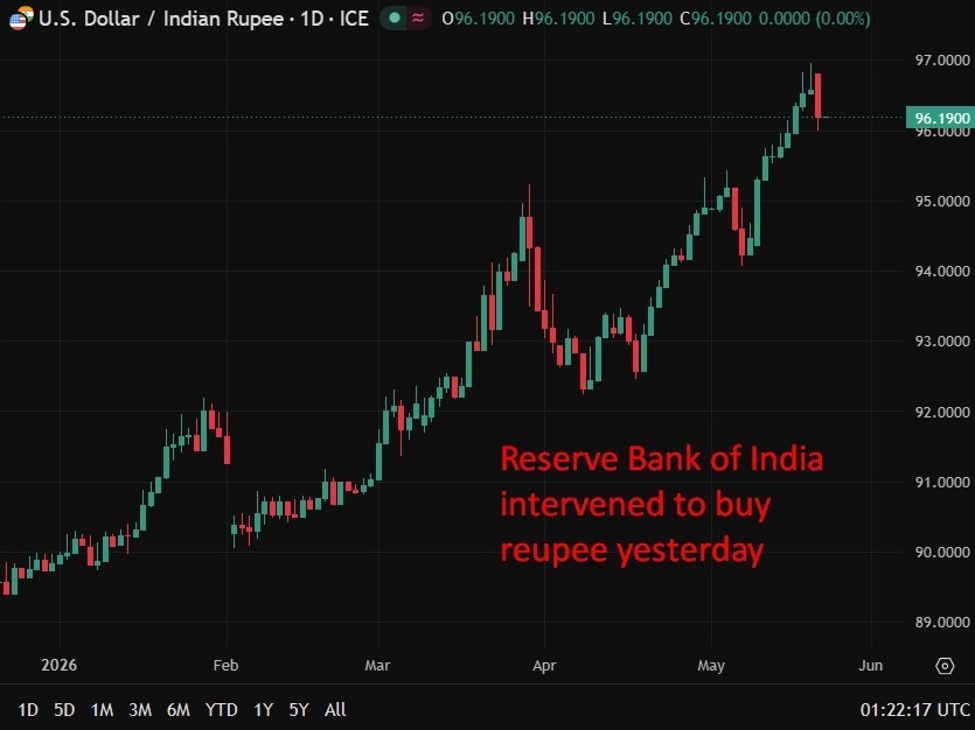
The RBI is expected to transfer a record 3.05 trillion rupees to the Indian government, but economists polled by Reuters say the windfall will not prevent New Delhi from missing its fiscal deficit target. Yesterday: Intervention by the Reserve Bank of India sends the rupee sharply higher.Summary:
Source: Reuters poll of 25 economists, conducted May 19-20The RBI is expected to transfer a record 3.05 trillion rupees ($31.5 billion) to the government, the midpoint of a poll range of 2.9 to 3.2 trillion rupeesThe transfer, driven largely by profits on US dollar sales as the RBI intervened to support the rupee, would be the highest share of expected government revenue in more than two decades, excluding fiscal year 2019-2020The RBI’s contingency reserve is currently held at the top of its recommended 4.5 to 7.5 percent range; amounts above that threshold are transferred to the governmentTwelve of 22 economists said the government is becoming excessively reliant on RBI transfers, which have risen 55-fold over two decadesThe median fiscal deficit forecast from the poll is 4.7% of GDP for the current fiscal year, above the government’s 4.3% target; some economists put it as high as 5%Higher crude oil prices, a record-low rupee, weaker revenue growth, and potential additional spending linked to the Iran war are all seen as pressures on public finances that the RBI transfer cannot fully offsetThe Reserve Bank of India is expected to hand the government a record surplus transfer of around 3.05 trillion rupees when it reports the figure on Friday, a windfall generated largely from profitable dollar sales during foreign exchange interventions, but economists are warning that the bumper payment will not be enough to keep India’s fiscal deficit on target.A Reuters poll of 25 economists put the likely transfer in a range of 2.9 trillion to 3.2 trillion rupees, equivalent to between $30 billion and $33.1 billion. The 3.05 trillion rupee midpoint would match the government’s own budget forecast and would represent the largest share of expected government revenue in more than two decades, with the exception of the fiscal year 2019-2020.The scale of the transfer reflects the RBI’s intervention activity over the past year, during which it sold US dollars heavily to arrest the rupee’s slide. Under the accounting framework applied to those sales, gains are calculated against the historical average price of the central bank’s foreign exchange purchases, which sits well below the current dollar-rupee rate. The result is a large book profit that feeds directly into the surplus available for transfer to the Treasury.Under rules revised from an original 2019 framework, the RBI is expected to maintain a contingency reserve equivalent to between 4.5 and 7.5 percent of its balance sheet, transferring any surplus above that band to the government. The reserve is currently held at the upper end of that range at 7.5 percent.Despite the size of the expected payment, a slim majority of economists in the poll expressed concern about the trajectory. Twelve of 22 respondents said the government has become too dependent on these transfers, which have grown 55-fold over two decades. The worry is not just one of optics: if markets come to believe that fiscal discipline is being maintained through central bank transfers rather than genuine revenue generation or spending restraint, the credibility cost could eventually show up in bond yields and the currency.The fiscal arithmetic is already under strain from the Iran war. Higher crude oil prices are increasing India’s import bill, the rupee has touched record lows, revenue growth is softening, and the prospect of additional government spending to cushion the energy shock adds further pressure. Median poll forecasts put the fiscal deficit at 4.7 percent of GDP for the current year, against the government’s 4.3 percent target, with some economists pencilling in a figure as high as 5 percent, compared with last year’s 4.4 percent outcome.Not all analysts take a uniformly critical view. Some point to genuine efforts by the government to improve the quality and composition of public spending alongside the balance sheet support provided by RBI transfers. But the broader message from the poll is clear: a record central bank dividend buys room, not resolution.—A transfer at or near the 3.05 trillion rupee midpoint would provide a near-term cushion for Indian government finances but is unlikely to materially shift the rupee or bond market given that the figure broadly matches the government’s own budget forecast. The more significant market signal is the fiscal deficit trajectory: a print heading toward 4.7 percent or higher would keep pressure on Indian government bonds and weigh on sentiment toward the rupee at a time when crude oil prices are already straining the current account. The debate over the RBI’s growing role as a fiscal backstop adds a longer-term credibility dimension that markets will not ignore indefinitely.
This article was written by Eamonn Sheridan at investinglive.com.
💡 DMK Insight
The RBI’s record transfer of 3.05 trillion rupees is a game-changer, but it won’t solve the fiscal deficit issue. While the rupee’s recent surge indicates market optimism, traders should be cautious. The expectation that this windfall will prevent New Delhi from missing its fiscal deficit target suggests underlying economic challenges. The rupee’s strength could be short-lived if the government fails to manage its fiscal responsibilities effectively. Traders should watch the 82.00 level for the rupee against the dollar; a break below could signal further strength, while failure to hold could lead to a pullback. Additionally, keep an eye on upcoming economic data releases that could impact sentiment. Here’s the flip side: if the government uses this windfall wisely to stimulate growth, it could bolster investor confidence and support the rupee. But if mismanaged, we could see increased volatility. Monitor the fiscal policy announcements closely, as they could provide insight into the government’s strategy moving forward.
📮 Takeaway
Watch the rupee at the 82.00 level; a break could signal further strength, but fiscal mismanagement may lead to volatility.