Bitcoin
  Ethereum
  Tether
  XRP
XRP  BNB
BNB  USDC
USDC  Solana
  TRON
TRON  Lido Staked Ether
  Figure Heloc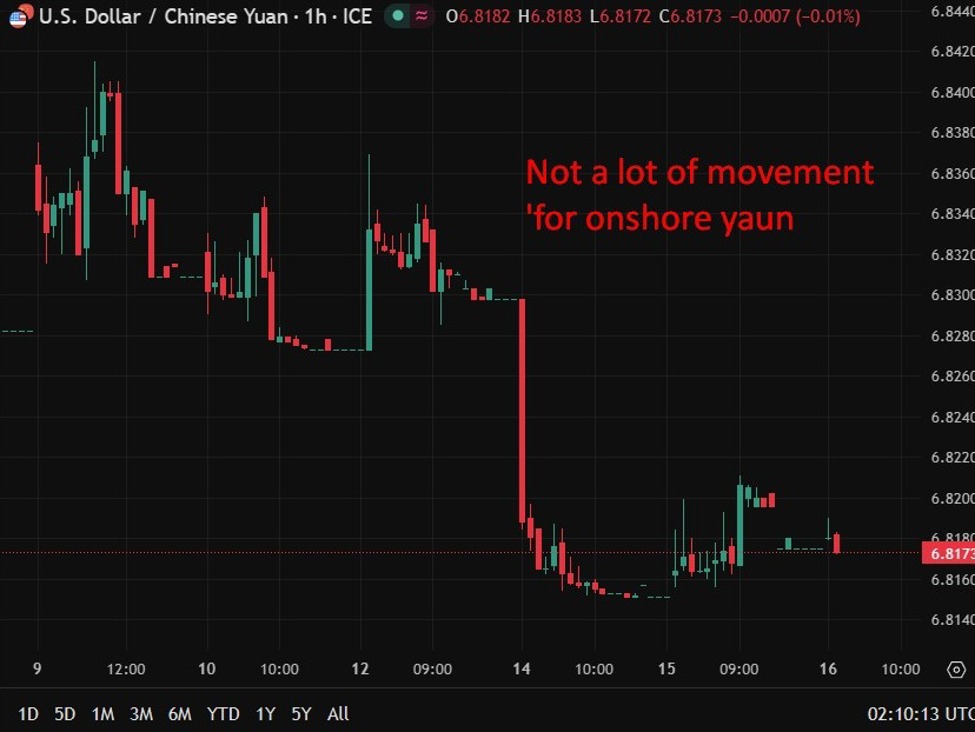
China industrial output beat forecasts in March, but retail sales missed and property investment stayed weak, highlighting a fragile recovery as the Iran war adds to growth risks.Earlier:China Q1 GDP beats forecasts but Iran war risks loomChina March new home prices -3.4% y/y (February -3.2%)Summary:China industrial production rose 5.7% y/y (exp 5.3–5.5%; prior 6.3%), beating forecasts.
Retail sales slowed sharply to 1.7% y/y (exp 2.3–2.4%; prior 2.8%), missing expectations.
Fixed-asset investment came in at 1.7% y/y (exp 1.9%; prior 1.8%), undershooting forecasts.
Property investment remained deeply negative at -11.2% y/y (prev -11.1%).
Surveyed unemployment rate rose to 5.4% (exp 5.2%; prior 5.3%).
Data show a mixed picture: industrial resilience but weak consumption and ongoing property drag.China’s March activity data painted a mixed picture of the economy, with stronger-than-expected industrial output offset by weakness in consumption and continued stress in the property sector, as the early effects of the Iran war begin to filter through.Industrial production rose 5.7% year-on-year in March, beating expectations for around 5.3–5.5%, although the pace slowed from 6.3% growth in the first two months of the year. On a year-to-date basis, output expanded 6.1%, slightly below expectations and easing from earlier momentum, suggesting some moderation in factory activity.In contrast, retail sales disappointed, rising just 1.7% year-on-year, well below expectations of around 2.3–2.4% and down from 2.8% previously. The weakness underscores ongoing fragility in household demand, which remains a key constraint on China’s broader economic recovery.Investment data also came in soft. Fixed-asset investment grew 1.7% year-to-date, missing expectations and slipping from 1.8% previously. Within that, private sector investment contracted 2.2%, highlighting subdued business confidence, while infrastructure investment remained a relative bright spot with 8.9% growth.The property sector continues to act as a major drag. Real estate investment fell 11.2% year-on-year in the first quarter, with new construction starts plunging more than 20% and developer funding conditions remaining tight. While residential property sales showed some improvement, they remained sharply negative, down 18.5% year-to-date.Labour market conditions also showed signs of softening, with the surveyed unemployment rate rising to 5.4%, above expectations.Taken together, the data suggest China’s economy is entering a more challenging phase. Industrial activity is holding up for now, but weak consumption, falling private investment and a deep property downturn point to underlying fragility.With the Iran war driving higher energy costs and weighing on global demand, the outlook for the coming quarters is increasingly uncertain, with risks skewed toward slower growth. -Mixed for markets: industrial strength supports near-term sentiment, but weak consumption and property risks reinforce expectations of policy support. Growth concerns remain as external shocks build.
This article was written by Eamonn Sheridan at investinglive.com.
💡 DMK Insight
China’s industrial output growth is a silver lining, but retail sales and property investment tell a different story. The 5.7% year-on-year increase in industrial production is impressive, yet the missed retail sales and declining property investment signal underlying weaknesses in consumer confidence and economic stability. With the ongoing Iran war adding geopolitical tension, traders should be cautious. This mixed economic data could lead to volatility in related markets, particularly commodities and currencies tied to China. Watch for how these factors influence the Chinese yuan and commodities like copper and oil, which often react to shifts in Chinese demand. As for trading strategies, consider monitoring key levels in the yuan against the dollar; a break below recent support could indicate further weakness. Also, keep an eye on the property sector, as any signs of recovery or further decline could impact broader market sentiment significantly.
📮 Takeaway
Watch for the yuan’s reaction to these mixed economic signals; a break below key support levels could signal further weakness.