
 Bitcoin
  Ethereum
  Tether
  BNB
BNB  USDC
USDC  XRP
XRP  Solana
  TRON
TRON  Lido Staked Ether
  Figure Heloc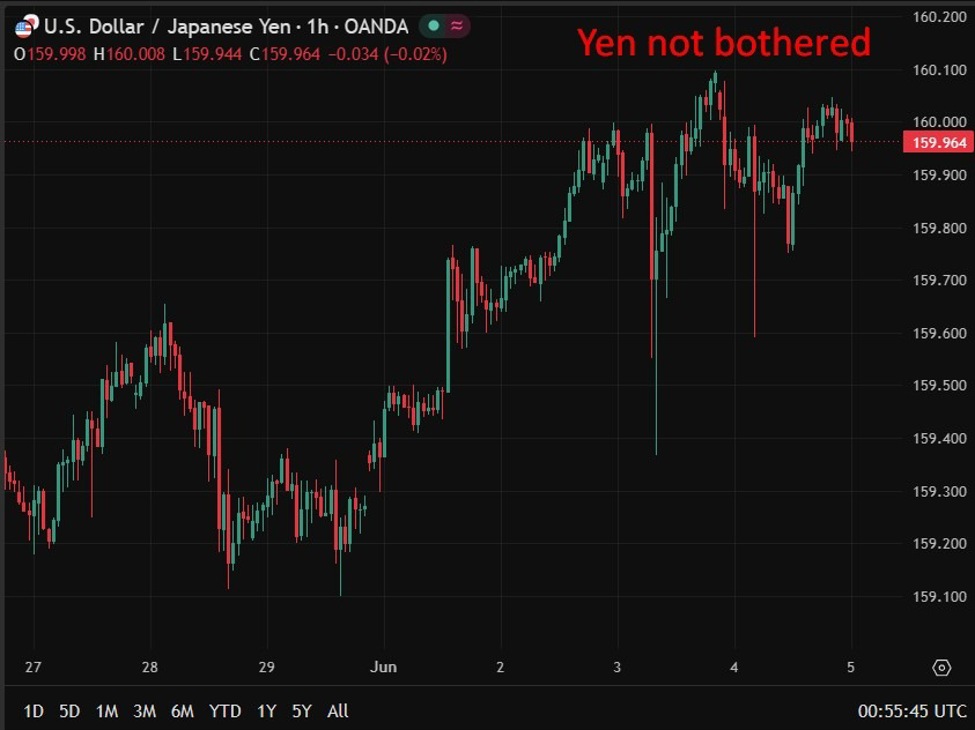
Japan’s finance minister renewed an intervention warning as the yen tested 160 per dollar, while a record drop in May foreign reserves suggests Tokyo may already have acted again. Summary:
The following draws on statements from Japanese Finance Minister Satsuki Katayama, Prime Minister Takaichi, and Japanese Finance Ministry data released on June 4-5:Finance Minister Katayama told parliament Japan will respond appropriately at any time on foreign exchange and reserves the right to take decisive action against excessively volatile currency movesThe yen was trading at around 160.015 per dollar, having touched the 160 level on Wednesday for the first time since April 30; that level is widely regarded as a market threshold for potential official interventionKatayama attributed a large portion of recent yen volatility to speculative activity since the onset of the Middle East war in February, and confirmed Japan and the US are in close contact on market movesTokyo’s intervention authority draws on a joint US-Japan statement from September last year reaffirming market-determined exchange rates while permitting intervention to counter excess volatilityPrime Minister Takaichi acknowledged there are pros and cons to a weak yen and stated her economic policy targets boosting Japan’s economic capability rather than FX manipulationJapan’s foreign reserves fell by the largest amount on record in May, in data available back to 2000, raising the possibility that intervention was conducted at significant scale during the monthMain article:Japan has renewed its warning that it stands ready to intervene in currency markets, with Finance Minister Satsuki Katayama telling parliament on Friday that Tokyo reserves the right to take decisive action against excessive yen volatility, as the currency hovered at the closely watched 160-per-dollar level.The warning carries more weight than usual given what the data is now showing about Japan’s reserve position. The Finance Ministry confirmed that foreign reserves fell by the largest amount on record in May, in a series stretching back to 2000. The scale of that decline is consistent with significant yen-support operations having already been conducted during the month, suggesting Tokyo did not simply watch as the currency weakened but deployed considerable firepower to slow the move.Katayama was careful to frame any future action within the diplomatic architecture Japan has established with Washington. She pointed to a joint statement agreed with the United States in September last year, under which both sides reaffirmed their commitment to market-determined exchange rates while acknowledging that intervention may be warranted to counter excess volatility. Her comment that Japan and the US remain in close contact on market moves was a deliberate signal that any intervention would not come as a surprise to Washington and would be defensible under the existing bilateral framework.She also offered an explanation for the yen’s recent weakness, placing significant blame on speculative flows that have intensified since the outbreak of the Middle East conflict in February. That framing is relevant because it characterises the volatility as externally driven and disorderly rather than a reflection of underlying fundamentals, which strengthens the case for official intervention under the terms of the joint statement.Prime Minister Takaichi added a nuanced note, acknowledging that a weak yen carries both costs and benefits for the Japanese economy, while being clear that her administration’s policy objective is to strengthen economic capacity rather than to target any specific exchange rate. The distinction matters politically, as any perception that Japan is deliberately weakening the yen to gain trade advantage would invite friction with trading partners, particularly the United States.With reserves already depleted at a record pace and the yen back at a level that has historically triggered action, the question for markets is less whether Tokyo will intervene again than when and how forcefully.—Japan’s finance minister renewed an intervention warning as the yen tested 160 per dollar, while a record drop in May foreign reserves suggests Tokyo may already have acted again.The combination of a record monthly drop in foreign reserves and a renewed intervention warning from the finance minister is a direct signal to yen bears that Tokyo is prepared to act, and may already have done so at scale in May. The 160 level has now been tested twice in recent weeks, and Katayama’s explicit invocation of the joint US-Japan statement on excess volatility gives the intervention threat formal diplomatic cover. Traders will be weighing the cost of holding short-yen positions against the risk of a sudden, large official move, particularly given the reserve data suggests the Ministry of Finance has already shown willingness to deploy significant firepower.
This article was written by Eamonn Sheridan at investinglive.com.
💡 DMK Insight
The yen’s plunge to 160 per dollar is a critical moment for traders: Japan’s finance minister is signaling potential intervention. With foreign reserves hitting record lows, it’s clear that the Bank of Japan might already be stepping in to stabilize the currency. This situation is particularly relevant for forex traders, as a government intervention could lead to sharp reversals or increased volatility. If the yen continues to weaken, watch for intervention levels around 160, as that could trigger significant market reactions. Additionally, this could impact correlated assets like Japanese equities, which often move inversely to yen strength. Keep an eye on the daily charts for any signs of reversal patterns or increased volume around these key levels, as they could provide actionable insights for short-term trades.
📮 Takeaway
Watch for intervention signals from Japan if the yen breaches 160 per dollar; this could lead to volatility in forex and Japanese equities.