
 Bitcoin
  Ethereum
  Tether
  XRP
XRP  BNB
BNB  USDC
USDC  Solana
  TRON
TRON  Lido Staked Ether
  Figure Heloc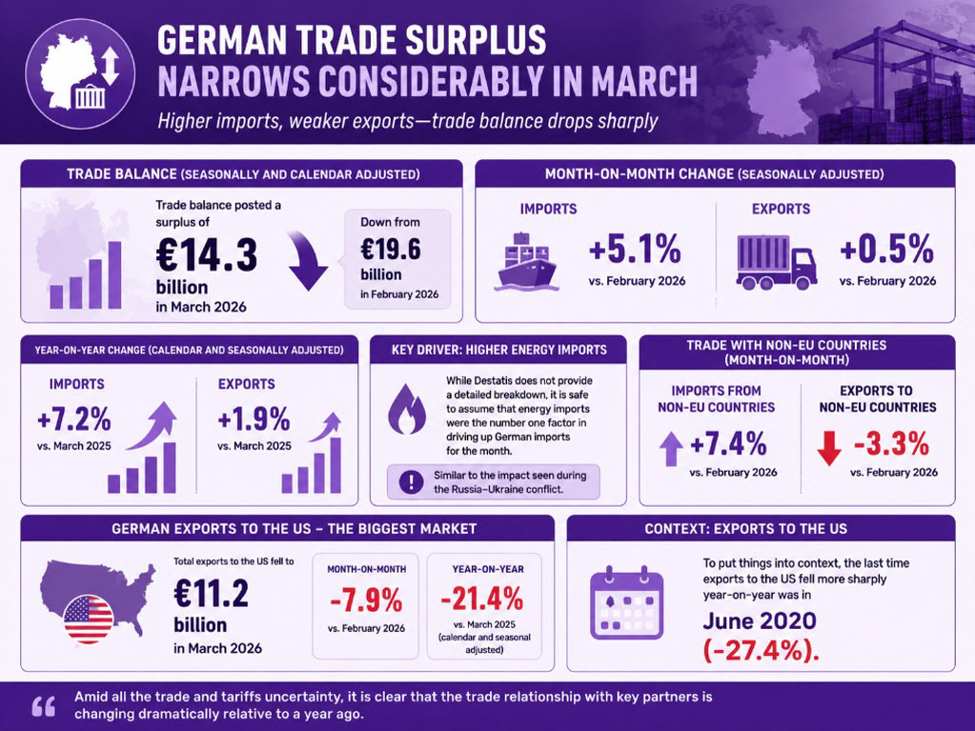
Overall imports increased by 5.1% on the month while exports were only seen up 0.5% on the month. And when compared to the same month a year ago, imports were markedly higher by 7.2% with exports only up by 1.9% relative to March 2025.While Destatis does not provide a detailed breakdown, it is safe to assume that energy imports were the numbers one factor in driving up German imports for the month. That as prices surged higher amid the US-Iran conflict. Thus, leading to the narrower trade surplus overall – which looks to be a repeat to the time of the Russia-Ukraine conflict.Of note, imports from non-EU countries jumped up considerably by 7.4% on the month. In contrast, exports to these countries fell markedly by 3.3% on the month.On the latter, the most notable is German exports to the US. While it still accounts for the biggest portion of German exports, the total figure fell to €11.2 billion. That represents a 7.9% drop compared to the month before. And when compared to March 2025, it reflects a 21.4% decline after adjusting for calendar and seasonal variations.Amid all the trade and tariffs uncertainty, it is clear that the trade relationship here is changing dramatically relative to a year ago.To put things into context, the last time exports to the US fell more sharply year-on-year was in June 2020 (-27.4%).
This article was written by Justin Low at investinglive.com.
💡 DMK Insight
So, imports are up 5.1% this month while exports barely budged at 0.5%. Here’s why that matters: this imbalance could signal a weakening domestic production capacity, which might affect currency values and trade balances. When imports rise significantly compared to exports, it often leads to a trade deficit, putting downward pressure on the currency. For traders, this could mean watching the EUR/USD pair closely; if the euro weakens, it might create shorting opportunities. Additionally, the broader economic implications could ripple into commodities, especially if demand for imported goods continues to rise without a corresponding increase in exports. It’s worth noting that while imports have surged by 7.2% year-over-year, exports lagged at just 1.9%. This trend could lead to increased volatility in forex markets as traders react to potential shifts in monetary policy or economic forecasts. Keep an eye on key support and resistance levels in the euro, particularly around recent lows, as these could indicate where the market is headed next.
📮 Takeaway
Watch the EUR/USD closely; a continued trade imbalance could lead to euro weakness, creating potential shorting opportunities.