 Bitcoin
  Ethereum
  Tether
  XRP
XRP  BNB
BNB  USDC
USDC  Solana
  TRON
TRON  Lido Staked Ether
  Figure Heloc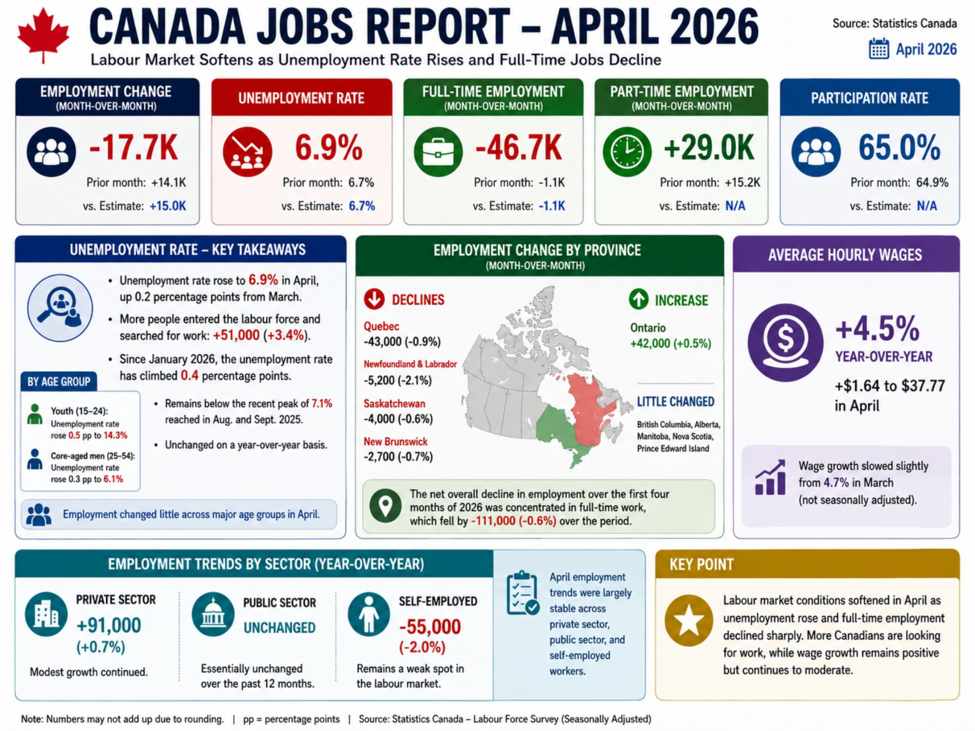
Prior month 14.1KEmployment change -17.7K vs 15.0 estimateUnemployment rate 6.9% vs 6.7% estimateFull time employment -46.7K vs -1.1K last monthPart-time employment 29.0K vs 15.2K last monthParticipation rate 65.0% vs 64.9% last month.Details from Statistics Canada:Employment changed little across major age groups in April.
The unemployment rate for youth aged 15–24 rose by 0.5 percentage points to 14.3%.
The unemployment rate for core-aged men (25–54) increased by 0.3 percentage points to 6.1%.
Employment declined in:
Quebec: -43,000 (-0.9%)
Newfoundland and Labrador: -5,200 (-2.1%)
Saskatchewan: -4,000 (-0.6%)
New Brunswick: -2,700 (-0.7%)
Employment increased in Ontario by +42,000 (+0.5%).
Employment was little changed in the remaining provinces.
Average hourly wages rose 4.5% year-over-year, increasing by $1.64 to $37.77 in April.
Wage growth slowed slightly from 4.7% in March (not seasonally adjusted).The net overall decline in employment over the first four months of 2026 was concentrated in full-time work, which fell by -111,000 (-0.6%) over the period.April employment trends were largely stable across private sector, public sector, and self-employed workers.Private sector hiring continued to show modest growth, with employment up 91,000 (+0.7%) from a year earlier.
Self-employment remained a weak spot in the labor market, falling by 55,000 (-2.0%) year-over-year.
Public sector employment was essentially unchanged over the past 12 months.On the job in the unemployment rate:Canada’s unemployment rate rose to 6.9% in April, up 0.2 percentage points from the prior month.
The increase came as more people entered the labor force and searched for work, with job seekers rising by 51,000 (+3.4%).
Since January 2026, the unemployment rate has climbed 0.4 percentage points, signaling some softening in labor market conditions.
Despite the recent rise, unemployment remains below the 7.1% peak reached in August and September 2025.
On a year-over-year basis, the unemployment rate was essentially unchanged.Overall the Canada jobs report was weaker than expectations with the unemployment rate moving higher, jobs negative and all the declines was in the full time jobs (weakness). The USDCAD has moved higher (weaker CAD) give the stronger US jobs report and the weaker Canada report. The rprice is extending to a new high for the week (above 1.3665). The next target comes in at the 38.2% of the move down from the April high at 1.3708 and swing area at the same area between 1.37089 and 1.37149. The 100 day MA is at 1.37198. Overview of the Labour Survey:For background, the Labour Force Survey, published monthly by Statistics Canada, provides comprehensive data on employment, unemployment, and labour force participation across Canada. Released on the first or second Friday of each month at 8:30 a.m. ET, the report surveys approximately 56,000 households and tracks employment changes by industry, province, full-time versus part-time status, and demographic characteristics. The survey measures not only net job creation but also unemployment rates, wage growth, and labour force participation, offering insights into the health of Canada’s economy. The data is closely monitored by the Bank of Canada when setting monetary policy and by economists assessing economic conditions. At the moment, there are no further cuts priced in for the Bank of Canada.
This article was written by Greg Michalowski at investinglive.com.
💡 DMK Insight
Canada’s employment data is a mixed bag, and here’s why it matters for ADA: With ADA currently at $0.27, the recent employment change of -17.7K against an estimate of 15.0K signals potential economic weakness. The unemployment rate ticking up to 6.9% from an expected 6.7% could dampen consumer confidence and spending, which might indirectly affect crypto investments. If traders see a correlation between economic performance and crypto demand, ADA could experience volatility as market sentiment shifts. Moreover, the participation rate slightly increased to 65.0%, suggesting more individuals are entering the job market, but the overall negative employment change raises concerns. If this trend continues, we might see a bearish sentiment in ADA and other cryptocurrencies as investors pull back. Keep an eye on ADA’s support levels; a break below $0.25 could trigger further selling pressure. On the flip side, if ADA can hold above this level, it might attract bargain hunters looking for a rebound. Watch for upcoming economic reports and how they might influence crypto sentiment, especially if employment trends worsen.
📮 Takeaway
Monitor ADA closely; a drop below $0.25 could signal increased selling pressure, while holding above may attract buyers.