Bitcoin
  Ethereum
  Tether
  XRP
XRP  BNB
BNB  USDC
USDC  Solana
  TRON
TRON  Lido Staked Ether
  Figure Heloc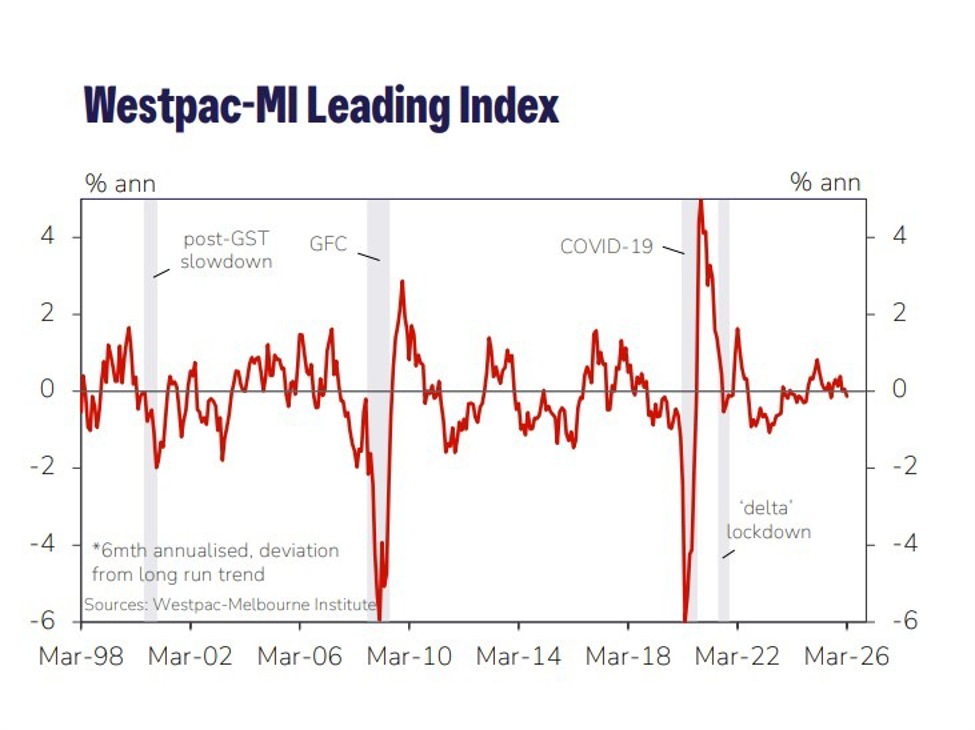
Australia’s Leading Index fell to –0.13% in March, slipping below trend for the first time since August, signalling softer growth ahead as higher rates and energy shocks weigh on activity.Summary:Leading Index falls to –0.13% in March (from +0.05%)
First below-trend reading since August last year
Signals weaker growth outlook into late 2026
Momentum has fallen sharply since October peak
Higher interest rates weighing on activity
Global energy shock adding pressure
Points to sustained but softer expansionAustralia’s growth outlook has softened, with the Westpac–Melbourne Institute Leading Index slipping back into below-trend territory in March, signalling a loss of economic momentum heading into the second half of 2026.The six-month annualised growth rate of the index, which tracks the likely pace of activity three to nine months ahead, fell to –0.13% in March, down from +0.05% in February. The move marks the first below-trend reading since August last year, indicating that the economy is no longer expanding at its typical pace.While the deterioration is not yet severe, the shift suggests that the growth pulse has weakened materially over recent months. The index has now declined steadily from a peak of +0.31% in October to around –0.15% currently, representing a cumulative slowdown of roughly 0.44 percentage points. This reversal highlights a clear loss of momentum after a period of relative resilience.Westpac notes that the slowdown reflects a combination of domestic and global pressures. Higher interest rates are continuing to weigh on activity, tightening financial conditions and dampening demand across key sectors. At the same time, the global energy shock linked to Middle East tensions is adding to cost pressures, complicating the outlook for both households and businesses.The March reading suggests that below-trend growth is likely to persist through the remainder of 2026. Although the current pace does not point to a sharp downturn, it does indicate a more subdued expansion phase, with risks tilted toward further softening if external pressures intensify.Historically, similar below-trend readings have been associated with periods of economic strain, including the prolonged weakness seen during the 2022–2024 cost-of-living crisis. While conditions today are less severe, the re-emergence of below-trend growth underscores the fragility of the recovery and the sensitivity of the economy to both policy settings and global shocks.From a policy perspective, the data presents a nuanced challenge. While growth is clearly moderating, persistent inflation pressures—particularly those stemming from energy—continue to complicate the outlook for monetary policy. This reinforces the likelihood that policymakers will remain cautious, balancing the need to contain inflation against signs of slowing activity.
This article was written by Eamonn Sheridan at investinglive.com.
💡 DMK Insight
Australia’s Leading Index just dipped below trend, and here’s why that matters: This decline to –0.13% from +0.05% is a clear signal that economic growth is slowing, influenced by rising interest rates and energy price shocks. For traders, this could mean a shift in sentiment towards Australian assets, particularly the AUD. If the trend continues, we might see increased volatility in forex pairs involving the AUD, especially against the USD. Keep an eye on how this impacts commodities, as weaker growth could dampen demand for resources, affecting prices in the energy and materials sectors. But don’t overlook the potential for a contrarian play here. If the market overreacts to this data, there could be a buying opportunity in undervalued sectors that typically rebound after initial downturns. Watch for key technical levels in the AUD/USD pair; a break below recent support could trigger further selling pressure. As we move into the next month, monitor any shifts in central bank rhetoric that could influence interest rates, as this will be crucial for gauging future market direction.
📮 Takeaway
Watch the AUD/USD closely; a break below recent support levels could signal further downside as growth concerns mount.