 Bitcoin
  Ethereum
  Tether
  BNB
BNB  XRP
XRP  USDC
USDC  Solana
  TRON
TRON  Lido Staked Ether
  Figure Heloc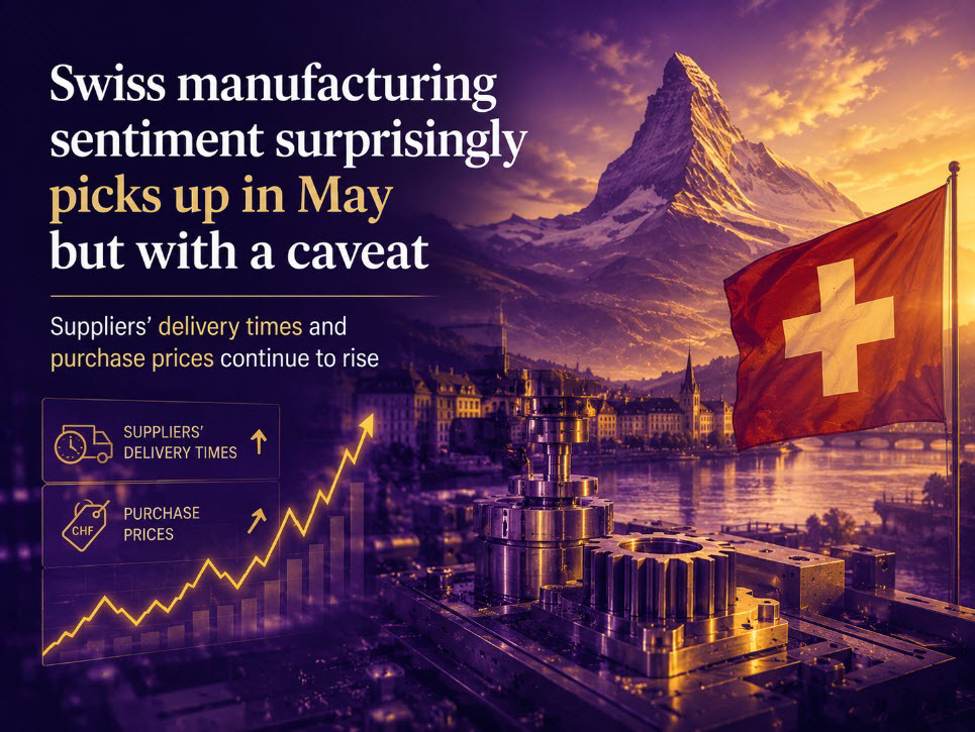
Manufacturing PMI 57.3 vs 53.5 expectedPrior 54.5The overall index jumps to a near three-year high but it comes amid a fresh decline in output and new orders on the month. Instead, the rise is largely in part driven by higher suppliers’ delivery times – which increased by another 1.6 points to 65.7 in May. Just be wary that this sub-index tends to have a positive contribution to the overall headline estimate.For some context, intensification of supply chain delays are normally viewed as a sign of busier vendors due to higher demand and positive in terms of economic growth. However, the Middle East conflict is not a telling sign of that as the deterioration in vendor times is largely tied to the effective closure of the Strait of Hormuz.The supply chain disruption also sees a further increase in order backlogs – up 3.3 points to 59.4, the highest since April 2022. Meanwhile, purchase prices continue to stay elevated on the month as well (down 0.1 points to 82.7). Firms reported notably higher prices for petroleum-based products such as plastics, driven by the current geopolitical situation in the Middle East.So yes, the headline estimate might seem positive and reflect an uptick in sentiment. But again, the devil is in the details. This article was written by Justin Low at investinglive.com. 🔗 Source 💡 DMK Insight The Manufacturing PMI hitting 57.3 is a headline grabber, but here’s the catch: it’s not all roses. While the index is at a near three-year high, the underlying details tell a different story. The increase is primarily due to longer delivery times from suppliers, which can signal supply chain issues rather than robust demand. This divergence could lead traders to rethink their positions, especially those betting on a manufacturing rebound. If output and new orders are declining, it raises questions about sustainability. Traders should keep an eye on related sectors, particularly commodities and stocks tied to manufacturing, as they might react negatively if this trend continues. Watch for the PMI to hold above 55 in the coming months; a drop below that could trigger a reassessment of growth expectations and impact broader market sentiment. 📮 Takeaway Monitor the Manufacturing PMI closely; a sustained drop below 55 could signal deeper economic issues and impact related sectors significantly.

Market outlook for the week of 1st-5th June
The week begins with the release of manufacturing PMI data for the eurozone, the U.K., and the U.S. on Monday followed by the eurozone core CPI flash estimate y/y and the CPI estimate y/y the following day. Also on Tuesday, the U.S. will release its JOLTS job openings report. Wednesday will bring Australia’s GDP q/q data, along with services PMI releases for the eurozone, the U.K., and the U.S. In addition, the U.S. will publish the ADP non-farm employment change report. On Thursday, Switzerland will release its latest inflation data while on Friday, Canada will report its employment change and the unemployment rate. In the U.S., Friday’s key releases will be the average hourly earnings m/m, non-farm employment change, and the unemployment rate. Throughout the week, several FOMC members are expected to deliver remarks. In the U.S., the consensus for the ISM manufacturing PMI is 53.3, compared to the prior 52.7, while the ISM services PMI is expected at 53.8 vs. 53.6 previously. Both manufacturing and services activity are expected to remain in expansionary territory. On the manufacturing side, analysts note that business conditions appear to have improved somewhat since April, supporting forecasts for continued expansion. This view is also reflected in recent regional Federal Reserve surveys. While factory activity appears relatively stable, investors are likely to focus primarily on the prices paid component to assess whether the conflict involving Iran is beginning to translate into broader inflationary pressures. Input costs in the manufacturing sector have risen noticeably, although a similar acceleration in prices has not yet emerged across the services sector, Wells Fargo analysts noted. Despite the latest uncertainty and concerns about elevated costs, the services sector continues to show resilience. Current data suggests that demand remains relatively firm rather than showing signs of a significant slowdown. In the eurozone, the consensus for the core CPI flash estimate y/y is 2.4% vs. the prior 2.2%, while the CPI flash estimate y/y is expected to rise to 3.3% from 3.0%. Overall, eurozone inflation is expected to come in higher, although analysts note that the monthly pace of price growth is likely to slow considerably as energy-related gains lose momentum. This suggests that much of the increase in annual inflation reflects base effects rather than a renewed acceleration in underlying price pressures. The key focus will be on whether inflationary pressures are spreading beyond energy-related sectors. Although input costs have picked up again, there is currently little evidence that businesses are broadly passing those higher costs on to consumers. The ECB will closely monitor this week’s data ahead of its June meeting. While many analysts expect the Bank to deliver a rate hike, softer core inflation or a continued concentration of price pressures in energy-related components could support a more cautious, wait-and-see approach before tightening begins. In Australia, the consensus for GDP q/q is 0.5%, compared to the prior 0.8%. The impact of the conflict in the Middle East is expected to weigh on the country’s economic outlook, but will be only partially reflected in this quarter. Growth is projected to have slowed in Q1 as the economy lost some momentum, although Q2 data will likely provide a clearer picture of the extent of the slowdown. There is also a risk of a temporary contraction if the external headwinds intensify. Westpac analysts note that a key source of support for Q1 was a surge in data center investment. Capital spending in the sector increased sharply during the quarter and remains on an upward trajectory, helping to offset some of the broader economic pressures. Although part of this investment will be reflected in higher imports, it is still expected to provide a meaningful boost to domestic activity. In Canada, the consensus for employment change is 10.2K, compared to the prior -17.7K, while the unemployment rate is expected to remain unchanged at 6.9%. The Canadian economy started the year on the back foot, with Q1 growth flat and unemployment continuing to edge higher. Although there were significant job losses earlier this year, there are signs of resilience in the labour market, analysts from RBC note. Layoffs have been concentrated mainly in trade-exposed sectors, and overall firing activity has eased since late 2025. The rise in the unemployment rate may therefore reflect slower hiring and longer job searches, particularly among new labour market entrants, rather than widespread job cuts. Deputy BoC Governor Nicolas Vincent has described the labour market as “low hire, low fire,” highlighting particular strain among younger workers and those unemployed for longer periods. Hiring plans weakened after the conflict in the Middle East increased business uncertainty, but job postings data suggest some stabilization, with a rebound seen in May after earlier declines. The main wildcard ahead are energy prices: higher oil prices support income in producing regions but risk squeezing consumers and shifting business focus away from hiring. For now, spending trends have not shown significant demand weakness, so the base case still leans cautiously toward gradual labour market stabilization and a slow improvement in unemployment over the remainder of the year. In the U.S., the consensus for average hourly earnings m/m is 0.3%, compared to the prior 0.2%. Non-farm employment is expected to increase by 95K vs. 115K previously, while the unemployment rate is projected to remain unchanged at 4.3%. The U.S. labor market remains in a low-hiring, low-firing environment. Weekly jobless claims are still contained, and layoffs have been largely concentrated in the tech sector, while broader employment trends remain subdued. Hiring momentum has yet to recover meaningfully, as job postings and regional surveys remain broadly flat, and recent data suggests that demand for workers has not picked up again. Analysts at Wells Fargo forecast nonfarm payrolls to increase by around 105K in May. There has been some improvement in more cyclical parts of the economy since late last year, but this is likely to be offset by weakness in areas affected by recent corporate stress and sector-specific layoffs, including air travel with the Spirit Airlines bankruptcy and

Italy May manufacturing PMI 52.9 vs 51.9 expected
Prior 52.1Key findings:Renewed growth in new orders supports stronger increase in manufacturing outputStockpiling efforts support fresh pick-up in order books Delivery delays worsen and inflation intensifiesComment:Eleanor Dennison, Economist at S&P Global Market Intelligence, said: “Faced with even more disruption to supply chains and greater cost pressures brought on by war in the Middle East, manufacturers in Italy are acting to mitigate any risk of production stoppages. Despite accelerated purchasing activity, efforts to build buffer stocks were unsuccessful amid greater instances of delivery delays. “This new improvement in demand seen across the sector is likely to be unsustainable when the boost from stockpiling inevitably fades. However, given that this was one of the strongest injections of new work in over four years, firms upgraded their production volumes in response. “Although good producers again faced another steep and accelerated increase in their average cost burdens, we are not seeing inflation hit the levels seen during the height of the 2022 energy crisis at present.” This article was written by Giuseppe Dellamotta at investinglive.com. 🔗 Source 💡 DMK Insight Manufacturing output is picking up, but supply chain disruptions and inflation are looming threats. The recent growth in new orders suggests a rebound in manufacturing, which is crucial for economic recovery. However, the worsening delivery delays and rising inflation could dampen this momentum. Traders should be cautious; while the uptick in orders might seem positive, the underlying issues could lead to volatility. If inflation continues to rise, it could prompt central banks to tighten monetary policy sooner than expected, impacting asset prices across the board. Keep an eye on sectors tied to manufacturing and commodities, as they might react sharply to these developments. Watch for key economic indicators in the coming weeks, particularly inflation data and supply chain reports, as they could provide insight into whether this growth is sustainable or just a temporary blip. 📮 Takeaway Monitor inflation trends and supply chain reports closely; they could dictate market volatility and affect manufacturing-related assets significantly.

France manufacturing contracts in May as supply chain hit intensifies
Manufacturing PMI 49.7 vs 48.9 prelimPrior 52.8The April growth, as expected, was short-lived as we see an unwinding to the frontrunning of stock in May. While the revised figures are better than initial estimates, it still points to a marginal contraction in business activity. Of note, there were fresh declines in production, new orders, purchasing volumes and stocks as the tailwinds from client stockpiling dissipated.Meanwhile, accelerated increases in both input costs and output charges pointed to intensifying inflationary pressures across France’s industrial sector.Looking at the details, demand conditions were dealt a major setback with the sub-index for new orders wiping out all of the gains made in April. Supply chain pressures were also more intense as vendor delivery times lengthened to the greatest extent since January 2023. Besides that, panellists also noted that shortages of raw materials and transportation, high fuel costs and front-loaded ordering squeezed supplier capacity further on the month.On the inflation front, the rate of input cost inflation jumped to a four-year high. Adding to that is French manufacturers raising their own prices charged in May, and to the greatest degree in 40 months. Trouble, trouble.S&P Global notes that:”As expected, April’s expansion was fleeting. Frontloaded ordering has faded, replaced by falling new business, production cutbacks and inventory reductions. Supply chains are still adjusting to the volatility induced by the war in the Middle East and ensuing energyprice shock. For example, more French manufacturers experienced delivery issues and input price rises than in April – pressures that could play out as higher goods prices and supply issues across the economy more broadly over the coming months. Unfortunately, the policy levers that can meaningfully address the problems created by an external shock on this scale are limited for indebted nations like France.” This article was written by Justin Low at investinglive.com. 🔗 Source 💡 DMK Insight The Manufacturing PMI dropping to 49.7 signals a contraction, and here’s why that matters: This figure, while slightly better than the preliminary estimate of 48.9, indicates that the manufacturing sector is struggling. A PMI below 50 typically reflects a decline in economic activity, which could lead to reduced demand for commodities and a bearish sentiment in related markets. Traders should keep an eye on how this affects the broader economic outlook, especially with inflation and interest rates still in play. If this trend continues, we could see a ripple effect on currencies tied to manufacturing exports, particularly the USD and JPY. Look for key levels around 50.0 as a psychological barrier; a sustained drop below this could trigger further selling pressure in equities and commodities. Additionally, monitor the upcoming economic indicators for any signs of recovery or further decline, as they could provide actionable insights for positioning in the forex and crypto markets. The real story is whether this contraction is a blip or the start of a more significant downturn. 📮 Takeaway Watch the 50.0 level on the PMI; a sustained drop could lead to bearish trends in equities and related currencies.

Germany May final manufacturing PMI 50.1 vs 49.9 prelim
Prior was 51.4Key findings:Manufacturing sector stalls amid waning demand and soaring costs New orders fall for first time in 2026 so far, weighing on output growth Job cuts deepen as cost pressures reach highest since June 2022 Comment:Phil Smith, Economics Associate Director at S&P Global Market Intelligence: “The upturn in the manufacturing sector stalled in May, confirming the warning signs from recent PMI surveys that growth – being driven by the frontloading of orders – was likely to fade. “The true underlying health of demand appears to be showing itself, with new orders falling for the first time this year amid still-elevated levels of uncertainty and soaring prices. “Cost pressures have continued to ratchet up across the manufacturing sector, though the rate output charge inflation stayed broadly in line with that seen in April as weakness in demand led some manufactures to be more cautious with their price setting. “With margins under pressure, something had to give, and that ‘thing’ was employment, with factory jobs losses accelerating to the quickest since early 2025. “Business expectations have steadied, recovering somewhat from April’s low, perhaps on hopes of a deal being reached to end the Middle East war. However, even if a peace agreement is reached and we start to see the Strait of Hormuz open up, there’s still going to be disruption and heightened inflationary pressure in the system for some time.” This article was written by Giuseppe Dellamotta at investinglive.com. 🔗 Source

Euro area manufacturing activity loses steam as stockpiling surge fades in May
Manufacturing PMI 51.6 vs 51.4 prelimPrior 52.2Euro area manufacturing activity slows down in May as the stockpiling surge from April begins to fade. The headline manufacturing index is a two-month low with the output index dropping to a four-month low in May. That comes as demand conditions take a hit amid rising price pressures in general.New orders rose at the fastest pace in four years during April, largely thanks to stockpiling, and that partially reversed in May. The volume of new orders stagnated on the month, partly driven by a fresh decrease in new export orders.Besides that, just note that the headline index is also exacerbated by the suppliers’ delivery times component. The report highlights that: “With the respective index signalling the worst delays since June 2022, its contribution to the Manufacturing PMI was positive (longer delivery times are historically associated with greater manufacturing activity).”For some context, intensification of supply chain delays are normally viewed as a sign of busier vendors due to higher demand and positive in terms of economic growth. However, the Middle East conflict is not a telling sign of that as the deterioration in vendor times is largely tied to the effective closure of the Strait of Hormuz.Looking to inflation, the extent to which input prices rose was the quickest in four years. Meanwhile, prices charged were subsequently raised, and to the greatest degree in three-and-a-half years. All of this is going to eventually feed through to consumer prices, that especially if the Middle East situation doesn’t change in the weeks/months ahead. This article was written by Justin Low at investinglive.com. 🔗 Source 💡 DMK Insight The Euro area’s manufacturing PMI just hit a two-month low, and here’s why that matters: A drop from 52.2 to 51.6 signals a slowdown in manufacturing activity, which could impact economic growth forecasts. The output index falling to a four-month low suggests that demand is weakening, likely affecting related sectors like commodities and forex pairs tied to the euro. Traders should keep an eye on how this impacts the euro against the dollar, especially if the PMI trend continues downward. If the PMI dips below 50, it would indicate contraction, which could lead to a bearish sentiment in the eurozone. But don’t overlook the potential for a short-term bounce if stockpiling resumes or if new orders pick up. Watch for any comments from the European Central Bank regarding interest rates, as this could influence market reactions. Key levels to monitor are the 1.10 mark for EUR/USD and the 1.05 support level. If we see a breach below these levels, it could trigger further selling pressure in the euro. 📮 Takeaway Watch the EUR/USD closely; a drop below 1.10 could signal further weakness in the euro as manufacturing slows.

Long-term consumer inflation expectations remained stable in April according to ECB survey
Inflation expectations 1-year ahead at 4.0% vs 4.0% prior3-year ahead at 2.9% vs 3.0% prior5-year ahead 2.4% vs 2.4% priorFull report hereThe survey showed that consumers perceived inflation over the previous 12 months at 4.0%, up from 3.5% in March. However, expectations for inflation over the next year remained unchanged at 4.0%.Longer-term inflation expectations were stable to slightly lower. Expectations for inflation three years ahead declined to 2.9% from 3.0%, while five-year inflation expectations held steady at 2.4%, suggesting that consumers continue to believe inflation will gradually move closer to the ECB’s target over time.Inflation uncertainty remained elevated, and lower-income households continued to report slightly higher inflation perceptions and expectations than wealthier households. Younger respondents generally expected lower inflation than older age groups.Consumers became less optimistic about income growth. Expected nominal income growth over the next 12 months fell to 0.8%, down from 1.2% in March.At the same time, households reported stronger spending trends. Perceived spending growth over the past year increased to 5.3%, while expected spending growth over the coming year rose to 4.3% from 4.1%. Lower-income households anticipated somewhat faster spending growth than higher-income households, potentially reflecting ongoing pressure from elevated living costs.Consumers’ outlook for the broader economy became slightly more pessimistic. Expectations for economic growth over the next 12 months fell to -2.2%, compared with -2.1% in March, indicating that households continue to anticipate economic contraction rather than expansion.Despite the weaker growth outlook, labour market expectations showed modest improvement. Consumers expected the unemployment rate in 12 months’ time to decline slightly to 11.2% from 11.3%.Survey responses suggested a generally stable labour market, with the expected future unemployment rate remaining only slightly above the perceived current rate of 10.5%.However, quarterly labour market indicators painted a mixed picture. Unemployed respondents reported a higher probability of finding a job within the next three months, rising to 32.1% from 30.1% in January. At the same time, employed respondents became more concerned about job security, with the perceived probability of losing their job increasing to 8.8% from 8.2%.Income disparities remained evident, with lower-income households expecting significantly higher unemployment rates than wealthier households.While longer-term inflation expectations remain stable and should give the ECB some comfort, a more negative growth outlook suggest that households remain wary about the economic environment ahead. This article was written by Giuseppe Dellamotta at investinglive.com. 🔗 Source 💡 DMK Insight Inflation expectations are stable, but here’s why that matters for ETH: With ETH currently at $1,981.43, the unchanged inflation outlook suggests that traders might not see immediate volatility in crypto markets. The 1-year inflation expectation holding at 4.0% indicates that while consumers feel the pinch of rising prices, the market isn’t pricing in further increases. This stability could lead to a more cautious approach among investors, especially those in the crypto space, as they weigh the potential for interest rate adjustments against their positions. However, the uptick in perceived inflation over the last year could still influence risk sentiment. If inflation persists, it might prompt central banks to tighten monetary policy, which historically has led to bearish trends in risk assets like cryptocurrencies. Traders should keep an eye on ETH’s support around $1,950 and resistance near $2,050. A break below support could trigger further selling pressure, while a rally past resistance might attract bullish momentum. Watch for any shifts in consumer sentiment or economic data releases that could impact these levels. 📮 Takeaway Monitor ETH’s support at $1,950 and resistance at $2,050; inflation trends could influence price action significantly.

UK May final manufacturing PMI 53.9 vs 53.7 prelim
Prior 53.7Key findings:UK manufacturing recovery continues in May despite rising price and supply chain pressures Input price inflation at near four-year high Supply chains remain under pressureComment:Rob Dobson, Director at S&P Global Market Intelligence “May saw the UK manufacturing upturn gather pace, as growth of production and business optimism both rose to three-month highs. “The sustainability of the upturn remains in doubt, however. The recent upturn in new order intakes that is driving the expansion in output is heavily reliant on both manufacturers and their clients front-loading purchases to mitigate expected war-related price increases and supply chain disruption. This bounce will fade once customers have built up sufficient safety stocks. “These price and supply factors are also having a direct impact on manufacturers, with cost inflation rising to a near four-year high and pressure on supply chains leading to material shortages and longer lead times. This will continue to constrain manufacturers and put growth at risk for as long as geopolitical uncertainty, war in the Middle East and risks to key transport routes such as the Strait of Hormuz continue to pose a threat.” This article was written by Giuseppe Dellamotta at investinglive.com. 🔗 Source 💡 DMK Insight UK manufacturing is showing signs of recovery, but rising input costs could derail momentum. The recent uptick in manufacturing, reflected in the 53.7 reading, suggests a rebound in production and business confidence. However, the near four-year high in input price inflation raises red flags. For traders, this means keeping a close eye on how these inflationary pressures could impact profit margins and overall economic growth. If costs continue to rise, we might see a slowdown in production as companies adjust to squeezed margins. This could lead to volatility in related sectors, particularly in commodities and consumer goods. On the flip side, if the manufacturing sector can navigate these challenges effectively, it could bolster the GBP against other currencies, especially if the Bank of England reacts with a more hawkish stance on interest rates. Watch for key levels in GBP/USD and related pairs, particularly if the manufacturing index continues to trend upward or if inflation data surprises to the upside in the coming weeks. 📮 Takeaway Monitor the GBP/USD closely; rising inflation could impact manufacturing growth and currency strength, especially if the index remains above 53.7.

Iran chief negotiator continues to pinpoint violations of existing ceasefire agreement
It doesn’t feel like much of anything is being resolved at the moment in the Middle East. All the conditions for a deal have been laid out on the table for two weeks now but it seems like both the US and Iran still cannot meet in the middle. Iran chief negotiator Ghalibaf is out saying that:”The naval blockade and escalation of war crimes in Lebanon by the genocidal Zionist regime are clear evidence of US noncompliance with the ceasefire. Every choice has a price, and the bill comes due. It will all fall into place.”He continues to harp on the violation to the initial ceasefire agreement, which is fair as these are two things that the US and Iran need to agree to before nuclear discussions begin. This is all going to be painted into a deal that will be announced by both sides but unfortunately, they still cannot strike a compromise.And they are among four key terms that both sides not only need to agree upon, but also hold in place for the next 60 days.If any one of these terms fail to hold up, any deal or agreement will just fall apart. Worse yet, is that both sides until today cannot agree – even just for the optics – to find some middle ground despite constant talk of a deal being “very close” and “imminent”.Markets are still holding out hope for the most part but are traders and investors underestimating the whole situation? It definitely does warrant some consideration.For some background:US and Iran know what the puzzle pieces are, but can they fit them all together?Deal or no deal? Markets continue to eye US-Iran headlines ahead of the weekend This article was written by Justin Low at investinglive.com. 🔗 Source 💡 DMK Insight With SOL trading at $80.98, geopolitical tensions in the Middle East could impact crypto volatility. Traders need to keep an eye on how these developments affect market sentiment. If the situation escalates, we might see a flight to safety, impacting risk assets like SOL. Historically, geopolitical instability can lead to increased volatility in crypto markets, as traders react to uncertainty. If SOL breaks below key support levels, it could trigger further selling pressure. Conversely, if a resolution occurs, we might see a rebound, especially if SOL can reclaim recent highs. Watch for any news that could shift the narrative, as this could create trading opportunities in both directions. 📮 Takeaway Monitor SOL closely; a break below $80 could signal further downside, while positive news from the Middle East might trigger a rally.

Gold erases gains as hopes for an imminent US-Iran deal fade. What's next?
FUNDAMENTAL OVERVIEWGold rallied strongly in the final part of last week on expectations of an imminent US-Iran deal. The catalyst that started the rally was an Axios report on Thursday saying that US and Iran had reached a 60-day memorandum of understanding (MoU) and the agreement required final approval from Trump. We got another impulse higher on Friday after Trump announced on Truth Social the lift of the US naval blockade and a “final determination” on a broader agreement to follow shortly in the White House Situation Room. Gold started to give the gains back after the New York Times reported that Trump did not reach a decision on any new deal with Iran in the Situation Room as several important issues remained unresolved and continue to prevent a final settlement. After that, we got many other reports indicating that an agreement might not be as close as it seemed last week. Moreover, the US struck again Iranian military sites and the Iran responded with an attack on a US base in Kuwait. The ceasefire is still supposedly intact. Despite the expectations for an imminent deal and the reopening of the Strait of Hormuz, we still haven’t got anything official. There’s just been lots of noise. The main risk for gold remains the Federal Reserve.More and more policymakers are now pushing for dropping the easing bias, so we can expect that to happen at the upcoming FOMC meeting. Moreover, if nothing changes on the Strait of Hormuz side before then, we might get a hawkish surprise as inflation continues to run hot and the US data remains resilient. In the short-term, a resolution and the reopening of the Strait will likely support gold on falling oil prices and increased rate cut bets. But if the Strait remains closed for longer and oil prices stay elevated, the risk of the Fed being forced to hike anyway increases, and that’s going to keep weighing on gold.GOLD TECHNICAL ANALYSIS – DAILY TIMEFRAMEOn the daily chart, we can see that gold bounced from the new two-month lows and erased all last week’s losses. The price is now trading again right in the middle of the two key trendlines, so there’s not much we can glean from this timeframe. We need to zoom in to see some more details.GOLD TECHNICAL ANALYSIS – 4 HOUR TIMEFRAMEOn the 4 hour chart, we can see the price broke above the downward trendline and extended the rally into the key resistance zone around the 4,585 level before pulling back. The price is now retesting the broken trendline. We can expect the buyers to step in around these levels with a defined risk below the 4,460 level to target a break above the 4,585 resistance. The sellers, on the other hand, will want to see the price breaking lower to increase the bearish bets into new monthly lows.GOLD TECHNICAL ANALYSIS – 1 HOUR TIMEFRAMEOn the 1 hour chart, we can see more clearly the retest of the trendline with the swing low around the 4,488 level acting as support. Again, this is where we can expect the buyers to step in with a defined risk below the support to position for a rally into new highs. The sellers, on the other hand, will look for a break lower to increase the bearish bets into new lows. The red lines define the average daily range for today. UPCOMING CATALYSTSToday, we have US ISM Manufacturing PMI. Tomorrow, we get the US Job Openings data. On Wednesday, we have the US ADP report and the US ISM Services PMI. On Thursday, we get the latest US Jobless Claims figures. On Friday, we conclude the week with the US NFP report. This article was written by Giuseppe Dellamotta at investinglive.com. 🔗 Source 💡 DMK Insight Gold’s recent rally is tied to geopolitical tensions, and here’s why that matters: The reported 60-day memorandum of understanding between the US and Iran has sparked renewed interest in gold as a safe haven. Traders often flock to gold during times of uncertainty, and this development could lead to increased volatility in both gold and related assets like oil. If the deal progresses, we might see a stabilization in oil prices, which could impact inflation expectations and, in turn, influence central bank policies. Watch for gold to test key resistance levels; a break above these could signal further upside. But don’t overlook the flip side—if the deal falls through or tensions escalate, gold could see a sharp pullback. Traders should monitor the geopolitical landscape closely, as any news could trigger rapid price movements. Keep an eye on the $1,900 level for gold; a sustained move above could indicate bullish momentum, while a drop below $1,850 might signal a bearish reversal. The next few weeks will be crucial for positioning ahead of potential market shifts. 📮 Takeaway Watch gold closely; a break above $1,900 could signal bullish momentum, while a drop below $1,850 might indicate a bearish reversal.