
 Bitcoin
  Ethereum
  Tether
  BNB
BNB  XRP
XRP  USDC
USDC  Solana
  TRON
TRON  Lido Staked Ether
  Figure Heloc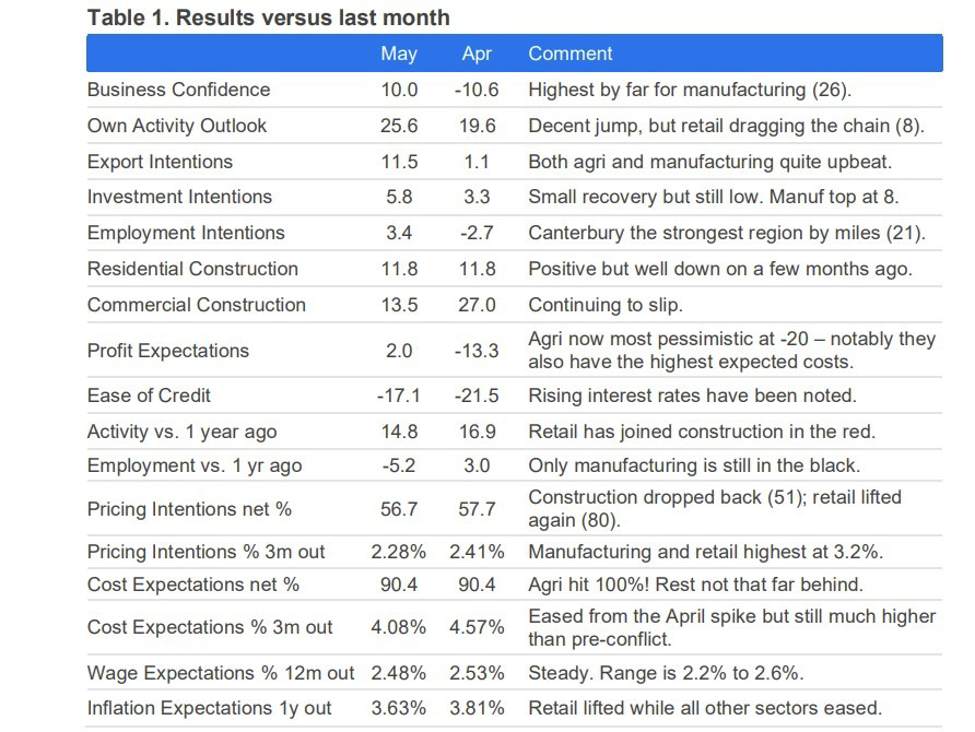
ANZ New Zealand Business Confidence rose 21 points to +10 in May but remained well below pre-conflict levels, with cost expectations near record highs and retail and construction activity still contracting. Before you go on, the bigger news ICYMI:RBNZ’s Breman signals faster and larger rate hikes than previously flaggedSummary:ANZ-Roy Morgan Business Confidence rose 21 points in May to +10, recovering from -10.6 in April, though remaining well below levels prevailing before the Middle East conflict, per ANZ ResearchExpected own activity rose 6 points to 25.6, with manufacturing the standout at +28 and retail the laggard at +8, per ANZ ResearchCost expectations held at 90.4% of firms reporting higher costs, unchanged from April, with agriculture hitting 100%; three-month cost expectations eased from 4.57% to 4.08% but remained well above pre-conflict levels, per ANZ ResearchInflation expectations for the year ahead eased from 3.81% to 3.63%, while pricing intentions fell 1 point to 56.7, per ANZ ResearchEmployment intentions recovered from -2.7 to +3.4, though reported employment versus a year ago fell from +3.0 to -5.2, with retail and construction both in contraction, per ANZ ResearchANZ Research noted wage intentions were little changed and showed no signs yet of the price shock morphing into broader core inflation pressures, though indicators have only come back into line with RBNZ forecasts rather than suggesting downside risksNew Zealand business confidence staged a partial recovery in May, rising 21 points to +10 in the ANZ Business Outlook survey, though the result leaves sentiment well short of levels seen before the Middle East conflict upended the global cost environment.The improvement was uneven across sectors. Manufacturing led with a confidence reading of +26, while agriculture and services also recovered. Retail remained a weak point, with activity versus a year ago falling into negative territory alongside construction, which has been contracting for several months.Cost pressures showed little sign of easing. The net proportion of firms reporting higher costs held at 90.4%, unchanged from April, with agriculture reaching 100%. The gap between what businesses expect to pay and what they can charge customers remains wide, continuing to compress profit margins across most sectors. Profit expectations recovered from -13.3 to +2.0, but the underlying squeeze is evident.Wage intentions were broadly steady and remain below pre-conflict levels, which ANZ Research said is consistent with a soft labour market and firms limiting cost increases where possible. No clear evidence of second-round inflation effects has emerged yet, though the bank cautioned it is early to draw firm conclusions. Freight disruption data, reintroduced to the survey this month, flagged emerging stress in retail inbound and manufacturing outbound shipping channels.—The bounce in confidence is real but narrow, and the cost picture offers little comfort for the RBNZ. With cost expectations holding at 90.4% and agriculture hitting 100%, the inflation pipeline remains pressurised even as headline inflation expectations eased slightly. The gap between what firms expect to pay and what they can charge continues to compress margins rather than feed through cleanly to prices, which complicates the inflation signal. Wage intentions were little changed and remain below pre-conflict levels, giving the RBNZ’s monetary policy committee limited evidence of second-round effects so far, though ANZ noted it is early days. The freight disruption data, reintroduced this month, flags emerging stress in retail inbound and manufacturing outbound shipping that could add to cost pressures in coming months if the Middle East situation persists This article was written by Eamonn Sheridan at investinglive.com. 🔗 Source 💡 DMK Insight ANZ’s business confidence spike to +10 is overshadowed by persistent cost pressures and contracting sectors. While the rise in confidence might seem positive, the reality is that cost expectations are near record highs, which could squeeze margins for businesses. This is particularly concerning for traders focused on retail and construction stocks, as both sectors are still in contraction. The Reserve Bank of New Zealand (RBNZ) signaling faster and larger rate hikes adds another layer of complexity. Higher interest rates could further dampen consumer spending and investment, especially in these already struggling sectors. Traders should keep an eye on the NZD, as the currency could react sharply to any further RBNZ announcements or economic data releases. Here’s the thing: while confidence is up, the underlying economic indicators suggest caution. If the RBNZ moves aggressively on rates, it could lead to a stronger NZD in the short term, but the long-term implications for growth could be negative. Watch for key levels in the NZD/USD pair, particularly around recent highs, as any failure to break through could signal a reversal as traders reassess the economic outlook. 📮 Takeaway Monitor the NZD/USD for potential resistance around recent highs, especially in light of RBNZ’s aggressive rate hike signals.

Bank of England Bailey, Mann and Greene due to speak at conferences: rates, crypto
BOE Governor Andrew Bailey speaks in Reykjavik Friday at 0910 GMT, followed by hawk Catherine Mann in Dubrovnik Saturday at 0940 GMT and Megan Greene on stablecoins Sunday at 1230 GMT.Bank of England Governor Andrew Bailey takes the podium in Reykjavik on Friday morning at 0910 GMT (0510 US Eastern) for a speech at the 2026 economic conference, with markets alert to any signals on the pace and extent of BOE rate cuts. The BOE has been navigating a difficult inflation picture, with services prices remaining stubbornly elevated even as headline inflation has moderated, and Bailey’s remarks will be parsed closely for any shift in tone on the timing of further easing. A more cautious message would support sterling; any hint of accelerating cuts would weigh on it. On Saturday, Catherine Mann participates in a panel at the 32nd Dubrovnik Economic Conference at 0940 GMT (0540 Eastern), with the session titled Central Bank Independence Under Attack. Mann has been the MPC’s most consistent hawk through the current cycle, voting to hold rates for longer than the majority of her colleagues on multiple occasions. While the panel topic is structural rather than immediately policy-focused, Mann is unlikely to pass up the opportunity to reinforce her view that central banks must guard their credibility on inflation above all else. Any commentary that strays into current rate expectations would carry weight given her track record.Megan Greene rounds out the BOE’s weekend presence on Sunday at 1230 GMT (0830 Eastern), also in Dubrovnik, on a panel examining stablecoins and monetary policy. Greene has engaged substantively with digital asset questions in the past and the topic is gaining policy relevance as stablecoin adoption grows and regulators wrestle with implications for monetary transmission. Her remarks are unlikely to be rate-sensitive but could touch on how central banks think about the boundary between traditional and digital money in a world where that line is increasingly blurred.—Bailey is the market-sensitive event. Any deviation from the BOE’s current cautious easing posture, particularly on the pace of rate cuts given sticky services inflation, would move sterling and gilts. Mann has been the MPC’s most prominent hawk and her panel topic, central bank independence under attack, is unlikely to produce market-moving rate commentary but could generate headlines if she addresses political pressure on central banks more broadly. Greene’s stablecoins panel is the least likely to move markets directly, though any comments linking digital asset growth to monetary policy transmission could attract attention given the current regulatory environment. This article was written by Eamonn Sheridan at investinglive.com. 🔗 Source 💡 DMK Insight Bailey’s upcoming speech could shake up GBP markets, and here’s why: With the Bank of England’s recent hawkish stance, traders should be on high alert. Bailey’s comments at 0910 GMT could provide crucial insights into future rate hikes or economic outlooks, especially as inflation remains a hot topic. If he hints at tightening measures, we could see GBP/USD react sharply, potentially breaking key resistance levels. Watch for the 1.30 mark on GBP/USD; a break above could signal a bullish trend. But don’t overlook the broader context. Catherine Mann’s speech on Saturday and Megan Greene’s discussion on stablecoins could also influence market sentiment. If Mann echoes Bailey’s hawkish tone, it might solidify expectations for further rate increases, pushing GBP higher. Conversely, if Greene’s comments on stablecoins highlight regulatory concerns, it could dampen crypto enthusiasm, impacting related assets like BTC and ETH. Keep an eye on these events—they could create volatility across multiple markets. 📮 Takeaway Watch GBP/USD around the 1.30 level after Bailey’s speech; a bullish breakout could signal further gains.
Dollar faces renewed strength if US-Iran talks fail, MUFG warns
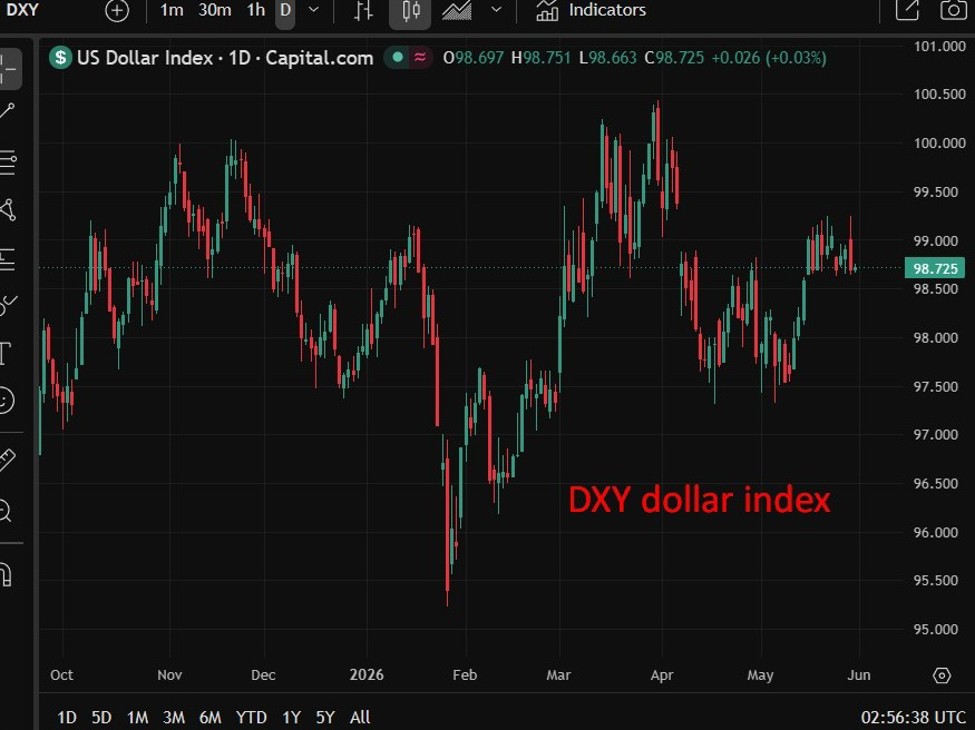
MUFG analysts warn the dollar could strengthen further if US-Iran talks collapse, with energy-driven inflation risks potentially pushing Fed officials toward a more hawkish stance and lifting US yields.-The US dollar faces renewed upward pressure if Washington and Tehran fail to finalise a ceasefire extension, MUFG Bank analysts warned, arguing that the unresolved conflict is building an inflation risk that could shift the Federal Reserve’s internal balance toward more hawkish rhetoric and push US Treasury yields higher.The warning comes as the dollar index sits just under at 99, having fallen 0.3% on Thursday after reports that a tentative 60-day truce extension had been agreed, though the deal has yet to receive President Trump’s approval and Iran has not confirmed the text of a potential memorandum of understanding is finalised. Vice President JD Vance acknowledged on Thursday that outstanding language points on Iran’s nuclear programme, including questions around the highly enriched uranium stockpile and enrichment rights, remain unresolved, and he declined to guarantee a deal would be reached.MUFG’s thesis is straightforward: a prolonged conflict keeps energy prices elevated, that inflation feeds into US data, and a sufficient number of Fed officials begin to prioritise price stability concerns over growth worries. Thursday’s PCE data lent that argument some support, with April headline inflation rising at its fastest pace in three years, driven by energy costs tied to the Iran war. While the softer core PCE reading at 0.2% month-on-month provided some relief, the broader inflation picture under a continued conflict scenario gives hawks within the Fed ample material to work with.The correlation between US yield spreads and foreign exchange rates is tightening again, according to MUFG, which means any repricing in rate expectations flows more directly into dollar strength than it might have in periods when that relationship was looser. That dynamic puts currencies already under pressure from the rate differential, most notably the Japanese yen near the 160-per-dollar threshold, in a particularly exposed position if deal optimism unwinds. The Australian and New Zealand dollars, which strengthened on Thursday’s ceasefire reports, face similar reversal risk.The Fed itself is navigating the same tension MUFG describes. New chairman Kevin Warsh is widely expected to oversee rate hikes this year, and markets are pricing that outcome with high confidence. If energy-driven inflation accelerates and core measures follow, the pace of that tightening could intensify, reinforcing the dollar’s yield advantage at a time when most other major central banks are either easing or moving far more cautiously.–The MUFG note crystallises a dynamic that has been building through the week. The dollar index fell 0.3% on Thursday on ceasefire optimism, but as Thursday’s session demonstrated, that move is highly reversible given the number of unresolved issues in the Iran talks. The tightening correlation between yield spreads and FX that MUFG flags is the key transmission mechanism to watch: if energy-driven inflation forces more Fed officials to lean hawkish, the rate differential trade reasserts itself and the dollar recovers its bid. The yen is particularly exposed in that scenario, given it is already pressing toward 160 and Japanese authorities are on intervention watch. The Australian and New Zealand dollars, which both strengthened on ceasefire optimism Thursday, would also give back gains quickly in a deal-failure scenario. This article was written by Eamonn Sheridan at investinglive.com. 🔗 Source 💡 DMK Insight The potential collapse of US-Iran talks could send the dollar soaring, and here’s why that matters: If negotiations fail, energy prices are likely to spike, which would stoke inflation fears. This scenario could push the Federal Reserve to adopt a more aggressive monetary policy, raising interest rates and boosting US yields. Traders should keep an eye on the dollar index, especially if it approaches key resistance levels. A stronger dollar could negatively impact commodities priced in USD, like gold and oil, leading to potential sell-offs in those markets. Additionally, if the Fed signals a hawkish shift, expect volatility in forex pairs, particularly those involving the euro and yen, as they react to changing yield differentials. But there’s a flip side—if talks miraculously succeed, we could see a rapid reversal, weakening the dollar and providing a buying opportunity in risk assets. Watch for any news updates from the negotiations, as they could trigger significant market movements. Keep an eye on the 10-year Treasury yield as a barometer for market sentiment and potential dollar strength. 📮 Takeaway Monitor the dollar index closely; a failure in US-Iran talks could push it above key resistance levels, impacting commodities and forex pairs significantly.
investingLive Asia-Pacific FX news wrap: Trump reviewing ceasefire extension, markets wait
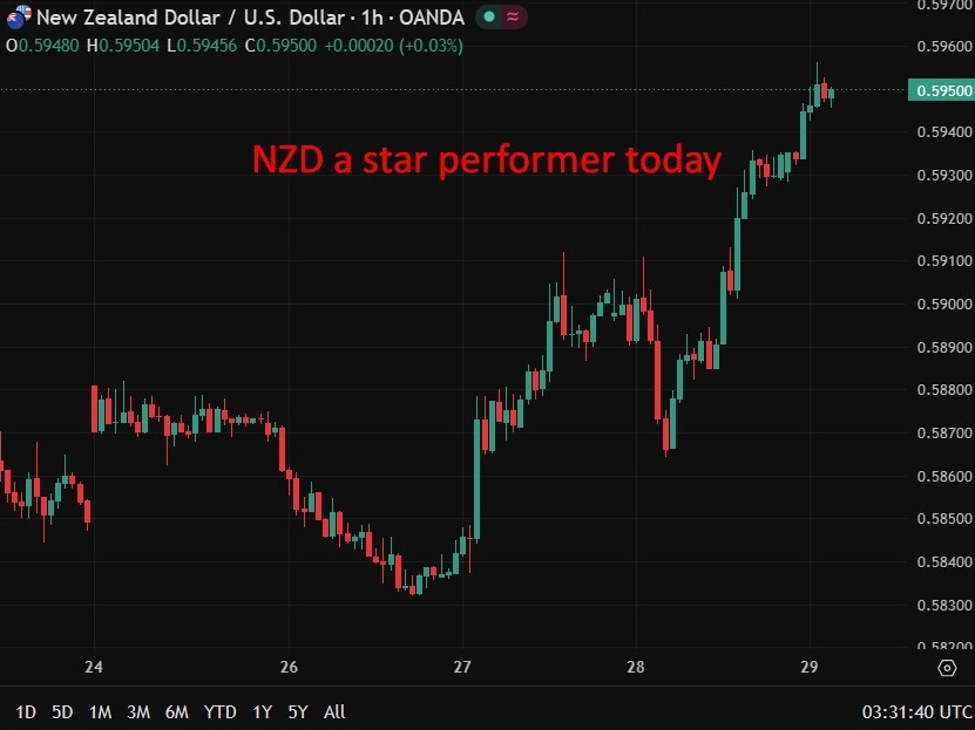
Dollar faces renewed strength if US-Iran talks fail, MUFG warnsBank of England Bailey, Mann and Greene due to speak at conferences: rates, cryptoNZ business confidence bounces in May but Middle East cost squeeze persistsRBNZ’s Breman signals faster and larger rate hikes than previously flaggedPBOC sets USD/ CNY reference rate for today at 6.8176 (vs. estimate at 6.7685)Katayama warns on yen volatility as intervention data looms at 1900 JSTMore Japan data: April retail sales and Manufacturing output both rise fast than expectedTokyo core CPI misses forecasts in May, complicating case for BOJ June rate hikeDell earnings explained: why the stock exploded after Q1 FY27 resultsRBNZ’s Silk flags near-term inflation pressure and rate hikes in coming meetingsTokyo May CPI data: Headline, core, and core-core all rise more slowly than in AprilYen edges back toward 160 as traders await Japan intervention data due FridayDELL up 30% in after hours trading – here’s why (massive contract with US military)US Vice Pres Vance says Trump not yet ready to endorse Iran agreementNZ consumer confidence lifts off lows but remains well below January peakUS officials say there have been no US aircraft shot down, contradicting Iranian claimsRecap: US-Iran ceasefire extension agreed but unconfirmed, markets whipsaw on war signalsinvestingLive Americas FX news wrap 28 May: Softer PCE pressures dollar and yieldsIran state TV says they destroyed a US aircraft. No US comment at this stage.Trump is speaking, says the US holds all the cards, Iran has been defeated ‘militarily’The major US stock indices close at record levelsAt a glance:US-Iran ceasefire extension tentatively agreed but awaiting Trump sign-off; nuclear language sticking points remain; Iran’s claim of shooting down a US aircraft near Bushehr denied by US authoritiesTokyo core CPI missed across all measures in May, extending a six-month slowdown; core ex-food and energy at 1.6% vs 1.9% forecast; Japanese factory output surprised to the upside in AprilRBNZ Governor Anna Breman signalled rates will rise sooner and by more than previously indicatedRussian drone struck a residential building in Galați, Romania; NATO response expected to be diplomatic rather than kineticDell shares surged 25%+ after blowout first-quarter earnings; Pentagon’s $9.7 billion software contract an additional driverSpaceX targeting $1.8 trillion IPO valuation; Blue Origin’s New Glenn rocket exploded during a hot-fire testJapan MOF intervention data due 1000 GMT / 0600 Eastern covering April 28 to May 27A tentative agreement to extend the US-Iran ceasefire for 60 days lifted risk sentiment through the session, but the deal remained unsigned and fragile. Vice President JD Vance said President Trump had yet to endorse the memorandum of understanding, with negotiations still grinding over language on Iran’s nuclear programme, specifically the disposition of Tehran’s highly enriched uranium stockpile and its future enrichment rights. Vance said he believed Iran was negotiating in good faith but could not guarantee an agreement would be reached. Iranian state television claimed a US aircraft had been destroyed near Bushehr, a report US authorities flatly denied.In Japan, Tokyo’s key inflation gauges missed forecasts across the board in May. Core CPI, excluding fresh food, rose 1.3% year-on-year against a 1.5% forecast, marking a sixth consecutive month of slowdown. The core-core index, stripping out both fresh food and energy, came in at 1.6% against an expected 1.9%. Government subsidies on utilities and tuition were the primary drag, with analysts expecting inflation to re-accelerate as energy and import price pressures build. Offsetting the soft inflation data, separate figures showed Japanese factory output rose 0.8% in April, confounding forecasts for a 0.9% decline, with manufacturers projecting a further 5.1% rise in May. The soft data complicates the BOJ’s messaging ahead of its June policy meeting, where overnight index swaps had been pricing around an 80% probability of a hike to 1% from the current 0.75%. With subsidies distorting the headline reads, the BOJ’s case for June rests heavily on the expectation that inflation will re-accelerate once those effects drop out. Japan’s TOPIX moved to a record high.New Zealand dominated the central bank narrative. RBNZ Governor Anna Breman, whose casting vote broke a 3-3 split on the monetary policy committee to keep the OCR on hold at 2.25% this week, made clear the pause is temporary. Breman said the OCR is likely to increase sooner and by more than previously signalled, with the bank focused on returning inflation to target while managing economic volatility. Assistant Governor Karen Silk had earlier reinforced the hawkish message, saying the bank does not need to wait for a quarterly CPI print to act and that the bias is toward rate increases at coming meetings. The New Zealand dollar firmed on the guidance.Currencies otherwise consolidated against a broadly flat US dollar. Traders nudged away from the greenback on ceasefire optimism but stopped well short of a full risk-on move, with the deal’s unsigned status keeping positioning cautious. A Russian one-way attack drone entered Romanian airspace during a strike on Ukraine and struck a residential apartment block in the eastern city of Galați, injuring several people. Romania’s defence ministry confirmed the incident and scrambled F-16s. NATO’s response is expected to be diplomatic, likely involving the summoning of the Russian ambassador and increased economic pressure rather than any kinetic reply.Dell shares surged more than 25% after the company reported its strongest earnings since returning to public markets in 2018. Revenue hit a record $43.8 billion, up 88% year-on-year, while diluted EPS rose 282% to $5.24. The Pentagon’s award of a five-year, $9.7 billion software purchasing agreement to Dell Federal Systems added further impetus, reinforcing the market’s view of Dell as a major AI infrastructure supplier rather than a traditional hardware company. Separately, SpaceX is targeting a valuation of at least $1.8 trillion in its forthcoming IPO, while Jeff Bezos’ Blue Origin reported an anomaly during a hot-fire test of its New Glenn rocket, which exploded in footage circulated on social media.Japan’s Ministry of Finance intervention data covering the period from April 28 to May 27 is due at 1000 GMT, 0600 Eastern. Bloomberg analysis of BOJ accounts had pointed to up to ¥10

Deal or no deal? Markets continue to eye US-Iran headlines ahead of the weekend
At the end of it, this will be framed as a “deal to put an end to the conflict”. However, what it actually will be is a memorandum of understanding to lay out the necessary preconditions to facilitate nuclear discussions. And that means extending the actual negotiations phase by another 60 days.Markets remain optimistic on the face of it but looking through it all, a lot will depend on what happens with the Strait of Hormuz.While the US and Iran are still squabbling about some details, both sides know very well the puzzle pieces that are needed to complete the picture. The only question is if they can fit them all together and make it last for 60 days or longer. It’s going to be tough but I wouldn’t be surprised if we see some empty promises get put out just so both sides can create an illusion of moving forward. You can read more on that below:US and Iran know what the puzzle pieces are, but can they fit them all together?For markets, the biggest concern remains the threat to the inflation outlook. In that lieu, energy prices and oil and gas supply remain the most critical factors at the moment. As such, the reopening of the Strait of Hormuz is the most important detail.The US wants an unconditional reopening of the waterway i.e. resumption of traffic akin to pre-war conditions. Let’s be real. That is not going to happen.Control over the strait remains Iran’s biggest and most important leverage in talks. If they allow the waterway to reopen fully, they are basically just giving up on the conflict and there’s no need for nuclear discussions. Without any leverage, the US can just bully Iran into any terms without any pushback.So, what is going to happen here instead?I would wager this is how things are going to play out. The US and Iran will tell a story that they have taken the next step to “end the war”. The Strait of Hormuz will reopen slowly as “Iran will need time to clear mines along the waterway”. This may take up to 30 days or perhaps more. There will be no tolls charged.This allows US president Trump to brag about “winning” while at the same time allowing Iran to keep management of the strait.Iran will then continue feeding data, as they have been doing recently, that traffic along the strait is picking up. But in reality, that is not the case. They are merely trying to play to the optics of a deal, making it so that the US has something to brag about back home.In essence, it will be a theatrical performance just so that the politics will cloud market judgement long enough before reality slaps hard.The actual shipping data is not likely going to corroborate with the narrative here. So while market prices will reflect one story, physical prices and what businesses/consumers are paying will be a different story.All this while global oil market supply continues to tighten further into the summer, and that’s when the pain will really hit hard for many economies as well.It’s a case of kicking the can down the road long enough in hoping markets will forget about it. Let’s see how that is going to work out. This article was written by Justin Low at investinglive.com. 🔗 Source

FX option expiries for 29 May 10am New York cut
There are just a couple of expiries to take note of on the day, as highlighted in bold below.They are for EUR/USD at the 1.1600 and 1.1650 levels. The expiries don’t tie to any technical significance but once again could act as a bit of a magnet and/or keep a lid on price action for the session ahead. The ones at 1.1650 in particular may just help to limit price movements on the session, with market players still keenly watching out for the US-Iran deal announcement.The broader risk mood and dollar sentiment remain the two bigger influences of price action. So, headline risks will continue to be a key driver in closing out the week. So, just be wary of that as that can override the impact or pull factor of the expiries above.Also, there is potential month-end shenanigans to watch out for as well. So, just take note of that when looking to the day ahead.Otherwise, we are likely to see markets keep more tentative in waiting for the announcement and details of the US-Iran deal. It’s now a real question of whether that will come before the weekend or not. And if not, will there be some late and heavy de-risking just in case? And even if there is a deal, is it going to be a case of buy the rumour, sell the fact on the details? Just a couple of things to consider.For more information on how to use this data, you may refer to this post here. This article was written by Justin Low at investinglive.com. 🔗 Source 💡 DMK Insight With EUR/USD expiries at 1.1600 and 1.1650, traders should watch for potential price magnetism. These levels might not hold technical significance, but they can influence short-term price action. As these expiries approach, expect increased volatility, especially if the market is near these levels. If EUR/USD hovers around 1.1600, a bounce or rejection could signal a short-term trading opportunity. Conversely, if it breaks through 1.1650, it might indicate bullish momentum, prompting traders to reassess their positions. Keep an eye on related pairs like GBP/USD, as movements in EUR/USD often correlate with shifts in other major currency pairs. The real story here is how these expiries could create a tug-of-war effect, drawing traders in and potentially leading to sharp moves as positions are unwound or adjusted. Watch for any news or economic data releases that could impact the euro or dollar, as these could amplify the effects of the expiries. The next few hours could be crucial for day traders looking to capitalize on these levels. 📮 Takeaway Monitor EUR/USD around 1.1600 and 1.1650 for potential volatility; expiries could create sharp price movements today.
German import prices climb further in April as US-Iran conflict continues to reverberate
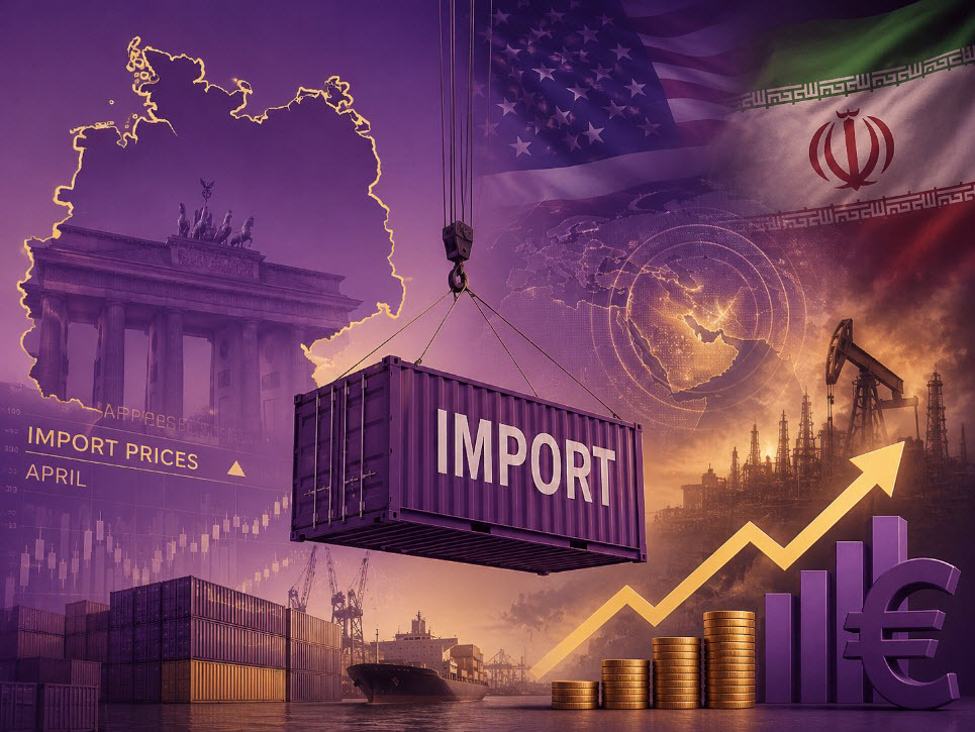
Import prices +1.2% vs +1.1% m/m expectedPrior +3.6%The annual change shows that German import prices were seen up by 5.3% compared to April last year. That represents the strongest year-on-year increase since January 2023. After the spike in March, we’re seeing a continued rise in import prices as the fallout from the Middle East conflict continues.That is leading to a further surge in energy prices but also the prices for intermediate goods. The former was up 2.8% on the month and 31.0% year-on-year. Meanwhile, the latter is up 2.4% on the month and 7.8% year-on-year. So, those two are the biggest contributors to the rise in import prices for April.Among intermediate goods, non-ferrous metals and their semi-finished products were significantly more expensive. And adding to that, prices for imported fertilizers and nitrogen compounds were also considerably higher compared to the month before (+7.6%).Even when excluding energy prices, import prices were still up by 1.0% on the month and 2.8% compared to April last year. As such, it also reflects a broader increase in other categories such as prices for capital goods (+0.5%), durable consumer goods (+0.1%), and non-durable consumer goods (+0.1%). This article was written by Justin Low at investinglive.com. 🔗 Source

France Q1 final GDP -0.1% vs 0.0% q/q prelim
Prior +0.2%French economic growth was revised down to -0.1% in the first quarter of the year, reflecting a contraction. That’s not a good look especially as much of the drag came about from March, with the Middle East conflict weighing. As conditions look set to worsen further in the months ahead, that will make it very difficult to see an improved outlook for Europe’s second largest economy ahead of the summer.As such, a technical recession beckons for France with stagflation worries surely set to rise as the weeks go by. This article was written by Justin Low at investinglive.com. 🔗 Source 💡 DMK Insight French GDP just got a downgrade to -0.1%, and here’s why that matters: This contraction signals potential weakness in the Eurozone, especially with geopolitical tensions in the Middle East impacting economic sentiment. Traders should keep an eye on the euro, as this news could lead to further depreciation against the dollar. The market’s reaction might also ripple through related assets like European equities and commodities, especially if investors start to price in a prolonged economic slowdown. Watch for key support levels in the euro; if it breaks below recent lows, we could see a sharper sell-off. On the flip side, this could create buying opportunities in safe-haven assets like gold or U.S. Treasuries as investors seek stability amid uncertainty. Keep an eye on upcoming economic indicators from France and the broader Eurozone, as they could provide further clues on the trajectory of the euro and related markets. The immediate focus should be on how the market reacts in the next few trading sessions, especially if further negative data emerges. 📮 Takeaway Watch the euro closely; a break below recent lows could trigger a sell-off, while safe-haven assets may gain traction amid economic uncertainty.
French inflation continues to pick up in May, highest reading since February 2024
CPI +2.4% vs +2.5% y/y expectedPrior +2.2%HICP +2.8% vs +2.9% y/y expectedPrior +2.5%On the month itself, French headline inflation was up 0.1% in May compared to April. That reflects some moderation in energy prices over the past month but that is still much higher than what it was a year ago. For some context, the headline annual inflation rate is now the highest since February 2024.Looking at the breakdown, food prices held steady at 1.2% while services inflation ticked a little higher to 2.0% (previously 1.8%). The latter continues to be a key sticking point and with higher energy prices set to permeate to other categories, the danger is that it will see a stronger uptick in the months to come.To add a bit of flavour to the report, energy prices were seen at -8.0% year-on-year in May last year. This year, energy prices are seen at +16.8% year-on-year instead. What a difference twelve months make.The major worry for the French economy now is that economic growth looks set to soften further in Q2 while price pressures are likely to pick up further going into the summer months later. Stagflation worries will be a key concern and that pose a considerable threat to the ECB’s plans to manage monetary policy this year. This article was written by Justin Low at investinglive.com. 🔗 Source 💡 DMK Insight French inflation data just came in slightly lower than expected, and here’s why that matters: The CPI at 2.4% versus the expected 2.5% suggests a minor easing in inflationary pressures, which could influence the European Central Bank’s (ECB) monetary policy decisions. With HICP also coming in below expectations, this might lead to speculation about a potential slowdown in rate hikes. Traders should keep an eye on the euro, as a softer inflation reading could weaken the currency against the dollar, especially if the ECB signals a more dovish stance. This data could also ripple through related markets, affecting commodities and equities tied to consumer spending. But don’t overlook the fact that inflation is still significantly higher than last year, which means the ECB may still feel pressured to maintain a hawkish tone. Watch for reactions in the forex market, particularly around key levels for EUR/USD. If the euro breaks below recent support levels, it could trigger further selling. Keep an eye on the upcoming ECB meeting for any shifts in guidance, as that could be a pivotal moment for traders looking to position themselves ahead of potential volatility. 📮 Takeaway Monitor EUR/USD closely; a break below key support levels could signal further euro weakness amid shifting ECB policy expectations.
Inflation pressures continue to hold up in Spain, core prices nudge a little higher
CPI +3.2% vs +3.4% y/y expectedPrior +3.2%HICP +3.6% vs +3.6% y/y expectedPrior +3.5%The preliminary estimate shows that Spanish headline inflation held steady in May, keeping at a similar rate to April. However, core annual inflation continues to tick up and is keeping above the average seen for last year already. And we’re only just five months in, still having to factor in further spillovers from higher energy prices in the months ahead.Core annual inflation is estimated to move up to 2.9%, same as it was in March but well above any levels that were recorded last year. The estimate is the highest since June 2024 otherwise.Circling back to headline prices, the Spanish stats office points out that higher prices were observed in the transport category – which arguably points to fuel prices being much higher than they were a year ago. That comes as no surprise amid the oil and gas price surge due to the Middle East conflict. And that looks set to intensify further in the months ahead, especially as we look to the summer time.The monthly rate shows just a 0.1% increase in headline inflation, at least reaffirming that general price pressures are holding thereabouts after the spike in March and April. This article was written by Justin Low at investinglive.com. 🔗 Source 💡 DMK Insight Spanish inflation data is holding steady, but core inflation is creeping up, and here’s why that matters: The CPI at 3.2% aligns with expectations, which might seem stable, but the core inflation rate’s upward trend indicates underlying price pressures that could affect monetary policy. For traders, this is crucial as it suggests potential tightening from the ECB if inflation persists, impacting the euro and related assets. Keep an eye on the euro against the dollar; if core inflation continues to rise, we might see the euro strengthen as traders price in a more hawkish stance from the ECB. On the flip side, if inflation stabilizes or declines in the coming months, it could lead to a more dovish outlook, which might weaken the euro. Watch for the next inflation report and any ECB commentary for clues on future interest rate adjustments. Key levels to monitor are the euro’s support around 1.05 and resistance near 1.10 against the dollar, as these could dictate short-term trading strategies. 📮 Takeaway Monitor core inflation trends closely; a sustained rise could trigger ECB tightening, impacting euro levels around 1.05 and 1.10 against the dollar.