
 Bitcoin
  Ethereum
  Tether
  XRP
XRP  BNB
BNB  USDC
USDC  Solana
  TRON
TRON  Lido Staked Ether
  Figure Heloc
Democrats seeking to crack down on the Trump family’s crypto empire have found an ally in Republican Thom Tillis, who supports ethics provisions in a key crypto bill. 🔗 Source 💡 DMK Insight The bipartisan push to regulate crypto could shake up market sentiment around ETH and beyond. With ETH currently at $2,282.33, any regulatory changes could lead to increased volatility. Traders should keep an eye on how this legislation progresses, as it could impact institutional participation in the crypto space. If regulations tighten, we might see a short-term sell-off as traders react to potential compliance costs and operational hurdles. On the flip side, clearer regulations could also attract more institutional money in the long run, stabilizing prices. Watch for ETH to test support levels around $2,200; a break below could signal further downside. Conversely, if the market views these regulations positively, we could see a push back toward the $2,400 mark in the coming weeks. Keep an eye on news from Congress and any shifts in sentiment from major players in the crypto market. 📮 Takeaway Monitor ETH’s support at $2,200 and resistance at $2,400 as regulatory news unfolds; volatility is likely.

Acting AG Todd Blanche confirms ‘code is not a crime’ in DOJ pivot
Acting US Attorney General Todd Blanche said developers will no longer be investigated or charged unless they knowingly help third parties commit crimes. 🔗 Source 💡 DMK Insight This shift in policy from the Acting US Attorney General could reshape the crypto development landscape significantly. By clarifying that developers won’t face scrutiny unless they knowingly assist in criminal activities, it lowers the regulatory risk for many projects. This could encourage innovation and attract more developers to the space, potentially leading to a surge in new projects and investments. However, it’s crucial to monitor how this policy is implemented, as the interpretation of ‘knowingly’ could vary, leaving room for ambiguity. Traders should keep an eye on related assets, particularly those in the DeFi and NFT sectors, which could see increased activity as developers feel more secure. Watch for any price movements in major cryptocurrencies like Bitcoin and Ethereum, as they often react to regulatory news. Also, keep an eye on the upcoming congressional hearings on crypto regulations, as they could provide further clarity on this issue and impact market sentiment. 📮 Takeaway Watch for potential price movements in Bitcoin and Ethereum as this regulatory shift could boost developer activity and market confidence.

Crypto lobby backs formal removal of ‘reputation risk’ from bank examinations
The Office of the Comptroller of the Currency and the Federal Deposit Insurance Corp. finalized a similar rule removing reputation risk earlier this month. 🔗 Source 💡 DMK Insight So the OCC and FDIC just finalized a rule that could shake up banking perceptions. This move to remove reputation risk is significant because it could encourage banks to engage more freely with crypto-related businesses, which have often been sidelined due to fear of reputational damage. For traders, this means a potential increase in institutional participation in the crypto space, which could drive prices higher. Look, the broader context here is that regulatory clarity often leads to market stability. If banks feel more secure in their dealings with crypto firms, we might see a surge in liquidity and trading volume. This could be particularly impactful for altcoins that have been struggling to gain traction. Keep an eye on how major banks react—if they start rolling out services for crypto clients, it could signal a new bullish phase. On the flip side, there’s always a risk of overexuberance. Traders should be cautious about jumping in too quickly; monitor key price levels and sentiment shifts. Watch for any announcements from major banks in the coming weeks, as they could provide critical insights into market direction. 📮 Takeaway Watch for major banks’ responses to the OCC and FDIC rule; increased crypto engagement could signal bullish trends, especially for altcoins.
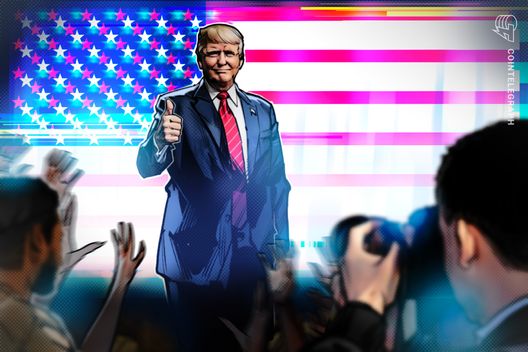
Trump changes tune on prediction markets days after saying he disliked them
US President Donald Trump says the US can’t be “left out in the cold” on prediction markets just days after he said he was “not happy” with the fast-growing platforms. 🔗 Source 💡 DMK Insight Trump’s comments on prediction markets signal potential regulatory shifts that could impact trading strategies. His mixed feelings highlight the tension between innovation and oversight in the market. Traders should be aware that any regulatory changes could lead to increased volatility, especially in sectors tied to prediction markets, such as cryptocurrencies and tech stocks. If the administration pushes for more regulation, it could stifle growth in these areas, leading to a potential sell-off. On the flip side, if the sentiment shifts towards a more favorable regulatory environment, we might see a surge in investment and trading activity. Keep an eye on related assets, particularly those in the crypto space, as they could react sharply to any news from the administration. Watch for key developments in the coming weeks, as they could set the tone for market sentiment moving into the end of the quarter. 📮 Takeaway Monitor Trump’s regulatory stance on prediction markets closely; any shifts could trigger significant volatility in crypto and tech stocks.
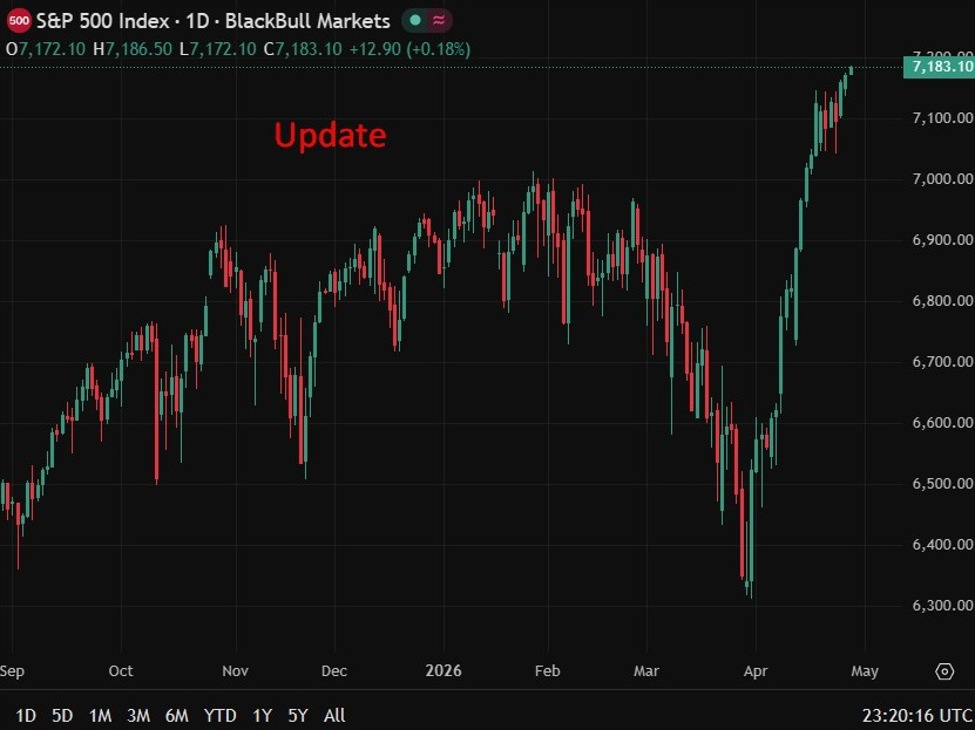
Vance said to question Pentagon's war picture as US missile stockpiles face serious strain
VP Vance has privately questioned Pentagon briefings on the Iran war and raised concerns about serious U.S. missile shortfalls, with Iran said to retain most of its military capability. SummaryVance has repeatedly questioned the Pentagon’s portrayal of the Iran war in closed-door meetings, raising concerns that U.S. missile stockpiles have been more severely depleted than official briefings suggestTwo senior administration officials told The Atlantic that Vance has queried the accuracy of information provided by the Pentagon, and has raised munitions concerns directly with TrumpDefence Secretary Pete Hegseth and Joint Chiefs chairman General Dan Caine have publicly described U.S. stockpiles as robust and Iranian military damage as drasticVance’s advisers say he has framed his concerns as his own rather than accusing Hegseth or Caine of misleading the president, in an apparent effort to avoid fracturing the war cabinetInternal intelligence assessments cited by the publication suggest Iran retains two-thirds of its air force, most of its missile-launching capability and the fast-boat fleet capable of disrupting Hormuz trafficThe Centre for Strategic and International Studies said this week the U.S. may have burned through more than half of its pre-war supply of four key munitions systemsThe Pentagon said Hegseth and other leaders consistently provide the president with a complete and unvarnished pictureSource: The AtlanticVice President JD Vance has privately and repeatedly challenged the Pentagon’s account of the war with Iran, questioning whether the Defence Department has presented an accurate picture of U.S. missile stockpile depletion and the true state of Iranian military capability, according to a report in The Atlantic citing senior administration officials.The publication, which has been consistently critical of the Trump administration, reports that Vance raised his concerns in closed-door meetings and in direct conversations with the president, framing the issue as a question of strategic accuracy rather than a personal attack on Defence Secretary Pete Hegseth or Joint Chiefs chairman General Dan Caine. Vance’s advisers told the publication he was trying to avoid creating divisions within the war cabinet, a dynamic that gives his reported interventions a degree of plausibility even if the sourcing carries its own caveats.Hegseth and Caine have publicly maintained that U.S. weapons stockpiles are robust and that eight weeks of fighting have inflicted drastic damage on Iranian forces. Trump himself declared weeks ago that the damage already constituted victory and that key weapons reserves were virtually unlimited. Some advisers quoted by The Atlantic suggest Hegseth’s consistently upbeat public briefings, which take place at 8am when Trump is known to be watching Fox News, are calibrated as much for the president’s consumption as for factual completeness.The picture painted by internal intelligence assessments, according to people who spoke to the publication, is considerably less flattering. Iran is said to retain approximately two-thirds of its air force, the bulk of its missile-launching capability and most of the small, fast boats capable of laying mines and harassing shipping through the Strait of Hormuz. In April, Iranian forces shot down an American fighter jet, an incident Hegseth compared publicly to the Resurrection of Jesus Christ, an assessment that did not go unnoticed in Washington.The stockpile question has independent support beyond Atlantic sourcing. The Centre for Strategic and International Studies said this week that the U.S. may have expended more than half of its pre-war reserves across four key munitions categories, including interceptors used to defend against Iranian missiles and offensive systems such as Tomahawk and Joint Air-to-Surface Standoff missiles. Reserves were already under pressure before the Iran war began, drained by years of sluggish manufacturing output and donations to Ukraine and Israel. Pentagon officials had warned even before hostilities commenced that existing deficits jeopardised the military’s ability to prevail in a conflict with Russia or China.The consequences of a serious munitions shortfall extend well beyond the Iran theatre. Vance is said to have raised specifically the implications for U.S. capacity to defend Taiwan against China, South Korea against North Korea and European allies against Russia. That framing elevates the stockpile question from a tactical Iran issue to a broader challenge of American deterrence posture.The Pentagon pushed back firmly. Spokesman Sean Parnell said Hegseth and other leaders consistently provide the president with a complete and unvarnished picture. A senior official described Caine as precise, exact and comprehensive in his operational assessments. Vance, for his part, issued a statement praising Hegseth’s performance, while the White House said the vice president simply asks probing questions about strategic planning, as all national security team members do.Whether that is the full story, or whether Vance’s concerns reflect something more substantive about the gap between the administration’s public narrative and the classified picture, is a question the coming days of Iran diplomacy may help to answer.—Bullish for crude if the stockpile picture is as dire as suggested, since a depleted U.S. arsenal materially reduces Washington’s ability to sustain or resume large-scale strikes against Iranian infrastructure and Hormuz-related targets. The claim that Iran retains two-thirds of its air force, most of its missile launchers and the fast-boat capacity to disrupt Strait of Hormuz traffic is the most market-relevant detail in the piece, directly challenging the Pentagon’s narrative of decisive military progress. If accurate, the path to a durable Hormuz reopening is considerably longer than official briefings have implied. The Atlantic’s known editorial disposition toward the current administration warrants some caution around sourcing, but the stockpile concerns are corroborated by independent think-tank analysis and predate this conflict. This article was written by Eamonn Sheridan at investinglive.com. 🔗 Source 💡 DMK Insight With VP Vance’s doubts about Pentagon briefings on the Iran war, traders should brace for potential volatility in defense stocks and related markets. His concerns about U.S. missile shortages could signal increased military spending or geopolitical tensions, both of which can impact sectors like defense contractors and commodities. If the narrative shifts towards a more aggressive U.S. stance, we might see a spike in defense stock prices, particularly for companies like Lockheed Martin or Raytheon. Keep an eye on how these stocks react in the coming days, especially

Japan March Unemployment rate 2.7% (vs. expected 2.6%, prior 2.6%)
Japan March 2026 jobs data.Unemployment rate 2.7% expected 2.6%, prior 2.6% Job-To-Applicant Ratio 1.18 expected 1.19, prior 1.19Still to come:BOJ expected to hold rates steady as Iran conflict complicates tightening path This article was written by Eamonn Sheridan at investinglive.com. 🔗 Source 💡 DMK Insight Japan’s job data is a mixed bag, and here’s why that matters for traders right now: With the unemployment rate ticking up to 2.7% from an expected 2.6%, it suggests a slight cooling in the labor market, which could influence the Bank of Japan’s (BOJ) monetary policy. The job-to-applicant ratio holding steady at 1.18 indicates that while jobs are available, the competition is tightening. This could lead to a cautious approach from the BOJ, especially with external pressures like the Iran conflict complicating their tightening path. Traders should keep an eye on how these factors might affect the yen and related forex pairs, particularly USD/JPY, which could see volatility if the BOJ decides to maintain its current stance. On the flip side, if the BOJ does hold rates steady, it might provide a temporary boost to equities, especially in sectors sensitive to interest rates. But be wary—if inflation continues to rise, the BOJ might be forced to act sooner than expected. Watch for any comments from BOJ officials in the coming days, as they could signal shifts in sentiment that impact market movements significantly. 📮 Takeaway Monitor USD/JPY closely; a steady BOJ could lead to short-term yen weakness, especially if inflation pressures mount.
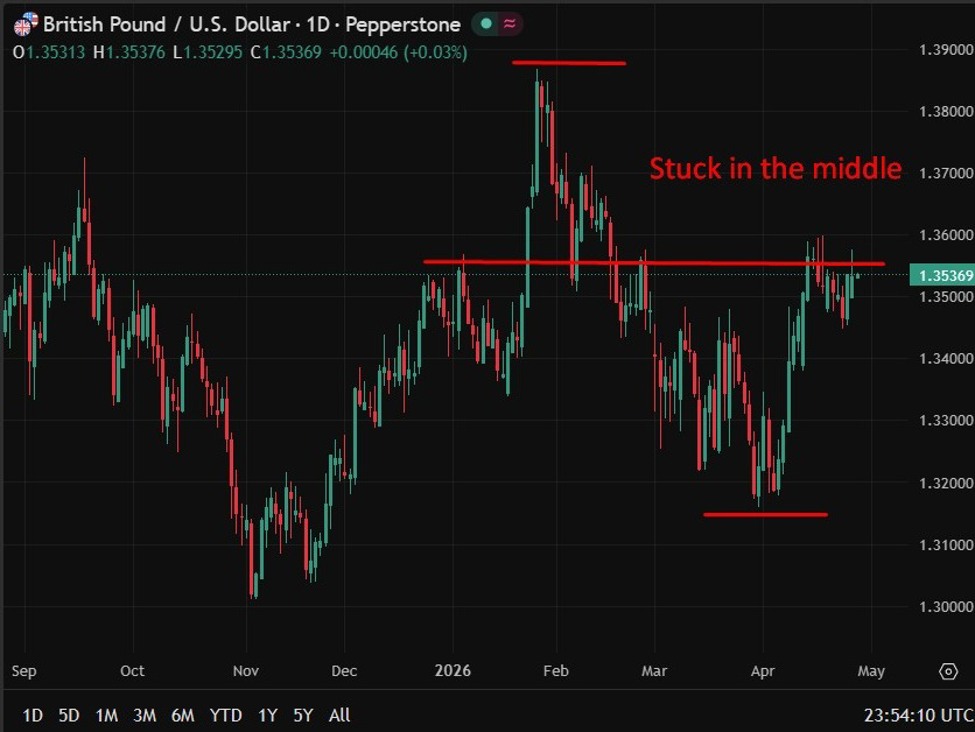
Easter discounts cool UK shop prices but Iran war inflation threat looms large
UK shop price inflation eased to 1.0% in April from 1.2% in March as Easter discounts helped retailers stimulate spending, though the BRC warned Middle East cost pressures are fast approaching. SummaryThe British Retail Consortium said UK shop prices rose 1.0% year on year in April, down from 1.2% in March, as Easter promotions on chocolate, home renovation materials and clothing eased the monthly readingFood price inflation slowed to 3.1% from 3.4%, with retailers competing harder on price amid weakening consumer confidenceSeparate CBI data published Monday showed retailers reported the biggest fall in sales volumes in more than 40 yearsThe BRC’s measure covers a narrower basket than official UK CPI, which stood at 3.3% in March; the IMF forecasts British inflation will reach 4% this yearBRC chief executive Helen Dickinson warned the full force of the Middle East conflict has yet to feed into consumer prices but said it would not be long before it doesNIQ analyst Mike Watkins cautioned that accelerating inflation is likely to weigh further on already fragile consumer spendingNote: the Bank of England’s Monetary Policy Committee is meeting this week to set interest rates. Most economists expect rates to be held for now, with the MPC monitoring the extent to which businesses are passing on higher costs. Governor Andrew Bailey said this month that businesses he had spoken to reported a lack of pricing power, offering some reassurance that inflation would not surge as it did in 2022 when it topped 11%UK shop price inflation eased slightly in April as Easter promotions across chocolate, home renovation products and clothing gave retailers a tool to stimulate spring spending, according to the British Retail Consortium’s monthly survey of major chains. The respite, however, is widely expected to be short-lived.The BRC said prices in April were on average 1.0% higher than a year earlier, down from a 1.2% annual increase in March. Food price inflation also softened, slipping to 3.1% from 3.4%. BRC chief executive Helen Dickinson attributed the improvement in part to competitive pricing by retailers facing a consumer base whose confidence has deteriorated markedly in recent months.The underlying picture is considerably less encouraging. Separate figures published by the Confederation of British Industry on Monday showed that retailers this month reported the steepest fall in sales volumes in more than 40 years, a reading that points to a consumer under serious strain well before the inflationary consequences of the Iran war have fully arrived.The BRC measure covers a narrower basket of goods than Britain’s official consumer price index, which registered 3.3% in March. The International Monetary Fund has forecast that UK inflation will reach 4% this year, a projection that assumes ongoing transmission of higher energy and import costs driven by the disruption to Middle East supply routes. Dickinson made the point plainly, saying the full force of the conflict had yet to hit consumer prices but would do so before long.Retailers have so far absorbed much of the cost pressure rather than pass it directly to customers, a strategy driven by the need to protect already fragile demand. NIQ analyst Mike Watkins, whose firm provides data for the BRC survey, warned that accelerating inflation and weak consumer confidence are a damaging combination, and that retailers can only hold the line for so long before price increases become unavoidable.-The data lands at a sensitive moment for UK monetary policy. The Bank of England’s Monetary Policy Committee is meeting this week to set interest rates, with most economists expecting rates to be held for now as policymakers weigh the competing pressures of slowing demand and building inflation. Governor Andrew Bailey said this month that businesses he had spoken to reported a lack of pricing power, offering some reassurance that inflation would not accelerate as sharply as it did in 2022, when it peaked above 11%. The MPC will nonetheless be watching closely for any sign that firms are beginning to pass on higher costs, a development that could force its hand regardless of the weakness in underlying demand.—The April BRC data offers a modest positive for UK consumer sentiment but should not be read as a trend. The Easter effect is mechanical and temporary, driven by promotional activity rather than any structural easing of cost pressures. The more telling data point sits alongside it: the CBI’s survey showing the biggest fall in retail sales volumes in more than 40 years signals that demand is deteriorating sharply even before the full inflationary impact of the Iran war feeds through. Sterling-denominated import costs and energy prices remain elevated, and the IMF has already pencilled in UK inflation reaching 4% this year. UK shop price inflation eased to 1.0% in April from 1.2% in March as Easter discounts helped retailers stimulate spending, though the BRC warned Middle East cost pressures are fast approaching. The combination of weakening demand and rising costs is a stagflationary signal that gives the Bank of England very little room to manoeuvre. This article was written by Eamonn Sheridan at investinglive.com. 🔗 Source 💡 DMK Insight UK shop price inflation dipping to 1.0% is a mixed bag for traders: While the decline from 1.2% in March suggests some easing in consumer price pressures, the British Retail Consortium’s warning about looming Middle East cost pressures could flip the script quickly. Retailers might see short-term relief, but if those external pressures materialize, it could lead to higher prices down the line, impacting consumer spending and overall market sentiment. For traders, this is a crucial moment to monitor retail stocks and related sectors. If inflation starts creeping back up, expect volatility in consumer discretionary stocks and potential shifts in forex pairs tied to the GBP. Watch for key technical levels in retail stocks; if they break below recent support zones, it could signal a bearish trend. Keep an eye on the broader economic indicators as well, especially any shifts in consumer confidence or spending habits. The real story here is how quickly the situation can change, so stay alert to
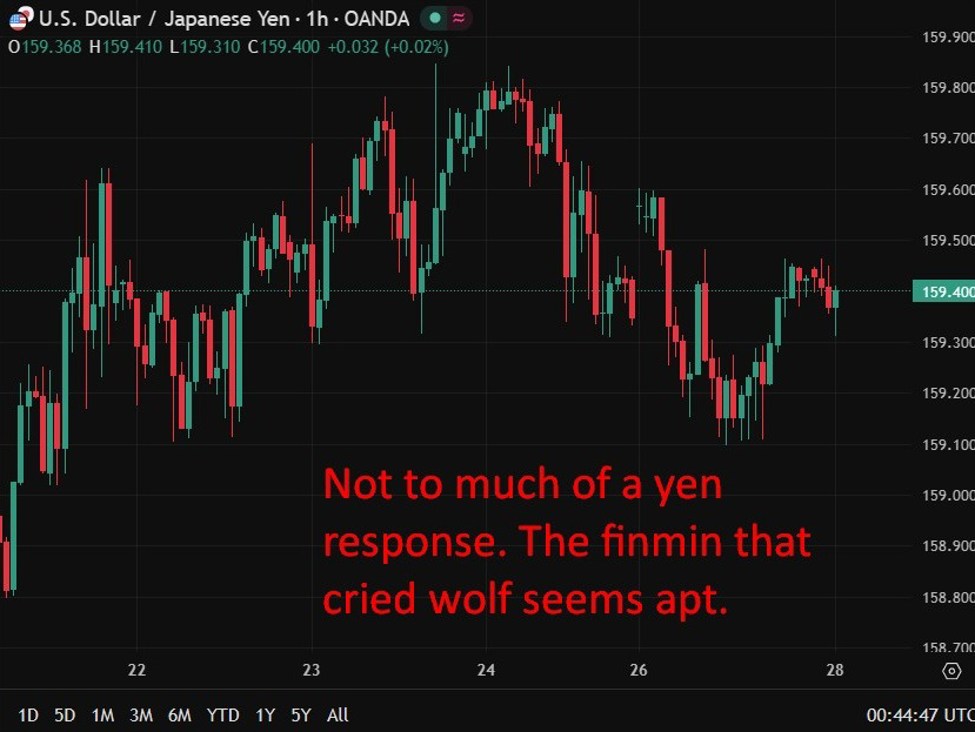
Katayama talks up yen intervention risk (as usual) as crude volatility weighs currency
Japan’s Finance Minister Katayama warns of decisive FX action coordinated with the U.S. as crude oil volatility drives yen weakness, with the BOJ rate decision due later in the session. BOJ expected to hold rates steady as Iran conflict complicates tightening pathSummaryFinance Minister Katayama said crude oil volatility is feeding into FX markets and affecting the broader economy, warning authorities are ready to take decisive action against speculative activityShe confirmed close coordination with the United States, citing an agreement with Washington to act jointly if necessary and said Japan is in constant contact with the U.S. without interruptionThe yen is hovering near 160 per dollar, a psychologically significant level that has previously triggered Japanese currency interventionKatayama said FX volatility is directly affecting household livelihoods, reinforcing the government’s sensitivity to yen weakness and its inflationary impact on energy and food import costsShe confirmed discussions with U.S. Treasury Secretary Bessent and said the matter has been communicated to G7 counterparts, while drawing a clear line between government FX policy and BOJ monetary decisionsJapan is reported to be evaluating unconventional options, including using its foreign exchange reserves to take short positions in crude oil futures to drive down energy prices and relieve yen pressure indirectly. Seems far-fetched that.Katayama described the economy as recovering modestly with wage hike momentum continuing, but said caution over the outlook is warrantedNote: the Bank of Japan’s Monetary Policy Committee is delivering its rate decision later today, with the policy rate widely expected to be held at 0.75%. Governor Ueda’s press conference will be closely watched for guidance on the future tightening path given the Iran war’s inflationary impact and the yen’s ongoing weaknessJapanese Finance Minister Satsuki Katayama has issued another warning to currency markets, saying Tokyo stands ready to take decisive action against speculative yen positions in close coordination with the United States, as the Iran war-driven surge in crude oil prices continues to weigh heavily on Japan’s currency and amplify domestic inflation.Speaking at a regular press conference, Katayama said authorities had observed rising speculative activity in currency markets linked directly to volatility in oil prices, and confirmed that Japan has a standing agreement with Washington that would allow joint action to be taken. She said Tokyo has been in constant contact with U.S. counterparts without interruption, including over holiday periods, a formulation designed to signal round-the-clock readiness rather than a reactive posture.The yen has been trading close to 160 per dollar, a level with deep significance for Japanese authorities. It was at similar levels that the Ministry of Finance previously authorised direct market intervention, and the proximity to that threshold gives Katayama’s language practical as well as rhetorical weight. She has also confirmed discussions with U.S. Treasury Secretary Bessent and said Japan’s concerns have been communicated to G7 partners, internationalising what might otherwise be read as a domestic currency management issue.The mechanism by which crude prices punish the yen is well understood in Tokyo. Japan imports the overwhelming majority of its energy needs, meaning higher oil prices push up the country’s import bill, widen the trade deficit and increase demand for dollars, all of which put downward pressure on the yen. That depreciation then feeds back into higher import costs for energy and food, compounding inflationary pressure on households. Katayama stressed that FX volatility is affecting livelihoods directly, a framing that signals political as well as economic urgency.Reports suggest Tokyo is also exploring more unconventional options. Japan is said to be evaluating the use of its substantial foreign exchange reserves to take short positions directly in crude oil futures, aiming to suppress energy prices and relieve yen pressure through the back door rather than intervening in FX markets outright. The idea has attracted internal scepticism, with some officials questioning whether a single country can move a market as large and liquid as global crude, and the financial exposure of a large short position in a volatile market carries its own risks. But the fact that the option is being discussed at all reflects the scale of the challenge Tokyo faces.On the broader economy, Katayama offered a measured assessment, describing Japan as recovering modestly with momentum for wage increases still intact. She was careful to add that caution over the outlook is warranted, a hedge that reflects how quickly the external environment can deteriorate given the unresolved Iran conflict.The session carries added significance because the Bank of Japan is delivering its rate decision later today, with the policy rate widely expected to be held at 0.75%. Governor Kazuo Ueda’s press conference will be closely watched for any shift in language around the tightening path, particularly given that yen weakness and import-driven inflation pull in a different direction to the growth caution that has kept the BOJ on hold. The convergence of fiscal intervention signals from Katayama and monetary policy guidance from Ueda makes this one of the more consequential sessions for Japanese markets in recent weeks.—The remarks carry classic verbal intervention characteristics: a warning calibrated to give pause to momentum traders without committing to immediate action. The yen’s proximity to the 160-per-dollar threshold, a level that triggered intervention in the past, makes the threat credible enough to command attention. The explicit reference to U.S. coordination is the most market-significant element, raising the prospect of a joint Japan-U.S. FX operation. Japan’s Finance Minister Katayama warns of decisive FX action coordinated with the U.S. as crude oil volatility drives yen weakness, with the BOJ rate decision due later in the session. Japan’s heavy reliance on oil imports means crude price volatility feeds directly into yen weakness and import-cost inflation, creating a compounding pressure loop that traditional monetary tools struggle to address. Whether Katayama’s words are followed by action will depend on how far the yen slides and how long crude prices remain elevated. With the Bank of Japan decision and Ueda’s press conference due later in the session, the yen is exposed to volatility from both fiscal and monetary directions simultaneously. This article was written by Eamonn Sheridan at
Foreign carmakers warn cheap models face U.S. exit without USMCA deal
Foreign automakers including Nissan, Hyundai and Toyota have warned the Trump administration they may pull affordable models from the U.S. market if USMCA is not renewed or is significantly weakened.Wall Street Journal (gated) reporting. SummaryForeign automakers including Nissan, Hyundai and Toyota have privately warned the Trump administration they may withdraw their most affordable models from the U.S. market if the USMCA is not renewed or is materially weakenedTrump’s second-term automotive tariffs charge 25% on the non-U.S. content of vehicles that previously qualified as duty-free under the agreement, making entry-level models unprofitable for many manufacturersEight of the ten cheapest new car models in the U.S. are made by foreign-based automakers, with options such as the Nissan Sentra at $22,600 and the Hyundai Venue at $20,550 among the most accessible for consumersNissan Americas chairman Christian Meunier said tariffs have been killing affordable cars, while Toyota said it is wary of committing to major U.S. factory investment until a trade settlement is reachedThe White House said automakers wanting to sell to American drivers need to come to terms with the need to reshore manufacturing, and pointed to deregulation and tax cuts as support for that transitionThe administration has not committed to tariff-free treatment for automobiles in any revised USMCA, and U.S. Trade Representative Greer has told Mexican officials some level of tariffs are likely to persistCanada and Mexico have both signalled they require automotive tariff relief as a condition of USMCA renewal, with Mexico’s economy chief saying the country is focused on reducing rather than eliminating proposed leviesForeign automakers have delivered a stark warning to the Trump administration: without a credible renewal of the U.S.-Mexico-Canada Agreement, some of the most affordable new cars available to American consumers may be withdrawn from the market entirely.Companies including Nissan, Hyundai and Toyota have communicated this position directly to Trump’s economic advisers, according to people familiar with the discussions. The message reflects a growing calculation among foreign manufacturers that Trump’s second-term tariff regime has made entry-level models financially unviable, and that without a trade framework that reduces duties on North American-built vehicles and parts, the economics of producing and selling cheap cars in the U.S. simply do not add up.At the heart of the problem is a 25% tariff on the non-U.S. content of vehicles that previously would have entered duty-free under the USMCA. Trump signed that agreement in 2020, providing tariff-free treatment to cars built largely with parts from the U.S., Mexico or Canada. His second-term levies have cut across those supply chains, and while some limited relief has been offered, manufacturers say their tariff bills continue to mount.The consequences for consumers would be tangible. Eight of the ten cheapest new car models sold in the U.S. come from foreign-based manufacturers. The Mexico-built Nissan Sentra starts at $22,600 and the Hyundai Venue, imported from South Korea, at $20,550. Detroit’s major automakers largely abandoned the small car segment years ago in favour of SUVs and trucks, leaving foreign brands as the primary source of affordable options for buyers priced out of a market where the average new car now costs around $50,000.Nissan Americas chairman Christian Meunier said tariffs have been killing affordable cars and described a USMCA deal as necessary to ease the pain. Toyota said it has been accumulating losses in North America since tariffs took effect and is reluctant to commit to major new U.S. factory investment until a trade settlement provides clearer ground. U.S. sales chief David Christ put it plainly, saying it is difficult to commit two or three billion dollars to new facilities without some form of resolution, and described USMCA renewal as the next big milestone for the industry.Honda took a slightly different position, saying it would continue selling the Civic in the U.S. even without a trade deal, but acknowledged the economics of doing so would become considerably more difficult without the stability of North American free trade.The White House response has been consistent: automakers that want access to American consumers need to accelerate the shift of manufacturing back to the United States. Spokesman Kush Desai pointed to deregulation, tax cuts and pro-investment policies as the administration’s offer to companies prepared to make that commitment. What the administration has not offered is any guarantee of tariff-free treatment for automobiles in a revised USMCA, and Trade Representative Jamieson Greer has told Mexican officials directly that some level of tariffs is likely to remain in any renewed agreement.That position puts Washington at odds with both its USMCA partners. Canada has said automotive tariff relief is a condition of renewal. Mexico has struck a more pragmatic tone, with its economy minister saying the country should not be nostalgic for a no-tariff era but is focused on minimising whatever levies the U.S. seeks to impose. Neither position suggests a swift resolution, leaving foreign carmakers in a prolonged state of uncertainty that is already shaping their investment and product decisions in the world’s largest car market.And we all thought this was the worst we’d get. Dummies. —Bearish for foreign automakers with significant North American affordable model exposure, particularly Nissan, Hyundai and Toyota. The 25% tariff on non-U.S. vehicle content has already rendered many entry-level models unprofitable, and the absence of USMCA clarity is freezing capital investment decisions across the sector. Toyota’s explicit reluctance to commit billions to new U.S. facilities until a trade settlement emerges illustrates how the uncertainty is suppressing the very reshoring the administration says it wants. The political dimension is equally significant: the departure of affordable models from the U.S. market would directly contradict the administration’s cost-of-living narrative ahead of any future electoral cycle, creating a tension that may ultimately force some form of tariff relief. Near term, automaker margins remain under pressure and supply chain restructuring costs continue to mount. This article was written by Eamonn Sheridan at investinglive.com. 🔗 Source 💡 DMK Insight Foreign automakers are sending a clear message: if USMCA isn’t renewed or weakened, they might pull affordable models from the U.S. market. This isn’t just a
PBOC sets USD/ CNY reference rate for today at 6.8589 (vs. estimate at 6.8282)
The PBOC allows the yuan to fluctuate within a +/- 2% range, around this reference rate.Injects 43.5bn yuan via 7-day reverse repos in open market operates today. Unchanged rate of 1.4%. This article was written by Eamonn Sheridan at investinglive.com. 🔗 Source 💡 DMK Insight The PBOC’s recent actions signal a strategic move to stabilize the yuan amid economic pressures. Injecting 43.5 billion yuan through reverse repos while maintaining the interest rate at 1.4% suggests a commitment to liquidity support. This is crucial as traders should be aware of the yuan’s +/- 2% fluctuation range, which could lead to volatility in forex pairs involving the yuan. If the yuan weakens beyond this threshold, it could trigger further interventions from the PBOC, impacting not just the yuan but also commodities and emerging market currencies that are sensitive to Chinese economic health. Keep an eye on the USD/CNY pair, as any significant movement could indicate broader market sentiment and risk appetite. Traders should monitor the yuan’s performance closely, especially in relation to key economic data releases from China in the coming weeks, as these could influence the PBOC’s next steps. 📮 Takeaway Watch the USD/CNY pair closely; any significant movement could indicate broader market sentiment and trigger further PBOC interventions.