
 Bitcoin
  Ethereum
  Tether
  XRP
XRP  BNB
BNB  USDC
USDC  Solana
  TRON
TRON  Lido Staked Ether
  Figure Heloc
There aren’t any major expiries to take note of on the day, with the full list seen below.As things stand, markets are continuing to feel more optimistic about the US-Iran situation. And with lower oil prices (at least on paper), that is helping to spread some relief across other asset classes. In particular, US equities are driving up with tech shares continuing to rebound strongly in the past two weeks. The S&P 500 and Nasdaq posted closed at fresh record highs in trading yesterday.In FX, that is leading to a weaker dollar and traders sense a better outlook on things to come. But whether or not that optimism is misplaced, is a topic for another conversation. Considering the overall risk mood for now though, the dollar is on the backfoot and that will look to hold in the session ahead barring any major headline surprises.USD/JPY remains one that is of interest with Tokyo officials stepping up their verbal intervention in the past day. That so as to try and put down traders just in case the market sentiment turns on any fallout from US-Iran tensions. The pair is keeping at 158.80 on the day now, down 0.1% and keeping little changed.Amid a lack of meaningful impact from the expiries, it’s all on headline risks once again. For now, all eyes will be on whether Pakistan can convince Iran to come back to the negotiating table and if there will be more talks in the coming days. Besides that, we’ll have to see if the ceasefire will also be extended. The current agreement is that it will hold until 22 April before lapsing.For more information on how to use this data, you may refer to this post here. This article was written by Justin Low at investinglive.com. 🔗 Source 💡 DMK Insight Optimism around the US-Iran situation is shifting market sentiment, and here’s why that matters: Lower oil prices are easing inflationary pressures, which could lead to a more stable economic environment. This relief is likely to boost risk appetite among traders, especially in equities and commodities. If oil continues to trend down, we might see a stronger dollar as investors shift away from inflation hedges. Keep an eye on correlated assets like energy stocks and commodities, as they could react sharply to any further developments. However, it’s worth noting that this optimism might be overblown. Geopolitical tensions can escalate quickly, and any sudden news could flip sentiment. Traders should watch for key technical levels in oil and the dollar index, particularly if oil prices break below recent support levels. The next few days could be pivotal, so stay alert for any shifts in news or market reactions. 📮 Takeaway Watch for oil prices breaking below key support levels; this could signal a stronger dollar and impact equities and commodities significantly.

UK February monthly GDP +0.5% vs +0.1% m/m expected
Prior 0.0%; revised to +0.1%GDP +1.0% vs +0.6% y/y expectedPrior +0.8%; revised to +0.7%Services +0.5% vs +0.2% m/m expectedPrior 0.0%; revised to +0.1%Industrial output +0.5% vs +0.2% m/m expectedPrior -0.1%Manufacturing output -0.1% vs +0.3% m/m expectedPrior +0.1%; revised to +0.2%Construction output +1.0% vs 0.0% m/m expectedPrior +0.2%; revised to +0.5%The main boost to the UK economy in February came amid a beat on estimates from the services sector output. That contributed to 0.42% (unrounded) in terms of monthly GDP growth. In the three months to February, UK GDP is also estimated to have grown by 0.5% after the 0.3% reading in the three months to January.The more positive showing by the services sector now sees it record a fourth straight month of increase in output. And the good news is that the growth is more widespread with 12 of the 14 subsectors showing positive increases in activity.The details show that the largest positive contribution to services sector output came from administrative and support service activities (up 2.0%). An increase of 2.5% in employment activities was the largest positive contributor to the subsector after haven fallen by 6.6% in January.All in all, it’s a positive showing by the UK economy right before the US-Iran conflict started. But with the war set to leave its mark, this is very much lagging data and not one that will have any material impact to the outlook currently. This article was written by Justin Low at investinglive.com. 🔗 Source 💡 DMK Insight Revisions in GDP and industrial output data are shifting market sentiment right now. The upward revision of GDP to +1.0% from +0.6% indicates stronger economic activity than previously thought, which could bolster confidence in risk assets. Services and construction output also beat expectations, suggesting a broadening recovery. However, the manufacturing output dip to -0.1% raises concerns about sector-specific weaknesses. Traders should watch how these mixed signals play out in the coming sessions, especially with the potential for volatility in equities and commodities. Key levels to monitor include support around recent lows in major indices and resistance in commodity prices that may react to these economic indicators. On the flip side, if the manufacturing sector continues to struggle, it could dampen overall economic optimism. This might lead to a flight to safety, impacting forex pairs like USD/JPY. Keep an eye on the upcoming economic calendar for further data releases that could influence market direction. 📮 Takeaway Watch for reactions in equities and commodities as GDP revisions suggest stronger growth, but keep an eye on manufacturing’s weakness for potential volatility.

Goldman Sachs pushes back timing of ECB rate hikes for this year by a little
The revised call comes as we are also starting to see ECB policymakers preach more patience rather than taking a more proactive step come later this month. Goldman Sachs had previously forecast the ECB to raise key interest rates in April and June but have now pushed back that timeline by just a little bit.The firm now expects the central bank to deliver on those rate hikes in June and September instead. On the call, they note that:”We expect energy prices to remain persistently high through 2026. A significant passthrough into inflation is likely in the coming months and the ECB’s communication has remained largely hawkish on the path ahead.”As mentioned earlier, traders are just pricing in ~20% odds of a rate hike for the April meeting for now. But come the June meeting, those odds jump up by quite a margin to ~81% at the moment. For this year, traders are pricing in ~56 bps of rate hikes by the ECB currently. This article was written by Justin Low at investinglive.com. 🔗 Source 💡 DMK Insight The ECB’s shift towards patience is a game changer for traders: it signals a potential delay in rate hikes, impacting euro volatility. Goldman Sachs’ revised forecast pushes back expectations for interest rate increases, which could lead to a weaker euro in the short term. Traders should watch the euro’s response against the dollar, especially if the ECB maintains a dovish stance. This could create opportunities for short positions on EUR/USD, particularly if it breaks below key support levels. The broader market context suggests that if the ECB continues to signal caution, we might see a ripple effect across European equities and bond markets as well. Keep an eye on upcoming ECB meetings and any comments from policymakers that might hint at future monetary policy direction, as these will be crucial for positioning. The flip side is that if inflation data surprises to the upside, the ECB might have to pivot quickly, catching traders off guard. So, stay alert for any economic indicators that could shift the narrative back towards tightening. 📮 Takeaway Watch for ECB comments and euro movements; a break below key support could signal shorting opportunities on EUR/USD.
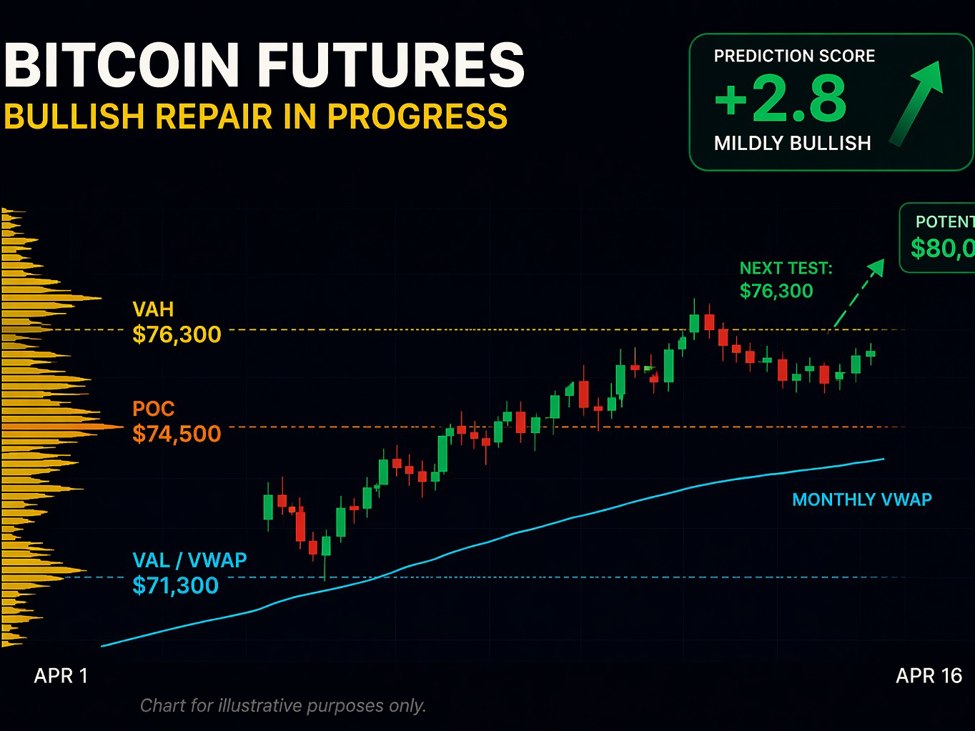
Bitcoin Analysis Today: BTC Holds Bullish Structure as Path Toward $80K Remains in Play
Bitcoin price prediction: Maybe something like this (watch $80k area on bitcoin futures)Bitcoin Price Analysis on the Above 4h Chart: The Path to $80,000The current technical setup suggests Bitcoin is entering a “price discovery” phase within its established ascending corridor. While the trend remains bullish, the $80,000 level represents more than just a round number—it is a critical psychological and structural resistance point.1. The Ascending Channel DynamicsAs seen in the chart, Bitcoin has been bouncing between a series of higher lows (starting near $62,590) and higher highs.The Support: The lower trendline has acted as a safety net, most recently holding firm around the $65,000–$68,000 zone.The Mid-Line: The dashed median line in the yellow channel serves as the “equilibrium.” Bitcoin is currently trading above this line, which signals strong momentum.2. Why $80,000 is the “X” FactorThe target marked “X” on the futures chart aligns with the upper resistance of the multi-month channel. Reaching this level would require a breakout from the current local consolidation at $75,000–$76,000.The Bull Case: A clean break above $76,320 (the previous local peak) would likely trigger a “short squeeze,” as traders who bet against the rally are forced to buy back their positions, potentially catapulting the price toward $80,000.The Institutional Play: With Bitcoin Futures trading at a slight premium, institutional sentiment remains cautiously optimistic despite recent geopolitical volatility.3. “Illustrative, Not a Forecast”The disclaimer in the chart is vital. Technical patterns are roadmaps, not guarantees. The channel is the more “reliable” element, the arrow with the path is illustrative. Why do I say “reliable”? Because if you are new to technical analysis, this art and science is not a crystal ball, and it is not guaranteed. Most of you al already know that. A pattern that plays itself out in 70% is amazing in terms of win rate. Watch the pullback on bitcoin: The zig-zag arrow leading to the $80k target suggests that the path won’t be a straight line. Investors should look for a “retest” of the $73,000 area to confirm it has flipped from resistance to support before the final leg up.Volume is key: For the “80k prediction” to manifest, we need to see an increase in buying volume to pierce the top of the yellow channel.Summary for crypto traders: Bitcoin is currently “holding the line” at $75,000. If it maintains this level, the structural “magnet” is the $80,000 resistance. However, a failure to hold the channel’s mid-line could see a revisit to the $69,800 support before another attempt at the highs.The Bottom Line: Keep your eyes on the futures. The $80,000 mark is the definitive “battleground” for the next phase of this bull market.Key Takeaways for Today’s Bitcoin Prediction at investingLive.comPrediction Score: +2.8 (Mildly Bullish) Bitcoin futures have reclaimed the monthly POC near $74,500 The market shows a bullish repair from $71K lows, not a full breakout yet $76,300 (VAH) remains the key resistance for bullish continuation A successful acceptance above that zone could open the path toward $80,000 The rising monthly VWAP near $71,300 continues to act as structural supportBitcoin futures are stabilizing after early-April weakness – but the real test is still aheadBitcoin futures are starting to look constructive again, and from my perspective, this is not just a random bounce. It is a structured recovery that traders should pay attention to.Since the start of April, Bitcoin initially slipped from around $68,700 to approximately $65,900, shaking out weaker hands early in the month. But what followed is far more important than the drop itself.The market reclaimed the monthly VWAP near $71,300, pushed back into the value area, and has now re-established itself above the Point of Control near $74,500. That shift tells us that price is no longer trading at a discount. Instead, it is now operating in a more balanced-to-constructive zone.The chart included in this analysis highlights this evolution clearly. It shows how Bitcoin moved from lower value back into the upper half of the monthly range, with the key levels and value structure acting as a roadmap for price behavior. Important note: The chart is for illustrative purposes only. It shows a potential path within a rising channel, not a guaranteed trajectory. Markets rarely move in straight lines.The bigger story: from bearish pressure to bullish repairWhat stands out most in this structure is the rejection of lower value.Bitcoin futures tested the $71,300 area (monthly value area low) and quickly reversed. That is not something to ignore. When markets reject lower prices and move higher quickly, it often signals that sellers failed to gain control.From there, Bitcoin climbed steadily: into the $72K–$73K zone then through the $74K area and eventually challenged $76,000+This type of move is what traders call a value repair. The market is essentially saying: “we went too low, and now we are recalibrating higher.”Even more important, the market managed to reclaim the $74,500 POC, which is the level where the most volume has traded this month. Holding above that level is typically a sign of improving structure.Why this is still not a full breakout for the Crypto King (yet)Now here is where the nuance comes in.Bitcoin already attempted a breakout above $76,300, reaching roughly $76,800. But that move did not hold. Price rotated back lower, showing that buyers were not yet strong enough to maintain control above that upper boundary.This matters.Because of that failed breakout, the $76,000–$76,300 zone becomes a key decision area. Traders now know that sellers previously stepped in there. Until Bitcoin proves it can hold above it, that level remains a barrier.So while the structure is bullish, it is still best described as:Bullish repair with overhead congestion – not full bullish controlThe $80K discussion: realistic target or premature optimism?I have been discussing Bitcoin actively on social media over the past weeks, and one thing stood out clearly – a large number of participants were aggressively bearish, many even shorting into this recovery.My response was simple: be careful, and protect your capital.Those who have been following investingLive.com know that we have maintained a constructive-to-bullish view on

USDJPY extends drop as US dollar stays on the backfoot amid US-Iran optimism
FUNDAMENTAL OVERVIEWUSD:The US dollar has been on the backfoot since Monday as the positive US-Iran deal expectations kept weighing on the greenback. The second round of negotiations were expected to begin today but we never had an official date. They are expected to happen before the April 22 ceasefire deadline though. In the meantime, we got reports that US and Iranian negotiators made progress in talks on Tuesday and they were moving closer to a framework agreement to end the war. A US official has also mentioned that if a framework agreement is reached, the ceasefire would need to be extended to negotiate the details of a comprehensive deal.Everything now hinges on US-Iran talks. If negotiations were to break down again, we might see a short-term rally in the greenback, but as long as the ceasefire holds, the upside could remain limited. On the other hand, a peace deal might see the dollar extending the losses although a “sell the fact” type of reaction remains a risk.The market is now pricing in 10 bps of easing by year-end and that might increase on a peace deal. I think the market might get disappointed further down the road as the boost to economic activity amid a resilient labour market and rate cut expectations will likely keep inflation above the 2% target and the Fed on the sidelines. JPY:On the JPY side, the currency has been mostly driven by US dollar strength and weakness as Japanese macro conditions continue to point towards a neutral policy. In fact, despite the growing expectations of a rate hike at the upcoming meeting, inflation in Japan has been gradually easing with most metrics being near or below the 2% target.Moreover, the US-Iran war hasn’t only put upward pressure on inflation but also downward pressure on growth. The end of the war would certainly be good news for the economy and should lift business sentiment which might eventually translate into favourable conditions for a rate hike.For now, the BoJ is more likely to hold rates steady and let things settle after the conclusion of the war. What the BoJ could do at the April meeting is to lay the groundwork for a rate hike in June if they think they have the right conditions in place and that could give the JPY a short-term boost.USDJPY TECHNICAL ANALYSIS – DAILY TIMEFRAMEOn the daily chart, we can see that USDJPY is still consolidating above the 158.00 support zone. The recent consolidation might have formed a head and shoulders pattern with the neckline around the support. If the price falls back to the support, we can expect the buyers to step in with a defined risk below the support to position for a rally into the 162.00 handle. The sellers, on the other hand, will look for a break to pile in for a drop into the 155.00 level next. USDJPY TECHNICAL ANALYSIS – 4 HOUR TIMEFRAMEOn the 4 hour chart, we can see the price rejected the downward trendline near the 160.00 handle and dropped into the 158.25 level today before bouncing. The sellers stepped in around the minor downward trendline with a defined risk above it to keep pushing into the 158.00 support. The buyers, on the other hand, will look for a break above the trendline to pile in for a rally into the next trendline.USDJPY TECHNICAL ANALYSIS – 1 HOUR TIMEFRAMEOn the 1 hour chart, we have a key swing level around 159.10. If we get a break above the trendline, the swing level is where we can expect the sellers to step back in to position for new lows, while the buyers will look for a break to increase the bullish bets into the next trendline. The red lines define the average daily range for today. UPCOMING CATALYSTSToday we get the latest US Jobless Claims figures but the focus remains on US-Iran headlines. This article was written by Giuseppe Dellamotta at investinglive.com. 🔗 Source 💡 DMK Insight The US dollar’s recent weakness signals shifting market dynamics, and here’s why that matters: With the US-Iran deal negotiations looming, traders should keep a close eye on how this impacts USD strength. The anticipation of a deal could lead to increased market confidence, potentially boosting risk assets while putting further pressure on the dollar. If negotiations progress positively, we might see a significant shift in capital flows, favoring emerging markets or commodities linked to Iran. This could create volatility in forex pairs like EUR/USD or USD/JPY, especially if the dollar breaks below key support levels. But there’s a flip side: if talks stall or fail, expect a sharp rebound in the dollar as safe-haven demand spikes. Traders should monitor the April 22 ceasefire deadline closely, as any developments leading up to that date could trigger rapid price movements. Watch for USD’s performance against major currencies, particularly if it approaches critical support levels, as this could indicate a broader trend reversal or continuation. 📮 Takeaway Keep an eye on the April 22 deadline for US-Iran negotiations; a positive outcome could weaken the dollar further, impacting pairs like EUR/USD.
Swiss franc appreciation has led to tighter monetary conditions – SNB minutes
Since the December meeting, financial market situation has been characterised by elevated volatilityMiddle East conflict has resulted in surge in energy prices, which led to a global rise in inflation expectationsWith the appreciation of the Swiss franc since December, monetary conditions are tighterHowever, monetary policy remains expansionaryThe board discussed the various factors responsible for the movements in the Swiss franc exchange rateOne factor is the Swiss franc’s role as a safe havenThe discussion also addressed the latest developments in energy pricesUncertainty about the future course of oil prices remains highThe board also discussed the conditional inflation forecast, which assumes that the policy rate remains at 0%In the short-term, it is higher than the December forecast due to the rise in energy pricesIn the medium-term, the appreciation of the Swiss franc reduces inflationary pressure, countering possible second-round effects of the rise in energy pricesTherefore, the inflation forecast over the medium-term is very close to that of the previous quarterDespite the escalation in the Middle East, the scenario for global economic developments has not changed fundamentallyIn light of the outlooks presented with regards to inflation and the economy, monetary conditions remain appropriateMonetary policy can currently still be considered expansionaryHowever, the SNB’s willingness to intervene in the foreign exchange market should remain high in order to counter a rapid and excessive appreciation of the Swiss franc, which would jeopardise price stability in SwitzerlandFull minutesThe key takeaway here is that the SNB is in stasis in now having to deal with the indirect repercussions of the US-Iran conflict. To be more specific, the issue of taming a much stronger Swiss franc currency.The mention of that being a counterweight to a second-round impact of inflation pressures is a valid argument. However, the main worry is that the currency’s strength will remain sticky and prove to be more detrimental when viewed from a more structural outlook.With the central bank already wanting to avoid unconventional monetary policy such as negative interest rates any time soon, this is a welcome distraction but it won’t change the path that the Swiss economy is put on in the bigger picture. This article was written by Justin Low at investinglive.com. 🔗 Source

The Indian Rupee holds ground amid US-Iran optimism as US dollar remains under pressure
FUNDAMENTAL OVERVIEWUSD:The US dollar has been on the backfoot since Monday as the positive US-Iran deal expectations kept weighing on the greenback. The second round of negotiations were expected to begin today but we never had an official date. They are expected to happen before the April 22 ceasefire deadline though. In the meantime, we got reports that US and Iranian negotiators made progress in talks on Tuesday and they were moving closer to a framework agreement to end the war. A US official has also mentioned that if a framework agreement is reached, the ceasefire would need to be extended to negotiate the details of a comprehensive deal.Everything now hinges on US-Iran talks. If negotiations were to break down again, we might see a short-term rally in the greenback, but as long as the ceasefire holds, the upside could remain limited. On the other hand, a peace deal might see the dollar extending the losses although a “sell the fact” type of reaction remains a risk.The market is now pricing in 10 bps of easing by year-end and that might increase on a peace deal. I think the market might get disappointed further down the road as the boost to economic activity amid a resilient labour market and rate cut expectations will likely keep inflation above the 2% target and the Fed on the sidelines. INR:The Indian rupee stabilised recently as the risk-on sentiment amid the US-Iran deal optimism gave the currency a reprieve. The focus remains on US-Iran negotiations as everything hinges on their outcome.In terms of macro, the RBI held interest rates steady at 5.25% and downgraded growth forecasts due to the US-Iran war at the last policy meeting. The central bank expects inflation to increase in the short-term and growth to slow down. In the big picture, the Indian Rupee remains on a bearish structural trend against the US dollar, so the dip-buyers will likely look for opportunities around strong technical levels to keep pushing into new highs, but for now the Rupee could remain supported and extend the relief rally in case the US-Iran war ends.USDINR TECHNICAL ANALYSIS – DAILY TIMEFRAMEOn the daily chart, we can see that USDINR fell below the upper bound of the channel and started to consolidate. The sellers are stepping in around the top trendline to extend the drop into the lower bound of the channel. The buyers, on the other hand, will want to see the price rising back above the top trendline to increase the bullish bets into new highs.USDINR TECHNICAL ANALYSIS – 4 HOUR TIMEFRAMEOn the 4 hour chart, we have a minor upward trendline acting as support. The buyers continue to step in around the trendline with a defined risk below it to keep pushing into new highs. The sellers, on the other hand, will look for a break lower to increase the bearish bets into new lows.USDINR TECHNICAL ANALYSIS – 1 HOUR TIMEFRAMEOn the 1 hour chart, we can see more clearly the consolidation between the minor upward trendline and the resistance zone around the 94.00 handle. There’s not much we can add here as the buyers will look for bounces around the trendline and wait for a break above the resistance, while the sellers will continue to step in around the resistance and wait for a break below the trendline.UPCOMING CATALYSTSToday we get the latest US Jobless Claims figures, but the focus remains on US-Iran headlines. This article was written by Giuseppe Dellamotta at investinglive.com. 🔗 Source 💡 DMK Insight The US dollar’s recent weakness is tied to optimistic expectations around US-Iran negotiations, and here’s why that matters: As traders, we need to consider how geopolitical developments can shift currency valuations. The anticipation of a deal could lead to increased risk appetite, pushing investors away from the dollar and into riskier assets. If negotiations progress positively, we might see the dollar continue to slide, especially if the market perceives a potential easing of tensions in the Middle East. This could also impact commodities like oil, which often sees price fluctuations based on geopolitical stability. Keep an eye on the April 22 ceasefire deadline; any breakthroughs or setbacks in negotiations could create volatility in the dollar and related markets. On the flip side, if talks stall or face significant hurdles, the dollar could rebound sharply as traders flock back to safety. Watch for key resistance levels in the dollar index and be prepared for potential swings. Monitoring sentiment indicators and market reactions to news from the negotiations will be crucial in the coming days. 📮 Takeaway Watch for developments in the US-Iran negotiations; a positive outcome could weaken the dollar further, impacting risk assets and commodities.
Italy March final CPI +1.7% vs +1.7% y/y prelim
Prior +1.5%HICP +1.6% vs +1.5% y/y prelimPrior +1.5%The jump in Italy’s headline inflation is not as profound as elsewhere in the region. However, it still reflects the same characteristics with energy price inflation spiking higher. Energy price inflation was down by 6.6% year-on-year in February but now reflect a 2.3% decline only instead.Besides that, the inflationary momentum is also supported by the acceleration in the prices of unprocessed food (+4.4% from +3.7%).As for core annual inflation, that is seen slowing in March to 1.9% – down from 2.4% in February. That comes as services inflation sees a marked slowdown to 2.8%, down from 3.6% previously.It’s only one month’s worth of reading for now and with surging energy prices, expect that to have more of an impact on headline and core prices in the region in the months ahead. This article was written by Justin Low at investinglive.com. 🔗 Source 💡 DMK Insight Italy’s inflation uptick, while modest, signals potential volatility in energy markets that traders need to watch closely. The recent rise in headline inflation to 1.5% year-on-year, driven by a rebound in energy prices, could have ripple effects across the Eurozone. Traders should be aware that energy price fluctuations can influence broader market sentiment, especially in commodities and related currencies. If energy prices continue to rise, we might see a shift in central bank policies, impacting interest rates and forex pairs like EUR/USD. Keep an eye on the technical levels around 1.10 for EUR/USD; a breach could trigger further selling pressure. On the flip side, the relatively contained inflation compared to other regions might lead to a more cautious approach from the European Central Bank, which could stabilize the euro in the short term. Watch for upcoming economic releases that could provide clarity on the trajectory of inflation and energy prices, as these will be crucial for positioning in both forex and commodity markets. 📮 Takeaway Monitor energy prices closely; a sustained rise could impact EUR/USD around the 1.10 level and trigger broader market shifts.

ECB's Villeroy: April hike premature, no rush to act
Focus on April hike is prematureThe ECB would have no hesitation to act if and when necessaryThere’s no rush to act at the momentThere’s no predetermined rate pathThe ECB will need critical mass of data before actingOur vigilance is first and foremost on the risk of persistent inflationUnderlying inflation is still close to targetECB’s Villeroy reiterated that focusing on a potential interest rate hike in April is premature as the bank maintains a cautious and data-dependent stance. While Villeroy made it clear that the ECB would have no hesitation to act if and when necessary to maintain price stability, he reiterated that there is no rush to act at the current moment.The governor noted that the ECB will need a critical mass of data before making any decisive policy shifts. Villeroy highlighted that the bank’s vigilance is first and foremost focused on the risk of persistent inflation, which remains the primary concern for policymakers. Despite recent global economic volatility and energy price fluctuations, he pointed out that underlying inflation is still close to the bank’s target.Villeroy’s comments suggest that while the central bank is prepared to tighten policy if inflationary pressures become entrenched, it prefers a patient wait-and-see approach.The market is currently pricing in just 20% probability of an April hike but that increases to 70% for June. In total, the market expects the ECB to deliver two rate hikes by year-end. This article was written by Giuseppe Dellamotta at investinglive.com. 🔗 Source 💡 DMK Insight The ECB’s cautious stance on rate hikes is a signal for traders: don’t expect immediate volatility. With ETH currently at $2,332.19, the broader market’s reaction to central bank policies will be crucial. If the ECB maintains its wait-and-see approach, we might see a stable environment for crypto and forex traders, especially those holding positions in ETH. This could lead to a consolidation phase, where traders should watch for key support and resistance levels around $2,300 and $2,400 respectively. However, if inflation data surprises to the upside, it could trigger a sudden shift in sentiment, impacting not just ETH but also correlated assets like Bitcoin and traditional currencies. Here’s the thing: while the ECB’s vigilance is clear, the lack of urgency could mask underlying risks. Traders should keep an eye on upcoming inflation reports and market reactions to any unexpected comments from ECB officials. A break below $2,300 could signal a bearish trend, while a push above $2,400 might invite bullish momentum. 📮 Takeaway Watch ETH closely; a break below $2,300 could indicate bearish momentum, while a push above $2,400 may signal a bullish trend.
Senior Iranian Official: Fundamental disagreements continue over nuclear issues
Pakistani army chief trip to Iran helped reduce differences in some areasAfter the trip, there are greater hopes for extending the ceasefire and holding a second round of talksFundamental disagreements continue over nuclear issuesThe fate of Iran’s highly enriched uranium and the duration of its nuclear restrictions remain unresolvedFollowing a high-level visit to Tehran by Pakistan’s Army Chief, Field Marshal Asim Munir, a senior Iranian official indicated that the mediation has successfully narrowed the gap in several key areas. The trip has bolstered hopes for both an extension of the current fragile ceasefire and the convening of a second round of formal talks, potentially to be held again in Islamabad.Despite the progress, fundamental disagreements continue to stall a broader breakthrough, particularly regarding Iran’s nuclear program. While the mediation facilitated better communication, the core dispute over the fate of Iran’s stockpile of highly enriched uranium remains a significant hurdle. The US has maintained a firm stance on the removal or dilution of this material, whereas Tehran continues to defend its sovereign right to maintain its nuclear infrastructure.Furthermore, the duration of nuclear restrictions, a cornerstone of any long-term settlement, remains unresolved. Negotiators are reportedly wrestling with the timeline for a “freeze” on enrichment, with significant disparities between the decades-long restrictions sought by the US and the much shorter duration proposed by Iran. While Pakistan’s involvement has helped maintain a diplomatic channel, the resolution of these high-stakes nuclear issues continues to be the primary obstacle to a lasting peace agreement. This article was written by Giuseppe Dellamotta at investinglive.com. 🔗 Source 💡 DMK Insight The recent diplomatic efforts between Pakistan and Iran could have significant implications for regional stability, which in turn may affect market sentiment towards assets like cryptocurrencies and forex. As SOL is currently at $85.04, traders should be aware that geopolitical tensions can lead to increased volatility in these markets. If the ceasefire extends and talks progress, we might see a bullish sentiment that could spill over into risk assets, including cryptocurrencies. However, the unresolved issues surrounding Iran’s nuclear program could still trigger sudden market reactions. Traders should keep an eye on any announcements or developments in this area, particularly in the next few weeks as talks continue. A strong bullish trend in SOL could be supported if it breaks above key resistance levels, but any negative news could lead to sharp corrections. Watch for SOL to maintain above $80 to confirm bullish momentum, while also monitoring broader market reactions to geopolitical developments. 📮 Takeaway Keep an eye on SOL’s performance; if it holds above $80, it could signal bullish momentum amid evolving geopolitical dynamics.