
 Bitcoin
  Ethereum
  Tether
  BNB
BNB  XRP
XRP  USDC
USDC  Solana
  TRON
TRON  Lido Staked Ether
  Figure Heloc
Prior was +2.7% (revised to +2.8%)PPI y/y +5.4% vs +5.4% priorRaw materials price index +0.6% m/m vs +7.7% priorRaw materials price index +8.6% y/y vs +8.0% priorNormally, the Bank of Canada would give a lower reading like this some attention but with energy prices spiking, that won’t be the case this year and instead they will wait for March data and to see what will happen with the war.The IPPI rose 0.4% month over month, a sharp deceleration from the 2.8% gain in January. Exclude energy and petroleum products and the index actually declined 0.4%. That tells you how narrow this move really was.Energy did all the heavy lifting. Refined petroleum products surged 8.2% on the month, with diesel climbing 10.5% as Iran-US tensions escalated through the second half of February. That’s a geopolitical risk premium getting priced in, and it’s the kind of move that can unwind just as quickly as it materialized.The easing of inflationary signals elsewhere are difficult to dismiss (at least pre-war). Primary non-ferrous metals fell 3.7% — their first decline since April 2025 — with silver and platinum group metals both retreating roughly 11%. Meat and dairy slid 5.9%, the steepest decline since July 2020, as poultry prices collapsed nearly 17% following Canada’s decision to lift its ban on Brazilian chicken imports.On the raw materials side, the RMPI gained 0.6% but ex-energy it was down 1.1%. Metal ores declined 2.7% as Chinese iron ore stockpiles continued to build.The canola story is worth watching — prices rose 6.3% after China announced a substantial reduction in tariffs on Canadian canola seeds effective March 1. A rare constructive development in the Canada-China trade relationship.Year-over-year, gold and precious metals remain the dominant theme, with that group nearly doubling. But the broader picture is one where energy volatility is masking genuine softness in manufacturing prices. This article was written by Adam Button at investinglive.com. 🔗 Source 💡 DMK Insight With ADA at $0.26, the recent PPI data and raw materials index are key indicators for traders right now. The PPI y/y at +5.4% matches expectations, but the raw materials price index’s jump to +0.6% m/m from +7.7% prior suggests inflationary pressures are still present. This could impact the Bank of Canada’s monetary policy, especially with energy prices on the rise. For ADA traders, these economic indicators could influence market sentiment, particularly if inflation leads to a more hawkish stance from central banks. Watch for ADA to react to any shifts in investor sentiment as inflation concerns mount. But here’s the flip side: if energy prices stabilize or decline, we might see a shift in the inflation narrative, which could provide a bullish sentiment for ADA. Keep an eye on the $0.25 support level; a break below could trigger further selling pressure. Conversely, a rally above $0.27 could signal a bullish reversal, so those are the levels to watch closely in the coming days. 📮 Takeaway Monitor ADA closely around the $0.25 support and $0.27 resistance levels as inflation data unfolds; these could dictate short-term price movements.

Canada January retail sales +1.1% vs +1.5% expected
Prior was -0.4%Ex autos +0.8% vs +1.2% expectedPrior ex autos +0.1% (revised to 0.0%)Advance February sales +0.9%Sales hit $70.7 billion in JanuarySales ex autos and gas +0.9%The advance reading tends to be the better signal in this report and the number for February is strong. As for January, vehicles rose 2.0% led by new car dealers. In terms of the core, general merchandise retailers (+3.0%) rose for a fourth month while food and beverage retailers fell 0.6%. Ecommerce sales rose 1.5%. This article was written by Adam Button at investinglive.com. 🔗 Source 💡 DMK Insight Retail sales data just came in stronger than expected, and here’s why that matters: The advance reading for February sales at +0.9% signals robust consumer spending, which could bolster economic growth forecasts. This is particularly relevant as traders assess the potential for interest rate hikes from the Fed. If consumer demand remains strong, it could lead to inflationary pressures, prompting the Fed to act more aggressively. Keep an eye on related sectors like consumer discretionary stocks, which often react positively to strong sales data. On the flip side, if the market perceives this as a signal for tighter monetary policy, we might see volatility in equities and bonds as traders adjust their positions. Watch the $70.7 billion figure closely; if sales continue to exceed expectations, it could shift market sentiment significantly. For now, monitor the upcoming economic indicators, especially any revisions to previous months’ data, as they could provide additional context for future trading strategies. 📮 Takeaway Traders should watch for potential Fed rate hike signals as February retail sales beat expectations, impacting consumer stocks and overall market sentiment.

Feds Waller: If oil stays high for months on end, at some point it bleeds into inflation
If oil stays high for months on and at some point it leads into core inflation.A high and persistent oil shock would not have a transitory impact on inflation. Based on the jobs report was planning to dissent, but since then inflation has become more of a concernZero job growth does not seem normal, but that is what the math may indicate will keep the unemployment rate stableFed cannot look through a large and persistent will shock, at this point caution for the Fed is warranted.Wants to wait and see how this evolves before deciding on rate cuts for later this year.Fed is making progress on taming structural inflation, which may be close to 2% now but is held higher by tariffs.Do not think there is a need to consider rate hikes.Inflation expectations are not unanchored.Investors understand inflation will drop once tariffs rolloff. If the tariff effects don’t roll off in the 2nd half of the year it will be tricky.A shock of the right sort could push companies to start cutting labor. It could be the price of oil moving higher.Consumer outlook could also be damaged with gas prices rising.No reason to make bank reserves scarce just to reduce the balance sheet.Fed Governor Christopher Waller, who had previously leaned toward lower rates, has shifted his stance amid renewed inflation concerns tied to the recent spike in oil prices.Waller argues that rising energy costs pose a broader risk than tariff-driven price increases, as oil feeds into a wide range of goods and services across the economy. In contrast, he views tariffs as more likely to create one-time price adjustments—not sustained inflation.He also noted that tariff-related price pressures have been less pronounced than expected so far. However, he cautioned that if those prices fail to ease by mid-year, it could become a more persistent inflation issue.For now, inflation expectations remain anchored, with the baseline view still leaning toward moderation in price pressures—but Waller’s shift highlights growing sensitivity to energy-driven risks, and a more wait-and-see attitude. Typically, Miran issues a statement on his dissenting bias on the Friday after the rate decision. Awaiting that response. . This article was written by Greg Michalowski at investinglive.com. 🔗 Source 💡 DMK Insight Oil prices are a ticking time bomb for inflation, and here’s why traders need to pay attention: If oil remains elevated for an extended period, it could lead to a sustained rise in core inflation, which is a major concern for central banks and could influence monetary policy decisions. The recent jobs report showing zero job growth adds another layer of complexity, as stagnant employment can exacerbate inflationary pressures. Traders should keep an eye on oil price movements, as a sustained increase could trigger a shift in interest rates, impacting not just commodities but also equities and forex markets. Look for key resistance levels in oil prices; if they break through, expect a ripple effect across related assets, particularly energy stocks and inflation-linked bonds. On the flip side, if oil prices start to decline, it could ease inflation fears and provide a temporary reprieve for markets. But with the current economic indicators pointing towards persistent inflation, the risk of a hawkish shift from central banks remains high. Watch for any comments from the Federal Reserve regarding inflation targets and oil price impacts in their upcoming meetings. 📮 Takeaway Traders should monitor oil price trends closely; a sustained high could trigger inflationary pressures and impact monetary policy decisions significantly.
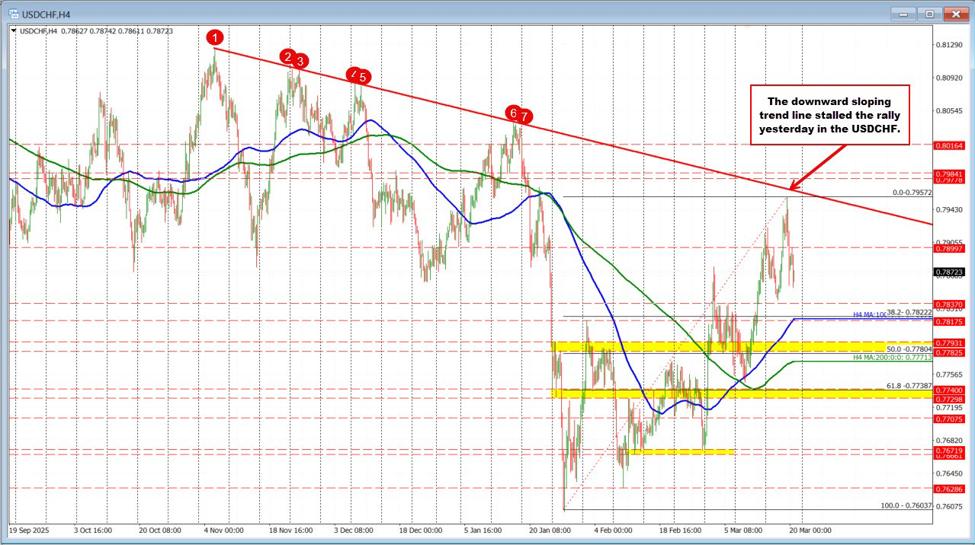
USDCHF backs off to MA support. Support at the 200 hour MA stalls the fall.
The CHF weakened initially (USDCHF moved higher) after the SNB signaled a willingness to intervene following its decision to keep rates unchanged on Thursday. The pair extended to a high of 0.7957, stalling just ahead of a downward-sloping trendline on the 4-hour chart.However, the upside momentum could not be sustained. Broad-based USD selling during the North American session triggered a rotation lower, pushing the price back below the 100-hour MA. A rebound during the Asian session lifted the pair back above that level (currently near 0.7885), but once again, buyers failed to maintain control.The pair has since rotated lower, dipping just below yesterday’s low before finding support near the rising 200-hour MA at 0.7869.With price now trading between the 100- and 200-hour moving averages, the short-term bias is neutral, and those MAs are the key directional barometers:Below the 200-hour MA (0.7869): Opens the door for a move toward a key swing area near 0.7837 (a level that held as support on Wednesday and has prior price memory). A break below that targets the 38.2% retracement at 0.7822.Above the 100-hour MA (0.7885): Shifts the bias back to the upside, with a retest of the 0.7900 natural resistance level. A break above that would increase bullish momentum and expose higher levels.In short, the market is in consolidation mode, with the battle between the 100- and 200-hour MAs setting up the next directional move. This article was written by Greg Michalowski at investinglive.com. 🔗 Source 💡 DMK Insight The SNB’s rate decision and intervention signals are shaking up USDCHF dynamics right now. With the pair hitting 0.7957 but failing to break through a key downward-sloping trendline on the 4-hour chart, traders should be cautious. This indicates a potential reversal or consolidation phase. The initial weakness of the CHF suggests that the market is reacting to the SNB’s stance, but the inability to maintain upward momentum raises questions about the sustainability of this rally. If USDCHF can break above that trendline, we might see a stronger bullish push, but if it retreats, it could signal a deeper correction. Keep an eye on the 0.7900 support level; a breach could lead to further downside. On the flip side, if the SNB follows through with intervention, it could create volatility not just in USDCHF but also in related pairs like EURCHF. Watch for any comments from SNB officials that might hint at future monetary policy shifts, as these could provide critical insight into market direction. 📮 Takeaway Monitor USDCHF closely; a break above 0.7957 could trigger bullish momentum, while a drop below 0.7900 may signal a bearish reversal.
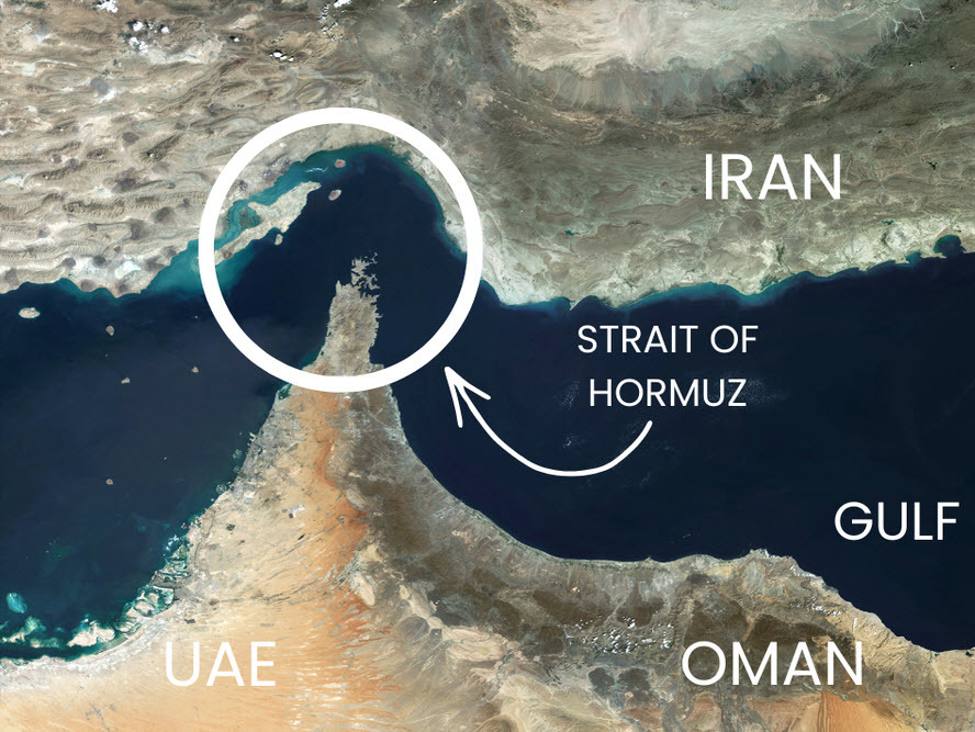
Trump says reopening Hormuz "a simple military manoeuver" with "so little risk"
Trump is lamenting the lack of help in reopening Hormuz:Without the U.S.A., NATO IS A PAPER TIGER! They didn’t want to join the fight to stop a Nuclear Powered Iran. Now that fight is Militarily WON, with very little danger for them, they complain about the high oil prices they are forced to pay, but don’t want to help open the Strait of Hormuz, a simple military manoeuver that is the single reason for the high oil prices. So easy for them to do, with so little risk. COWARDS, and we will REMEMBER! President DONALD J. TRUMPThere is some generally good news here:1) The US appears to be willing to do it alone2) Trump sounds confident it can be done3) He sounds ready to declare victorySo despite all the unfriendly rhetoric here, this is a positive post for risk assets and should be negative for oil. That said, a US F35 (or two) were struck yesterday by Iran and they hit neighbours with ballistic missiles. The idea they’re defeated sounds premature but we will have to wait and see.May WTI crude is down 19-cents to $95.22 but well above the low of $92.47 from early in Asia.The S&P 500 is down 0.5%.I think there is some apprehension going into the weekend because Trump has tended to escalate on Friday nights once the market closes and he’s an unpredictable man. The downside here is that the possibility of trump saying “mission accomplished” is dwindling and the US is now committing itself to reopen Hormuz, for however long that takes. Organizing the military escorts of the tankers is also problematic and it’s hard to see how you don’t lose the Iranian barrels now, even if you regain the ones from other gulf states, so it still leaves the world short of oil. This article was written by Adam Button at investinglive.com. 🔗 Source 💡 DMK Insight Trump’s comments on NATO and the situation in Hormuz highlight a critical geopolitical tension that could impact oil prices and, by extension, the broader markets. With rising oil prices often linked to geopolitical instability, traders need to keep a close eye on how this narrative evolves. If tensions escalate or if there’s a perceived threat to oil supply routes, we could see a spike in crude oil prices, which would ripple through related markets like energy stocks and currencies tied to oil exports. Moreover, the sentiment around NATO’s effectiveness could influence investor confidence in global stability, potentially leading to increased volatility in the forex markets. Traders should monitor the Brent crude oil futures closely, especially if prices approach key resistance levels. If oil breaks above recent highs, it could trigger a wave of speculative buying. On the flip side, if diplomatic efforts succeed and tensions ease, we might see a pullback in oil prices, presenting a shorting opportunity. Watch for any announcements from NATO or the U.S. regarding military involvement or sanctions, as these could serve as catalysts for market movements. 📮 Takeaway Keep an eye on Brent crude oil prices; a breakout above recent highs could signal increased volatility and trading opportunities.

Trump: Pass the farm bill, NOW!
Oft times, there are implications to actions. The Trump administration tends to look to solve problems with laser focus that goes above and beyond without thinking of the consequences. The ICE/deportation implementation is an example. That is being clawed back.The War against Iran is another major situation. Who knows what they thought how everything was going to work out – they will never tell the truth. What we do know is the pattern is that solving “the problems” (parenthetical) tend to create more problems. Trump is now imploring Congress to pass the FARM BILL, NOW! Why? Fertilizer prices are rising due to the war in Iran as supply disruptions, higher energy costs, and shipping constraints hit the market simultaneously. The Middle East is a key supplier of fertilizers, and tensions—particularly around the Strait of Hormuz—are restricting exports and delaying shipments. At the same time, fertilizer production is heavily dependent on natural gas, so rising energy prices are pushing input costs higher.This is occurring just as global planting demand is ramping up, creating a classic supply-demand squeeze that is driving fertilizer prices sharply higher. As a result, some farmers are already considering reducing corn acreage due to higher input costs.That has important downstream effects: less corn supply can lead to higher feed costs for cattle, which in turn pushes beef prices higher. Ultimately, this becomes a second-round inflation story, where higher fertilizer costs ripple through to food prices and broader inflation pressures.Of course prices at the gas pump are going higher and higher. The AAA average price is at $3.88. That is up from $2.934 last month. The price of a gallon at the end of the Biden administration was at $3.11. The price of oil was at $76.50. The White House has been vocal about wanting the Federal Reserve to cut interest rates, but that outcome looks increasingly unlikely with inflation moving in the wrong direction. Even Christopher Waller — one of the Fed’s most reliably dovish voices — voted to hold rates steady at Wednesday’s meeting, and made clear this morning that he is firmly in wait-and-see mode. Waller warned that if elevated oil prices persist, the knock-on effects rippling through the costs of goods and services could push inflation from a temporary nuisance into something more entrenched and non-transitory. The one silver lining he offered: inflation expectations among consumers and markets are still holding steady. But with the underlying pressures unresolved, a rate cut remains a distant prospect — and the gap between what the administration wants and what the Fed is willing to deliver keeps widening. Yesterday we learned that the Trump administration is asking for $200B for the war effort (that is above an already higher defense budget). Hegseth said, “It takes money to kill bad guys.”. How many bad guys need to be killed and at what cost per “bad guy”. What is the cost in terms of the troops? (i.e. lives).. Was the threat imminent to warrant the increased costs? Asking that question is important. This week Tulsi Gabbard, the Director of National Intelligence (DNI) when pressed directly by Senator Jon Ossoff, declined to say whether intelligence showed Iran posed an “imminent threat” prior to the launch of operations, telling him “the only person who can determine what is and is not an imminent threat is the president.” Also, in her written prepared remarks stated that Iran’s nuclear enrichment program was obliterated by the June 2025 strikes and that there had been “no efforts since then to try to rebuild their enrichment capability” — a statement she notably omitted from her oral testimony. When Senator Warner confronted her on the omission, he accused her of choosing “to omit the parts that contradict Trump,” to which Gabbard said simply she didn’t have enough time — but she did not deny the assessment. We will never know.The good news is the Trump brothers—Donald Trump Jr. and Eric Trump—have reportedly invested in and partnered with a U.S.-based drone technology company as part of a broader push into defense and security-focused industries. The deal centers on developing and scaling advanced drone systems for military, surveillance, and border-security applications, reflecting growing demand for unmanned aerial technology amid rising global geopolitical tensions. Their involvement is seen as both a business opportunity and a strategic alignment with increased government and private-sector spending on defense innovation, particularly as drones become a critical tool in modern warfare and national security operation.Jared Kushner is actively seeking additional funding for his investment firm, Affinity Partners, as part of an effort to expand its portfolio and influence. Recent reports indicate he is targeting roughly $5 billion in new capital, with a significant portion expected to come from Middle Eastern sovereign wealth funds, including investors in Saudi Arabia, the UAE, and Qatar. This follows earlier large commitments—most notably a reported $2 billion investment from Saudi Arabia’s Public Investment Fund—which helped launch the firm. While the fundraising reflects strong demand and strategic positioning in global investment markets, it has also drawn scrutiny due to Kushner’s prior role in U.S. foreign policy and ongoing connections in the region, raising questions among critics about potential conflicts of interest.Of note is Israel attacked Iran’s South Pars gas field, prompting retaliatory missile attacks from Tehran on Qatar’s Ras Laffan liquefied natural gas terminal. Whoops. Solving problems can create greater problems for the LNG price, and even for the family members too.Now, Iran is weaker but are all the bad guys gone? Will it go on and on and cost more and more and more. If more key targets are hit, what does that do to the apple cart?. What other industries – other than farmers – will need support? I don’t know, but it seems there is a lot of tail chasing now with attempts to solve problems creating even more problems… This article was written by Greg Michalowski at investinglive.com. 🔗 Source
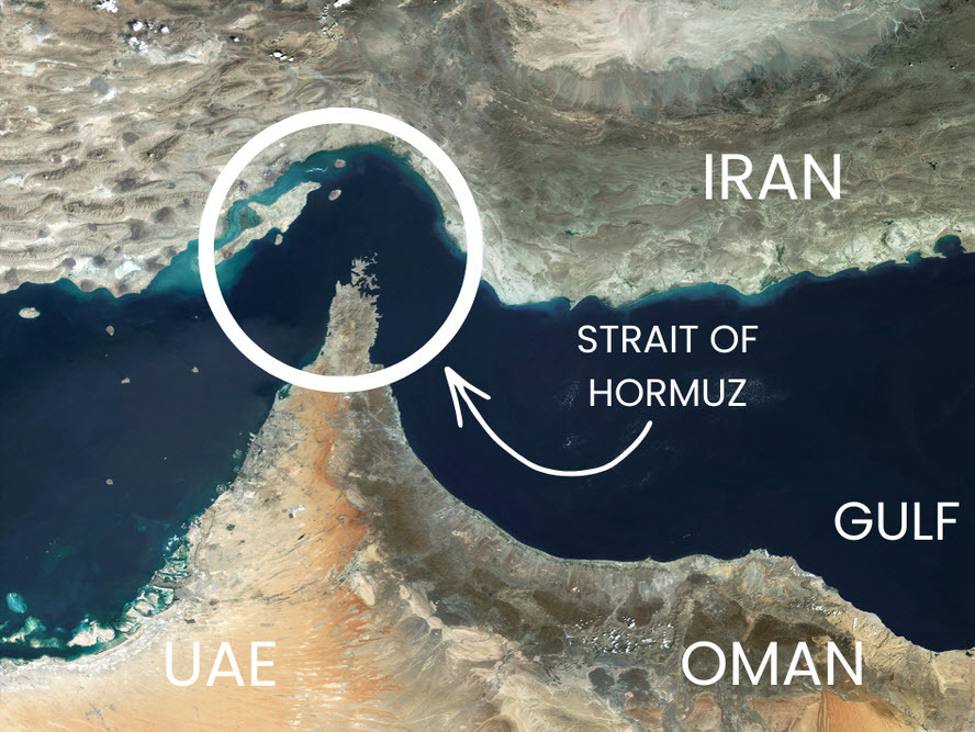
US stock roll over as Trump commits hiimself to a military reopening of Hormuz
One of the ideas that’s been floating around markets is that Trump just wanted to dramatically degrade Iran’s military, it’s nuclear program and its ability to make missiles. Once that was done, he would declare victory and leave it to Europe and gulf states on how to open the Strait of Hormuz. It was never clear if Iran would have accepted that but it was a possibility they would say “ok, enough, we’ll live to fight another day.”Now, it looks like that’s off the table and instead Trump has committed the US military to reopen Hormuz, with little help from allies. He said it would be easy but markets aren’t so sure, and it also could be time consuming. Trump called it “a simple military maneuver” with “so little risk”.If that’s true, it’s good news but the market isn’t so sure. There are various reports today that the US is deploying more marines and ships to the area. Seven days ago, Trump ordered +2500 marines to transit from Japan to the Gulf and that force will presumably be used to take Hormuz as it includes the amphibious assault ship USS Tripoli. It’s not clear where it is now but this was from a report today:The USS Tripoli is currently moving through the Indian Ocean and was recently spotted south of Sri Lanka. The warship is heading toward the North Arabian Sea and is expected to reach the broader Middle East theatre around March 22–23.It’s not clear if there will have to be some staging and coordination after it arrives. That likely stretches the timeline for a landing into next week in any case.The think from the Trump administration appears to be that by taking Kharg Island, which much of Iran’s oil is loaded, they will force Iran to capitulate. A report from today:The Trump administration is considering plans to occupy or blockade Iran’s Kharg Island to pressure Iran to reopen the Strait of Hormuz, four sources with knowledge of the issue tell Axios.That report also lengthened the timeline of the war: “We need about a month to weaken the Iranians more with strikes, take the island and then get them by the balls and use it for negotiations,” a source with knowledge of the White House thinking said.Trump started out saying 4-5 weeks and repeatedly said they were ahead of schedule. Next week will be Week 4 and this would certainly lengthen the timeline.In short, what the market is seeing right now is a lengthening of the timeline of the war. That has the S&P 500 down 0.9% and near the lows of the day. European stocks are struggling even more with the DAX down 1%. The image of the DAX isn’t a pretty picture. This article was written by Adam Button at investinglive.com. 🔗 Source 💡 DMK Insight The speculation around Trump’s strategy regarding Iran’s military and nuclear capabilities is more than just political chatter—it’s a potential market mover. If traders believe that a significant reduction in Iran’s military capabilities could lead to a more stable Middle East, we might see shifts in oil prices and related commodities. Historically, geopolitical tensions in the region have led to spikes in oil volatility, and any perceived easing could result in downward pressure on crude prices. Look at the recent trends in oil futures; if prices start to dip below key support levels, say around $70 per barrel, it could signal a broader risk-off sentiment among traders. Conversely, if tensions escalate unexpectedly, we could see a rapid spike in oil prices, impacting not just energy stocks but also currencies of oil-dependent economies. Keep an eye on how this narrative develops, especially as we approach any significant geopolitical announcements or negotiations. The flip side is that if the market overreacts to these rumors, we might see a quick correction. Traders should monitor the sentiment closely, particularly any shifts in trading volumes or positioning in oil futures as these developments unfold. 📮 Takeaway Watch for oil prices around $70 per barrel; a breach could signal a shift in market sentiment based on geopolitical developments.
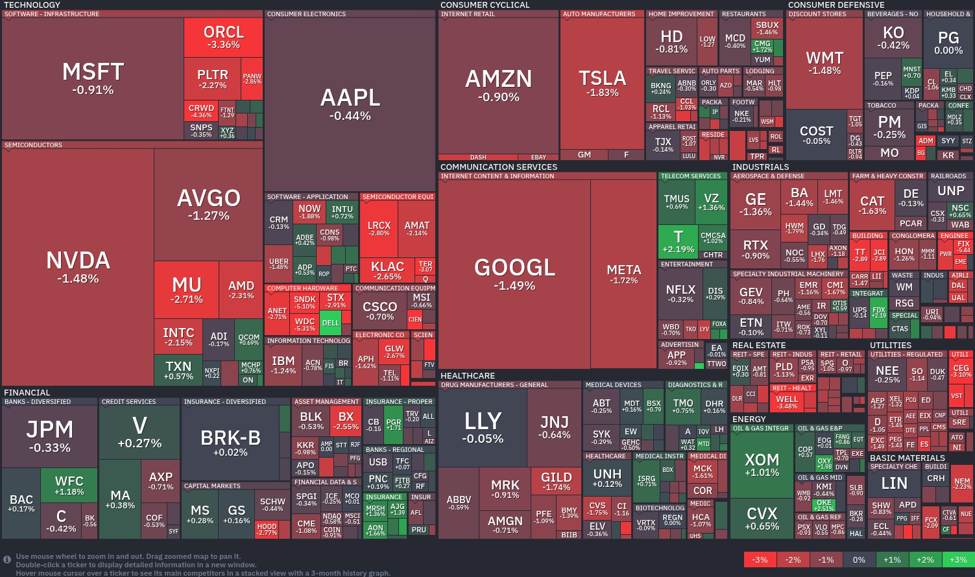
Tech sector struggles: energy stocks shine amid market fluctuations
Today’s stock market heatmap paints a vivid picture of a market grappling with varied performance across different sectors. Let’s delve into the dynamics shaping the trading landscape today.📉 Technology Sector Faces HeadwindsThe technology sector is currently under significant pressure, marked by notable declines. Microsoft (MSFT) is down 0.91%, while Oracle (ORCL) has taken a sharper fall, dropping by 3.36%. Meanwhile, Semiconductor giants like Nvidia (NVDA) and Micron Technology (MU) are also experiencing decreases of 1.48% and 2.71%, respectively. This downturn is indicative of broader concerns within the tech space, possibly linked to factors such as fluctuating demand and regulatory scrutiny.⚡ Energy Sector Gains TractionIn contrast, the energy sector is displaying strength. ExxonMobil (XOM) has risen by 1.01%, and Chevron (CVX) is up 0.65%. This sector’s positive movement may be fueled by increased oil prices and optimistic forecasts surrounding energy demand, offering investors a safe haven amid the tech downturn.🔍 Financial Sector: A Mixed BagLooking at the financial sector, we see a somewhat mixed performance. While JPMorgan Chase (JPM) is showing a minor dip of 0.33%, Wells Fargo (WFC) manages to edge up by 1.18%. This varied performance suggests differing investor sentiment regarding interest rate expectations and economic outlook.📈 Health and Consumer Defensive SectorsWithin healthcare, Eli Lilly (LLY) remains relatively stable with a slight decrease of 0.05%, while Johnson & Johnson (JNJ) drops by 0.64%. Meanwhile, consumer defensive giant Coca-Cola (KO) sees a marginal dip of 0.42%, indicating cautious consumer sentiment or strategic repositioning by investors.📊 Overall Market AnalysisThe bearish signals from the tech sector are highlighting investor caution, with potential overvaluations and macroeconomic factors possibly contributing to the sector’s retreat.The energy sector’s robust performance suggests a positive outlook for industries aligned with raw materials and essential commodities.Investors are encouraged to diversify their portfolios, enhancing exposure to sectors like energy that exhibit positive momentum. Meanwhile, tech investments should be approached cautiously, accounting for volatility and potential shifts in market sentiment. Stay updated with InvestingLive.com for real-time insights and strategic advice as markets continue to evolve 🚀. This article was written by Itai Levitan at investinglive.com. 🔗 Source 💡 DMK Insight The tech sector’s struggles are a warning sign for traders: it’s not just a blip. With Microsoft down 0.91% and Oracle also facing declines, this could indicate broader market sentiment shifting against growth stocks. Traders should keep an eye on the NASDAQ, which often reflects tech performance. If it breaks below key support levels, say around 13,000, we might see a cascading effect across related sectors. This isn’t just about tech; it could spill over into consumer discretionary and even financials, as investor confidence wanes. Look for volatility in these sectors as earnings reports roll in, especially from major players. The real story is how long this pressure lasts and whether it leads to a broader market correction. Watch for any bounce-back attempts in the tech sector, particularly if we see a reversal in sentiment or positive earnings surprises. But be cautious—if the downward trend continues, it could trigger stop-loss orders and further exacerbate the sell-off. 📮 Takeaway Monitor the NASDAQ closely; a drop below 13,000 could signal broader market weakness, impacting tech and related sectors.
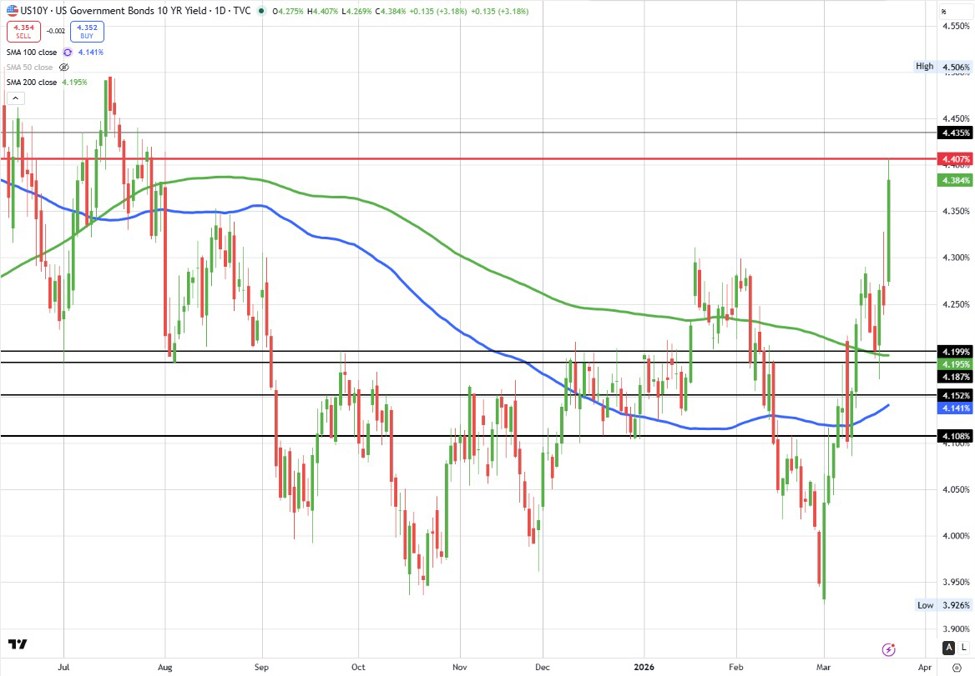
USD moves to new highs for the day. 10 year yield rises to 4.40%
The USD 10 year yield is trading up to 4.407%. That is the highest level going back to August 1, 2025.. The yield is up over 10 basis points this week. Yields are up around 45 basis points since low of 3.926% on March 2.The move higher has the US dollar moving to the upside.USDJPY: The USDJPY has now moved above the 100 and 200 hour moving averages near 158.90 and 158.96 . The price is testing the underside of the broken trendline at session highs near 159.17. Move above that level and the price is back within the channel after the break and run lower yesterday. Close risk is now a move back below the 158.90 level for buyers looking for more upside.EURUSD: The EURUSD moves moved to new lows and in doing so is testing the 200 hour MA at 1.15277 and the 100 hour MA at 1.1517. The low just stalled in between those levels at 1.1526. Risk is now a move back above 1.15549 for sellers looking for more downside but getting below the 100 hour MA and staying below is needed to increase the bears control. Bias lower but overall sentiment is neutral above the MAs. GBPUSD: The GBPUSD is continuing the retracement of the move higher yesterday and in doing so, is back below the 200 and 100 hour MAs at 1.33478 and 1.33367 respectively Those levels are now risk defining levels for sellers looking for more downside momentum. The price is testing a swing area between 1.3296 to 1.33058. This article was written by Greg Michalowski at investinglive.com. 🔗 Source 💡 DMK Insight The surge in the USD 10-year yield to 4.407% is a critical signal for traders right now. This spike, marking the highest level since August 2025, suggests a shift in market sentiment, likely driven by expectations of tighter monetary policy and inflationary pressures. With yields up over 10 basis points this week and a significant 45 basis points since the March low of 3.926%, traders should be wary of the implications for equities and other asset classes. Higher yields typically lead to increased borrowing costs, which can dampen corporate profits and consumer spending, potentially triggering a sell-off in stocks. Look for key resistance levels around 4.5% in the yield, as a breach could accelerate the move higher, impacting sectors sensitive to interest rates, like real estate and utilities. On the flip side, if yields pull back, it might provide a temporary relief rally in equities. Keep an eye on upcoming economic data releases and Fed commentary, as they could further influence yield movements and market sentiment. 📮 Takeaway Watch the USD 10-year yield closely; a break above 4.5% could trigger significant market shifts, particularly in equities and interest-sensitive sectors.

SMCI stock implodes: Supermicro down 27% after co-founder arrested
Why is it always the meme stocks where they find the fraud? Supermicro shares are getting absolutely destroyed on Friday, down 27% and hitting fresh 52-week lows after federal prosecutors unsealed an indictment charging three company associates — including co-founder Wally Liaw — with smuggling $2.5 billion in Nvidia-powered AI servers to China.The stock is trading around $24, well below every major moving average, and the chart is a disaster after once trading as a meme stock.What’s remarkable here is the sheer brazenness of the alleged scheme. According to the indictment, the defendants used a Southeast Asian middleman to create fake end-user documentation, staged “dummy” servers for compliance inspectors, and even arranged for a “friendly” auditor to handle reviews. When someone sent Liaw a news link about Chinese nationals being arrested for chip smuggling, he allegedly responded with sobbing emojis. YThe company is quick to point out SMCI itself isn’t named as a defendant and it’s placed the employees on leave. But the market doesn’t care about that distinction right now, and frankly, it shouldn’t. This is a company that already settled SEC fraud charges in 2020, lost its auditor Ernst & Young in 2024 amid the Hindenburg short report, and has spent the better part of two years lurching from one governance crisis to the next.The real question for traders is whether this is the kind of washout that eventually creates opportunity, or whether the compliance risk now becomes an existential overhang. Dell is already getting bid up 5% today as the rotation trade into the “clean” AI server play gains momentum.The AI server demand story is real, but the governance discount on SMCI just got a whole lot wider. When the market gets a sniff of fraud, it’s a ‘no go’ zone for real money. This article was written by Adam Button at investinglive.com. 🔗 Source 💡 DMK Insight Supermicro’s 27% plunge signals deeper issues in tech stocks, especially those tied to AI hype. The indictment of key associates for smuggling Nvidia-powered AI components raises red flags for investors. This isn’t just about Supermicro; it reflects broader market skepticism around tech valuations, particularly in AI sectors. Traders should be cautious, as this could trigger a sell-off in related stocks, especially those with inflated valuations based on AI narratives. Watch for potential ripple effects on Nvidia and other AI-related assets, as investor confidence may wane. Key support levels for Supermicro are now in focus, and a breach could lead to further declines. Keep an eye on the daily charts for any signs of recovery or continued weakness, as this situation unfolds. 📮 Takeaway Monitor Supermicro’s support levels closely; a break below current lows could signal further declines in tech stocks tied to AI hype.