 Bitcoin
  Ethereum
  Tether
  XRP
XRP  BNB
BNB  USDC
USDC  Solana
  TRON
TRON  Lido Staked Ether
  Figure Heloc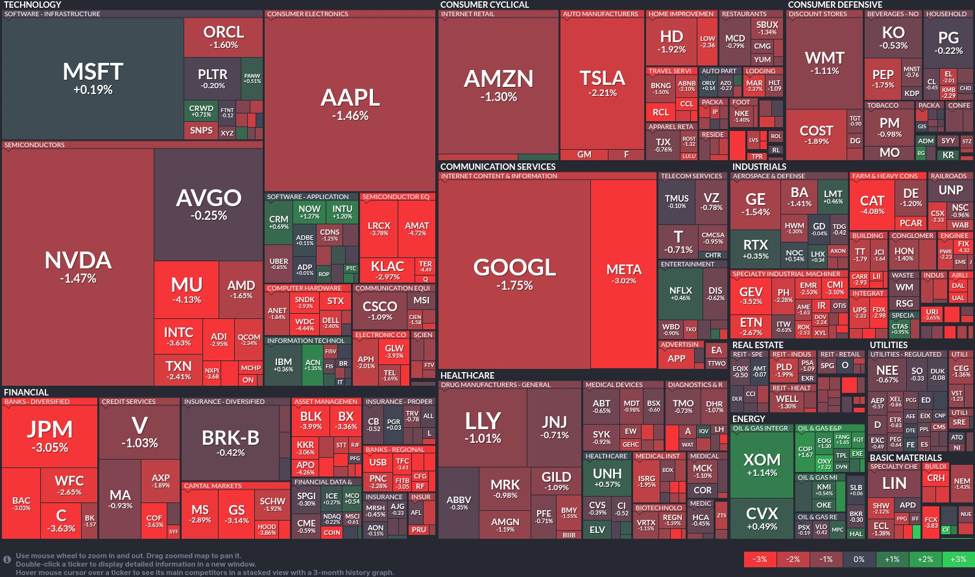
Today’s stock market revealed a turbulent yet dynamic trading environment, as the tech sector faltered while energy stocks outperformed. The trading landscape was riddled with red, except for a few bright spots in specific sectors, reflecting broader market uncertainty.📉 Technology and Semiconductor StrugglesSemiconductors: The semiconductor sector is experiencing considerable pressure. Key players such as Nvidia (NVDA) and Micron Technology (MU) have dipped by 1.47% and 4.13%, respectively. This downturn suggests caution among investors, possibly influenced by recent geopolitical tensions and supply chain concerns.Tech Giants: Major firms like Apple (AAPL) and Google (GOOGL) have seen their stocks decline by 1.46% and 1.75%. Such drops may signal profit-taking amid uncertainties in tech valuations.⚡ Energy Sector GainsOil and Gas: Amid broader market declines, the energy sector, led by ExxonMobil (XOM) with a gain of 1.14%, displayed resilience. This growth aligns with rising oil prices, indicating optimism within the sector as global energy demands increase.🏦 Mixed Signals in FinancialsDespite the overall negative performance, the financial sector showed mixed outcomes. JPMorgan Chase (JPM) dropped 3.05%, while other institutions like Visa (V) and Mastercard (MA) had minor declines of 1.03% and 0.93% respectively. This reflects uncertain economic forecasts impacting investor confidence.🔍 Market Mood and TrendsThe overall sentiment today leaned bearish, characterized by investor caution and a retreat from high-growth and tech stocks. Factors contributing to this mood include ongoing inflationary pressures and interest rate considerations, along with investor reactions to recent earnings reports.Conversely, the energy sector’s positive performance highlights a potential pivot in investor priorities towards sectors with less vulnerability to current geopolitical and economic stresses.🛡️ Strategic RecommendationsInvestors should consider favoring stability and growth potential in their portfolios by increasing exposure to robust sectors like energy and healthcare. Though tech and semiconductors present short-term challenges, they remain long-term growth candidates; thus, selective engagement may be wise.As the market weathers volatility, diversification remains key. Monitoring upcoming economic data releases and earnings reports will be crucial in anticipating market shifts. Keeping tuned to real-time updates is vital for exploiting new opportunities as they arise.For further insights and strategies, stay connected with InvestingLive.com for comprehensive coverage of market moving developments. 📊📰 This article was written by Itai Levitan at investinglive.com. 🔗 Source 💡 DMK Insight Tech stocks are stumbling, and here’s why that matters: the semiconductor sector is under significant pressure, which could ripple through the broader market. With energy stocks outperforming, traders should consider reallocating their portfolios. The tech sector’s struggles, especially in semiconductors, indicate potential volatility ahead. This isn’t just a blip; it reflects broader economic concerns, including supply chain issues and demand fluctuations. If the semiconductor sector continues to decline, it could drag down tech stocks further, impacting indices like the NASDAQ. Watch for key support levels in tech stocks—if they break, it could trigger a wave of selling. On the flip side, energy stocks are showing resilience, suggesting a rotation in market sentiment. Traders might want to look at energy ETFs or stocks as a hedge against tech weakness. Keep an eye on the upcoming earnings reports in the tech sector; they could provide critical insights into whether this trend will continue or reverse. 📮 Takeaway Monitor semiconductor stocks closely; a break below key support levels could signal further declines in tech, while energy stocks may offer a safer haven.

The USD moved lower but has since bounce back after the weaker than expected jobs report
The initial reaction to the February U.S. nonfarm payroll report saw the dollar move lower after the headline employment figure came in weaker than expected. Job growth slowed and several sectors posted declines, including construction, manufacturing, and leisure and hospitality. The report was also weighed down by a sharp drop in private education and health services, partly tied to strike activity. Overall, the details showed a softer labor market picture for the month, though some of the weakness may prove temporary.Despite that initial reaction, the dollar’s decline did not last long. In many of the major currency pairs, the early move lower in the greenback ran into key technical levels where buyers stepped in. The EURUSD and GBPUSD moved higher immediately following the release, but those gains stalled near resistance. At the same time, pairs like USDJPY and USDCHF found support at important technical areas. As those levels held, the dollar began to move back higher.This type of price action highlights the importance of technical levels in the immediate aftermath of a major data release. While the data pushed the dollar lower at first, the market quickly ran into areas where the risk for buyers and sellers was defined. Once those levels held, the bias shifted and the dollar recovered.In the video above, I take a closer look at the technical picture across the major currency pairs and walk through what happened both immediately after the data and in the hours that followed. I break down the price action in EURUSD, USDJPY, GBPUSD, USDCHF, and USDCAD, highlighting the key support and resistance levels, what the price action says about the current bias, and the targets traders will be watching going forward. This article was written by Greg Michalowski at investinglive.com. 🔗 Source 💡 DMK Insight The weaker-than-expected nonfarm payroll report is shaking up the dollar, and here’s why that matters: When job growth slows, it raises concerns about the overall health of the economy, which can lead to a dovish stance from the Fed. This could mean lower interest rates for longer, making the dollar less attractive to investors. If you’re trading USD pairs, watch for potential support levels around recent lows, as a sustained decline could trigger further selling pressure. Additionally, sectors like construction and manufacturing are already struggling, which might ripple through to related assets like commodities and equities. Keep an eye on the upcoming inflation data; if it shows signs of easing, it could further weaken the dollar’s position. On the flip side, if the market overreacts, we might see a bounce back as traders look for value. But right now, the sentiment is leaning bearish, so be cautious with long positions in USD-related trades. Watch for key resistance levels to confirm any reversal before jumping back in. 📮 Takeaway Monitor the dollar’s reaction around recent support levels; a sustained drop could signal further weakness, especially if inflation data supports a dovish Fed stance.

Fed's Goolsbee: The jobs report was a tough miss. It was not a good month.
The jobs report was a tough mess.It is just one month but it was not a good month.If we get several months like this data, it would be of concern.It is hopeful that we see continued progress on inflation. Hopeful that we can resume the rate cuts by the end of the year.Question is whether inflation rates will be temporary or is it long haul .Oil price shocks can lead to stagflationary direction. Stagflation is worst case scenario for banks.Reasons we are seeing low hiring, low firing is uncertainty.Remains hopeful we will see progress on inflationNon-tariff inflation has been disturbingly highDisturbing persistance of services inflationWants to get as much information as possible, especially given recent conflicting dataEverything is on the table at every meeting. Strong consumer has been driving US growth.Policy tone: Slightly dovish / cautiousOpen to resuming rate cuts later this year if inflation continues to improve.Concerned about labor market softness and economic uncertainty.However, still wary of persistent services inflation and oil-driven inflation risks. This article was written by Greg Michalowski at investinglive.com. 🔗 Source 💡 DMK Insight The disappointing jobs report is a red flag for traders, signaling potential volatility ahead. If this trend continues, it could impact the Fed’s timeline for rate cuts, which many are banking on for market support. A weaker labor market often leads to reduced consumer spending, affecting sectors like retail and tech. Traders should keep an eye on upcoming reports for confirmation of this trend. If we see another month of weak job growth, expect increased pressure on equities and possibly a flight to safety in bonds or gold. Watch for key support levels in the S&P 500; a break below recent lows could trigger further selling. On the flip side, if inflation shows signs of easing, it might give the Fed the green light to cut rates sooner than expected, which could provide a temporary boost to risk assets. So, it’s a balancing act—monitor inflation data closely as it could dictate market direction in the coming weeks. 📮 Takeaway Keep an eye on upcoming jobs reports and inflation data; a continuation of weak job growth could lead to increased market volatility and impact rate cut expectations.

US business inventories for December 0.1% versus 0.1% expected
For what it is worth, the US business and retail inventories for the month of December was released: Business inventories rose 0.1% versus 0.1% expected. Prior month was revised lower to 0.0% from 0.1%.Retail inventories rose 0.4% versus 0.2% last month.Details:Total sales (manufacturers’ shipments + distributive trade): $1,965.9B in December+0.5% m/m vs November 2025+3.2% y/y vs December 2024Inventories-to-sales ratio: 1.36 in December1.39 in December 2024 (ratio declined year over year)It is early March, so the December data is old as the Census Department continues to catch up after the government shutdown.. This article was written by Greg Michalowski at investinglive.com. 🔗 Source 💡 DMK Insight Business inventories rose slightly, but here’s why that matters: traders need to watch for potential shifts in consumer demand. The 0.1% increase in business inventories aligns with expectations, but the prior month’s revision to 0.0% raises questions about underlying demand trends. Retail inventories, however, jumped 0.4%, significantly above the 0.2% forecast, suggesting that retailers are stocking up in anticipation of higher sales. This could indicate confidence in consumer spending, especially as total sales reached nearly $2 trillion. If consumer demand picks up, it could lead to inflationary pressures, impacting interest rates and, consequently, forex and crypto markets. But here’s the flip side: if these inventory levels remain high without a corresponding increase in sales, we could see a slowdown in production, which might negatively affect economic growth. Traders should keep an eye on the upcoming sales data for January to gauge whether this inventory build-up translates into actual sales growth. Watch for key levels in related assets, particularly in the USD and commodities, as these figures unfold. 📮 Takeaway Monitor January sales data closely; if inventories don’t lead to increased sales, expect potential market corrections in related assets.
Crude oil futures stretch toward $90 a barrel
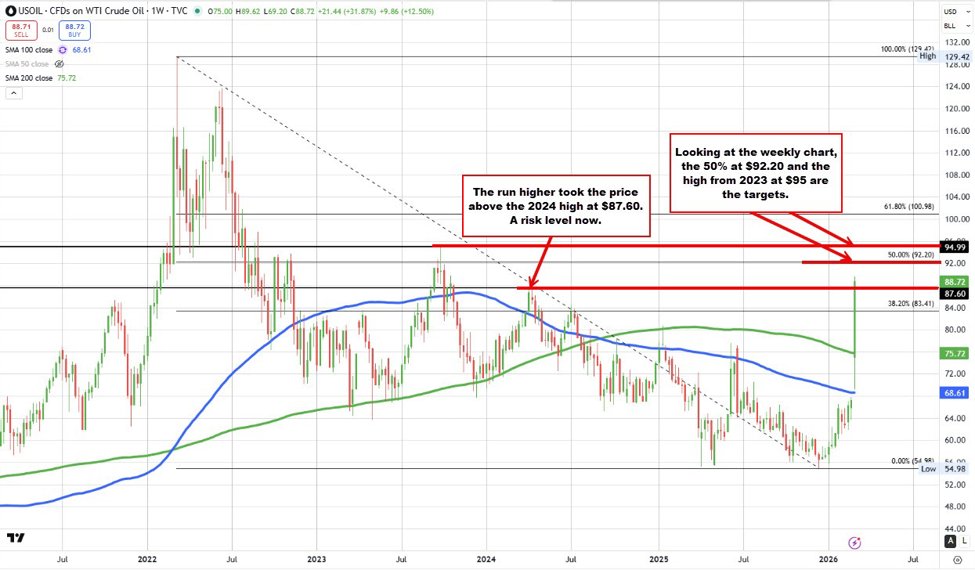
The price of crude oil has continued its sharp move to the upside. The current price is trading at $88.74. For the trading day versus the settle price from yesterday at $81.01:Price change: $88.74 − $81.01 = +$7.73Percent gain: (7.73 ÷ 81.01) × 100 = +9.54%The high price extended to $89.62 just short of the $90 level. For the trading week, the price is currently up 32% that’s the largest increase going back to 2020. The price today extended above the high price from April 2024 which reached $87.60. The low for the year was reached on January 7 at $55.76. Trump started his 2nd term in January 2025 when the price was at $76.24. The low price for 2025 reached down to $54.98 in 2025 there were 5 separate lows reached between $54.98 and $55.96.Looking at the weekly chart, the next major target would be the 50% midpoint of the move down from the 2022 my price. That level comes in at $92.20.Above that, and traders will look toward the 2023 high price near $95.If sellers are looking for hope, it comes from the rejection above the topside channel trendline on the shorter-term 5-minute chart (see chart below). The latest spike higher pushed the price briefly above that channel resistance near $89.70, which also coincided with a recent swing high. However, the move could not sustain momentum above that level and quickly rotated back lower.As long as the price remains below the $89.70 area, that failed breakout keeps the door open for sellers. The next step for the bearish case would be a move below the lower channel trendline, followed by a break of the 38.2%–50% retracement zone of the most recent leg higher between $87.29 and $87.84. A move through that area would signal that sellers are gaining traction and could shift the short-term bias more clearly to the downside. However, the price would need to stay below the rising lower trendline. This article was written by Greg Michalowski at investinglive.com. 🔗 Source 💡 DMK Insight Crude oil’s surge to $88.74 is a game-changer for traders focused on energy markets. This 9.54% jump from yesterday’s settle price signals strong bullish momentum, likely driven by geopolitical tensions and supply constraints. Traders should be aware that such rapid price movements can lead to increased volatility, which might attract both retail and institutional players looking to capitalize on the trend. Watch for resistance around $90, as a break above could trigger further buying pressure. Conversely, if the price retraces, the $81 level might act as a critical support point, providing a potential entry for swing traders. Here’s the thing: while the bullish sentiment is palpable, it’s essential to keep an eye on inventory reports and OPEC decisions, as these could significantly impact price direction. The real story is how quickly sentiment can shift in this market, so stay nimble and ready to adjust your strategies based on upcoming data releases. 📮 Takeaway Watch for crude oil to test $90 resistance; a break could signal further upside, while $81 remains key support for potential retracements.

Fed Gov. Miran: Hesitant to read too much into one month job report
Fed Miran on CNBC is saying: Hesitant to read too much into one month jobs report.Policy is mis-calibratedmonetary policy is too tight.Fed typically does not respond to oil prices.If anything biases me toward even more dovish policy.Hesitant to respond to oil prices until we know more It is hard to imagine what the new type of jobs will be. There is no pressure in rents right now.I never took the view that tariffs are a driver inflation.Apparel pushed through price increases in Q3 and Q4They expect they will be able to push price pressures back on their international suppliers. Neutral policy is like 2.5% to 2.75%The longer we are too restrictive the better chance we have employment numbers like we saw todayInflation expectations are all in ranges that they been in over the last several months.The point he raised about apparel prices highlights a broader issue in the inflation debate. If prices surged at an accelerated pace during the inflation spike, does that imply a period of outright deflation is needed to truly rebalance them? if wages don’t keep up, the net impact is negative on the consumer. The economy is increasingly two-tiered: inflation disproportionately hurts lower- and middle-income households while having far less impact on higher-income groups.As a result, even if higher prices – like in apparel or oil prices – prove to be a one-off shock that eventually levels off, the initial price increase still has real consequences. Once prices move higher, the cost burden remains, unless there is a deflationary rotation lower. At the same time, if employment growth slows – like it did today – workers lose bargaining power for higher wages. The result is a squeeze on purchasing power, with the lower and middle class bearing the brunt of the erosion. Stephen Miran is an American economist and policymaker serving as a member of the Federal Reserve Board of Governors. Before joining the Fed, he worked as a senior adviser at the U.S. Treasury Department during the Trump administration, where he focused on economic policy, fiscal strategy, and financial markets. Miran is expected that he would resign from the Fed when It Fed chair nominee Kevin Warsh takes over for Fed chair Powell in May.He is a dove who has argued for cutting rates since he became a board member (nominated by Pres. Trump) This article was written by Greg Michalowski at investinglive.com. 🔗 Source 💡 DMK Insight The Fed’s cautious stance on the jobs report signals potential shifts in monetary policy. Miran’s comments about mis-calibrated monetary policy and hesitance to react to oil prices suggest that the Fed may be leaning towards a more dovish approach. This could impact interest rates and, consequently, the forex market. If traders interpret this as a signal for lower rates, we might see a weakening of the dollar against major currencies. Keep an eye on the upcoming economic indicators, especially inflation data, which could further influence the Fed’s decisions. A dovish pivot could also ripple through commodities, particularly oil, as lower rates might boost demand. However, there’s a flip side: if inflation remains stubbornly high, the Fed might have to recalibrate its approach, which could lead to volatility. Traders should monitor key levels in USD pairs and oil prices for any signs of reaction to these Fed comments. Watch for the next jobs report and inflation data as critical indicators of the Fed’s future moves. 📮 Takeaway Watch for the next jobs report and inflation data; a dovish Fed could weaken the dollar and impact oil prices significantly.

Atlanta Fed GDPNow Q1 estimate 2.1% versus 3.2% previously
The Atlanta Fed GDPNow estimate for Q1 has declined to 2.1% from 3.2%. The GDPNow model estimate for real GDP growth (seasonally adjusted annual rate) in the first quarter of 2026 is 2.1 percent on March 6, down from 3.0 percent on March 2. After recent releases from the US Census Bureau, the US Bureau of Labor Statistics, the US Bureau of Economic Analysis, and the Institute for Supply Management, the nowcasts of first-quarter real personal consumption expenditures growth and real gross private domestic investment growth decreased from 2.8 percent and 7.9 percent, respectively, to 1.8 percent and 6.8 percent.The next GDPNow update is Thursday, March 12. Please see the “Release Dates” tab below for a list of upcoming releases. This article was written by Greg Michalowski at investinglive.com. 🔗 Source 💡 DMK Insight The Atlanta Fed’s GDPNow estimate drop to 2.1% signals potential economic slowdown, and here’s why that matters: A decline from 3.2% to 2.1% in GDP growth expectations can shake investor confidence, especially in a market already grappling with inflation and interest rate hikes. Traders should watch for how this impacts sectors sensitive to economic growth, like consumer discretionary and industrials. If growth slows, we might see a shift in risk appetite, pushing investors toward safer assets like bonds or gold. Additionally, this could lead to increased volatility in equities as earnings forecasts may need to be revised downwards. On the flip side, a lower GDP growth forecast might prompt the Fed to reconsider its tightening stance, which could provide a temporary boost to risk assets. Keep an eye on the 2.1% level; if subsequent data confirms this trend, it could trigger a broader market reaction. Watch for upcoming economic releases that could further influence these estimates, particularly employment and inflation data, as they will be crucial in shaping market sentiment moving forward. 📮 Takeaway Monitor the 2.1% GDP growth estimate closely; if confirmed, expect increased volatility in equities and potential shifts toward safer assets.

Kansas City Fed Pres. Schmid: Businesses are pausing on hiring
Kansas City Fed Pres. Jeffrey Schmid is speaking and says: Businesses are pausing on hiring.Labor market is under a structural not cyclical strainJeffrey Schmid leans to the hawkish side on the Federal Reserve. In his most recent public appearance on March 3, 2026, he signaled his continued opposition to further interest-rate cuts, stating that there is “no room to be complacent” as inflation remains “too hot”.His current policy stance is defined by the following key points:Opposition to Rate Cuts: Schmid has consistently voted against recent interest rate reductions, including formal dissents in late 2025 where he preferred to leave the policy rate unchanged while the majority of the committee voted for cuts.Persistent Inflation Concerns: He notes that inflation has remained above the Fed’s 2% objective for nearly five years. He recently warned that demand is still outpacing supply, which continues to push up the price of services too quickly.Skepticism Toward AI Gains: While some colleagues argue that artificial intelligence is boosting productivity and allowing for lower rates without fueling inflation, Schmid has remained skeptical. He argues there is currently not enough data to support the idea that AI-driven productivity is yet significant enough to justify easing.FOMC Role: Although a vocal hawk, Schmid is not a voting member of the Federal Open Market Committee (FOMC) in 2026 due to the Fed’s annual rotation of regional bank presidents.Jeffrey R. Schmid took office on August 21, 2023, as the 10th president and chief executive officer of the Federal Reserve Bank of Kansas City. A Nebraska native with over 40 years of experience in banking and supervision, he leads a workforce of nearly 2,000 professionals and represents the Tenth Federal Reserve District on the Federal Open Market Committee (FOMC). Before joining the Fed, Schmid served as president and CEO of the Southwestern Graduate School of Banking Foundation at SMU’s Cox School of Business. His extensive private-sector career includes serving as chairman and CEO of Mutual of Omaha Bank from 2007 to 2019 and president of American National Bank from 1989 to 2007. He began his career in 1981 as a field examiner for the FDIC in Kansas City. Schmid holds a BS in business administration from the University of Nebraska-Lincoln and is a graduate of the Southwestern Graduate School of Banking. This article was written by Greg Michalowski at investinglive.com. 🔗 Source

ECB Schnabel: ECB is still in a good place, but war increases upside inflation risks
ECB’s Isabel Schnabel is is speaking and says:Temporary inflation overshoot is of little relevance if expectations remain anchored.ECB is still in a good placeIran war creates upside inflation risks.Central bank must monitor persistence of energy price shockPost-pandemic lessons suggest ECB must tread carefully. With inflation projected to be at our target over the medium-term, inflation expectations anchored, monetary policy remains a good place.Isabel Schnabel is a member of the European Central Bank’s Executive Board and is widely regarded as one of the more hawkish voices within the ECB. A German economist and former professor of financial economics, she has developed a reputation for emphasizing the importance of maintaining the ECB’s credibility in fighting inflation. Schnabel has often warned that inflation pressures—particularly from wages, services, and energy—could prove more persistent than many expect. Because of this, she has repeatedly stressed that policymakers should avoid easing monetary policy too quickly and risk reigniting inflation before it is firmly under control.More recently, Schnabel has suggested that the ECB is in a relatively good place with current policy settings but should remain cautious given ongoing uncertainty around inflation and external shocks, including higher energy prices. While she supports a data-dependent approach, her tone has generally leaned toward keeping policy restrictive for longer if needed to ensure inflation returns sustainably to the ECB’s 2% target. In market terms, her stance is typically viewed as hawkish, favoring vigilance on inflation and resisting premature rate cuts unless there is clear evidence that price pressures are easing on a durable basis. This article was written by Greg Michalowski at investinglive.com. 🔗 Source 💡 DMK Insight Schnabel’s comments signal a cautious ECB stance, and here’s why that matters: Inflation expectations are a critical focus for traders, especially with the potential for energy price shocks from geopolitical tensions like the Iran war. If inflation remains above target but expectations stay anchored, the ECB might not feel pressured to hike rates aggressively. This could lead to a more stable Eurozone environment, impacting the Euro and related assets. Traders should keep an eye on inflation metrics and energy prices, as any signs of persistent inflation could shift the ECB’s approach. On the flip side, if inflation expectations begin to unanchor, we could see volatility spike, particularly in the forex markets. The Euro might react sharply if traders perceive a shift in the ECB’s commitment to its inflation targets. Watch for key inflation reports and energy price movements in the coming weeks, as these will be crucial in shaping market sentiment and trading strategies. 📮 Takeaway Monitor inflation reports and energy prices closely; a shift in expectations could lead to significant Euro volatility in the near term.

Iran launches attack on US forces in Bahrain, and in Baghdad.
Reports that Iran is launching attacks on US forces in Bahrain, and also attacking military base housing US diplomatic centered near Baghdad international airport. The price of crude oil is extending above the $92 level. The high price of just reached $92.61. The current price is trading at $92.20. That’s up $11.19 or 13.81% on the day.Earlier today, I highlighted the 5-minute chart and outlined levels that would tilt the bias more toward the downside and give sellers greater control. A key requirement was a move below the 38.2%–50% retracement of the most recent rally. The corrective move off the high dipped into that retracement zone but quickly found willing buyers, keeping the downside momentum in check. Since then, the price has rotated back to the upside and has now broken above the topside channel trendline for the second time today. If the price can remain above that trendline on the 5 minute chart above, it would signal that buyers remain firmly in control and could lead to an acceleration higher.On the downside, the 38.2-50% retracement of the last leg comes in at $90.05 to $90.65. If that can not be broken, the sellers are not winning. The buyers are still in trend control. Looking at the hourly chart below, the price has also reached the 50% midpoint of the longer-term move down from the 2022 high at $92.20. It has taken 54 days for the price to retrace half of that decline—a move that originally took roughly 950 days to unfold from the March 2022 high to the eventual low (54 days ago).The average price of a gallon of gas is up to $3.32 up from $2.90 a month ago. The low average price was $2.79 on January 11. That is a rise of 18.8% from the year low. This article was written by Greg Michalowski at investinglive.com. 🔗 Source 💡 DMK Insight Iran’s military actions are pushing crude oil prices higher, and here’s why that matters: With crude oil now trading around $92.20, the geopolitical tensions in the Middle East are likely to create volatility in energy markets. Traders should be aware that any escalation could lead to further price spikes, especially if the situation disrupts supply chains. Historically, similar geopolitical tensions have resulted in oil prices surging, and with the current price already above $92, we could see a test of resistance levels around $95. Look for potential reactions from major oil producers and OPEC, as they might adjust output to stabilize prices. Additionally, keep an eye on related assets like energy stocks and ETFs, which often move in tandem with crude oil prices. On the flip side, if the situation de-escalates, we could see a sharp correction in oil prices, so it’s crucial to monitor news developments closely. For now, traders should watch for any significant news updates and be prepared for rapid market shifts. 📮 Takeaway Watch for crude oil to test resistance at $95; geopolitical developments could drive prices higher or trigger a sharp correction.