
 Bitcoin
  Ethereum
  Tether
  BNB
BNB  XRP
XRP  USDC
USDC  Solana
  TRON
TRON  Lido Staked Ether
  Figure Heloc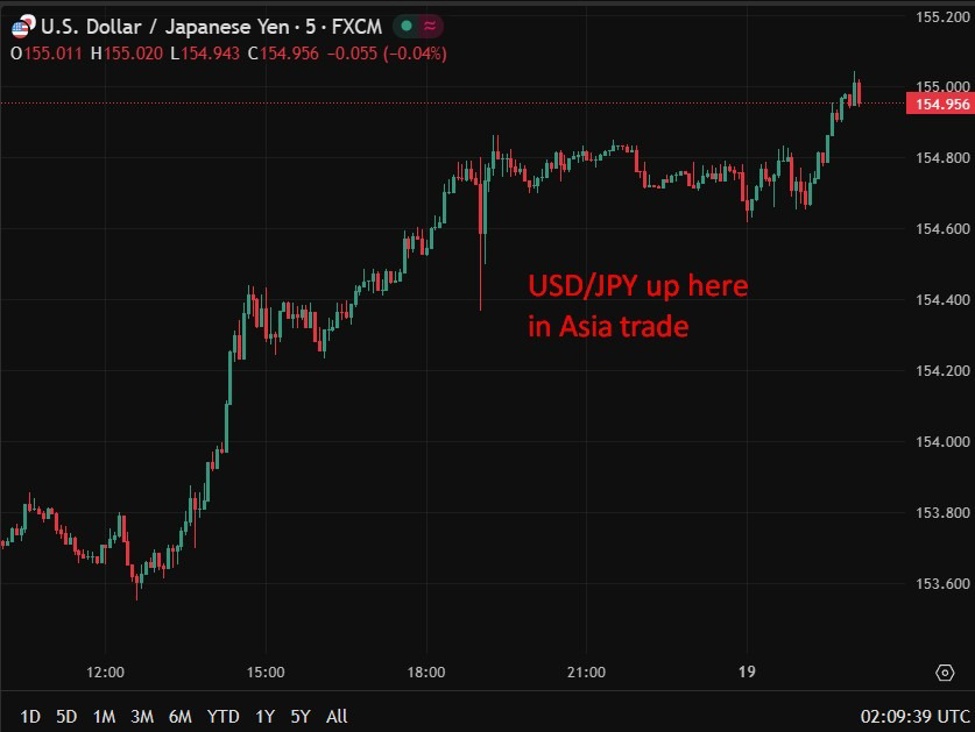
Japan’s machinery orders rebound sharply, reinforcing capex strength despite fiscal caution.Summary:Core machinery orders surged 19.1% m/m in December vs 4.5% expectedAnnual growth jumped to 16.8% y/y vs 3.9% forecastRebound follows sharp November declinesData support the BOJ’s outlook for continued economic expansionCorporate survey (report earlier) shows ongoing fiscal caution despite strong capex signalJapan’s core machinery orders delivered a powerful upside surprise in December, underscoring renewed momentum in business investment and offering support to the Bank of Japan’s constructive growth outlook.Core machinery orders, a volatile but closely watched leading indicator of capital expenditure, surged 19.1% month-on-month, far exceeding expectations for a 4.5% rise. On an annual basis, orders climbed 16.8%, again well above forecasts for a 3.9% increase. The strength marks a sharp reversal from November, when orders had slumped 11% on the month and fallen 6.4% year-on-year.The scale of the rebound suggests November’s weakness was more a reflection of volatility than a meaningful deterioration in investment appetite. Machinery orders are often lumpy, but the magnitude of December’s rise points to solid underlying corporate demand. The data bode well for production and output in the months ahead, reinforcing expectations that Japan’s economy will continue expanding in line with the BOJ’s projections.The strong capex signal also comes against a backdrop of equity market strength. Japanese stocks have been rallying amid expectations of expansionary fiscal policies under Prime Minister Sanae Takaichi, while government bond yields have edged higher on speculation of increased debt issuance.However, the upbeat machinery data contrast with a more cautious tone in broader corporate sentiment. A recent Reuters survey showed two-thirds of Japanese firms remain concerned about fiscal discipline under the current administration. While worries about tensions with China have eased compared with the previous month’s poll, they remain a lingering source of uncertainty for some companies.Overall, December’s machinery orders point to resilient business investment momentum, even as fiscal and geopolitical concerns continue to shape the broader corporate outlook. This article was written by Eamonn Sheridan at investinglive.com. 🔗 Source 💡 DMK Insight Japan’s machinery orders skyrocketing 19.1% m/m is a game changer for traders right now. This surge not only beats expectations but also signals robust capital expenditure, which could lead to a stronger yen and impact forex pairs like USD/JPY. The annual growth rate of 16.8% further supports the Bank of Japan’s (BOJ) optimistic economic outlook, suggesting that despite fiscal caution, businesses are investing in growth. Traders should keep an eye on the upcoming BOJ meetings, as this data could influence monetary policy decisions. If the yen strengthens, it could create volatility in related markets, particularly commodities priced in USD. However, there’s a flip side: the sharp rebound follows significant declines in November, which raises questions about sustainability. Traders should monitor how this data affects market sentiment in the coming weeks. Key levels to watch include the USD/JPY resistance around 145, as a break above could signal further yen strength. Keep an eye on corporate earnings reports as well, as they may provide insight into how this capex strength translates into broader economic performance. 📮 Takeaway Watch USD/JPY closely; a break above 145 could indicate sustained yen strength driven by robust capex data.
CBS: US military ready for possible Iran strike as soon as Saturday, Trump undecided
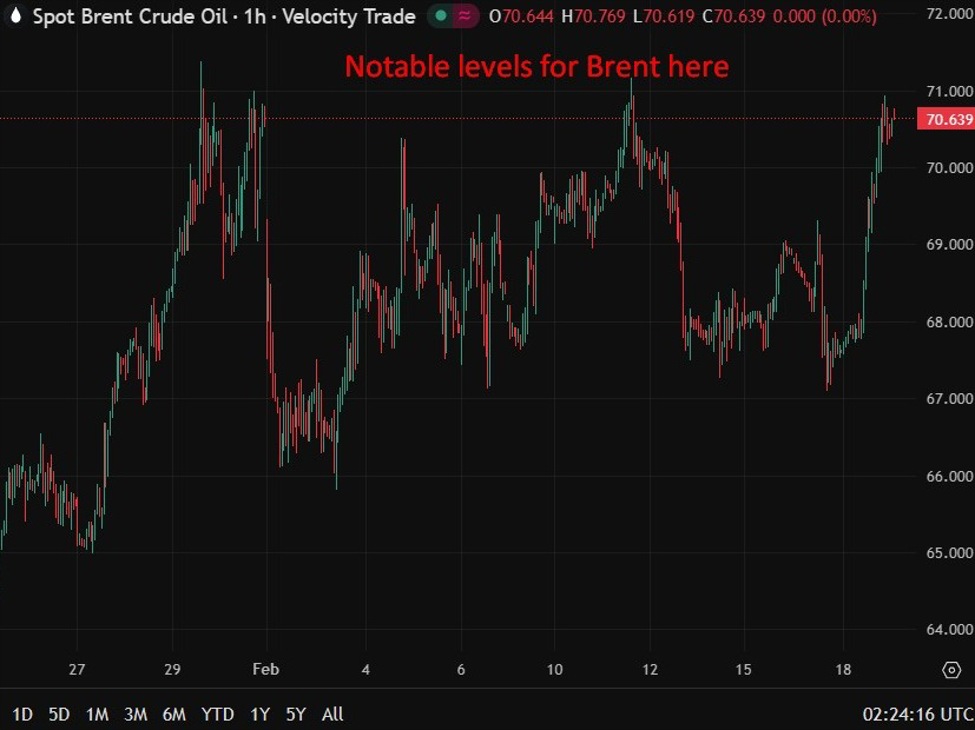
CBS says the US military is ready for possible Iran strikes as soon as Saturday, but Trump has not decided.Summary:CBS reports senior officials say the US military is ready for potential Iran strikes as soon as Saturday Trump has not made a final decision; discussions are described as fluid and ongoing Pentagon is moving some personnel out of the Middle East over the next three days as a precaution CBS says the shift is standard practice and does not necessarily mean an attack is imminent Rubio is expected to meet Netanyahu on Feb. 28, per officials (AP), amid ongoing Iran deliberationsA potential US military strike on Iran could come as soon as Saturday, according to CBS News, which cited sources familiar with internal discussions saying senior national security officials have told President Donald Trump the military is ready to act. The report stresses that Trump has not yet made a final decision, and that deliberations inside the White House remain fluid as officials weigh escalation risks against the political and military costs of restraint. As part of preparations, CBS says the Pentagon is moving some personnel temporarily out of the Middle East region over the next three days, primarily to Europe or back to the United States, positioning the move as a precaution in the event of action or potential Iranian counterattacks if the US proceeds. One source told CBS that such shifts are standard practice ahead of potential military activity and do not necessarily indicate an attack is imminent. A Pentagon spokesperson, contacted by CBS, said there was no information to provide. CBS also reports that the White House continues to publicly foreground diplomacy even as military planning advances. Press Secretary Karoline Leavitt said there are “many reasons and arguments” for a strike but described diplomacy as the president’s first option, while declining to discuss whether any operation would be coordinated with Israel. On the regional posture, CBS says US force deployments are expected to be in place by mid-March, with the USS Abraham Lincoln carrier group already in the region and the USS Gerald R. Ford carrier group en route. The report also notes Iran and the US held mediated talks in Geneva on Iran’s nuclear program, with the administration indicating progress but saying major gaps remain and no follow-up date has been set. Separately, AP reports Secretary of State Marco Rubio is expected to meet Israeli Prime Minister Benjamin Netanyahu on Feb. 28 to brief him on US-Iran talks, as Washington weighs next steps and continues to surge military resources to the region. This article was written by Eamonn Sheridan at investinglive.com. 🔗 Source 💡 DMK Insight Tensions with Iran are heating up, and here’s why that matters for traders: geopolitical risks can lead to volatility in oil and gold markets. If the US military takes action, we could see a spike in crude oil prices, which are already sensitive to Middle Eastern conflicts. Traders should keep an eye on the $80 per barrel level for WTI crude; a breach could trigger a wave of buying. Gold often acts as a safe haven during such uncertainties, so watch for movements around $1,900 per ounce. The broader market could react negatively to any military engagement, impacting equities and risk assets. It’s worth noting that while some may see this as a buying opportunity for commodities, others might be cautious about the potential for escalation. Keep an eye on the weekend for any developments, as they could set the tone for next week’s trading. In short, monitor oil and gold closely, especially if military action occurs, as these assets could see significant price swings. 📮 Takeaway Watch for crude oil prices around $80 and gold near $1,900; military action could trigger volatility in these markets.
South Korea KOSPI hits record high as tech rally triggers Kosdaq sidecar
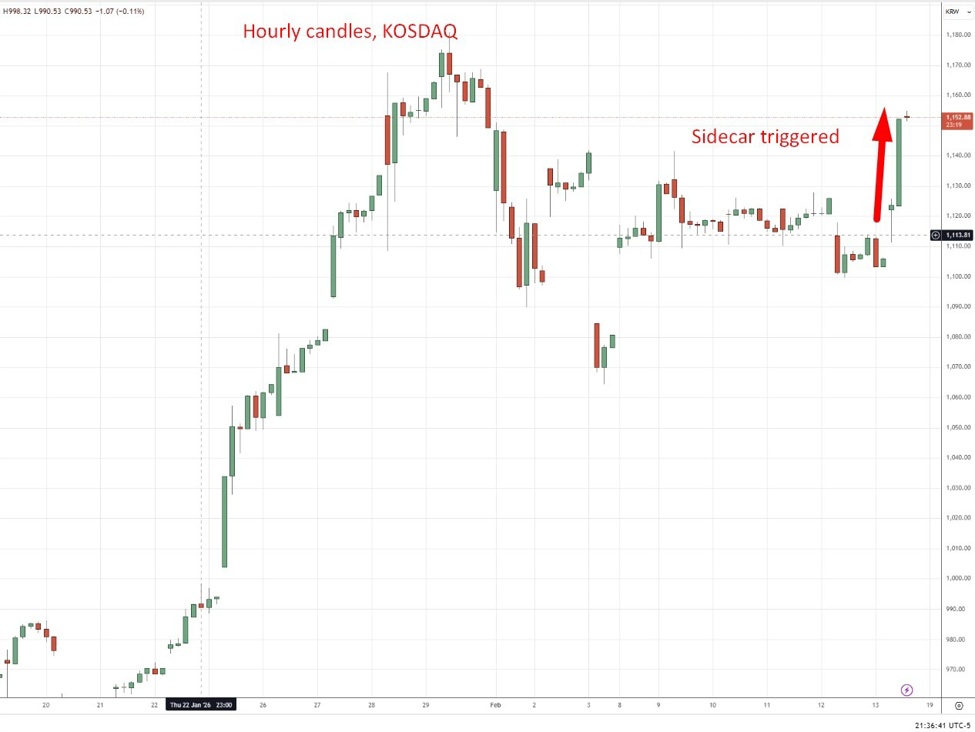
Korean stocks hit a record high on tech strength, with a Kosdaq sidecar briefly triggered.Summary:KOSPI surged 2.46% to a record 5,642, breaking above 5,600 for the first timeTech stocks led gains, with Samsung Electronics up 4.0%Kosdaq programme trading was briefly halted after sidecar activationForeign investors were net sellers despite the rallyWon weakened while benchmark bond yields fellSouth Korean shares rallied to a fresh record high on Thursday, with the benchmark KOSPI rising 2.46% to 5,642.37, surpassing the 5,600 mark for the first time. The advance came as markets reopened following a three-day holiday break, with investor sentiment lifted by a strong rebound in US technology stocks overnight.Heavyweight semiconductor names drove the gains. Samsung Electronics jumped 4.03%, while SK Hynix added 1.48%, reflecting renewed optimism in the global chip cycle. Battery maker LG Energy Solution rose 1.77%, while industrial and auto names also participated in the rally. Hyundai Motor gained 0.40% and Kia climbed 2.32%, while POSCO Holdings advanced nearly 4%. Market breadth was positive, with 583 of 927 traded issues rising.The rally was strong enough to trigger a volatility control mechanism in the junior Kosdaq market. Programme trading was halted for five minutes after the Kosdaq 150 futures contract surged 6%, activating the Korea Exchange’s “sidecar” rule.Sidebar: What is the Korea sidecar rule? The sidecar is a temporary volatility control mechanism designed to curb excessive swings in derivatives-linked markets. It is triggered when Kospi 200 or Kosdaq 150 futures move sharply, typically by 5–6%, within a short period. When activated, programme trading (computer-driven arbitrage linked to futures) is suspended for five minutes. The rule does not halt all trading, but it slows algorithmic flows that can amplify momentum, helping stabilise the market during rapid moves.Despite the equity surge, foreign investors were net sellers, offloading shares worth 485.6 billion won. The Korean won weakened against the US dollar, while bond markets firmed. Three-year treasury futures rose and benchmark yields fell, with the 10-year yield down nearly 4 basis points.The KOSPI is now up nearly 34% year-to-date, highlighting strong momentum in Korean equities even as currency weakness persists. This article was written by Eamonn Sheridan at investinglive.com. 🔗 Source 💡 DMK Insight Korean stocks are on fire, with the KOSPI hitting a record high, and here’s why that matters: The 2.46% surge to 5,642 is a significant psychological barrier broken, especially with tech stocks like Samsung Electronics leading the charge at a 4% gain. This bullish momentum could attract more retail and institutional investors, especially if the tech sector continues to show strength. However, foreign investors turning net sellers raises a red flag—are they anticipating a pullback? This could create volatility in the short term, especially if profit-taking kicks in. Traders should keep an eye on the KOSPI’s ability to hold above 5,600; a sustained move here could signal further upside, while a drop back below could trigger selling pressure. Look for correlated movements in global tech stocks and monitor the Kosdaq for any signs of weakness. The sidecar activation indicates heightened volatility, so be prepared for rapid price swings. Watch for key levels around 5,600 and 5,700 in the coming days as potential pivot points for trading strategies. 📮 Takeaway Monitor the KOSPI’s ability to maintain levels above 5,600; a failure to hold could trigger a sell-off, especially with foreign investors turning net sellers.
Mega-cap tech most under-owned in 17 years, says Morgan Stanley
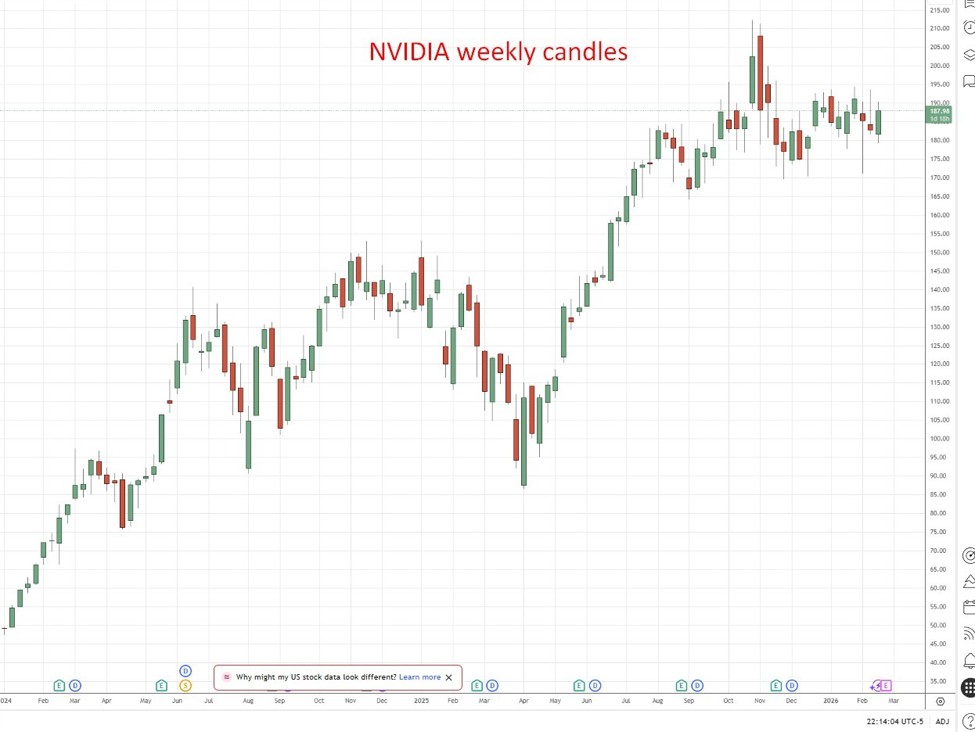
Posting this ICYMI from a Wednesday note from Morgan Stanley. Morgan Stanley says Nvidia is the most under-owned megacap as institutions lag tech benchmarks.Summary:Morgan Stanley says mega-cap tech is the most under-owned in 17 yearsNvidia is the most under-owned large-cap tech stockInstitutional ownership lags S&P 500 weightings across major megacapsInvestors show bias toward AI “picks and shovels” hardware namesSNDK stands out as the most over-owned large-cap tech stockMorgan Stanley’s latest analysis of fourth-quarter 13F filings highlights a striking positioning gap in US equities: mega-cap technology stocks are the most under-owned relative to the S&P 500 in 17 years.According to the bank, the ownership gap versus the benchmark widened to negative 155 basis points by the end of the quarter, underscoring how active institutional managers remain structurally underweight some of the largest names in the index despite their dominant market capitalisations.Among individual stocks, Nvidia stands out as the most under-owned large-cap technology name. Analyst Erik Woodring calculates a negative 2.57 percentage point gap between Nvidia’s S&P 500 weighting and active institutional ownership. Apple and Microsoft follow closely behind with gaps of negative 2.16% and negative 2.13%, respectively, while Amazon shows a negative 1.37% gap.The data suggest that even after a prolonged AI-driven rally, active managers have not fully caught up to benchmark allocations in these mega-cap leaders. Woodring notes that the modest widening in under-ownership from the prior quarter implies investors continue to lag index weightings rather than aggressively rotate back into the largest constituents.However, the positioning story is not uniform across the technology sector. Morgan Stanley sees a clear institutional bias toward AI “picks and shovels” names entering 2026. Semiconductor and hardware stocks such as SNDK, KLAC, WDC, LRCX and STX show elevated ownership levels, reflecting investor preference for infrastructure beneficiaries of AI spending. By contrast, institutional positioning in software names including IBM, ORCL, PANW, NOW and ADBE remains notably light.One standout is SNDK, whose institutional ownership has steadily increased since its re-listing in the first quarter of 2025. After joining the S&P 500 last quarter, it now shows the largest positive ownership gap among large-cap tech stocks at +1.58%.Overall, the note suggests active managers remain selective within technology, favouring hardware leverage to AI over broad megacap exposure — even as index concentration continues to climb. —Persistent under-ownership in megacaps could fuel catch-up buying if performance continues. Conversely, crowded positioning in AI hardware names raises the risk of sharper pullbacks if sentiment shifts. This article was written by Eamonn Sheridan at investinglive.com. 🔗 Source 💡 DMK Insight Nvidia’s under-ownership signals a potential buying opportunity for savvy traders right now. Morgan Stanley’s note highlights a significant disconnect between institutional ownership and the S&P 500 weightings, particularly for Nvidia. This could mean that as institutions catch up, we might see upward price pressure on Nvidia shares. With tech stocks generally gaining traction, especially in a market that’s been volatile, Nvidia stands out as a prime candidate for a rebound. If institutions start reallocating funds to align with tech benchmarks, we could see a surge in buying activity. Keep an eye on Nvidia’s price action; if it breaks above recent resistance levels, it could trigger a wave of institutional buying. However, it’s worth considering that the broader market sentiment can shift quickly. If macroeconomic indicators, like inflation or interest rates, take a turn for the worse, even strong fundamentals might not shield Nvidia from a pullback. Watch for key earnings reports and market reactions over the next few weeks, as these could provide critical insights into institutional behavior and overall market direction. 📮 Takeaway Monitor Nvidia closely; a breakout above recent resistance could signal institutional buying, making it a key stock to watch in the coming weeks.

RBNZ to increase monetary policy decisions to eight per year from 2027
RBNZ increases policy meeting frequency to eight per year as CPI moves monthly.Summary:RBNZ will increase scheduled policy decisions from 7 to 8 per year starting in 2027Change aligns with move to monthly CPI data from next yearFebruary 2027 decision date brought forward by one weekCommittee retains ability to act between meetings if requiredFinancial Stability Reports remain twice yearly in May and NovemberThe Reserve Bank of New Zealand (RBNZ) will move to eight scheduled monetary policy decisions per year from 2027, increasing from the current seven-meeting format. The shift comes as New Zealand prepares to transition to monthly Consumer Price Index (CPI) releases from next year, significantly increasing the flow of inflation data available to policymakers.The Monetary Policy Committee said the higher frequency of inflation data warrants a corresponding increase in scheduled decision points. With CPI moving from a quarterly to a monthly release schedule, policymakers will have more timely and granular insights into price pressures, allowing for more responsive calibration of interest rate settings.Under the new structure, one additional scheduled decision will be added to the annual calendar. To accommodate the eight-meeting schedule, the previously announced February 2027 decision date has been moved one week earlier. The RBNZ has already published decision dates through February 2028 to provide forward clarity for markets.Importantly, the Committee reiterated that scheduled meetings are not the only opportunities for action. The RBNZ retains the authority to make unscheduled policy decisions at any time should economic or financial conditions warrant it, something it has done in the past during periods of market stress or acute economic disruption.The shift does not alter the frequency of the Bank’s Financial Stability Reports, which will continue to be released twice a year, in May and November.While operational in nature, the decision signals an institutional adjustment to a more data-intensive environment. With inflation data becoming available monthly, the RBNZ is positioning itself to respond more dynamically to evolving price and demand conditions — a structure more in line with other major central banks. This article was written by Eamonn Sheridan at investinglive.com. 🔗 Source 💡 DMK Insight RBNZ’s decision to increase policy meetings signals a proactive approach to inflation management, and here’s why that matters now: With CPI data shifting to a monthly release, traders should brace for more frequent adjustments in monetary policy. This could lead to heightened volatility in the NZD as the central bank reacts swiftly to inflation trends. The move to eight meetings a year, starting in 2027, indicates that the RBNZ is serious about staying ahead of economic indicators. For traders, this means keeping a close eye on upcoming CPI releases and potential shifts in interest rates. If inflation pressures build, expect the NZD to respond accordingly, particularly against currencies like the AUD and USD. However, there’s a flip side: while more meetings could mean more opportunities for profit, they also increase the risk of knee-jerk reactions in the market. Traders should be cautious of overreacting to each policy statement. Watch for key levels in the NZD/USD pair, especially around recent highs and lows, as these could serve as critical support or resistance zones in the wake of policy changes. 📮 Takeaway Monitor upcoming CPI releases closely; increased RBNZ meetings could lead to significant NZD volatility, especially against the AUD and USD.
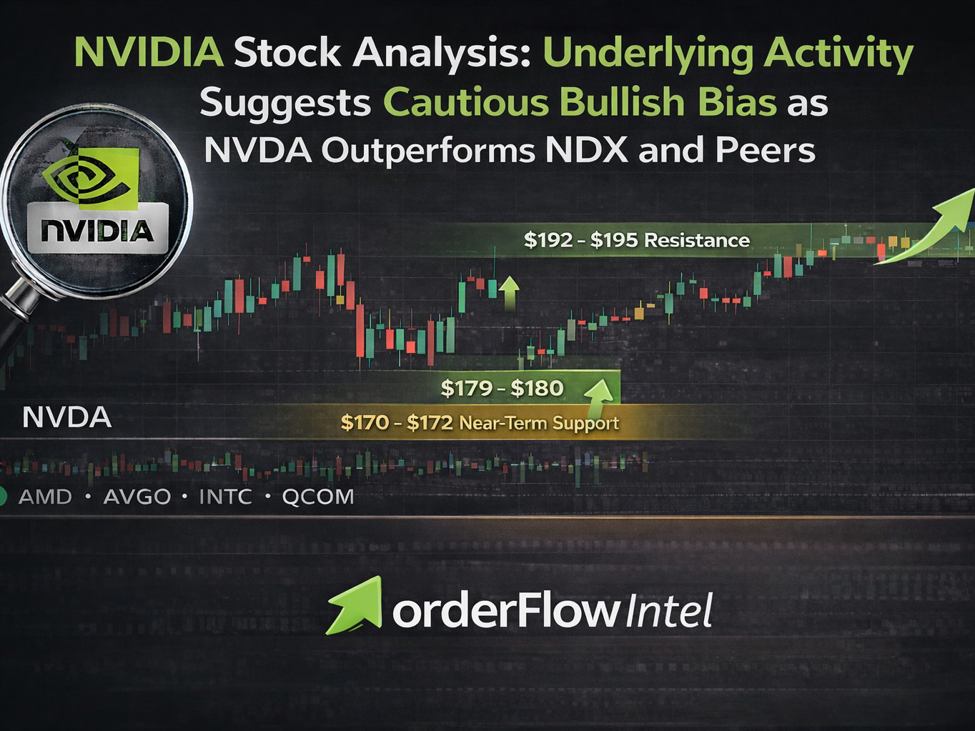
NVDA Stock Analysis Shows It Is Stronger Than You Might Think
NVIDIA stock analysis: underlying activity suggests cautious bullish bias as NVDA outperforms NDX and peersNVIDIA (NVDA) is trading near ~$188 after rebounding sharply from the ~$170 area, while the Nasdaq 100 (NDX) remains in a broader repair phase below recent highs near ~$26,000.Technology shares have experienced volatility, but NVDA has shown relative resilience versus both the index and several semiconductor peers including AMD, AVGO, INTC, and QCOM.The key question now: is this leadership sustainable, or is it a temporary bounce within a larger consolidation?What underlying activity for NVDA stock suggestsRecent participation dynamics show a clear shift in tone.When NVDA tested the ~$170–$172 area, selling pressure failed to produce meaningful follow-through. Price stabilized quickly, suggesting that demand was willing to absorb downside attempts rather than allowing a cascade lower.On the rebound toward ~$190–$195, supply has become more responsive. Rallies have encountered sellers, but not with the same urgency seen during the prior decline. This creates a constructive but incomplete picture: buyers appear active on pullbacks, yet upside still needs stronger acceptance above resistance to confirm renewed momentum.In contrast, when looking at the close peers of NVDA:AMD continues to behave more like a “sell-the-rally” structure below ~$210–$220.QCOM is attempting recovery from ~$132–$133 but still faces overhead supply near ~$145–$150.INTC shows balanced behavior between ~$43–$44 support and ~$47–$48 resistance.AVGO is stabilizing above ~$295–$300 but remains in structural repair below ~$345–$355.Relative to this group, NVDA’s participation quality remains stronger.Longer-term view for Nvidia stock vs recent behaviorFrom a longer-term perspective, NVDA remains in a constructive structure as long as it holds above ~$170–$172.Recent sessions show improving demand, but the stock has not yet decisively accepted higher levels above ~$192–$195. This means the tone is improving, but not aggressively bullish.Meanwhile, the broader NDX must hold above approximately ~$24,400 to prevent renewed index pressure that could spill into even stronger names.Leadership can persist only if the broader market backdrop stabilizes.NVIDIA (NVDA) Consolidates Within Previous Value Area as Point of Control Shifts HigherThe daily chart for NVIDIA (NVDA) highlights two distinct volume profiles, comparing the previous earnings period with the current period since the last earnings report. Key areas to watch for NVDA stockNotably, the value area for the current quarter is entirely contained within the previous quarter’s range, indicating a period of tightening consolidation. However, bullish undertones are evident as the Point of Control (POC) for the current period has migrated upward to approximately $184.75, compared to the previous quarter’s POC of $182.25. Despite this higher concentration of trading volume, the stock faces persistent structural resistance at the Value Area High (VAH), positioned just below the $190.50 mark. Traders will be watching closely to see if NVDA can break through this ceiling or if the VAH acts as a firm rejection point, keeping the asset range-bound.Trading the Point of Control This tutorial provides a practical breakdown of how to interpret and build strategies around the Point of Control during different market rotations and trendsFor traders and investors monitoring NVDA:Resistance: ~$192–$195Near-term support: ~$179–$180Major support: ~$170–$172NVDA stock options sentiment: what positioning signals add to the pictureRecent options flow provides additional context.Institutional-sized trades represented roughly 37% of notional participation, with retail and professional activity comprising the remainder. Notably, the largest single-leg notional volume came from large institutional trades, with approximately $47M transacted.However, the most significant positive directional exposure came from retail traders, who were net long roughly 204K deltas.At the same time, large institutional positioning showed an on-balance delta reading near -137,663, suggesting some hedging or cautious positioning at higher levels.This combination matters:Retail appears actively leaning long.Institutions are participating heavily in notional terms, but with a more defensive or hedged posture.Upside enthusiasm is present, but not universally aggressive.Options sentiment therefore aligns with the price structure: constructive, but not euphoric.Scenarios for NVDA as it prepared for its earnings on 25 Feb, 2026 (AMC)Bullish scenario for NVDA stockAs long as NVDA holds above ~$179–$180 and demand continues to absorb pullbacks, the path of least resistance remains higher. Sustained acceptance above ~$192–$195 would open the door toward a broader continuation phase.Bearish scenario for NVDA stockIf NVDA begins to accept prices below ~$179 and especially below ~$170–$172, it would suggest that sellers are regaining control. A renewed breakdown in NDX below ~$24,400 would further increase downside risk.Market bias score for NVDA stock: +2 (slightly bullish)A +2 score reflects modest buyer advantage rather than aggressive momentum. NVDA is showing relative strength versus peers and the index, but supply remains present near resistance.This is resilience, not runaway upside.The score would improve with sustained acceptance above ~$195 and continued outperformance versus NDX. It would weaken quickly if price begins accepting below ~$170–$172.What would change the view on NvidiaSustained acceptance below ~$170–$172Clear underperformance versus NDXStrong follow-through selling after failed rallies near ~$192–$195This analysis is intended for educational and decision-support purposes only. It is not financial advice. Markets are inherently uncertain, and all trading and investing decisions carry risk.For real-time trade ideas, follow-ups, and market insights across stocks, indices, commodities, and crypto, check out the investingLive Stocks Telegram channel. Trade ideas are shared for educational purposes only and at your own risk.https://t.me/investingLiveStocks This article was written by Itai Levitan at investinglive.com. 🔗 Source 💡 DMK Insight NVIDIA’s recent rebound to around $188 is a signal for cautious optimism among traders. The stock’s performance, especially as it outpaces the Nasdaq 100, suggests a potential bullish bias, but the broader market remains shaky. With the NDX hovering below $26,000, traders should be wary of volatility. If NVDA can maintain momentum above $180, it might attract more buying interest, especially from institutional players looking for tech exposure. However, a failure to hold above this level could trigger profit-taking, leading to a pullback. Keep an eye on the upcoming earnings reports and macroeconomic indicators that could influence tech sentiment. The real story is whether NVDA can decouple from the broader market’s repair phase or if it will follow suit. Watch for NVDA’s ability to break decisively above $190, which could signal a stronger bullish trend, while a drop below $180 might indicate
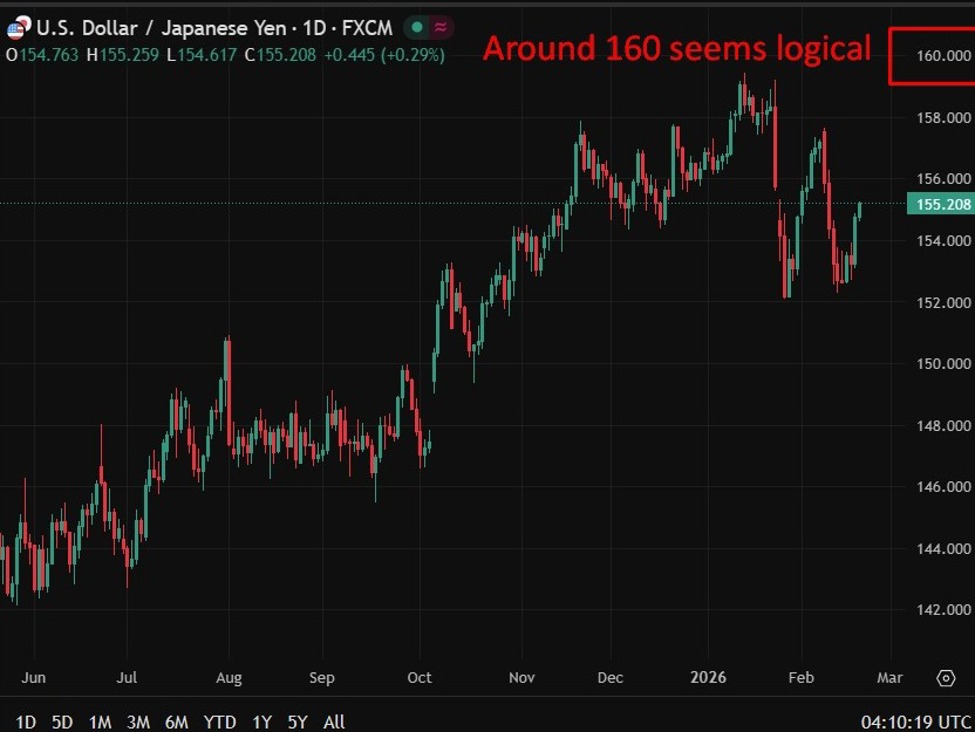
BOJ expected to reach 1% by mid-year as yen intervention risks rise near 160 USD/JPY
Economists bring forward BOJ hike expectations and see yen intervention risk near 160.Summary:All 76 economists expect the BOJ to hold rates steady in MarchMajority now see policy rate at 1% by end-June, earlier than pre-election viewGrowing concern about fiscal expansion and yen weakness69% expect currency intervention if USD/JPY nears 160Inflation risks and wage growth keep tightening bias intactExpectations for the Bank of Japan have shifted meaningfully in the wake of Prime Minister Sanae Takaichi’s election victory, with economists bringing forward forecasts for the next rate hike and increasing bets on potential currency intervention.According to a Reuters poll conducted February 10–18, all 76 economists expect the BOJ to leave its policy rate unchanged at its March meeting. However, beyond March, the outlook has turned more hawkish. A majority, 58%, now see the policy rate reaching 1% by the end of June, compared with just 36% in the January survey. Among those specifying timing, June was the most popular call, though a notable minority see April as a live possibility, while others expect July.The shift reflects mounting concern over upside inflation risks, a still-weak yen and the implications of expansionary fiscal policy. The BOJ raised rates to 0.75% in December, the highest level in three decades, and signalled readiness to continue tightening, diverging from many global peers nearing the end of their rate-cutting cycles.Currency dynamics remain central to the policy outlook. After briefly approaching the psychologically important 160 per dollar level in January, the yen rebounded sharply, but volatility has kept markets on alert. In the poll, 69% of economists said they expect Japanese authorities to intervene again in currency markets if the yen weakens materially. Among those, 40% identified the 160 per dollar level as the most likely trigger for action.Fiscal policy is also influencing expectations. More than half of respondents expressed concern that a proposed two-year suspension of the consumption tax on food could strain public finances, potentially complicating the BOJ’s inflation outlook and bond market stability.Wage growth remains a key variable. While economists expect solid increases in this year’s wage negotiations, expectations have moderated slightly compared with late last year, though still consistent with inflation running above target.Overall, the consensus is clear: March is likely a pause, but tightening toward 1% by mid-year is now the base case, with intervention risks rising should yen weakness re-emerge.”Bid 160? Go ahead, make my day!” This article was written by Eamonn Sheridan at investinglive.com. 🔗 Source 💡 DMK Insight Yen intervention fears are rising as economists shift BOJ rate hike expectations, and here’s why that matters: With all 76 economists predicting the BOJ will maintain current rates in March, the majority now anticipate a policy shift to a 1% rate by the end of June. This accelerated timeline reflects growing concerns over fiscal expansion and the yen’s persistent weakness. If USD/JPY approaches the 160 mark, 69% of these economists foresee intervention, which could trigger significant volatility in forex markets. Traders should keep a close eye on this pair, as the psychological barrier of 160 could prompt swift action from the BOJ, impacting not just the yen but also related assets like Japanese equities and commodities priced in yen. Here’s the flip side: while many are focused on the potential for intervention, the market could react differently if the BOJ signals a more dovish stance. If the yen weakens further without intervention, it may lead to increased inflationary pressures, complicating the BOJ’s policy decisions. Watch for USD/JPY movements around key levels, particularly 160, and monitor any statements from BOJ officials for clues on their next moves. 📮 Takeaway Keep an eye on USD/JPY approaching 160; intervention risks are high, which could lead to significant market volatility.
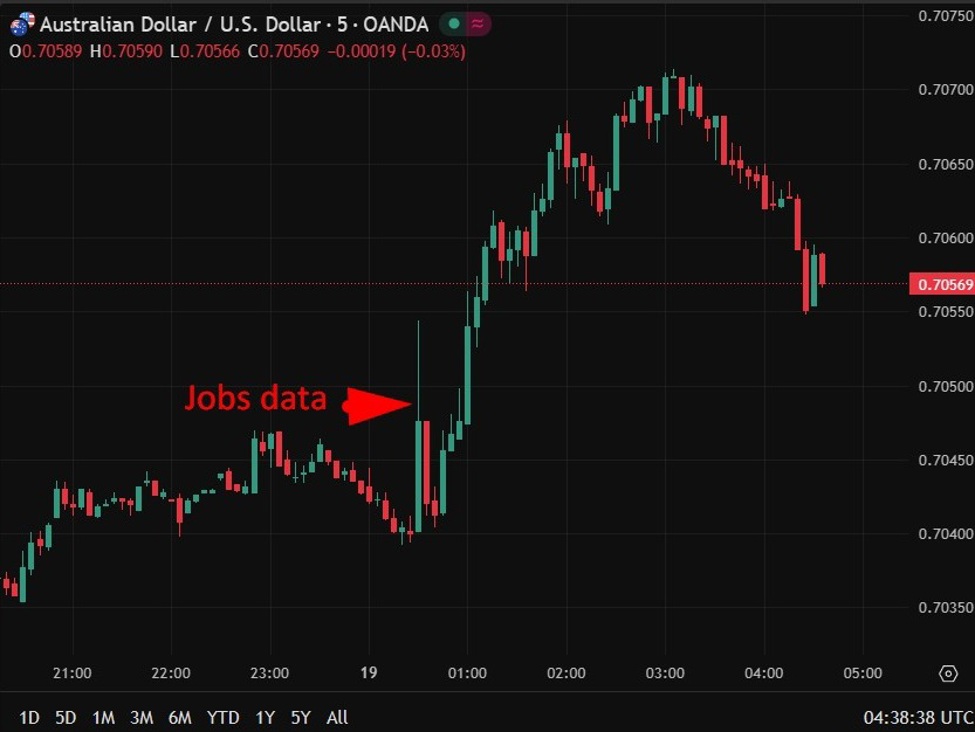
investingLive Asia-Pacific FX news wrap: Tight Australian job market lifts AUD
BOJ expected to reach 1% by mid-year as yen intervention risks rise near 160 USD/JPYNVDA Stock Analysis Shows It Is Stronger Than You Might ThinkRBNZ to increase monetary policy decisions to eight per year from 2027Mega-cap tech most under-owned in 17 years, says Morgan StanleySouth Korea KOSPI hits record high as tech rally triggers Kosdaq sidecarCBS: US military ready for possible Iran strike as soon as Saturday, Trump undecidedJapan machinery orders surge 19.1% in December, smashing forecastsRBNZ’s Silk: easing cycle over, but weak demand and sticky inflation pose two-way risksWhat the Fed didn’t say: January minutes omit the date inflation returns to 2%Australia unemployment total falls for fourth straight month. RBA March rate hike prospectAustralian January jobs data, Unemployment rate 4.1% (expected 4.2%, prior 4.1%FOMC minutes showed Powell to remain as Chair for all of 2026. Gridlock, here’s why.Two-thirds of Japanese firms concerned about Takaichi fiscal disciplineJP Morgan raise their forecasts for AUD, NZD and for USD/JPY (EUR/USD unchanged)Private survey of inventory shows headline crude oil drawinvestingLive Americas FX news wrap 18 Feb: USD higher with yields, commodities leadingAt a glance:AUD strengthened after solid Australian employment dataUnemployment fell for a fourth straight month; hours worked rose 0.6%RBA March hike expectations firmed, though not locked inJapan machinery orders surged 19% m/m, supporting capex outlookIran strike rumours persistedKorea’s KOSPI hit a record highThe Australian dollar was the standout mover during the session, gaining ground as markets leaned further toward the possibility of a Reserve Bank of Australia rate hike at its March 16–17 meeting following another firm labour market report.Headline employment rose modestly, but the underlying detail reinforced the message of a still-tight labour market. The number of unemployed fell for a fourth consecutive month, a sequence last seen in the four months immediately preceding the RBA’s May 2022 rate-hike cycle. Hours worked also climbed 0.6% in January, pointing to solid labour demand.The data do not lock in a March move, but they keep the RBA’s tightening bias intact. AUD/USD climbed from around 0.7040 to just above 0.7070 before retracing a good portion of the move later in the session.USD/JPY edged higher in relatively light news flow. However, Japanese data delivered a standout surprise, with core machinery orders jumping more than 19% month-on-month in December, far exceeding expectations for a 4.5% rise. The capex indicator supports the Bank of Japan’s outlook for continued economic expansion, even as fiscal and currency dynamics remain in focus. In other data Japanese equites were reported to have seen their biggest weekly foreign inflow in four months, and their eighth consecutive weekly net purchase.Elsewhere, geopolitical chatter persisted around the possibility of a US strike on Iran, with reports suggesting this weekend remains under consideration. The headlines added a layer of caution to broader risk sentiment.In equity markets, South Korea’s KOSPI surged to a record high as trading resumed following a three-day holiday. Mainland China and Hong Kong markets remained closed, keeping regional liquidity thinner than usual. This article was written by Eamonn Sheridan at investinglive.com. 🔗 Source

Geopolitics in focus in the second half of the week
The rising tensions and expectations of a potential military conflict over the weekend is now keeping markets on edge. Oil prices rallied yesterday, with WTI crude moving up by over 4% to $65 levels now. The jump also coincides with a solid rebound off the 200-day moving average once more, holding since the start of the month.In other markets, the reaction was calmer but there are some nerves showing. The dollar is holding up with EUR/USD easing back under the 1.1800 level while USD/JPY creeps up to just above the 155.00 mark. Despite the early flows here, I would argue the dollar remains vulnerable as we’ve seen with the Venezuela episode last month. The dollar held up well in early January before tumbling later in the month.And so again, precious metals are a key spot to watch in all this. Gold is inching back closer towards the $5,000 level while silver is also creeping up a little to near $78 now. The latter faces some key near-term resistance around $78.84 currently, from the 200-hour moving average.The latest report is that Trump has not yet decided if and when he wants to launch military strikes at Iran. The Pentagon is already moving personnel out of the Middle East as a precaution but it is said that nothing has been decided just yet. The narrative remains that the US administration will want to wait on further talks to weigh up the situation.But considering the erratic and uncertain nature of their policy handling, markets surely cannot rule out something happening over the weekend. As such, that could see some key posturing in the sessions ahead just in case there are any notable developments.As with war and geopolitical conflict, more often than not the best trade is always to buy the rumour then sell the fact. I reckon we might be headed down that road once again, at least for the oil market. But in waiting too long for the conflict to start up, we could see pullbacks to the price positioning since yesterday. So, just be wary of that. This article was written by Justin Low at investinglive.com. 🔗 Source 💡 DMK Insight With SOL at $81.54, geopolitical tensions are shaking up markets, and here’s why that matters: The recent spike in oil prices, with WTI crude climbing over 4% to $65, is a signal that traders need to watch closely. Rising oil prices often correlate with increased volatility in both crypto and forex markets, as they can impact inflation expectations and central bank policies. For SOL traders, this could mean heightened uncertainty, especially if the military conflict escalates, leading to risk-off sentiment. If SOL breaks below key support levels, it could trigger further selling pressure. On the flip side, if SOL holds above $80, it might attract buyers looking for a rebound, especially if the broader market stabilizes. Keep an eye on the 200-day moving average for potential support or resistance in the coming days. The real story is how these geopolitical developments could ripple through to other assets, particularly those tied to energy markets. Watch for correlations with BTC and ETH, as they often react similarly to macroeconomic shifts. 📮 Takeaway Traders should monitor SOL’s performance around the $80 mark and watch for oil price movements, as geopolitical tensions could drive volatility this week.

Foreign holdings of US Treasuries cool slightly after peaking in November
In wrapping up the 2025 year, foreign holdings of US Treasuries dropped slightly in December to $9.27 trillion. That compares with the peak seen in November at $9.36 trillion. The $88.4 billion drop might not seem much but it still represents the largest monthly decline since late 2022. But after hitting a record high in November, I think we can give that a pass.That especially if we put things more into context. The 2025 year-end figure still marks a massive year for US debt demand, with it being well above the $8.5 trillion at the end of 2024.So, what can we make of the trend and the data from the report yesterday?There are just a couple of things that stand out from the chart above.The first of course being the glaring and continued decline in China’s holdings of US Treasuries. The figure dropped to $683.5 billion by the end of 2025, which is the lowest since 2008. The total reduction in China’s holdings for the whole of last year was over $200 billion. So, it keeps up with the trend we’re seeing since the peak in 2013.That being said, the important detail when looking into this report is to not take the numbers at face value. It is best to remember that the numbers here are only a measure of each country’s holdings of Treasuries in US custodians. The thing about this is that some countries might still buying Treasures via non-US custodians. As such, China likely falls under this category.And these numbers tend to show up in the likes of Belgium and Luxembourg. That is not to say all of it are tied to proxy buying though. Both Belgium and Luxembourg also double as agents to facilitate demand for private financial institutions in Europe especially.As for the UK, it is more so a case of London acting as a global clearinghouse for private international investors. That especially after the Covid pandemic.In essence, the narrative there also highlights the continued shift in trend in terms of structural holdings of Treasuries and US debt.It is no longer central banks being the big players but instead private investors i.e. hedge funds, pension funds, asset managers who are now the dominant buyers. And they have been for quite a while now.As mentioned yesterday, this just means that US funding is now becoming more increasingly dependent on market-based capital and not so much so on reserve recycling. To put things more simply, it’s more about yield and financial demand rather than being a case of a geopolitical feature.And for all the negativity surrounding the dollar and US assets since last year, foreign demand for Treasuries remain strong. The total holdings by foreign investors last year even showed a staggering increase of $770 billion over the course of 2025.That’s good news for the US administration as they continue to balance on a very fine tightrope on the fiscal side of things. But even as foreign demand is holding up just enough to keep the engine running, the fiscal cost continues to put a stranglehold on the government.And now with the “financialisation” shift in who is demanding Treasuries, that creates a bigger risk especially since private investors are more price/yields sensitive. That in turn also creates the risk for more potential yield spikes on any major developments. This article was written by Justin Low at investinglive.com. 🔗 Source 💡 DMK Insight Foreign holdings of US Treasuries just took a hit, and here’s why that matters: The drop to $9.27 trillion in December, down from November’s $9.36 trillion, signals a potential shift in investor sentiment. This is the largest monthly decline since late 2022, which could indicate that foreign investors are becoming more cautious about US debt. For traders, this could impact the USD and Treasury yields. If foreign demand continues to wane, we might see upward pressure on yields, making US debt less attractive. Keep an eye on the 10-year Treasury yield; any significant movement could affect broader market sentiment and risk appetite. On the flip side, this decline might also reflect a strategic repositioning by foreign investors, possibly favoring equities or other assets. If they’re reallocating towards riskier assets, it could lead to volatility in both the forex and equity markets. Watch for reactions in the forex market, especially with the USD, as shifts in Treasury holdings often correlate with currency strength. Traders should monitor the upcoming economic data releases and Fed commentary for clues on how this trend might evolve. 📮 Takeaway Watch the 10-year Treasury yield closely; a rise could signal increased volatility in the USD and broader markets as foreign demand shifts.