
 Bitcoin
  Ethereum
  Tether
  BNB
BNB  XRP
XRP  USDC
USDC  Solana
  TRON
TRON  Lido Staked Ether
  Figure Heloc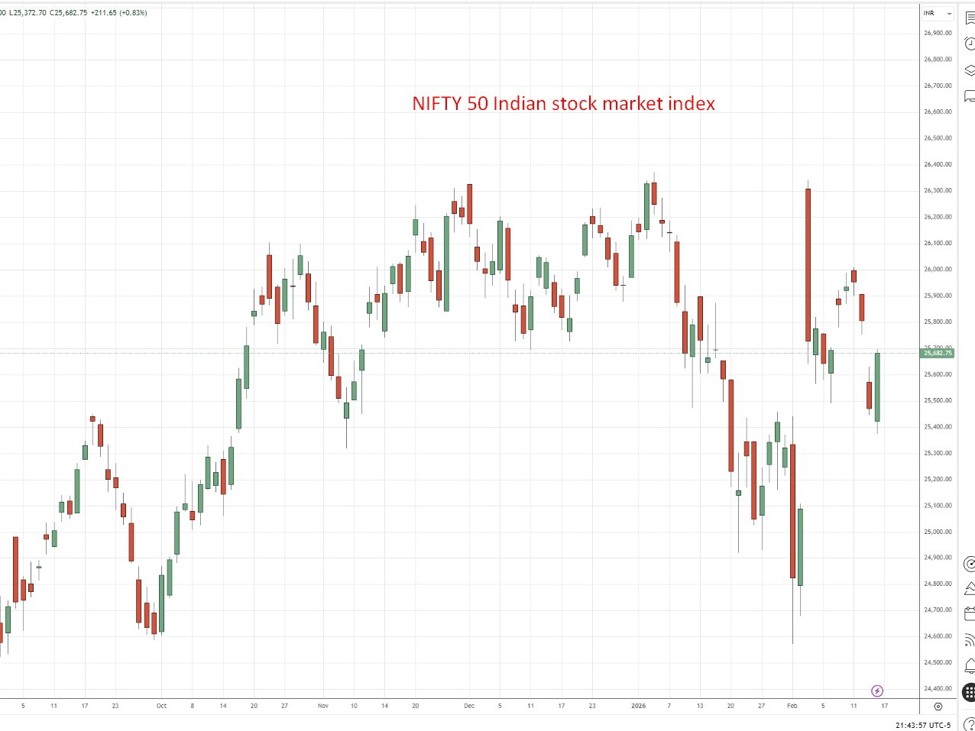
India’s ECB rule changes widen offshore funding options for corporates, with a mild positive read-through for risk. Info via Reuters reporting. Summary:RBI finalised easier rules for external commercial borrowings (ECBs), expanding flexibility for corporates raising overseas debt.Eligible firms can borrow up to $1bn or 300% of net worth, in foreign currency or rupees.Pricing constraints eased, with borrowing costs to be aligned with market conditions.Minimum average maturity set at three years; refinancing of existing borrowings permitted.End-use restrictions remain in place for some purposes, including parts of real estate, unless structured within rules.India’s central bank has finalised a set of reforms that make it easier for companies to raise debt offshore, a move likely to broaden funding options for corporates and lower financing frictions as investment and refinancing needs remain elevated.Under the updated framework, eligible borrowers will be able to raise external commercial borrowings of up to $1 billion or 300% of their net worth, with funding permitted in either foreign currency or Indian rupees. The rules also loosen earlier constraints around borrowing costs, allowing firms to raise foreign debt at market pricing rather than being bound by more restrictive cost ceilings.The central bank has retained basic safeguards, including a minimum average maturity requirement of three years. It has also explicitly allowed ECB proceeds to be used to refinance existing borrowings, a change that may be particularly relevant for firms facing near-term maturity walls or seeking to optimise funding mixes between domestic and offshore markets. In addition, ECBs may be converted into non-debt instruments, subject to compliance with foreign exchange regulations.The reforms are likely to be welcomed by larger corporates with established access to international markets, as well as by issuers that can arbitrage between onshore and offshore rates depending on currency basis, swap costs and market windows. At the same time, the central bank has kept some end-use restrictions, including limitations linked to real estate activity unless transactions are structured in line with the rulebook. That suggests policymakers are still aiming to prevent speculative leverage while improving legitimate corporate funding channels. —Stock market implications are broadly constructive at the margin. Sectors with sizable capex plans or refinancing needs could benefit from a wider set of funding options and potentially lower blended borrowing costs. Companies with strong credit profiles may be best positioned to take advantage of market-priced offshore funding. Financials could see a mixed effect: easier offshore access might reduce incremental domestic loan demand for some top-tier borrowers, but it can also support credit quality by easing refinancing risk and reducing stress for leveraged balance sheets. In macro terms, greater offshore borrowing could influence FX flows and INR hedging demand, particularly if issuance rises in foreign currency, making currency management and hedging costs an important swing factor for corporates. This article was written by Eamonn Sheridan at investinglive.com. 🔗 Source 💡 DMK Insight India’s new ECB rules could shift risk appetite among traders, and here’s why that matters: By allowing corporates to borrow up to $1 billion or 300% of their net worth, the RBI is effectively opening the floodgates for offshore funding. This could lead to increased liquidity in the market, potentially driving up asset prices as companies leverage these funds for expansion or investment. For traders, this means a heightened risk-on sentiment could emerge, impacting sectors like infrastructure and manufacturing that typically benefit from such capital inflows. But there’s a flip side to consider. While the immediate reaction might be bullish, the long-term implications hinge on how these funds are utilized. If companies over-leverage or if global interest rates rise, we could see a reversal in sentiment. Traders should keep an eye on the USD/INR pair, as any significant depreciation of the rupee could lead to increased costs for these borrowings, impacting corporate profitability. Watch for volatility in related sectors and monitor the broader economic indicators that could signal shifts in investor sentiment. 📮 Takeaway Keep an eye on the USD/INR exchange rate and sector performance as India’s ECB rule changes could spark a risk-on rally or reveal underlying vulnerabilities.
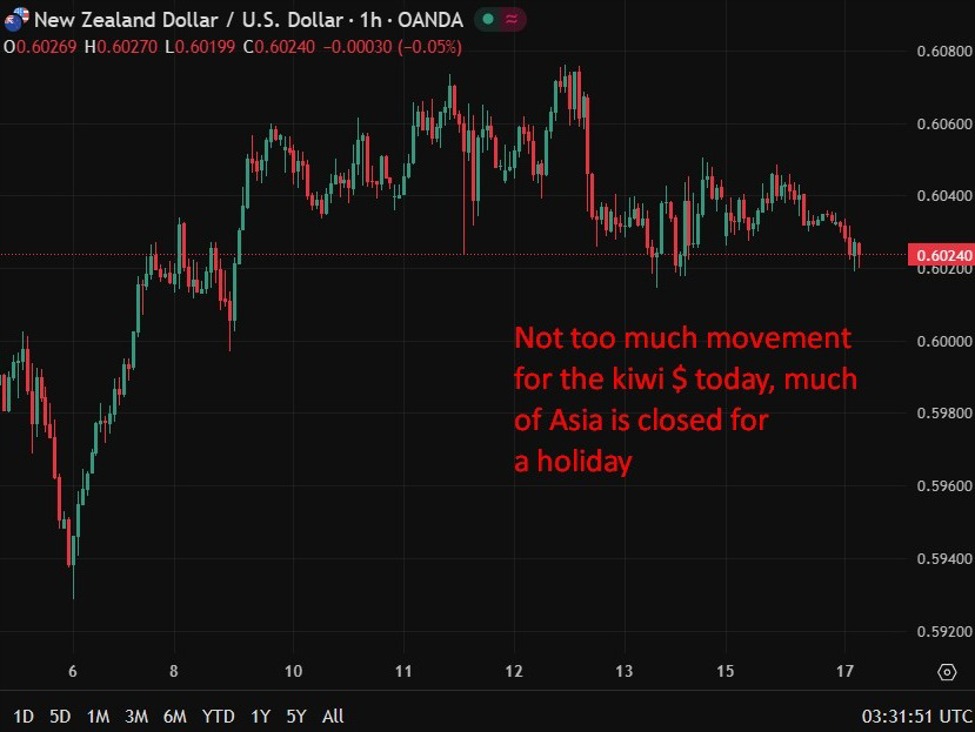
RBNZ to hold, signal rate hikes ahead, ING. Upside risks for NZ/US toward 0.62 by year-end
ING expects the RBNZ to hold in February 18 but signal a more hawkish stance as inflation surprises to the upside, forecasting two hikes from 3Q and medium-term NZD strength.Summary of their views below. Earlier:RBNZ expected to hold rates as higher food price inflation adds limited pressureLikely RBNZ on hold decision February 18RBNZ statement due 18 February at 2pm New Zealand time (0100 GMT / 2000 US Eastern time on Tuesday 17 February)Summary:RBNZ expected to keep rates unchanged on 18 February, but projections may turn more hawkish.Recent inflation prints have exceeded the bank’s forecasts, raising questions over last year’s easing.New Governor Anna Breman’s reaction function in focus at her first full meeting.ING expects two rate hikes from 3Q, taking the policy rate to 2.75% by year-end.NZD seen supported medium term, with year-end NZD/USD forecast at 0.62.The Reserve Bank of New Zealand is widely expected to leave its policy rate unchanged at its February meeting, but attention is likely to centre on whether policymakers begin laying the groundwork for renewed tightening later this year, according to ING.The bank argues that inflation developments have challenged the RBNZ’s earlier disinflation narrative. Fourth-quarter headline CPI rose 3.1% year-on-year, above the central bank’s 2.7% projection, while non-tradable inflation also exceeded expectations. That gap has fuelled debate over whether last year’s easing cycle may have been too aggressive.With the first-quarter CPI report not due until late April, this week’s meeting and the one in early April will be key opportunities for the RBNZ to signal how it interprets the inflation backdrop. ING expects no immediate policy move but sees scope for upward revisions to both inflation forecasts and the projected rate path.February’s meeting will also provide investors with their first clear read on Governor Anna Breman’s approach after stronger-than-expected price data. While she previously carried a dovish reputation, recent communications have emphasised flexibility and a willingness to adjust policy if inflation proves sticky. Markets currently price no rate hikes until late 2026, a stance ING sees as vulnerable to revision.On growth and employment, the picture remains relatively firm. Employment growth has outpaced central bank projections, participation has risen and business surveys suggest gradual momentum in services and manufacturing. That backdrop reduces pressure for further easing and supports the case for eventual tightening.ING’s core call is for two rate hikes beginning in the third quarter, lifting the policy rate to 2.75% by year-end, followed by a further move in 2027 toward a 3.0% neutral level. With markets already pricing around 40 basis points of tightening by December, confirmation of a hawkish shift in projections could validate expectations and prompt renewed NZD strength. ING sees upside risks for NZD/USD toward 0.62 by year-end, although it cautions that near-term gains could be tempered by fragile global risk sentiment and recent rapid currency appreciation. This article was written by Eamonn Sheridan at investinglive.com. 🔗 Source 💡 DMK Insight RBNZ’s potential hawkish shift could shake up the NZD market significantly. With ING forecasting two rate hikes starting in Q3, traders should be on alert for any hints of this in upcoming statements. A hold in February might not be the end of the story; if inflation continues to surprise on the upside, as suggested by rising food prices, the RBNZ could pivot sooner than expected. This could lead to a stronger NZD, impacting not just forex pairs like NZD/USD but also commodities priced in NZD. Watch for key resistance levels around recent highs, as a break could signal a bullish trend. Keep an eye on inflation data releases and RBNZ communications for clues on timing and market sentiment shifts. The flip side? If inflation pressures ease unexpectedly, the RBNZ might maintain a more dovish tone, which could weaken the NZD and create opportunities for short positions. Overall, the market’s reaction will hinge on how the RBNZ balances inflation concerns with economic growth, so stay tuned for any shifts in their narrative. 📮 Takeaway Watch for RBNZ’s February meeting; a hawkish signal could strengthen the NZD, especially if inflation data continues to surprise.

Japan 5-year JGB auction sees steady demand, bid-to-cover at 3.10
Japan’s 5-year JGB auction drew steady demand with a 3.10 bid-to-cover ratio and a modestly tighter tail, though participation was slightly softer compared with stronger sales last year.Japan sold ¥1.89 trillion of 5-year JGBs with a bid-to-cover ratio of 3.10 (vs 3.08 prior).Stop rate (highest accepted yield) came in at 1.646%, average yield 1.640%.Auction tail narrowed to 0.03 from 0.05, signalling relatively solid price discovery.Bid-to-cover was the lowest since August 2025, suggesting marginally softer demand.Overall result viewed as stable, with no signs of disorderly selling pressure.Japan’s Ministry of Finance conducted a ¥1.89 trillion reopening auction of five-year Japanese government bonds (JGBs), drawing steady, though slightly softer, investor demand as yields remain elevated relative to recent years.The auction achieved a bid-to-cover ratio of 3.10, meaning total bids were just over three times the amount sold. While marginally above the previous sale’s 3.08 reading, it was the lowest level since August 2025, hinting at some cooling in demand compared with stronger earlier auctions.The lowest accepted price was 99.7900, with an average accepted price of 99.8200. Because bonds are priced relative to a face value of 100, a price below par implies a yield above the coupon rate. The stop rate, effectively the highest yield accepted at the auction, was 1.646%, while the average yield came in slightly lower at 1.640%. The bond carries a 1.600% coupon and matures in December 2030.One closely watched metric, the “tail”, narrowed to 0.03 from 0.05 at the previous sale. The tail measures the gap between the average price and the lowest accepted price. A smaller tail typically signals tighter bidding and healthier demand, as investors cluster more closely around the clearing level.The data also showed that 17.1% of bids were accepted at the lowest price, indicating a moderate concentration of demand at the cut-off level. In addition to competitive bids, the ministry allocated bonds through non-price competitive auctions, which allow certain participants to buy at the average accepted price.Overall, the auction points to stable demand for intermediate Japanese debt, even as the Bank of Japan continues its gradual policy normalization. With five-year yields hovering around multi-year highs, investors appear willing to absorb supply, though not with the same intensity seen during periods of ultra-loose policy—Jargon explainedBid-to-cover ratio: Total bids divided by the amount sold. Higher = stronger demand.Stop rate: The highest yield (lowest price) accepted in the auction.Tail: The difference between the average accepted price and the lowest accepted price. Smaller = smoother auction.Reopening: Additional issuance of an existing bond rather than a brand-new maturity This article was written by Eamonn Sheridan at investinglive.com. 🔗 Source 💡 DMK Insight Japan’s JGB auction results could ripple through global markets, especially for risk assets like crypto. The 3.10 bid-to-cover ratio indicates solid demand, but the softer participation compared to last year raises eyebrows. Traders often look at these metrics as indicators of broader economic sentiment. If investors are pulling back from JGBs, it might signal a shift in risk appetite, potentially leading to volatility in assets like SOL, currently priced at $85.06. If SOL can hold above the $80 mark, it may attract buyers looking for a dip, but a break below could trigger stop-losses and further selling pressure. Keep an eye on the correlation between JGB yields and crypto prices. Rising yields could push investors back to traditional assets, while falling yields might boost riskier assets. Watch for SOL’s performance over the next few days; if it holds above $85.06, it could indicate bullish sentiment, but a drop below $80 would suggest caution. 📮 Takeaway Monitor SOL closely; a hold above $85.06 could signal bullish momentum, while a drop below $80 may trigger selling pressure.
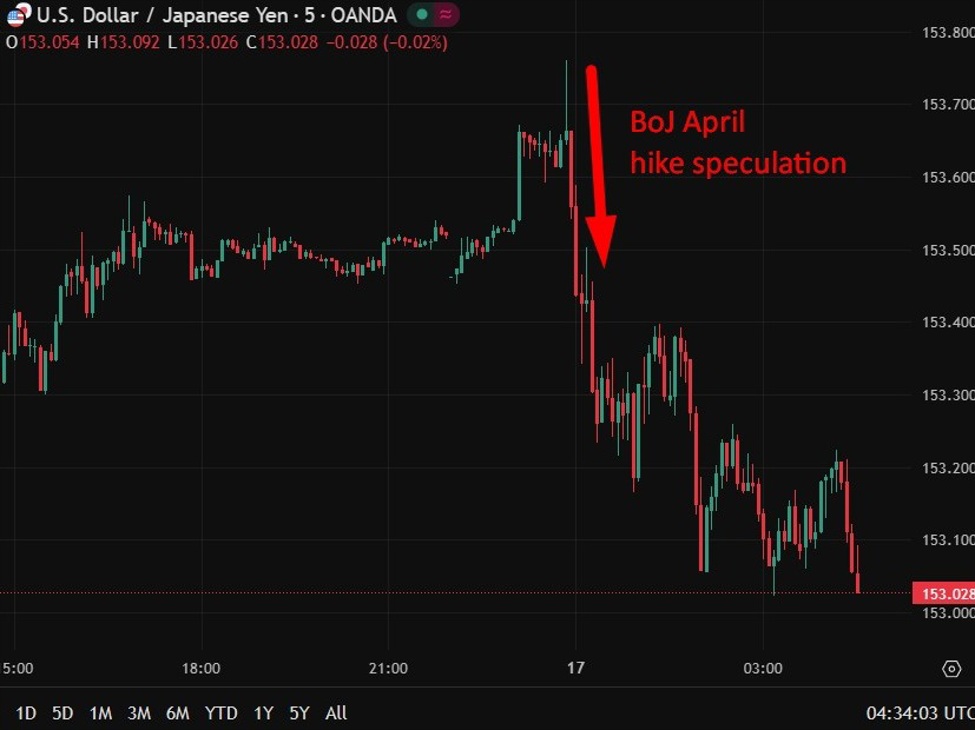
investingLive Asia-Pacific FX news wrap: USD/JPY sharp drop
Japan 5-year JGB auction sees steady demand, bid-to-cover at 3.10RBNZ to hold, signal rate hikes ahead, ING. Upside risks for NZ/US toward 0.62 by year-endIndia central bank finalises easier foreign borrowing rules for corporatesOil steady as Iran drills near Strait of Hormuz ahead of US talksUS dollar positioning hits record underweight in Bank of America surveyGold and silver both lower into thin Asia tradeReminder, China, Singapore & Hong Kong markets are all closed today, Tuesday, February 17BOJ likely to raise rates 25bp April, former board member says. Gradual move toward 1.25%RBA minutes show inflation risks ‘shifted materially’ behind February rate hikeICYMI: China to remove tariffs on imports from 53 African nations from May 1FX option expiries for 17 February 10am New York cutSoft landing looks more plausible, but the Fed isn’t ready to call it done.RBNZ expected to hold rates as higher food price inflation adds limited pressureRBA February minutes to detail case for rate hike, set to reinforce tightening biasAt a glance:USD/JPY fell sharply after a Bloomberg report flagged April as the likeliest timing for the next BOJ rate hike, citing an ex-BOJ board member.Broader USD firmed modestly against most majors despite yen strength.RBA minutes showed a hold was considered but a 25bp hike seen as the stronger case; no discussion of 50bp.Thin liquidity due to US Presidents Day and Lunar New Year holidays across much of Asia.RBNZ decision due Wednesday; widely expected to hold, focus on forward guidance.Gold and silver edged lower.USD/JPY dropped at pace during the session following a Bloomberg report citing former Bank of Japan board member Seiji Adachi, who said April is the most likely timing for the next rate hike. Policymakers are seen waiting for wage negotiation results and updated forecasts before moving, with further tightening toward 1.25% still considered possible. The move reinforced expectations that policy normalization in Japan is not finished, lending support to the yen.Elsewhere across FX, the US dollar was a little firmer overall, gaining modest ground against several majors even as it softened versus JPY.The Indian rupee slipped alongside, with continued weakness in domestic equities also weighing on the currency. Dollar selling by state-owned banks helped limit the decline.Minutes from the Reserve Bank of Australia showed the board did consider leaving rates unchanged at its February meeting, but ultimately judged there was a stronger case for a 25bp increase. There was no indication that a 50bp move was seriously contemplated. The minutes reiterated the strategy of returning inflation to target within a reasonable timeframe while preserving employment gains, a balance that suggests a likely pause in March. Next week’s January monthly CPI data will be key in shaping that decision.Price action was partly distorted by holiday-thinned liquidity. US markets were closed for Presidents Day on Monday, while Lunar New Year holidays kept mainland China, Hong Kong, Singapore, South Korea and Taiwan offline here today, limiting participation.Looking ahead, the Reserve Bank of New Zealand meets on Wednesday, February 18. The policy statement is due at 2pm New Zealand time (0100 GMT / 2000 US Eastern on Tuesday). The bank is widely expected to remain on hold, with markets focused on whether policymakers begin signalling renewed tightening later this year.In commodities, gold and silver both lost ground during the session.—Adding in some late data just out from Japan, the December Tertiary Industry Index -0.5% m/mexpected -0.2%, prior -0.4%The Japan Tertiary Industry Index measures monthly changes in output across Japan’s service sector, which accounts for roughly 70% of the economy. The weak ressult points to potentially slowing demand and reduced inflation momentum.— This article was written by Eamonn Sheridan at investinglive.com. 🔗 Source 💡 DMK Insight Japan’s steady demand in the 5-year JGB auction signals confidence, but here’s why traders should pay attention: The bid-to-cover ratio at 3.10 indicates solid interest, which could influence the yen and Japanese equities positively. Meanwhile, the RBNZ’s hint at potential rate hikes adds a layer of complexity for NZD traders, especially with forecasts suggesting upside risks toward 0.62 against the USD by year-end. This could lead to increased volatility in the forex market as traders adjust positions based on anticipated monetary policy shifts. Also, keep an eye on oil prices as geopolitical tensions rise with Iran’s drilling activities near the Strait of Hormuz. Any disruptions could impact not just oil prices but also currencies tied to commodity exports. The US dollar’s record positioning suggests traders are heavily leaning towards a stronger dollar, but this could create a crowded trade that may reverse quickly if economic data disappoints. Watch for key resistance levels in the NZD/USD pair and be prepared for potential pullbacks as the market digests these developments. 📮 Takeaway Monitor the NZD/USD for potential upside toward 0.62, but be cautious of volatility from geopolitical tensions and US dollar positioning.

This Ramadan, Versus Trade Presents Its 100% Deposit Bonus Campaign
100% Ramadan Mubarak Bonus — discipline meets opportunity.In honor of the holy month of Ramadan, Versus Trade — an award-winning CFD broker — introduces a special Ramadan 100% Deposit Bonus, a limited-time offer created to support traders during a period traditionally associated with focus, patience, and reflection.Designed as a seasonal opportunity, the bonus expands trading capacity during a period when focus naturally takes center stage. Versus Trade responds with a meaningful trading boost, credited instantly as additional margin from the first trade.More Margin. More Flexibility.The 100% Deposit Bonus allows traders to increase their available trading margin and explore broader market opportunities. By doubling the deposited amount, traders can open larger positions while managing capital more efficiently, test and refine trading strategies under real market conditions, as well as maintain flexibility during periods of lower volatility and selective trading.Key Bonus ConditionsBonus amount: 100% of the deposit, up to $500Eligible accounts: Standard, Cent, Pro, Raw SpreadPayment methods: Deposits can be made using any available payment method, including bank transfers, credit cards, digital wallets and cryptocurrencies. Withdrawals: All profits generated from trading are fully withdrawable, while the bonus is provided exclusively as trading margin.Usage: The bonus is credited as additional margin and does not cover drawdown. Validity: Bonus is valid for 60 days from activation.How to Activate the Ramadan 100% Deposit Bonus?Activating the Ramadan 100% Deposit Bonus is straightforward. First, traders opt-in to the promotion and make a qualifying deposit using any available payment method. Once the deposit is completed, the 100% bonus is credited instantly — no additional activation steps required. With the bonus already applied as additional margin, traders can begin trading right away with expanded capacity and greater flexibility.“Ramadan is a time when many traders operate with greater clarity and intention. During this period, traders tend to be more disciplined and focused on doing better — not trading more, but trading smarter. The 100% Deposit Bonus supports that approach by providing additional margin upfront, allowing for more structured planning and better risk management”Mohd FazrinBusiness Development Director MalaysiaA Seasonal Reward for Disciplined TradersRamadan brings focus — and Versus Trade rewards it. This promotion is designed for supporting traders who value precision, patience, and thoughtful decision-making during an important time of the year.Available for a limited time, the 100% Ramadan Mubarak Bonus offers traders a timely opportunity to activate extra margin during this seasonal period. Full details and eligibility can be checked directly in the Trader Area under the Offers section.About Versus TradeVersus Trade is an award-winning, next-generation CFD broker offering multiple trading assets alongside its unique Versus Pairs — allowing traders to trade asset-to-asset comparisons such as Bitcoin vs Gold or Tesla vs Ford. The company is focused on becoming a leading broker by providing access to low spreads and fast, transparent trading through the MT5 platform. Versus Trade delivers high-quality order execution designed to support both new traders and experienced professionals. These trading solutions enable flexible strategies and allow traders to make decisions based on real-time market data, helping them respond effectively to changing market conditions. In addition, Versus Trade supports client growth through its competitive partnership programs.Media Contact: pr@versus.trade This article was written by IL Contributors at investinglive.com. 🔗 Source

FX option expiries for 17 February 10am New York cut
EUR/USD1.2000 (EUR 940.83 mn)1.1900 (EUR 1.34 bn)1.1700 (EUR 975.72 mn)USD/JPY156.00 (US$ 1.95 bn)151.00 (US$ 1.09 bn)GBP/USD1.3560 (GBP 766.08 mn)USD/CHF0.7730 (US$ 694.69 mn)USD/CAD1.3600 (US$ 1.02 bn)1.3500 (US$ 973.00 mn)AUD/USD0.7025 (AUD 449.18 mn)NZD/USD0.6100 (NZD 140.98 mn)0.5975 (NZD 196.92 mn)EUR/GBP0.8970 (EUR 117.05 mn)WHAT ARE OPTION EXPIRIES?The FX option expiration price levels refer to the strike prices where option contracts are set to expire. These levels include both calls and puts.When you see “EUR/USD at 1.1600 for €4 billion” it means there is a total of €4 billion worth of options (calls + puts combined) that have a strike price of 1.1600 and are expiring at that specific time (the “New York Cut” at 10:00 AM ET).Traders watch these levels because they often act as a “magnet” for the price. For example, if there’s nothing happening in the market and the price is close to the expiry level, let’s say 30-50 pips away, what you will usually see is the price moving into the expiry level. This happens due to the hedging activity of the market makers (banks, dealers and so on).As the price gets closer to the strike price near expiration, these market makers must aggressively buy or sell the currency to hedge their risk. This hedging activity tends to suppress volatility and keep the price “pinned” close to the strike price until the expiration time passes.RELATED ARTICLES:For more information on how to use this data, you may refer to this post here. This article was written by Giuseppe Dellamotta at investinglive.com. 🔗 Source 💡 DMK Insight The recent option expiries at key levels like 1.2000 for EUR/USD are crucial for traders right now. With significant expiries at 1.2000 (EUR 940.83 million) and 1.1900 (EUR 1.34 billion), these levels could act as strong support or resistance. Traders should watch how the market reacts as we approach these expiries, especially since they can trigger volatility. If the EUR/USD breaks above 1.2000, it could signal bullish momentum, while a drop below 1.1900 might indicate a bearish reversal. Look for correlated movements in the USD/JPY and GBP/USD pairs, as shifts in the Euro can often ripple through these markets. Keep an eye on the daily charts for any breakout patterns or reversals around these levels, as they could dictate short-term trading strategies. The flip side is that if traders are overly focused on these levels, they might miss broader market trends. Economic indicators or geopolitical events could easily shift sentiment, so it’s worth monitoring news that could impact the Euro or the Dollar significantly. 📮 Takeaway Watch the 1.2000 and 1.1900 levels for EUR/USD; a breakout or breakdown could signal significant market moves in the short term.

UK December ILO unemployment rate 5.2% vs 5.1% expected
Prior 5.1%Employment change 52k vs 94k expectedPrior 82kAverage weekly earnings +4.2% vs +4.6% 3m/y expectedPrior +4.7% (revised to 4.6%)Average weekly earnings ex bonus +4.2% vs +4.2% 3m/y expectedPrior +4.5% (revised to 4.4%)January payrolls change -11kPrior -43k (revised to -6k)As a general reminder, the UK labour market report is still one plagued by data quality issues. And that looks set to continue further as outlined here: UK statistics office evaluates potential delay to its overhauled jobs survey – reportWe have softer than expected figures across the board here, but as mentioned earlier, the data is unlikely to change much for the BoE as it already projected more weakness and more rate cuts ahead. Today’s report should solidify expectations for a rate cut at the next meeting though. Traders were already pricing a 70% probability, so that will likely rise to 80% or even 90% when the market opens.MARKET REACTIONThe British pound dropped across the board as traders firm up expectations for an imminent rate cut. The market was pricing a total of 48 bps of easing by year-end which is likely to increase slightly after the employment data. If we see more weakness in the next months, we should see traders pricing in even more rate cuts than currently expected. This article was written by Giuseppe Dellamotta at investinglive.com. 🔗 Source 💡 DMK Insight UK’s latest employment figures are a mixed bag, and here’s why that matters for traders: The employment change of 52k, falling short of the 94k expectation, signals potential weakness in the labor market. This could impact consumer spending and, by extension, economic growth. Average weekly earnings growth at 4.2% is also below expectations, indicating that wage pressures might be easing, which could influence the Bank of England’s monetary policy decisions. If the BoE perceives a slowdown in wage growth, it may reconsider its interest rate trajectory, which is crucial for forex traders, especially those trading GBP pairs. Keep an eye on the GBP/USD and EUR/GBP for potential volatility as traders digest this data. On the flip side, the revision of January payrolls to -11k from -43k suggests that the labor market isn’t as weak as initially thought, which could lend some support to the pound. However, the overall sentiment remains cautious. Watch for key levels around 1.2200 for GBP/USD; a break below could trigger further selling pressure, while a rebound could signal a buying opportunity if supported by other economic indicators. 📮 Takeaway Monitor GBP/USD around 1.2200; a break below could lead to increased selling pressure amid mixed employment signals.

Germany January final CPI +2.1% vs +2.1% y/y prelim
Prior +1.8%HICP +2.1% vs +2.1% y/y prelimPrior +2.0%Core CPI 2.5% y/yNo changes to the preliminary estimates here. The reaction to the data was muted as expected given no surprises and no influence on ECB’s policy outlook.The agency notes: “The rise in overall consumer prices intensified at the start of the year. In particular, the price of food increased more in January than in the previous months. In the months from September to December 2025, the price increase observed for food was still lower than overall inflation. Furthermore, the increase in service prices continues to drive up inflation in January.”The market doesn’t expect the ECB to adjust interest rates this year although we’ve been seeing a slow dovish repricing since the start of the year due to some easing in inflation and policymakers’ attention to the exchange rate after the euro broke above the 1.20 handle versus the US dollar. This article was written by Giuseppe Dellamotta at investinglive.com. 🔗 Source 💡 DMK Insight Inflation data showed a slight uptick, but traders shouldn’t panic just yet. With HICP at +1.8% and Core CPI steady at +2.5% y/y, the ECB’s policy remains unchanged, which means no immediate shifts in interest rates. This stability is crucial for traders, especially those in forex and bond markets, as it indicates that the ECB isn’t under pressure to tighten monetary policy. However, keep an eye on how this data influences the euro against major pairs, particularly if we see any unexpected shifts in economic sentiment. The muted market reaction suggests that traders are already pricing in these figures, but a sudden change in inflation expectations could lead to volatility. Watch for any comments from ECB officials in the coming days that might hint at future policy adjustments. The flip side here is that if inflation continues to rise unexpectedly, it could force the ECB’s hand sooner than anticipated. So, monitor the upcoming economic indicators closely, especially any shifts in consumer spending or wage growth, as these could be early signals of inflationary pressures building up. For now, keep your positions flexible and be ready to react to any surprises. 📮 Takeaway Watch for ECB comments and upcoming economic indicators; any unexpected inflation shifts could trigger market volatility.

AI bubble top tail risk, long gold most crowded trade according to BofA survey
Global investors stay “uber-bullish” but asset price upside in Q1 is harderCommodity overweight at highest since May 2022 Equity overweight at highest since December 2024Most optimistic on earnings since August 2021, but investors saying companies are “overinvesting” at new recordAI bubble is top tail riskLong gold is the most crowded tradeRecord shorts on US dollar, most bearish since 2012The Bank of America Global Fund Manager Survey (FMS) is one of the most influential monthly reports in the financial world. It polls roughly 200 to 400 institutional fund managers (people managing hundreds of billions of dollars in hedge funds, pension funds, and mutual funds) to see how they are positioned in the markets. It’s useful as a contrarian indicator. In fact, when positioning gets overstretched on one side or the other, the risk of aggressive unwinding increases. We’ve seen what happened with precious metals recently as silver plummeted by 47% in just a week. Complacency is punished in the markets. There’s generally a catalyst triggering the reversals or just multiple factors signalling an inflection point.For example, traders have been very bearish the US dollar due to the de-dollarisation narrative (not supported by the data) and very dovish expectations for the Fed’s interest rate path. The greenback could actually bounce back in 2026 with improving labour market or just with the other major central banks getting more dovish due to weakening data. This article was written by Giuseppe Dellamotta at investinglive.com. 🔗 Source 💡 DMK Insight Investors are feeling bullish, but here’s the catch: asset price gains in Q1 might be tougher to come by. With commodity and equity overweights at their highest levels since mid-2022 and late 2024 respectively, it shows a strong sentiment shift. However, the optimism around earnings is tempered by concerns that companies are overextending themselves, which could lead to a correction. The AI bubble is also a significant risk, suggesting that while enthusiasm is high, the underlying fundamentals may not support such valuations. Traders should keep an eye on how these dynamics play out, especially in sectors heavily invested in AI. Watch for key technical levels in commodities and equities; if we see a pullback, it could trigger a wave of profit-taking. The crowded long gold position indicates that any shift in sentiment could lead to rapid sell-offs, so monitoring gold prices closely is essential. Overall, while the bullish sentiment is palpable, the risks are mounting, and traders need to be prepared for potential volatility. 📮 Takeaway Keep an eye on gold prices and watch for potential corrections in equities and commodities as investor sentiment shifts.

RBNZ preview: risk of disappointment given the high expectations
The Reserve Bank of New Zealand (RBNZ) is widely expected to leave the Official Cash Rate (OCR) unchanged at 2.25% tomorrow. Alongside the decision, we’ll also get the latest Monetary Policy Statement and updated economic projections.Analysts expect the central bank to signal an earlier start to rate hikes, with the first increase seen in December 2026. Inflation forecasts are also likely to be revised higher. These expectations have been driven mainly by stronger-than-expected Q4 inflation, which came in at 3.1%, well above the RBNZ’s 2.7% projection. At the same time, incoming data has generally pointed to a steady economic recovery.Although the latest unemployment rate was slightly above the RBNZ’s forecast, it was accompanied by a rise in the participation rate, making it less of a concern overall.That said, there’s risk for disappointment. Markets have already priced in around 37 basis points of tightening by year-end, and many analysts are looking for two rate hikes this year. However, Governor Breman’s comments on January 23 were not particularly hawkish. While she acknowledged the ongoing recovery, she also highlighted lingering signs of weakness. She reiterated that favourable conditions remain in place to bring inflation back to the 2% midpoint target, citing spare capacity in the economy and moderate wage growth.Even if the RBNZ simply meets expectations by bringing forward the first rate hike to December 2026, we could still see a classic “sell-the-fact” reaction in the New Zealand dollar. It’s unlikely that the central bank will deliver a more hawkish surprise than the market is already anticipating, but if it does so by signalling two rate hikes by year-end, then we should see a strong rally in the New Zealand dollar across the board.If policymakers instead strike a more cautious tone, downplaying the recent inflation pickup and focusing on softer areas of the economy, the NZD could come under more pronounced pressure. This article was written by Giuseppe Dellamotta at investinglive.com. 🔗 Source 💡 DMK Insight The RBNZ’s decision to maintain the OCR at 2.25% is crucial for traders focused on the Kiwi dollar and interest rate-sensitive assets. With expectations of an earlier start to rate hikes, this could shift market sentiment significantly. If the RBNZ hints at tightening sooner than anticipated, we might see a bullish reaction in the NZD, especially against currencies like the AUD and USD. Traders should keep an eye on the Monetary Policy Statement for any language that suggests a shift in their inflation outlook or economic growth projections. A strong signal could push the NZD/USD above key resistance levels, while a dovish tone might lead to a pullback. Watch for volatility around the announcement, as market participants react to the implications for future rate hikes and economic stability. 📮 Takeaway Watch for the RBNZ’s Monetary Policy Statement; any hint of earlier rate hikes could boost the NZD significantly against the USD.