
 Bitcoin
  Ethereum
  Tether
  XRP
XRP  BNB
BNB  USDC
USDC  Solana
  TRON
TRON  Lido Staked Ether
  Figure Heloc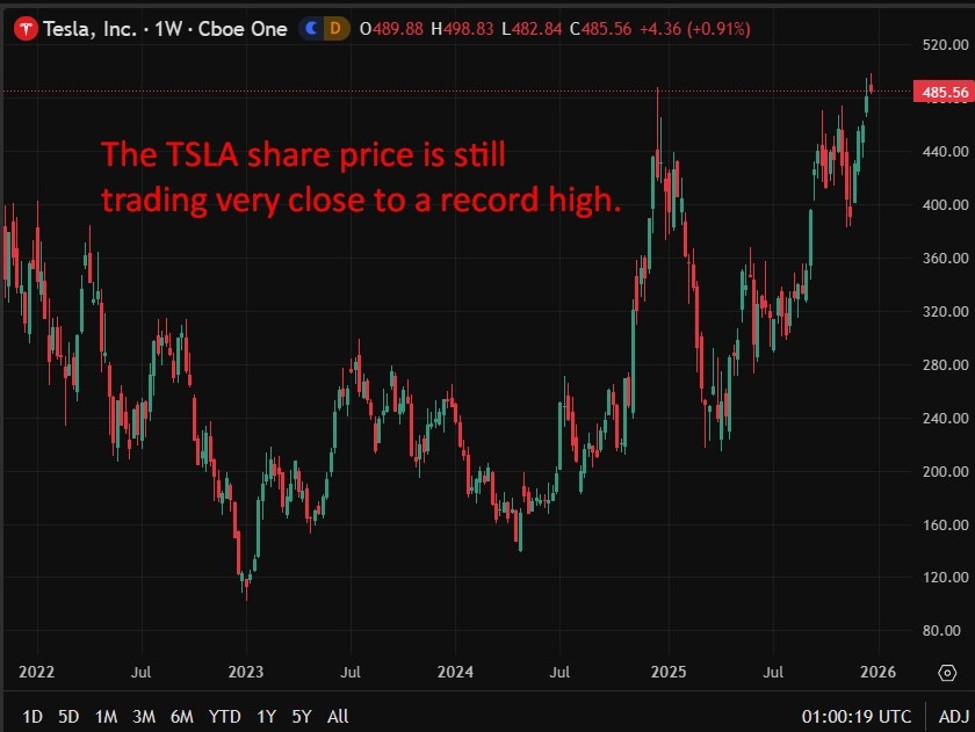
SummaryTesla UK sales fell sharply in November, echoing wider European declinesGermany and France saw particularly steep drops in Tesla registrationsCompetition from Chinese automakers, especially BYD, intensifiedUK EV buyers increasingly favour plug-in hybrids over full BEVsThe data point to structural challenges rather than a one-off dipSales of Tesla continued to weaken across Europe in November, with the UK joining a broader regional slowdown that has highlighted growing competitive pressures and shifting consumer preferences in the electric-vehicle market.In the UK, Tesla registrations, a proxy for sales, fell sharply year on year. Preliminary data from industry tracker New AutoMotive showed registrations down 19% to around 3,800 vehicles, while figures from the Society of Motor Manufacturers and Traders pointed to a similar decline of more than 17%. While the two datasets differ slightly due to methodology, both underscore a clear loss of momentum for Tesla in one of Europe’s most important EV markets.The UK weakness mirrors an even steeper downturn elsewhere in Europe:Tesla sales reportedly fell around 20% in Germany in November and slumped by close to 60% in France and several other European markets, declines that were only partly offset by stronger demand in Norway. Taken together, the figures suggest Tesla’s European performance is under sustained pressure rather than experiencing a one-off monthly setback.A key factor has been intensifying competition, particularly from Chinese manufacturers. In the UK, registrations of BYD more than tripled in November, reflecting the growing appeal of lower-priced electric and plug-in hybrid models. British consumers now have access to more than 150 electric vehicle models, sharply reducing Tesla’s first-mover advantage.Tesla has also been grappling with an aging product lineup in Europe, even as it begins rolling out updated versions of its best-selling Model Y. At the same time, broader brand sentiment has softened in recent months, adding another headwind in an already crowded market.The wider UK auto market also showed signs of cooling. Total new car registrations declined in November, while battery-electric vehicle sales edged lower. In contrast, plug-in hybrid registrations rose, suggesting some consumers are opting for transitional technologies rather than committing fully to battery-electric vehicles amid concerns over costs, incentives and charging infrastructure.Taken together, the November data reinforce the view that Europe and the UK, has become a tougher operating environment for Tesla. Slowing demand growth, fierce competition from Chinese rivals and a more discerning consumer base are increasingly weighing on sales performance across the region. This article was written by Eamonn Sheridan at investinglive.com. 🔗 Source 💡 DMK Insight Tesla’s UK sales slump isn’t just a blip—it’s a warning sign for traders. With November showing a sharp decline, particularly in Germany and France, this trend reflects broader European market challenges. The rise of competition from Chinese brands like BYD is reshaping consumer preferences, pushing UK buyers towards plug-in hybrids instead of full battery electric vehicles (BEVs). This shift suggests that Tesla might face structural challenges that could impact its market share and profitability in the long run. For traders, this means keeping an eye on Tesla’s stock performance and potential support levels, especially if the trend continues into the next quarter. Watch for key price levels around recent lows, as breaking these could trigger further selling pressure. On the flip side, if Tesla can pivot effectively and address these competitive pressures, there might be hidden opportunities for a rebound. But for now, the immediate focus should be on how these sales figures influence Tesla’s upcoming earnings report and investor sentiment in the EV sector. 📮 Takeaway Monitor Tesla’s stock closely; a break below recent support levels could signal further declines, especially with ongoing competition from BYD.
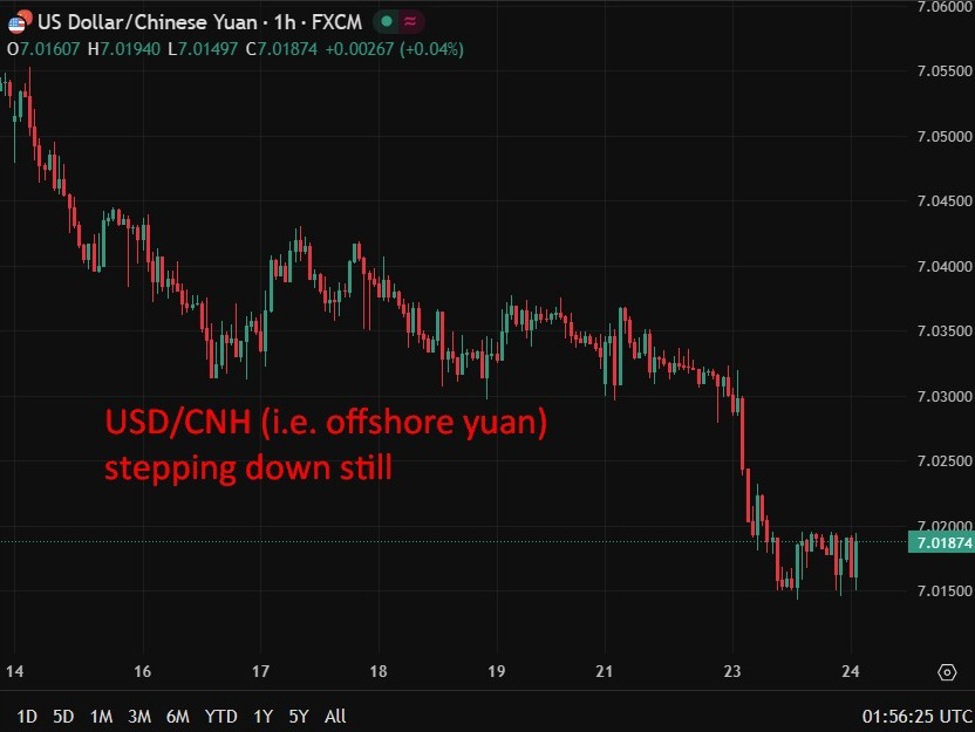
PBOC sets USD/ CNY reference rate for today at 7.0471 (vs. estimate at 7.0240)
The People’s Bank of China (PBOC), China’s central bank, is responsible for setting the daily midpoint of the yuan (also known as renminbi or RMB). The PBOC follows a managed floating exchange rate system that allows the value of the yuan to fluctuate within a certain range, called a “band,” around a central reference rate, or “midpoint.” It’s currently at +/- 2%.The Bank injected CNY 26bn via 7-day reverse repos at an unchanged rate of 1.4%.Earlier:PBOC is expected to set the USD/CNY reference rate at 7.0240 – Reuters estimateThe daily fixing of this mid-rate is often interpreted as a policy signal rather than just a technical reference point. A higher-than-expected USD/CNY midpoint is typically read as a sign the PBOC is leaning against CNY appreciation pressure, like today.–In trading yesterday the offshore yuan (CNH) strengthened past 7.02 per dollar, to its strongest level since October 2024.As Wednesday’s USD/CNY trade opened the pair moved to the lowest since September 30 of 2024. In other FX news:Cable has moved to its highest in 3 months through 1.3530EUR/USD has moved to its highest in 3 months also, above 1.1805 Yen is also pushing stronger following the data and BoJ earlier:Bank of Japan Services Producer Price Index (November) +2.7% y/y (expected & prior 2.7%)Japan policymakers flag inflation persistence and asset-price risks in October BoJ minutesYen is having a good week. As I posted earleir:Remarks from Atsushi Mimura warning about excessive and one-sided currency moves prompted a reassessment of short-yen positions, reinforcing the sense that authorities are increasingly sensitive to renewed volatility. This message was later echoed by Finance Minister Satsuki Katayama, adding further weight to the view that sharp or disorderly moves would not be ignored.Japan officials’ warnings have continued to bolster the yen, USD/JPY under 156.50 This article was written by Eamonn Sheridan at investinglive.com. 🔗 Source 💡 DMK Insight The PBOC’s control over the yuan’s midpoint is crucial for traders navigating forex markets right now. With the yuan’s value fluctuating within a managed band, any shifts in PBOC policy can lead to significant volatility. Traders should keep an eye on the central bank’s announcements, as changes could impact not just the yuan but also correlated currencies like the Japanese yen and Australian dollar, which often react to shifts in Chinese economic policy. If the PBOC tightens its band, it could signal a stronger yuan, affecting export competitiveness and potentially leading to broader market implications. Watch for key levels around the current midpoint; a break could trigger a cascade of trading activity across the forex landscape. Here’s the thing: while mainstream coverage may focus solely on the yuan’s immediate value, the underlying economic indicators—like trade balances and inflation rates—are just as critical. If you’re trading in this environment, monitor the PBOC’s next moves closely, especially any hints at policy shifts that could affect the yuan’s band. 📮 Takeaway Keep an eye on the PBOC’s announcements regarding the yuan’s midpoint; any changes could trigger significant volatility in forex markets, especially with correlated currencies.
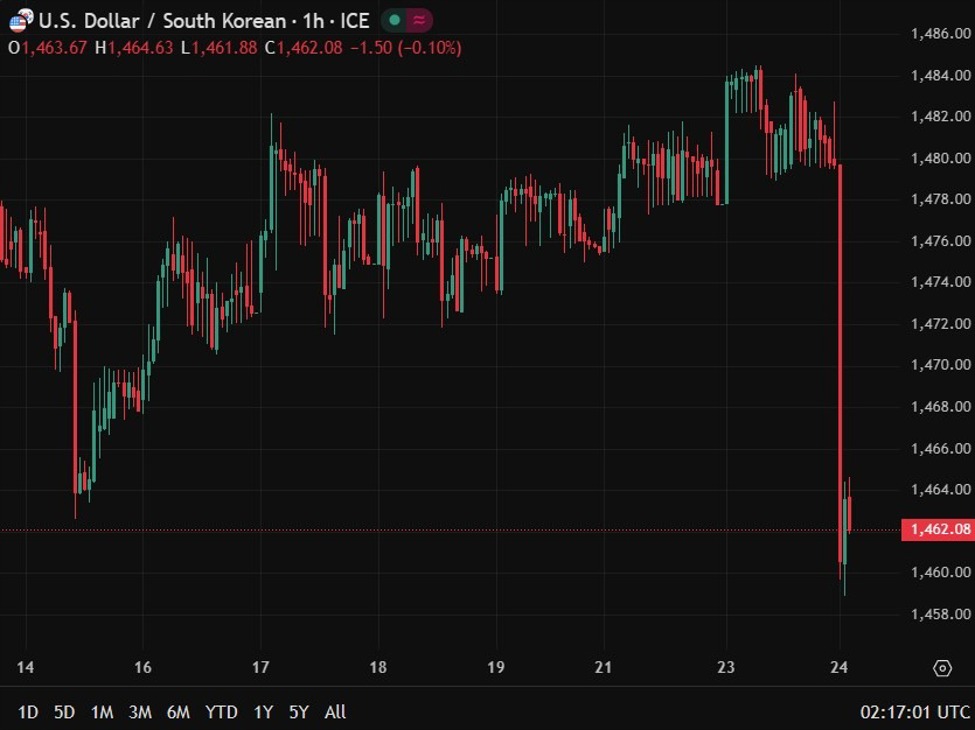
KRW up: South Korea NPS activates strategic FX hedging to curb won weakness and volatility
SummaryBank of Korea says NPS has activated strategic FX hedgingThe move aims to manage FX risk and curb won volatilityHedging could generate dollar selling and support the wonAuthorities frame it as risk management, not interventionSignals lower tolerance for prolonged currency weakness-South Korea’s central bank, the Bank of Korea, said the country’s National Pension Service (NPS) has activated a new framework for strategic foreign-exchange hedging, marking an important shift in how authorities are seeking to stabilise the won amid persistent currency volatility.The NPS, one of the world’s largest pension funds with extensive overseas investments, has traditionally run a relatively low level of currency hedging, allowing foreign-exchange moves to flow through to returns. Under the new approach, the fund can activate FX hedging in a more systematic and strategic manner, particularly during periods of heightened market stress or excessive exchange-rate swings.The move comes as the won has faced sustained depreciation pressure, driven by a strong U.S. dollar, global risk aversion and concerns over capital outflows. A weaker currency raises imported inflation risks and complicates monetary policy, increasing the sensitivity of authorities to sharp or disorderly FX moves. By activating strategic hedging, the NPS effectively becomes a source of dollar selling and won demand, helping to counter downward pressure on the currency.Crucially, the mechanism is designed to operate as a risk-management tool rather than a form of direct FX intervention. Hedging decisions are intended to be rules-based and aligned with portfolio management objectives, rather than day-to-day market targeting. Even so, given the sheer scale of the NPS’s overseas assets, its hedging activity has the potential to influence FX market dynamics in a meaningful way.The Bank of Korea has framed the initiative as part of a broader effort to strengthen financial stability without relying solely on interest-rate policy or overt market intervention. It also allows authorities to lean on domestic institutional flows to smooth volatility, while preserving foreign-exchange reserves and avoiding the political sensitivities associated with direct intervention.For markets, the activation of strategic hedging adds an important new layer to the won’s policy backdrop. While it does not imply a specific exchange-rate target, it signals a lower tolerance for persistent weakness and outsized volatility. It may also act as a deterrent to speculative positioning against the won, particularly during periods of global stress.Overall, the move underscores South Korea’s increasingly pragmatic approach to FX management, blending monetary policy, institutional balance-sheet tools and communication to contain volatility while maintaining policy flexibility. In other moves, South Korea unveiled a set of tax measures aimed at encouraging capital to flow back onshore and reducing currency-related risks for households. Authorities said retail investors will be exempt from capital gains taxes when selling overseas stocks if the proceeds are reinvested domestically. The government will also increase tax incentives for companies that repatriate earnings from abroad, while offering new tax benefits for retail investors who hedge foreign-exchange exposure. Together, the measures are designed to support domestic investment, ease pressure on the won by dampening outbound capital flows, and improve resilience to FX volatility without resorting to more direct market intervention. This article was written by Eamonn Sheridan at investinglive.com. 🔗 Source 💡 DMK Insight The Bank of Korea’s activation of strategic FX hedging is a game-changer for the won’s stability. By managing FX risk and curbing volatility, this move could lead to increased dollar selling, which might support the won in the short term. Traders should note that this isn’t just a routine measure; it signals a lower tolerance for prolonged currency weakness. Given the current economic climate, where central banks globally are tightening, South Korea’s proactive stance could influence other Asian currencies as well. If the won strengthens, it could impact export competitiveness, so keep an eye on related assets like KOSPI and export-heavy stocks. Watch for any shifts in dollar-won levels, particularly if the won approaches significant support or resistance levels in the coming days. This could be a pivotal moment for traders looking to capitalize on currency fluctuations and related market movements. 📮 Takeaway Monitor dollar-won levels closely; a strengthening won could impact export stocks and related markets significantly.
Washington delays semiconductor tariffs as it seeks China trade truce
SummaryU.S. to impose tariffs on Chinese legacy chips, but only from June 2027Decision follows a year-long Section 301 investigation launched under BidenDelay preserves leverage while easing near-term trade tensions with ChinaMove coincides with negotiations over rare earths and tech export controlsBroader Section 232 chip tariffs remain possible but not imminentThe United States has opted to delay the imposition of new tariffs on Chinese semiconductor imports until mid-2027, signalling a tactical effort to manage trade tensions with Beijing even as Washington keeps the option of tougher action firmly on the table. News via Reuters ICYMI. The Office of the United States Trade Representative said it would move ahead with tariffs on Chinese “legacy” or older-generation chips following a year-long Section 301 investigation, but that the measures would not take effect until June 2027. The tariff rate itself will be announced at least 30 days before implementation, preserving flexibility for future administrations.The investigation into Chinese chip exports was launched under former President Joe Biden, which concluded that Beijing’s industrial policy amounted to an unreasonable effort to dominate the global semiconductor industry and posed a burden on U.S. commerce. The current administration under Donald Trump has now chosen to delay enforcement, a move widely seen as aimed at stabilising relations with China amid sensitive negotiations over technology and critical minerals.China responded by opposing the planned tariffs, warning that politicising trade and technology would disrupt global supply chains and ultimately prove counterproductive. Beijing also reiterated that it would take steps to defend its interests if tariffs were imposed.The decision to defer action comes as Washington seeks to ease pressure points in the broader U.S.–China trade relationship. China has recently imposed export curbs on rare earth metals, a key input for global technology manufacturing. In parallel talks, the U.S. has delayed restrictions on technology exports to certain Chinese firms and launched a review that could allow limited shipments of advanced chips, including some from Nvidia, to resume, despite resistance from U.S. lawmakers concerned about national security risks.The semiconductor sector is also watching a separate and potentially far more sweeping investigation under Section 232, which could eventually lead to tariffs on chips and chip-containing products from multiple countries. For now, U.S. officials have suggested that any such action is unlikely in the near term.Taken together, the delay underscores a calibrated approach: maintaining leverage over China’s chip sector while prioritising short-term trade stability and supply-chain resilience. —For U.S. technology equities, the decision to delay China chip tariffs until 2027 removes a near-term policy overhang, particularly for semiconductor names with exposure to complex global supply chains. Shares of Nvidia stand out in this context. While Nvidia’s most advanced AI chips remain tightly restricted, the administration’s willingness to review potential shipments of lower-tier processors to China, alongside the tariff delay, suggests a more pragmatic approach that prioritises trade stability and revenue continuity over immediate escalation.For Nvidia, China remains a strategically important market even under export controls, and clarity that new tariffs will not land imminently helps reduce uncertainty around demand, inventory planning and pricing. More broadly, the move is supportive for U.S. tech hardware firms and semiconductor suppliers, which have been navigating a patchwork of export controls, tariffs and geopolitical risks. By pushing tariff action into the next administration cycle, Washington effectively lowers the probability of sudden supply-chain disruption or retaliatory measures in the near term.Equity markets are likely to read the delay as modestly constructive for the sector, particularly for mega-cap technology stocks where earnings visibility and global sales exposure are key valuation drivers. However, the longer-term risk remains intact: tariffs have not been cancelled, and policy uncertainty beyond 2026 will continue to cap valuation multiples for chipmakers with meaningful China exposure. This article was written by Eamonn Sheridan at investinglive.com. 🔗 Source 💡 DMK Insight The U.S. delaying tariffs on Chinese legacy chips until June 2027 is a strategic move that could impact tech stocks and semiconductor prices in the interim. By postponing these tariffs, the Biden administration is likely trying to maintain a balance in trade relations while negotiating other critical issues like rare earths and tech export controls. This delay could provide a temporary boost to companies reliant on these chips, as the immediate cost pressures are alleviated. Traders should keep an eye on semiconductor stocks, particularly those heavily exposed to Chinese supply chains, as they might see short-term gains. However, the looming threat of broader Section 232 tariffs could create volatility in the long run, especially if negotiations falter. Watch for any updates on trade talks or shifts in policy that could signal a change in this dynamic, as they could lead to rapid price movements in related assets like tech ETFs or semiconductor indices. 📮 Takeaway Monitor semiconductor stocks closely for short-term gains, but stay alert for any shifts in trade policy that could trigger volatility.
Nomura flags Asia policy split as Fed seen cutting twice in 2026
SummaryNomura sees Asia’s easing cycle largely complete despite low inflationA north–south monetary policy divide is emerging across the regionKorea, Australia, New Zealand and Malaysia seen holding or hiking ratesResidual rate cuts expected in India, ASEAN economies and ChinaRisks skewed to global growth, trade tensions and AI-related volatilityAsian monetary policy is entering a more fragmented phase, with a growing divide emerging between northern and southern economies, according to Nomura.In a recent note, Nomura argues that the easing cycle across much of Asia is now largely complete, despite inflation remaining relatively subdued in many economies. The bank says improving growth dynamics, policy rates close to neutral and a desire among central banks to preserve policy ammunition have encouraged a more cautious stance. Financial stability concerns, particularly rising housing prices, are also limiting the scope for further rate cuts in parts of the region.This cautious posture contrasts with expectations in the United States, where Nomura’s U.S. economics team continues to forecast two Federal Reserve rate cuts in 2026. As a result, the bank suggests Asia could increasingly decouple on the hawkish side relative to the U.S.Within the region, Nomura identifies a policy split. In South Korea, New Zealand, Australia and Malaysia Nomura says the easing cycle is seen as over, reflecting stronger growth momentum. Nomura expects Bank Negara Malaysia to raise rates in the fourth quarter of 2026, pre-empting a build-up in financial stability risks, while the Reserve Bank of New Zealand is forecast to resume rate hikes in 2027.Japan stands somewhat apart. Nomura expects just one more rate hike from the Bank of Japan in December 2025, followed by a prolonged pause through 2026 as core inflation gradually slips back below the 2% target.By contrast, other Asian economies are expected to retain an easing bias. Nomura forecasts additional rate cuts in India, Thailand, Indonesia and the Philippines, citing a combination of softer growth and muted inflation pressures. In China, the bank expects a modest 10-basis-point policy rate cut, but sees fiscal policy doing more of the heavy lifting from around spring 2026, particularly via increased lending by policy banks to local governments.Nomura highlights faster global growth and stronger Chinese domestic demand as key upside risks, while warning that weaker U.S. demand, renewed trade tensions or a sharp correction in AI-related investment could derail the outlook. This article was written by Eamonn Sheridan at investinglive.com. 🔗 Source 💡 DMK Insight Nomura’s take on Asia’s monetary policy is a game-changer for traders: it’s signaling a shift. With Korea, Australia, New Zealand, and Malaysia poised to either hold or hike rates, traders should brace for potential volatility in those currencies. This could lead to a stronger AUD and NZD, especially if inflation remains subdued. On the flip side, countries like India and China may face residual rate cuts, which could weaken their currencies against the rising ones. The divergence in monetary policy could create trading opportunities, particularly in pairs involving AUD, NZD, and their Asian counterparts. Keep an eye on economic indicators from these regions, as they will be crucial in shaping market sentiment. Watch for any surprises in inflation data or central bank statements, as these could trigger sharp moves in the forex markets. The next few weeks will be critical, especially as global growth risks and trade tensions loom large. Traders should monitor the AUD/USD and NZD/USD pairs closely for breakout levels, as a shift in sentiment could lead to significant price action. 📮 Takeaway Watch for potential rate hikes in Australia and New Zealand, as they could strengthen AUD and NZD against weaker Asian currencies in the coming weeks.
investingLive Asia-Pacific FX news wrap: Gold cracked above US$4500, but then gave it back
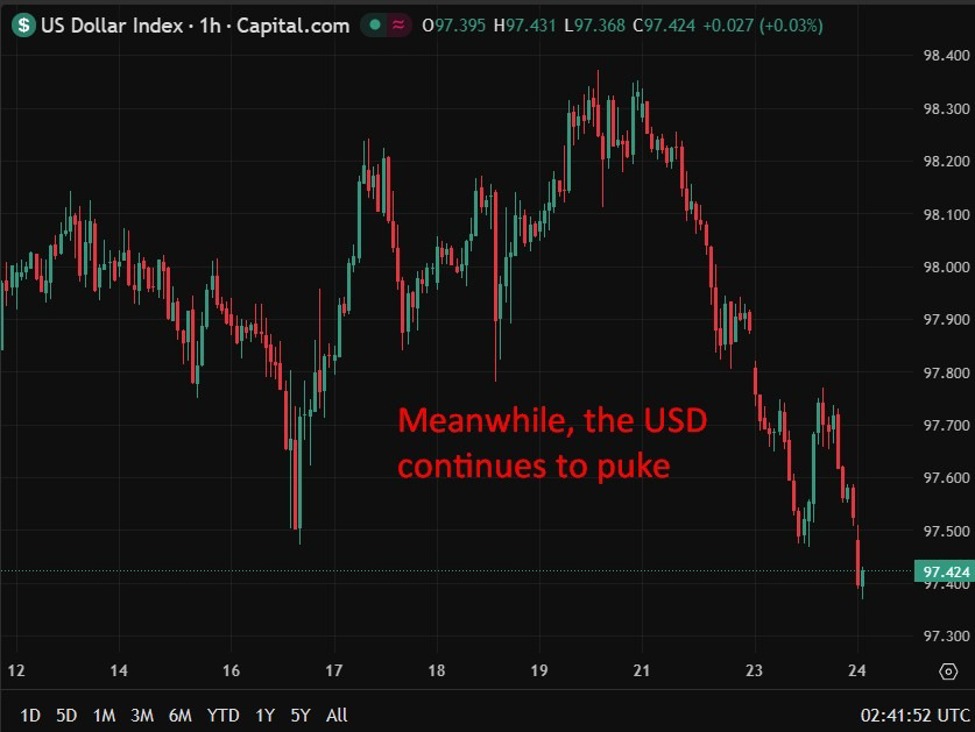
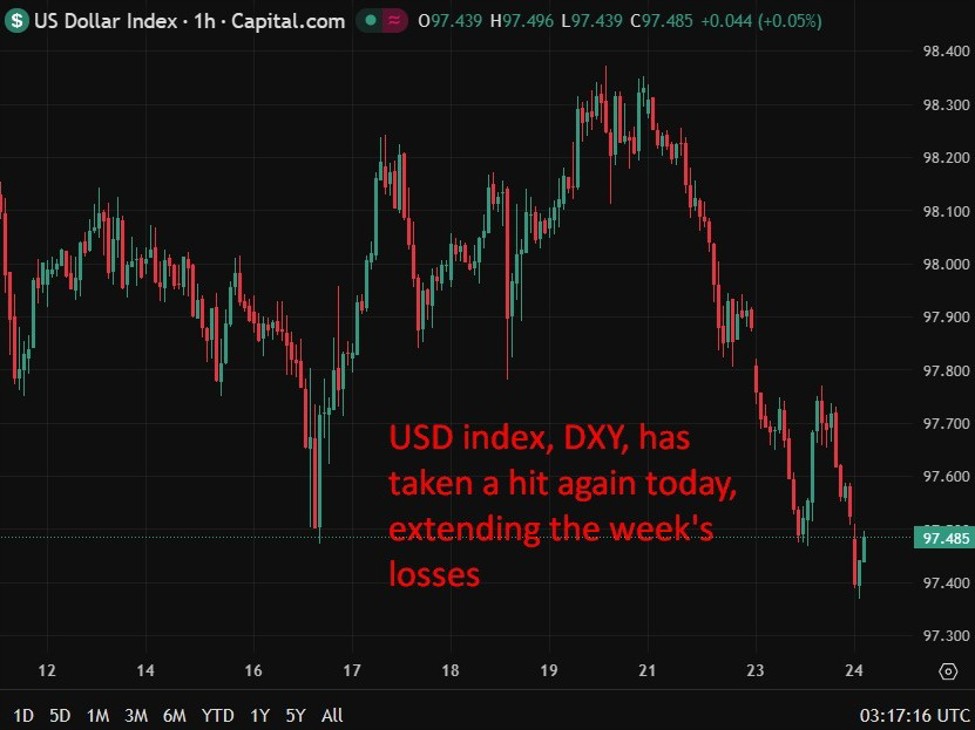
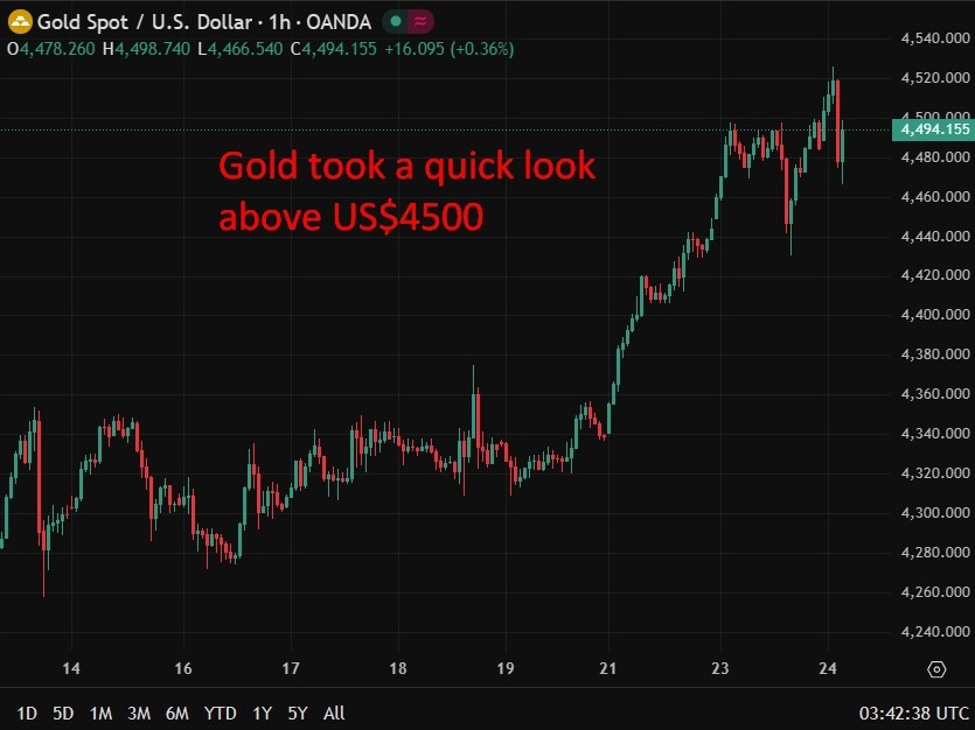
Nomura flags Asia policy split as Fed seen cutting twice in 2026Washington delays semiconductor tariffs as it seeks China trade truceKRW up: South Korea NPS activates strategic FX hedging to curb won weakness and volatilityPBOC sets USD/ CNY reference rate for today at 7.0471 (vs. estimate at 7.0240)ICYMI – Tesla sales plummet in UK and Europe as EV market turns hostileJapan policymakers flag inflation persistence and asset-price risks in October BoJ minutesBank of Japan Services Producer Price Index (November) +2.7% y/y (expected & prior 2.7%)ICYMI – Rising yields force Japan to budget for higher debt-servicing costsOil: Private survey of inventory shows a headline crude oil build vs. draw expectedAsia session summaryJapan’s November services PPI printed as expected at an elevated 2.7% y/yBOJ October minutes landed but were largely overlooked after December’s rate hikeBroad USD weakness lifted G10 FX, with JPY, AUD and KRW outperformingAPAC equities traded mixed in thin pre-holiday conditionsGold and silver extended gains, with silver breaking above US$72Data and policy signals from Japan were the early focus in Asia. Japan’s November Corporate Service Price Index , the services-sector PPI, printed in line with expectations at a still-elevated 2.7% year-on-year, reinforcing the view that underlying service-sector price pressures remain firm. The Bank of Japan also released minutes from its October policy meeting, though these attracted little attention given they pre-dated December’s far more consequential decision to lift the short-term policy rate to its highest level in around 30 years.In FX markets, broad U.S. dollar weakness dominated price action. The dollar index remained on the back foot in holiday-thinned trade, extending losses seen earlier in the week and pushing several G10 currencies to session highs. The yen continued to strengthen, supported by recent official jawboning that reinforced authorities’ discomfort with excessive JPY weakness. The Australian dollar also advanced, while the euro and sterling pushed up toward three-month highs.The standout move in Asia FX came from South Korea, where the won strengthened sharply after reports that the country’s pension fund had activated strategic foreign-exchange hedging measures — a development seen as adding institutional support for the currency.Asian equity markets were mixed and largely range-bound, reflecting light volumes as traders wind down ahead of the Christmas period. Japan’s Nikkei 225 posted modest gains, while Hong Kong’s Hang Seng and the Shanghai Composite were little changed. U.S. equity futures traded quietly overnight, hovering around flat in narrow ranges.In commodities, precious metals extended their recent surge. Gold briefly popped above the US$4,500 level before easing back below the psychological threshold, while silver pushed decisively higher again, trading above US$72 and outperforming on the session. This article was written by Eamonn Sheridan at investinglive.com. 🔗 Source 💡 DMK Insight Nomura’s warning about a policy split in Asia is a big deal for traders right now. With the Fed expected to cut rates twice in 2026, this could shift capital flows significantly. The South Korean won’s recent strengthening, driven by the National Pension Service’s strategic FX hedging, indicates a proactive approach to combat volatility. Traders should keep an eye on the USD/CNY reference rate set by the PBOC at 7.0471, which is higher than the market estimate of 7.0240. This discrepancy suggests potential weakness in the yuan, which could ripple through Asian markets and affect export-driven economies. While the immediate focus is on the won and yuan, the broader implications of U.S.-China trade relations and semiconductor tariffs could create volatility across tech stocks and commodities. Watch for how these geopolitical tensions evolve, as they could lead to sudden market shifts. The key levels to monitor are the USD/CNY around 7.05 and the won’s performance against the dollar, as these will signal broader market sentiment and potential trading opportunities. 📮 Takeaway Keep an eye on the USD/CNY at 7.05 and the won’s strength; these levels will guide your trading strategy amid shifting Fed policies and geopolitical tensions.
The inflation mirage that will take shape next year
So, it’s been about eight months already since “Liberation Day”. How time flies. Yet, we’re yet to see a significant bump to the overall inflation outlook in the US. Yes, higher prices have come but it hasn’t quite translated too strongly to the overall narrative.And as we look towards 2026, how will all of this change and what will be the inflation story for the year ahead?The thing to remember about “Liberation Day” is that higher tariffs did not have an instant impact. It took time to filter through to prices and even until today, we’re still yet to see the full extent of how those tariffs have driven up consumer prices.Core goods inflation is the one thing that’s been slowly showing evidence of that. But otherwise, the overall inflation story is one that has been tamer than anticipated especially for all the fears surrounding Trump’s tariffs before April this year.Come next year, be wary of the inflation mirage. No, the consumer price index (CPI) isn’t cooling in a meaningful way. Inflation isn’t going away. It’s just the fact that higher prices are here to stay and that we’re reaching a new equilibrium level in terms of where prices should be. That especially in the second half of next year.As mentioned above, Trump’s tariffs did not have an instant impact. It’s taking well over six months for things to filter through and that’s the important thing to take note for market players.All of this is going to impact the base effect calculation in how we derive the CPI next year, especially in the second half of the year onwards.That in turn could see inflation data and the PCE as well drop significantly during the second half of 2026. And if the Fed hasn’t already become politically corrupt by then, it could give them an easy way out in appeasing Trump to deliver more rate cuts.Long story short, just be wary of the impact of base effects when reading into the CPI data in the second half of next year. That will account for the impact of Trump’s tariffs that have slowly been filtering through to the economy over the last few months.In other words, the year-on-year reading might show a cooling in terms of inflation. However, that’s just the base effect talking. As such, the monthly data will be the more important metric to scrutinise when the time comes.Just think of it this way, tariffs caused the price of a watch to increase from $20 to $25 this year. That’s a 25% bump in “inflation”. Come the same period next year, the price might still be at $25 and the “inflation” metric will show 0% instead.Why is all of this important?It plays into the Fed outlook of course. How will the central bank respond to all of this?If pushing for rate cuts in the first half of the year proves difficult, this is one avenue that they could point to in making sure that their policy fits with Trump’s agenda. That as they continue to strive towards a neutral rate of what most people seem to think it’s at around 3%.So, should and would the Fed look through the base effects and stick to its guns on policy? Or will the new Fed chair deliver on Trump’s agenda and use this as a key selling point?In any case, the reality of the situation will remain that lower inflation does not mean lower prices. That’s the reality of the world we’ve been living in for the past decades. This article was written by Justin Low at investinglive.com. 🔗 Source 💡 DMK Insight Inflation’s slow burn is raising eyebrows among traders, especially with the Fed’s next moves looming. Despite higher prices, the overall inflation narrative in the US hasn’t shifted significantly, which could lead to a more cautious approach from the Fed. This stagnation might impact interest rate expectations, influencing both forex and crypto markets. If inflation data continues to underwhelm, we could see the dollar weaken, potentially benefiting assets like Bitcoin and Ethereum as investors seek alternatives. Keep an eye on the upcoming economic indicators; a surprise uptick in inflation could shift sentiment dramatically, leading to volatility across the board. On the flip side, if inflation remains tepid, it might embolden the Fed to maintain a dovish stance longer than expected, which could keep risk assets buoyant. Traders should monitor key levels in the dollar index and crypto markets, particularly the $30,000 mark for Bitcoin and $2,000 for Ethereum, as these could dictate short-term trading strategies. Watch for any shifts in consumer sentiment or spending data, as these could provide clues to the inflation trajectory and subsequent market reactions. 📮 Takeaway Watch for inflation data and key levels like $30,000 for Bitcoin and $2,000 for Ethereum; they could signal significant market moves.

Sometimes brains are a detriment in investing
I don’t want to sound mean-spirited but there is a lesson here that’s worth highlighting.If you’ve listened to Cathie Wood extensively — and I certainly have — then you know what I’m talking about. She’s certainly not stupid but probably won’t strike you as the kind of person that should be running what was once the world’s largest actively-managed ETF and currently hold more than $7 billion.Last week’s example is particularly cringe-worthy as her ARK Innovation ETF invests in technology and she’s supposedly a thought-leader in what’s coming next.In short, she fell for some badly-generated AI slop on her twitter page.That’s some ‘grandma-on-Facebook’ level stuff.Now, whatever, it’s a mistake. In the future we’re all going to fall for AI slop because it’s getting so good.But she followed that up by touting satellites with localized AI compute, a $1 million target for bitcoin and and a $2600 target for Tesla shares. It’s the same thing she’s been doing for years.The thing is, it worked, at least for awhile. She became a celebrity in the post-covid investing landscape as her fund rose 10x. The problem was that the fund was very small when it ran up and then money piled in and nearly everyone who bought in 2021-22 lost money.Her star dimmed in the latest tech boom when she completely whiffed on AI. She sold out of Nvidia early and hasn’t been able to generate alpha in a bustling tech market, though the most-recent returns are better.Ok, so I promised a lesson here and it’s a simple one. Sometimes it’s better to be dumb.Overthinking is one of the classic pitfalls of traders. The #1 asset you can have is conviction and it’s simply easier to maintain if you don’t question things. Most of the money in the fund was made in Tesla and Elon Musk is the greatest salesman in history and that’s all you ever really needed to know. Sure, repeat his talking points about whatever and go ahead and believe them.Now many people would look at his track record of predictions and draw some conclusions but the stock hit a record high this week. Just buy, close your eyes and believe.The thing is, it’s just easier to believe when you can’t tell reality from AI slop. We’re in a weird world where questioning valuations and business models doesn’t make you money.There’s nothing new under the sun, in 1511, Erasmus said:“In a world of madmen, the sane man must appear mad.”Now one option is to kill your braincells:If you don’t like the sound of that, the lesson here is that you need to find investments or strategies that you believe in and don’t overcomplicate them. The money really is in the holding. Anyway, after all that meanness to Cathie Wood, I better do something nice or Santa will put me on the wrong list; so here are her top-10 holdings:TSLA – TESLA INCROKU – ROKU INCCRSP – CRISPR THERAPEUTICS AGCOIN – COINBASE GLOBAL INC -CLASS ASHOP – SHOPIFY INC – CLASS AHOOD – ROBINHOOD MARKETS INC – ATEM – TEMPUS AI INCPLTR – PALANTIR TECHNOLOGIES INC-ARBLX – ROBLOX CORP -CLASS AAMD – ADVANCED MICRO DEVICES This article was written by Adam Button at investinglive.com. 🔗 Source

How to Spot Unfair Prop Firm Practices Before You Sign Up
Prop Trading Challenges for Newbies: How to Spot Unfair Rules and Platform Risk Before You PayIf you are taking prop trading challenges, you are not only trading the market. You are also trading the prop firm’s rules, technology, and support quality.Two fresh examples show why this matters:A major futures prop firm faced trader backlash after repeated platform outages and trading anomalies that reportedly left some traders unable to open or close positions. The CEO publicly acknowledged the issue and referenced a January deadline to make things right.Another futures prop firm faced a wave of complaints after a reported retroactive rule change that affected things like trade holding time and profit split, with traders claiming trades that were valid under the old rules got penalized under the new ones. This is like the court telliing you, you are now charged for doing something legal yesterday, after changing the rule today. Talk about absurd, right?If you want the original reporting, here are the two Finance Magnates articles:Topstep Faces Prop Traders’ Wrath due to Repeated Outages, CEO Sets January Deadline for a FixProp Firm FundingTicks Faces Massive Backlash after “Retroactive Rule Change”Below is a newbie-friendly guide to protect yourself from the 2 biggest non-market risks in prop trading: platform failures and rule surprises.First, a quick glossary (so the rest makes sense)Challenge / evaluation: The paid phase where you must hit profit targets while obeying risk rules.Funded account: The phase after passing the evaluation (some firms call it funded, some call it “performance” or “pro”).Profit split: How much of your profits you keep (example: 80% to trader, 20% to firm).Drawdown: The max loss allowed. This is usually what fails accounts, not the profit target.Scalping: Very short-term trading aiming for small moves, often held seconds to minutes.Minimum hold time: A rule that forces you to keep trades open at least X time (example: one minute). This directly impacts scalpers.The 2 hidden risks that can blow a challenge (even if your strategy is good)Risk 1: Platform outages and execution problemsIf a platform freezes, rejects orders, or disconnects at the wrong time, it can do real damage:you cannot enteryou cannot exityou cannot manage riskyour account can hit drawdown even if your trade idea was fineFinance Magnates reported that traders complained about being unable to open or close positions during outages on Topstep’s only platform, TopstepX, and some traders claimed accounts were blown due to those issues.Important detail for beginners: you can have the best setup in the world, but if you cannot execute, your edge does not matter.What to look for before buying a challenge:Does the firm rely on a single platform only?Do they have a public track record of incidents and how they handle them?When incidents happen, do they acknowledge quickly and clearly?Do they have a consistent policy for disputes tied to outages?In the Topstep story, Finance Magnates noted that Trustpilot scores fell and that the company responded to only a small portion of negative reviews, which matters because it is one proxy for how seriously a firm treats support and reputation.Risk 2: Rule changes, especially retroactive onesRules can change in any business. The key question is how they change, and whether they apply to accounts that were opened under earlier terms.Finance Magnates reported that FundingTicks faced backlash after reportedly changing rules retroactively, including a minimum one-minute hold time and a reduction in profit split. Why this is a big deal:If rules are applied retroactively, trades that were valid yesterday can be punished today.Your past trading can be re-judged under new constraints.Your expected payouts can change even if you did nothing “wrong” under the rules you agreed to.In that same report, Finance Magnates described traders claiming that accounts were breached or profits reduced if trades violated the current rules, even if those trades occurred before the change.For newbies, the simple takeaway is this:Your biggest risk is not always your strategy.Sometimes the risk is whether the goalposts move after you already started running.A simple “Prop Firm Due Diligence Checklist” for challenge takersUse this before you pay for any evaluation.A) Technology and uptime checksDo they offer more than one trading platform, or is it a single point of failure?Do they post incident updates (Discord, status page, email updates)?Do traders report frequent order issues, disconnects, or slippage spikes?Do they have a clear dispute process when platform issues occur?Finance Magnates reported trader complaints of not being able to open or close positions during outages in the Topstep situation.B) Rule stability checksDo they clearly state when new rules take effect?Do they explicitly say whether rules apply to existing accounts?Do they change core rules often (hold times, payout rules, profit split, withdrawal caps)?Do they provide a change log or versioning, or do you have to “discover” changes?In the FundingTicks case, the report listed multiple rule changes including the one-minute minimum hold period and a change in profit split compared with earlier terms. C) Incentives check (this matters more than most people think)Prop firms make money in different ways. Some earn mostly from:challenge feesresets and retriesdata, partnerships, and platform economicssuccessful traders who scaleHere is my personal note on how I look at it: I pay close attention to which firms actually provide a real path to trading on live accounts, or at least use some form of risk mirroring (where trades may be replicated or risk-managed beyond a purely simulated environment), versus firms that appear to keep traders in simulated environments indefinitely. I also watch which firms seem genuinely interested in developing real traders, not just collecting reset revenues.This does not require you to “know the inside story.” You can often infer a lot from:how transparent they are about account progressionhow consistent payouts are handledhow they treat traders during problemshow often rules shift in ways that reduce payoutsWhat to do if a platform outage happens during your challengeThis is practical and important.Screenshot and screen recordinclude timestampscapture the error, rejected orders, disconnect messages, and your open positionsExport your trade logsfills, order history, and account statementsSave the firm’s announcementsDiscord messages, status updates, emailsContact support

HSBC vs Barclays: Which global bank is better positioned for 2026?
HSBC Holdings PLC (HSBC – Free Report) and Barclays PLC (BCS – Free Report) are two global banks based in London that have been restructuring their businesses to improve operating efficiency and focus on core operations. 🔗 Source 💡 DMK Insight HSBC and Barclays are streamlining operations, and here’s why that matters for traders: Both banks are focusing on core operations, which could signal a shift in their risk profiles. For traders, this restructuring might affect how these stocks perform in the near term, especially if cost-cutting measures lead to improved margins. Keep an eye on their quarterly earnings reports; if they show significant improvements in efficiency, it could boost investor confidence and drive stock prices higher. On the flip side, if these changes lead to disruptions in service or customer dissatisfaction, we might see a negative reaction in the market. Watch for key technical levels in both stocks; if HSBC can break above its recent resistance, it could indicate a bullish trend. Similarly, Barclays’ performance will be crucial to monitor, especially if it approaches its support levels. The broader banking sector may also react to these changes, so keep an eye on indices like the FTSE 100 for potential ripple effects. 📮 Takeaway Monitor HSBC and Barclays’ upcoming earnings reports for signs of improved efficiency; key resistance and support levels will be critical for trading decisions.