Bitcoin
  Ethereum
  Tether
  XRP
XRP  BNB
BNB  USDC
USDC  Solana
  TRON
TRON  Lido Staked Ether
  Dogecoin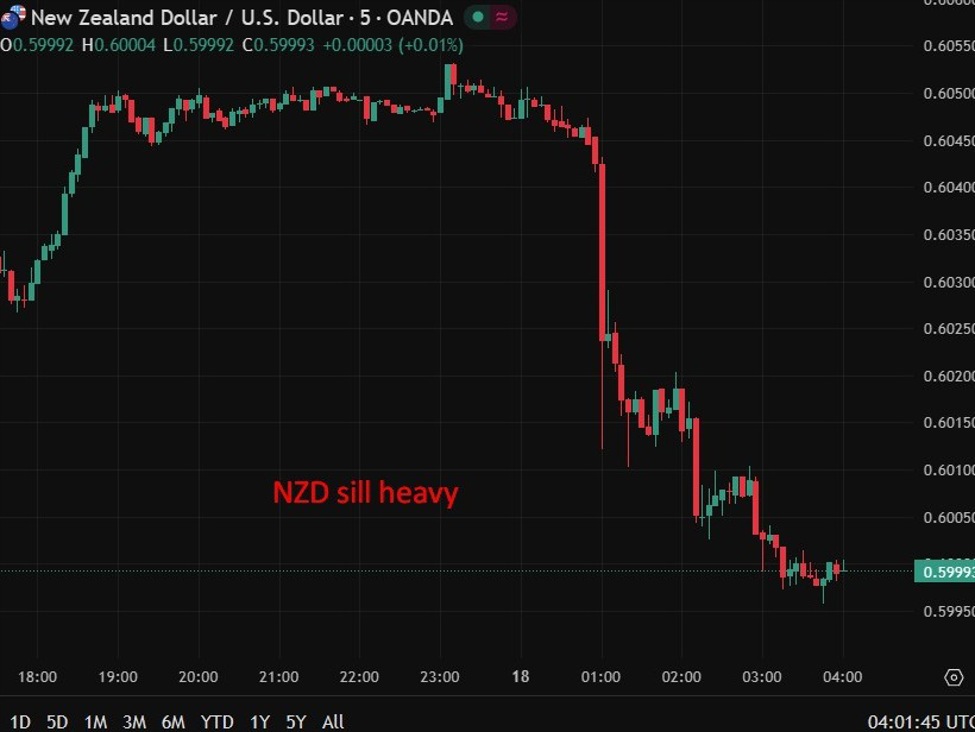
The RBNZ held the OCR at 2.25%, reiterated that policy will stay accommodative while inflation returns toward target, and brought forward its projections for a potential first hike, reinforcing a data-dependent, gradual normalisation path.Summary:The Reserve Bank of New Zealand held the OCR at 2.25%, reinforcing that policy remains supportive.The updated OCR track was lifted vs November, bringing the first potential hike closer but still conditional.The central bank views the economy as in the early stages of recovery and inflation returning toward target.Forecasts show inflation falling toward 2% and growth near 2.9% this year, underpinned by commodity strength but with persistent spare capacity.Markets broadly took the message as a balanced hold with doors open for later hikes, even if the pace of tightening remains slow.New Zealand’s central bank delivered a cautiously calibrated message alongside its decision to hold the Official Cash Rate at 2.25%, underscoring that monetary policy will stay accommodative “for some time” even as it subtly brings the possibility of future tightening into view.In the bank’s February 2026 Monetary Policy Statement, and as summarised in a note from Kiwibank analysts, policymakers reiterated that the economy remains in the early stages of recovery and that inflation is likely to fall back toward the midpoint of the 1–3% target band over the coming year. Spare capacity, modest wage growth and core inflation readings within the target range support the central forecast of inflation settling around 2%. There was also emphasis on balanced risks, with the global landscape still uncertain and domestic demand evolution key to how quickly price pressures dissipate. While the OCR was held as expected, the RBNZ’s revised projections lifted the end-of-year rate path to around 2.38%, a modest upward shift compared with the train of forecasts from November and signalling that policymakers now see the first rate rise as possible before year-end if the economy evolves as expected. Markets interpreted this as a subtle recalibration rather than a pronounced policy pivot — a reiteration that any future tightening will be gradual and data-dependent, not an imminent shift. Underlying data show that growth has gained traction since late 2025, and while non-tradable inflationary pressures have eased, tradable inflation remains elevated partly due to past currency weakness. The bank’s updated outlook also reflects a slightly less negative output gap and forecasts annual growth of around 2.9% this year, up on earlier estimates. Despite this improvement, significant spare capacity remains, including in labour markets, reinforcing the case for patience. For markets, the calibrated message delivered a familiar duality: support where needed, but openness to tightening if conditions warrant it. New Zealand swap rates and the kiwi dollar saw only modest moves post-decision, reflecting that the revised rate track was largely in line with expectations and that the emphasis remains on measured progression rather than a sudden shift in stance.In essence, the RBNZ has reaffirmed its commitment to accommodative policy for now, while signalling that tightening — hinted at for year-end — is becoming a more credible part of the medium-term outlook.
This article was written by Eamonn Sheridan at investinglive.com.
💡 DMK Insight
The RBNZ’s decision to keep the OCR at 2.25% signals ongoing support for the economy, and here’s why that matters now: By maintaining an accommodative stance, the RBNZ is clearly prioritizing economic recovery over immediate inflation concerns. This could lead to a weaker NZD in the short term, as traders might anticipate prolonged low interest rates. For forex traders, this means keeping an eye on NZD pairs, particularly against the USD and AUD, as any signs of a shift in sentiment could trigger volatility. The RBNZ’s commitment to a gradual normalization path suggests that any future hikes will be data-driven, making economic indicators like GDP growth and employment figures crucial to watch. If inflation doesn’t pick up as expected, the RBNZ might delay tightening, which could further pressure the NZD. On the flip side, if inflation surprises to the upside, we could see a rapid shift in market sentiment, leading to a potential spike in the NZD. Traders should monitor key levels around 0.60 against the USD for potential breakouts or reversals. Overall, the immediate focus should be on upcoming economic data releases that could influence the RBNZ’s outlook and the NZD’s trajectory.
📮 Takeaway
Watch for economic indicators in New Zealand; a surprise in inflation could shift the RBNZ’s stance and impact the NZD significantly.