Bitcoin
  Ethereum
  Tether
  BNB
BNB  XRP
XRP  USDC
USDC  Solana
  TRON
TRON  Lido Staked Ether
  Figure Heloc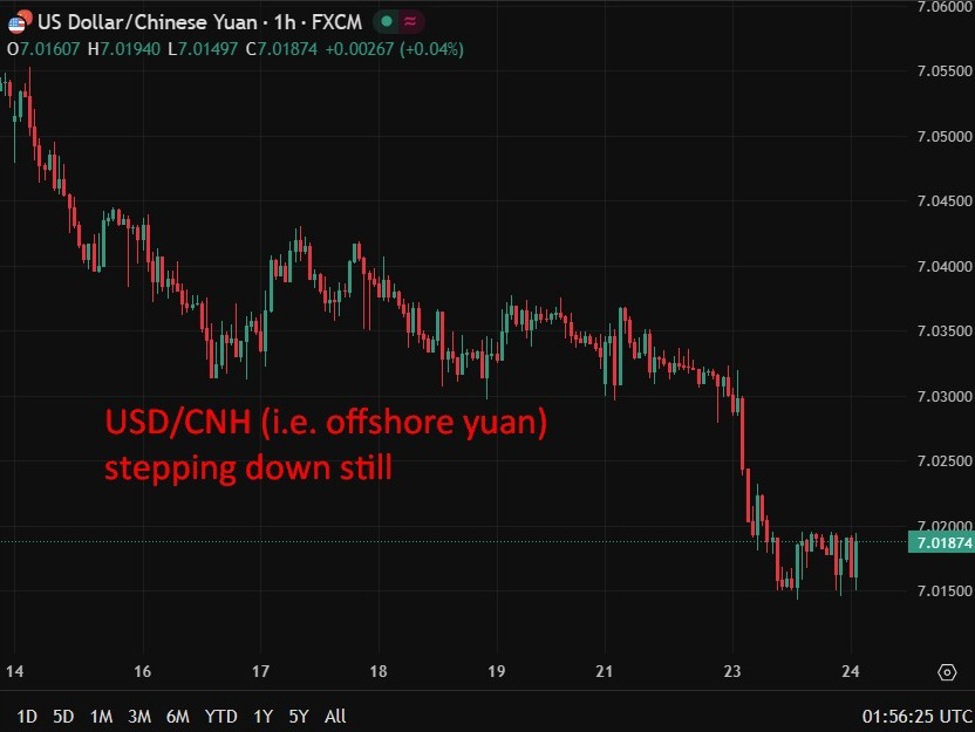
The People’s Bank of China (PBOC), China’s central bank, is responsible for setting the daily midpoint of the yuan (also known as renminbi or RMB). The PBOC follows a managed floating exchange rate system that allows the value of the yuan to fluctuate within a certain range, called a “band,” around a central reference rate, or “midpoint.” It’s currently at +/- 2%.The Bank injected CNY 26bn via 7-day reverse repos at an unchanged rate of 1.4%.Earlier:PBOC is expected to set the USD/CNY reference rate at 7.0240 – Reuters estimateThe daily fixing of this mid-rate is often interpreted as a policy signal rather than just a technical reference point. A higher-than-expected USD/CNY midpoint is typically read as a sign the PBOC is leaning against CNY appreciation pressure, like today.–In trading yesterday the offshore yuan (CNH) strengthened past 7.02 per dollar, to its strongest level since October 2024.As Wednesday’s USD/CNY trade opened the pair moved to the lowest since September 30 of 2024. In other FX news:Cable has moved to its highest in 3 months through 1.3530EUR/USD has moved to its highest in 3 months also, above 1.1805 Yen is also pushing stronger following the data and BoJ earlier:Bank of Japan Services Producer Price Index (November) +2.7% y/y (expected & prior 2.7%)Japan policymakers flag inflation persistence and asset-price risks in October BoJ minutesYen is having a good week. As I posted earleir:Remarks from Atsushi Mimura warning about excessive and one-sided currency moves prompted a reassessment of short-yen positions, reinforcing the sense that authorities are increasingly sensitive to renewed volatility. This message was later echoed by Finance Minister Satsuki Katayama, adding further weight to the view that sharp or disorderly moves would not be ignored.Japan officials’ warnings have continued to bolster the yen, USD/JPY under 156.50
This article was written by Eamonn Sheridan at investinglive.com.
💡 DMK Insight
The PBOC’s control over the yuan’s midpoint is crucial for traders navigating forex markets right now. With the yuan’s value fluctuating within a managed band, any shifts in PBOC policy can lead to significant volatility. Traders should keep an eye on the central bank’s announcements, as changes could impact not just the yuan but also correlated currencies like the Japanese yen and Australian dollar, which often react to shifts in Chinese economic policy. If the PBOC tightens its band, it could signal a stronger yuan, affecting export competitiveness and potentially leading to broader market implications. Watch for key levels around the current midpoint; a break could trigger a cascade of trading activity across the forex landscape. Here’s the thing: while mainstream coverage may focus solely on the yuan’s immediate value, the underlying economic indicators—like trade balances and inflation rates—are just as critical. If you’re trading in this environment, monitor the PBOC’s next moves closely, especially any hints at policy shifts that could affect the yuan’s band.
📮 Takeaway
Keep an eye on the PBOC’s announcements regarding the yuan’s midpoint; any changes could trigger significant volatility in forex markets, especially with correlated currencies.