Bitcoin
  Ethereum
  Tether
  BNB
BNB  XRP
XRP  USDC
USDC  Solana
  TRON
TRON  Lido Staked Ether
  Figure Heloc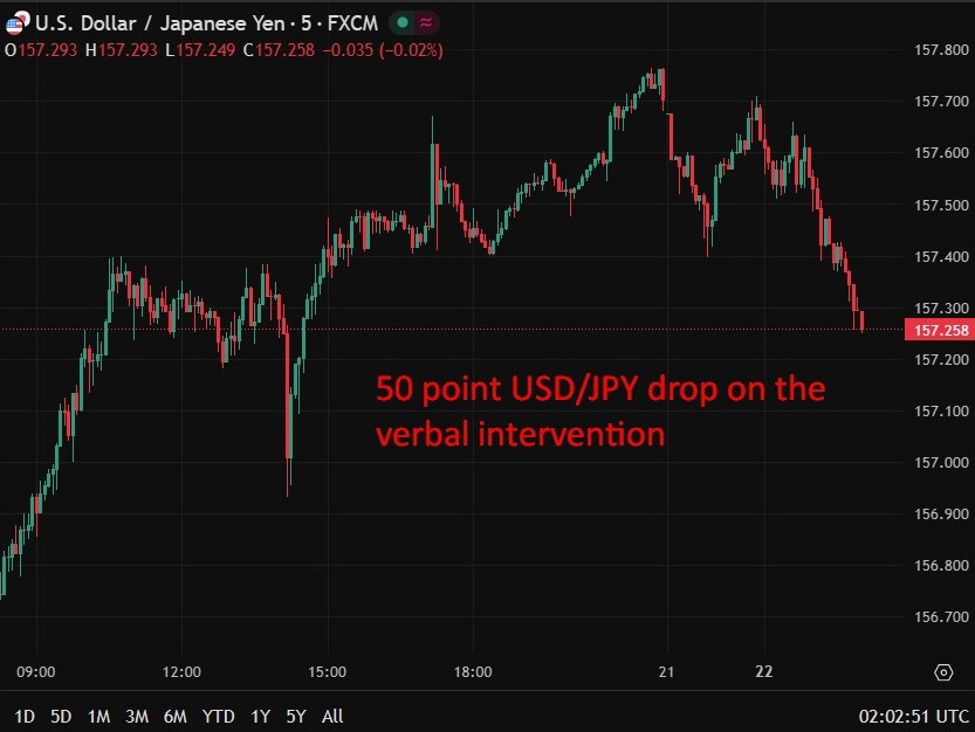
Summary: Japan’s intervention warning gave the yen a modest liftUSD/JPY slipped toward 157.25 from highs near 157.75Officials flagged concern over “one-sided and sharp” movesVerbal intervention slowing momentum, not reversing trendAUD/JPY still supported by yield differentials—A renewed warning from Japanese officials about the risk of currency intervention has given the yen a modest lift at the start of the week. The move followed comments from Japan’s top currency diplomat, Atsushi Mimura, which pushed USD/JPY about half a big figure lower from earlier highs near 157.75 as I update, to around 157.25.Mimura said on Monday that authorities are “concerned” about recent foreign-exchange moves, describing them as “one-sided and sharp,” and warned that officials would take “appropriate actions” against excessive volatility. The language was familiar, but the timing, coming so soon after last week’s central bank meeting, has been enough to nudge the market toward trimming short-yen positions.The remarks followed similar comments late last week from Finance Minister Satsuki Katayama, who also warned that Tokyo would respond appropriately to excessive and speculative yen moves. Together, the statements underline growing discomfort in Tokyo over the pace of yen weakness, particularly given the impact on import prices and household living costs.While the move in USD/JPY has so far been measured rather than dramatic, it reinforces the sense that official tolerance for renewed yen declines is limited, especially when moves appear disorderly. For now, verbal intervention appears to be doing just enough to slow momentum, even if it has not yet triggered a broader reversal.Elsewhere in FX, I note earlier commentary from Commonwealth Bank of Australia on AUD/JPY, which continues to find fundamental support from solid risk sentiment and, more importantly, widening interest-rate differentials between Australian and Japanese 10-year government bond yields. That yield gap remains a powerful structural driver for the cross.CBA’s forecast has AUD/JPY rising to 109 by March 2026, highlighting that while intervention risk may periodically cap yen weakness, broader yield dynamics continue to favour higher AUD/JPY levels over the medium term. —Atsushi Mimura is Japan’s vice finance minister for international affairs — the country’s top currency diplomat — and the official with day-to-day responsibility for overseeing foreign-exchange policy. In practice, Mimura is the key decision-maker on whether Japan intervenes in the FX market, acting under the authority of the finance minister and in coordination with the Bank of Japan, which executes intervention operations on his instruction. He monitors market conditions closely, assesses whether yen moves are excessive, disorderly or driven by speculation, and delivers the government’s verbal warnings that often precede action. When intervention is authorised, Mimura formally directs the BOJ to enter the market, typically through yen-buying operations aimed at stabilising sharp or one-sided moves rather than targeting specific exchange-rate levels.
This article was written by Eamonn Sheridan at investinglive.com.
💡 DMK Insight
Japan’s intervention warning is a classic case of verbal intervention, and here’s why it matters right now: The USD/JPY pair’s slip from near 157.75 to around 157.25 reflects market sensitivity to these signals. Officials are clearly concerned about ‘one-sided and sharp’ moves, which suggests they’re ready to act if the yen continues to weaken. This verbal intervention can slow momentum but rarely reverses the broader trend, especially when yield differentials still favor the AUD/JPY. Traders should keep an eye on this pair, as any further comments from Japanese officials could lead to increased volatility. If USD/JPY breaks below 157.00, it could trigger more aggressive selling, while a bounce back above 157.75 might reignite bullish sentiment. But don’t overlook the AUD/JPY; its support from yield differentials could lead to a divergence in performance between these pairs. If the yen strengthens, it could impact risk sentiment across the board, affecting equities and commodities as well. Watch for any shifts in the Bank of Japan’s stance or U.S. economic data that could influence these dynamics.
📮 Takeaway
Monitor USD/JPY closely; a break below 157.00 could signal further yen strength, while AUD/JPY remains supported by yield differentials.