Bitcoin
  Ethereum
  Tether
  XRP
XRP  BNB
BNB  USDC
USDC  Solana
  TRON
TRON  Lido Staked Ether
  Figure Heloc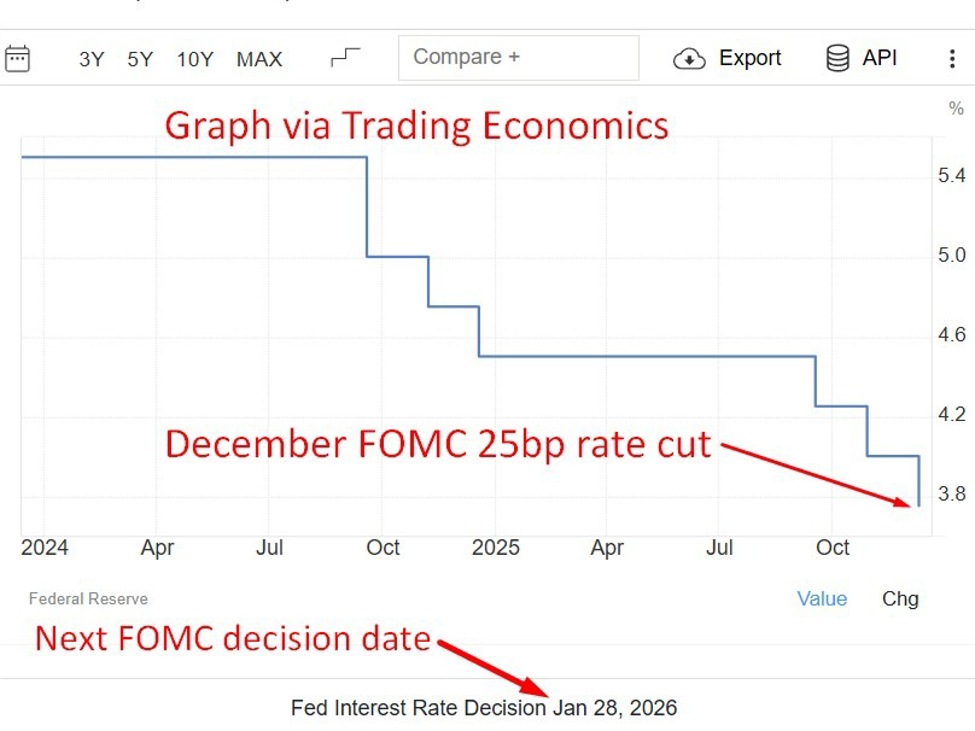
Summary: The December meeting minutes from the Federal Open Market Committee reveal a finely balanced debate over the decision to cut interest rates, with policymakers divided between growing labour-market risks and lingering concerns over inflation credibility. While most participants see scope for further easing if disinflation resumes, several warned against moving too quickly while inflation remains above target.—Minutes from the Federal Reserve’s December policy meeting, released on December 30, show a central bank increasingly split between supporting a softening labour market and preserving confidence in its inflation-fighting credentials.Several participants who ultimately supported lowering the federal funds rate said the decision was “finely balanced,” noting they could have supported leaving rates unchanged. Some policymakers preferred holding steady to gain greater confidence that inflation is returning to the Fed’s 2% target, while one participant (political appointee Miran) favoured a larger 50-basis-point reduction. Those backing the cut judged that downside risks to employment had increased, while upside inflation risks appeared to be easing.Most participants supported lowering the target range to 3.50%–3.75%, and judged that further rate cuts would likely be appropriate if inflation continued to decline broadly in line with expectations. However, two(Goolsbee and Schmid dissented in favour of no rate cut) argued for keeping rates unchanged for a period following the December move, in order to assess the lagged effects of recent policy easing as the Fed shifts toward a more neutral stance.Inflation remained a key source of caution. Participants noted that price pressures had risen through September and remained above target, with core services inflation easing but core goods inflation picking up, a development staff largely attributed to higher tariffs. While many expected near-term inflation to remain elevated before gradually returning to 2% as tariff effects faded, several warned that cutting rates too aggressively could risk inflation becoming entrenched or be misinterpreted as weakening the Fed’s commitment to its target.On the labour market, most participants observed continued softening, with hiring subdued and unemployment edging higher. Labour-market risks were broadly seen as tilted to the downside, particularly for cyclically sensitive groups, even as overall economic activity was judged to be expanding at a moderate pace. Consumption remained supported by higher-income households, while lower-income spending was more muted. Many participants expect growth to pick up in 2026 and run near potential over the medium term, albeit with elevated uncertainty.The minutes also highlighted technical discussions around balance-sheet policy, with agreement that reserves have declined to ample levels and that reserve-management purchases may soon be warranted to maintain smooth money-market functioning.
This article was written by Eamonn Sheridan at investinglive.com.
💡 DMK Insight
The Fed’s December meeting minutes highlight a critical tug-of-war between inflation concerns and labor market risks, and here’s why that matters for traders right now: Policymakers are clearly divided, which suggests that any future rate cuts could be more data-dependent than previously thought. If disinflation trends continue, we might see a shift towards easing, but the warning signs from those concerned about inflation could keep the Fed on a cautious path. This uncertainty can lead to increased volatility in both the forex and crypto markets, particularly for assets sensitive to interest rate changes. Traders should keep an eye on economic indicators like employment data and inflation reports, as these will likely dictate the Fed’s next moves. On the flip side, if inflation shows signs of stability, the market might react positively, pushing equities and risk assets higher. Watch for key levels in the S&P 500 and major currency pairs like EUR/USD, as these could signal broader market sentiment shifts. The next few weeks will be crucial, so stay alert for any economic data releases that could sway the Fed’s stance.
📮 Takeaway
Monitor upcoming employment and inflation data closely; they could dictate the Fed’s next move and impact market volatility significantly.