Bitcoin
  Ethereum
  Tether
  XRP
XRP  BNB
BNB  USDC
USDC  Solana
  TRON
TRON  Lido Staked Ether
  Dogecoin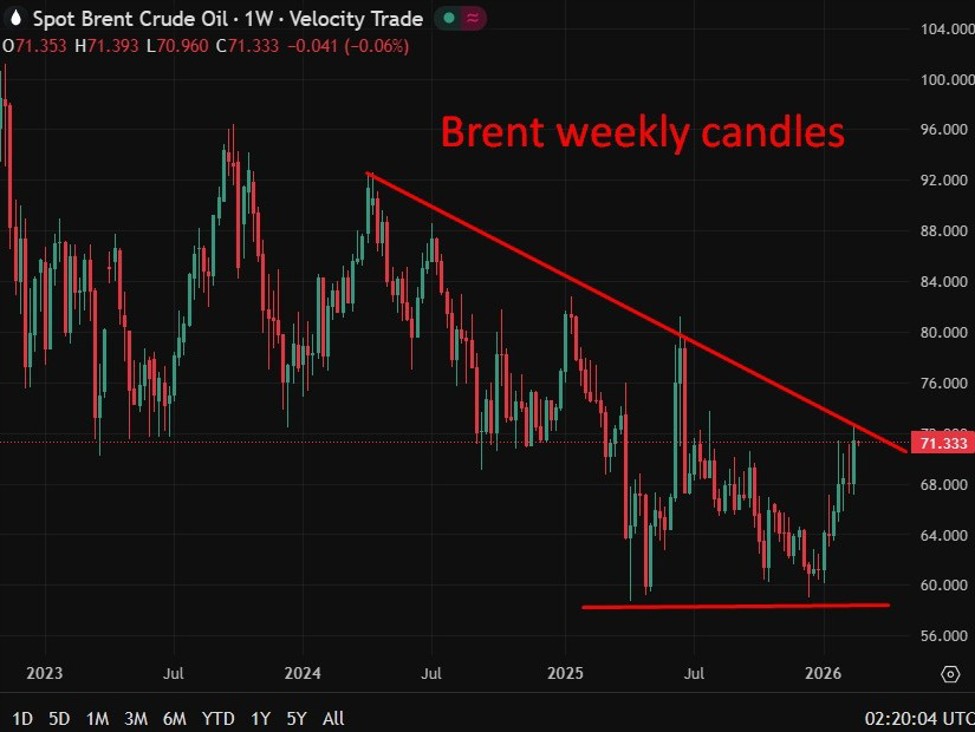
Goldman raised its 2026 Q4 Brent/WTI forecasts to $60/$56 on tighter OECD stocks, while maintaining a 2026 surplus assumption. The bank sees firmer prices in 2027 but flags sanctions relief in Iran/Russia as a key downside risk.Summary:Goldman raises 2026 Q4 Brent/WTI by $6 to $60/$56Assumes no Iran-related supply disruption and still sees a 2026 surplusUpgrade driven by lower-than-expected OECD inventoriesSees 2027 averages at $65/$61Forecasts recovery to $70/$66 by Dec 2027 on firm demand, slower supply growthFlags $5/$8 downside risk to 2026 Q4 if Iran/Russia sanctions relief boosts supplyGoldman Sachs has raised its oil price forecasts for late 2026, citing tighter OECD inventories, while maintaining that the global market is likely to remain in surplus next year absent major geopolitical disruption.The bank lifted its 2026 fourth-quarter Brent forecast by $6 to $60 per barrel, and its WTI forecast by $6 to $56, reflecting lower-than-expected stock levels across OECD economies. Despite the upward revision, Goldman continues to assume no Iran-related supply shock, keeping its broader 2026 balance framework intact.The adjustment suggests that inventory dynamics, rather than a shift in core supply-demand assumptions, are driving the near-term upgrade. Lower OECD stocks imply a smaller cushion against demand surprises or supply interruptions, tightening the price outlook at the margin even within a surplus environment.Looking further out, Goldman expects prices to firm in 2027. The bank projects average Brent/WTI prices of $65/$61 in 2027, before rising toward $70/$66 by December 2027. The expected recovery reflects solid global demand growth alongside a moderation in non-OPEC supply expansion, particularly as US production growth slows and capital discipline remains broadly intact across major producers.However, Goldman flagged meaningful downside risks. Potential sanctions relief involving Iran or Russia could accelerate landed stock builds and unlock incremental supply into the market. In that scenario, the bank estimates downside risk of approximately $5 per barrel for Brent and $8 for WTI relative to its 2026 Q4 forecasts.The note highlights the continued sensitivity of oil markets to geopolitical developments and sanctions policy, even as the underlying supply-demand picture remains broadly balanced. For now, Goldman’s base case assumes no major disruption — but also no rapid easing of sanctions that would materially alter supply trajectories.
This article was written by Eamonn Sheridan at investinglive.com.
💡 DMK Insight
Goldman’s upward revision of Brent and WTI forecasts signals a potential shift in market sentiment. Raising the Q4 2026 Brent forecast to $60 and WTI to $56 reflects tighter OECD stocks, which could lead to short-term bullish momentum. However, the bank’s assumption of a surplus in 2026 suggests that traders should remain cautious about longer-term price stability. The mention of sanctions relief in Iran and Russia introduces significant uncertainty; if these sanctions are lifted, we could see a flood of oil into the market, which would counteract any price gains. Traders should monitor the geopolitical landscape closely, especially any developments regarding sanctions, as these could create volatility in the oil markets. For those trading oil, keep an eye on technical levels around $60 for Brent and $56 for WTI. A sustained break above these levels could trigger further buying, while failure to hold could lead to a pullback. Watch for inventory reports and OPEC announcements in the coming months, as these will provide additional context for price movements.
📮 Takeaway
Watch Brent at $60 and WTI at $56; geopolitical developments in Iran and Russia could significantly impact prices.