Bitcoin
  Ethereum
  Tether
  XRP
XRP  BNB
BNB  USDC
USDC  Solana
  TRON
TRON  Lido Staked Ether
  Figure Heloc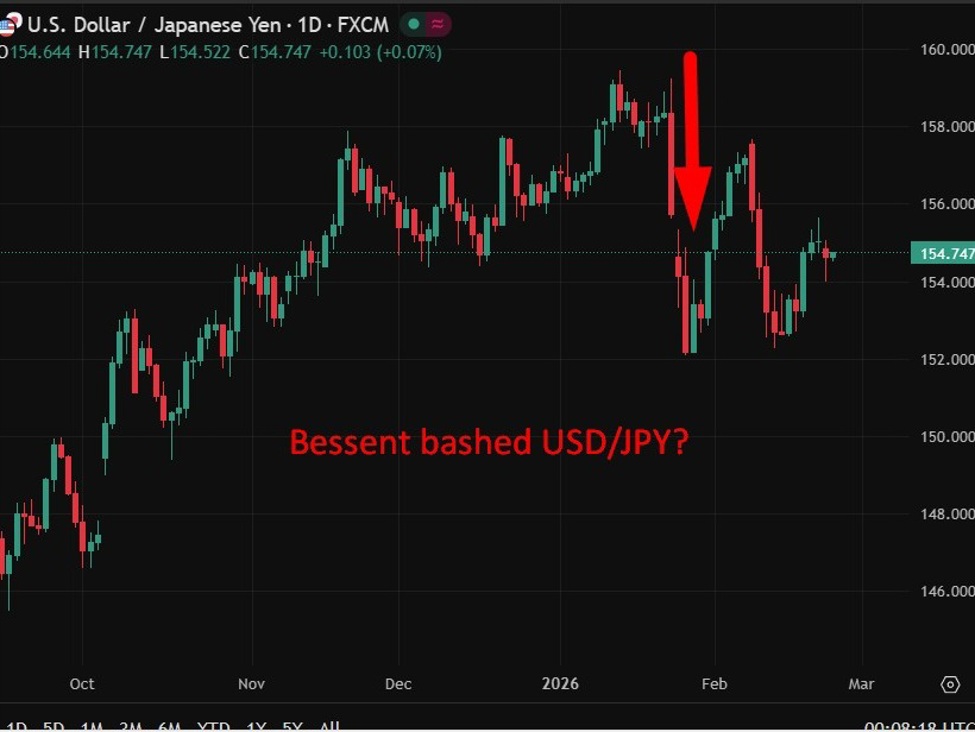
U.S. Treasury led January yen rate check to steady markets during Japan’s election turmoil, Nikkei reports.Summary:U.S. Treasury Secretary Scott Bessent led January yen “rate check”Action not requested by Japan, according to senior U.S. officialsMove aimed at calming instability ahead of Japan’s lower house electionYen rebounded from ~158 to ~155 per dollar after Jan. 23 checkU.S. open to coordinated intervention if formally requestedU.S. Treasury Secretary Scott Bessent personally led a January “rate check” on the yen during its sharp slide against the dollar, according to senior U.S. officials cited by Nikkei, in a move designed to stabilise markets rather than respond to a formal Japanese request.The check, conducted on Jan. 23 by the Federal Reserve Bank of New York at the Treasury’s direction, came as the yen weakened toward the 158 per dollar level amid political uncertainty ahead of Japan’s Feb. 8 lower house election. Officials said Bessent was concerned about broader market instability during what he described as a “political vacuum,” as well as the potential for spillovers into global bond markets.Rate checks are typically viewed as a precursor to possible currency intervention, involving authorities sounding out financial institutions on pricing were official action to occur. Following the move, the yen strengthened sharply to around 155 per dollar.According to U.S. officials, Japan’s Ministry of Finance had not requested either a rate check or coordinated intervention at the time. However, Washington would have considered joint action had Tokyo asked.The backdrop included rising long-term Japanese government bond yields, with newly issued 40-year debt touching 4% for the first time. Selling pressure spilled into U.S. Treasuries, pushing 10-year yields toward 4.3%, before retreating toward 4.0% after the rate check.Officials said Bessent believed markets were misreading signals from Japan’s bond market and feared that higher global yields could undermine broader financial stability. The action was described as consistent with a broader U.S. principle of using its economic strength to help stabilise allies.Following the landslide election victory of Prime Minister Sanae Takaichi, U.S. authorities assess that political uncertainty has receded. They have also expressed confidence in Finance Minister Satsuki Katayama and Bank of Japan Governor Kazuo Ueda.While no specific measures are currently planned, U.S. officials indicated close coordination with Japan will continue.
This article was written by Eamonn Sheridan at investinglive.com.
💡 DMK Insight
The U.S. Treasury’s intervention to stabilize the yen is a significant move amid Japan’s election chaos. With the yen rebounding from around 158 to 155, traders should note that this action wasn’t requested by Japan, suggesting a proactive approach by the U.S. to mitigate volatility. This could indicate underlying concerns about Japan’s economic stability and the potential impact on global markets. The upcoming lower house election adds another layer of uncertainty, making it crucial for traders to monitor how political outcomes might influence the yen’s trajectory. If the yen continues to strengthen, it could pressure export-driven stocks and related currencies, particularly if the market perceives a shift in Japan’s economic policy. Look for key resistance levels around 155.5 and support near 158. The immediate focus should be on how the yen reacts in the coming days, especially as election results unfold. Traders should also keep an eye on U.S. Treasury yields, as any shifts there could amplify or dampen the yen’s movements.
📮 Takeaway
Watch for the yen’s reaction around 155.5 and 158 as Japan’s election results unfold; volatility could impact related markets significantly.