
 Bitcoin
  Ethereum
  Tether
  BNB
BNB  USDC
USDC  XRP
XRP  Solana
  TRON
TRON  Lido Staked Ether
  Figure Heloc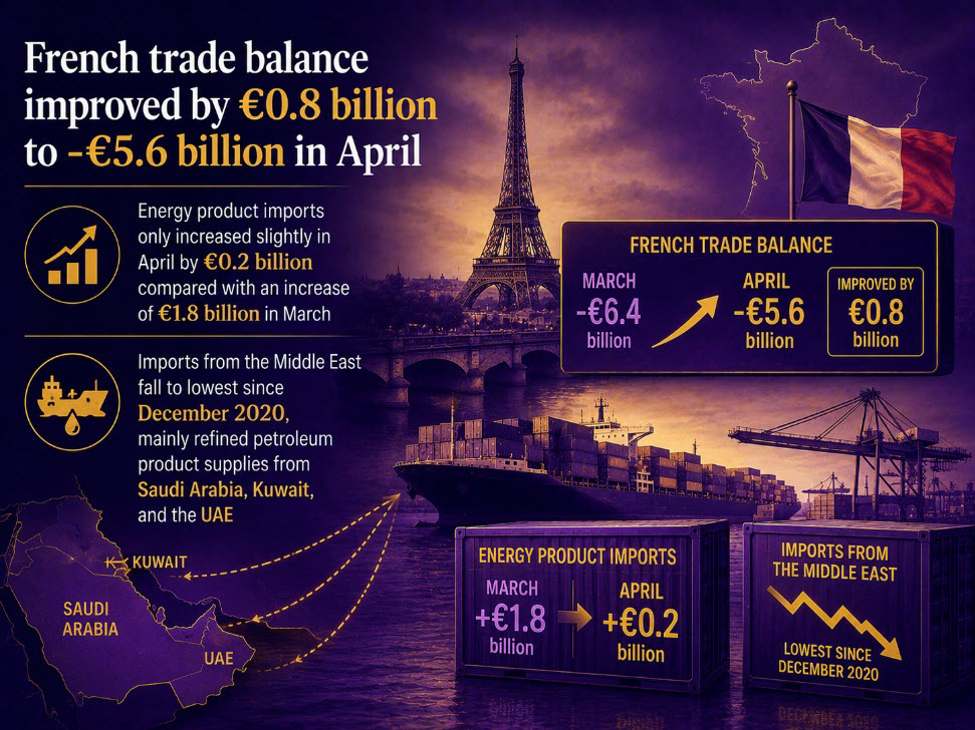
The French trade balance improved by €0.8 billion to -€5.6 billion in April, reflecting a narrowing in the overall deficit. This of course follows from the sharp declines recorded in February (-€3.5 billion) and March (-€1.3 billion).The better showing was driven by a strong increase in exports (+€1.7 billion), which outpaced the growth in imports (+€0.9 billion).Looking at the details, export growth owed much to increased deliveries of transport equipment. That saw an improvement of €0.7 billion, in particular for aeronautical products (+€0.5 billion). Besides that, exports of mechanical, electronic, and IT equipment also rose sharply (+€0.6 billion) on the month.Meanwhile, import growth was mostly driven by supplies of natural hydrocarbons (+€0.4 billion). However, the more telling detail is where the switch in terms of geographical weight of overall imports.Of note, imports originating from countries in the Middle East were reduced by half compared to March. And for the most part, this involved energy imports especially. Instead, these imports were then compensated by supplies from other countries (US, African countries in particular).For some context, energy product imports only increased slightly in April by €0.2 billion. That is much lower compared to the big jump in March, which showed an increase of €1.8 billion.And to give a better perspective on that, imports from the Middle East fell by €0.7 billion to €0.5 billion. That marks the lowest level since December 2020. Of note, the decline primarily stemmed from refined petroleum product supplies from Saudi Arabia, Kuwait, and the UAE.
This article was written by Justin Low at investinglive.com.
💡 DMK Insight
France’s trade balance shift is a key indicator for traders watching the Eurozone’s economic health. The improvement to -€5.6 billion in April, up from -€6.4 billion, signals a potential rebound in export strength, which could influence the euro’s value against major currencies. With exports rising by €1.7 billion, this trend might attract institutional investors looking for bullish positions in EUR/USD. A sustained improvement could lead to a stronger euro, impacting forex pairs and even related markets like commodities, particularly those tied to European manufacturing. However, traders should be cautious; the previous months’ deficits were substantial, and a single month of improvement doesn’t guarantee a trend. Watch for upcoming economic indicators, especially any shifts in consumer demand or global trade tensions that could reverse this momentum. Key levels to monitor include the euro’s performance around 1.10 against the dollar, which could act as a psychological barrier for traders. Overall, keep an eye on the next trade balance report and any geopolitical developments that could affect trade dynamics.
📮 Takeaway
Watch the euro’s performance around 1.10 against the dollar; a sustained trade balance improvement could signal bullish momentum.