Bitcoin
  Ethereum
  Tether
  BNB
BNB  XRP
XRP  USDC
USDC  Solana
  TRON
TRON  Lido Staked Ether
  Figure Heloc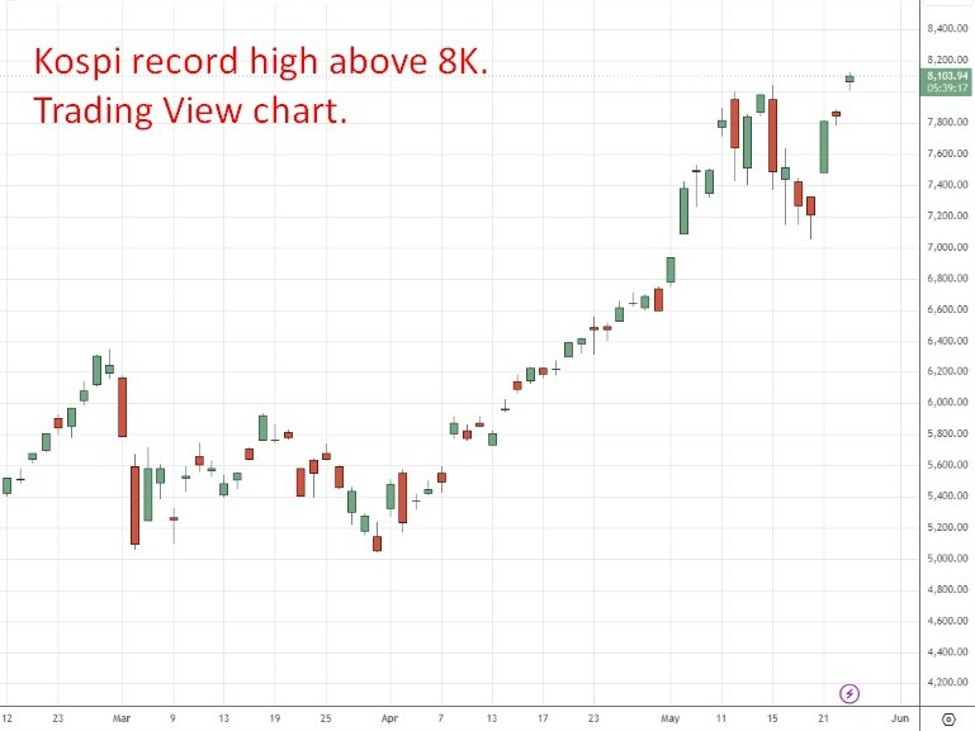
The Bank of Korea is expected to hold its base rate at 2.50% on May 28, but over 70% of economists in a Reuters poll now forecast at least one hike by end-September as Iran war inflation builds.Summary:
Source: Reuters poll of 29-32 economistsThirty of 32 economists polled by Reuters expect the BOK to leave its base rate unchanged at 2.50% at the May 28 meeting, with only two forecasting a riseTwenty-one of 29 respondents predict at least one rate hike by end-September, a dramatic shift from last month when just three of 30 expected a moveSouth Korea’s April inflation rate of 2.6% was the highest in nearly two years, breaching the BOK’s 2.0% target, with oil prices holding mostly above $100 a barrel for close to three monthsThe won’s weakness is compounding imported inflation pressures, with ANZ’s Krystal Tan noting that inflation expectations are also continuing to drift higherSouth Korea’s Q1 GDP expanded 1.7%, the fastest pace in nearly six years, and economists expect the BOK to revise up its full-year growth forecast from 2.0% on ThursdayOf 29 economists providing end-2026 forecasts, 17 see the base rate at 3.00%, six at 2.75%, and six unchanged at 2.50%South Korea’s central bank is all but certain to leave its benchmark interest rate on hold at 2.50% when it meets on Thursday, but the more consequential question is how quickly the Bank of Korea moves to begin tightening once it does. A Reuters poll of economists suggests the answer may be: sooner than almost anyone expected a month ago.The survey, conducted between May 19 and 25, found that 30 of 32 economists forecast no change at the May 28 meeting. The two dissenters called for an immediate hike. That near-unanimity on the near-term outcome sits alongside a striking shift in the medium-term view: 21 of 29 respondents who gave longer-range projections now expect at least one rate increase by the end of September. Last month, the same question produced just three hike calls from a comparable group.The catalyst for that shift is the Iran war and its sustained impact on energy prices. Oil has traded mostly above $100 a barrel for close to three months, pushing South Korea’s April consumer price inflation to 2.6%, the highest reading in nearly two years and above the BOK’s 2.0% target. For an economy that imports virtually all of its energy, elevated crude prices feed through to headline inflation with relatively little lag, and the effect is being compounded by a weaker Korean won that raises the domestic cost of all imported goods.The case for hikes: inflation is running above target, appears set to climb further, and expectations are drifting upward, all against a backdrop of persistent energy-driven price pressure and currency-amplified import costs. That combination gives the BOK both the justification and the room to act.The room to act is partly supplied by the resilience of the underlying economy. South Korea recorded first-quarter GDP growth of 1.7%, the strongest quarterly expansion in nearly six years, driven in significant part by a robust semiconductor export cycle. Strong external demand for chips has insulated the economy from the worst of the global energy shock, leaving the central bank less exposed to the concern that rate hikes might tip a weakening economy into contraction.On Thursday, the BOK is also expected to revise its full-year growth projection upward from the 2.0% forecast made before the Iran conflict began. An upgrade on that front would further erode the case for holding rates beyond the near term. Looking to year-end, the modal forecast among economists has the base rate reaching 3.00% by December, a 50 basis point move from the current level that would represent the most active tightening cycle the BOK has undertaken in several years.—The sharp swing in economist expectations, from three hike forecasts last month to 21 this month, reflects how decisively the Iran conflict has reframed the BOK’s policy outlook. Sustained oil prices above $100 a barrel are feeding directly into South Korean consumer prices via energy costs and an imported inflation channel amplified by won weakness. A BOK growth upgrade on Thursday, if it materialises, would remove the last meaningful argument for continued accommodation, potentially pulling forward the timing of the first hike. Korean won and short-end rate markets will be sensitive to both the rate decision and the tone of the accompanying statement.
This article was written by Eamonn Sheridan at investinglive.com.
May 26, 2026