Bitcoin
  Ethereum
  Tether
  BNB
BNB  XRP
XRP  USDC
USDC  Solana
  TRON
TRON  Lido Staked Ether
  Figure Heloc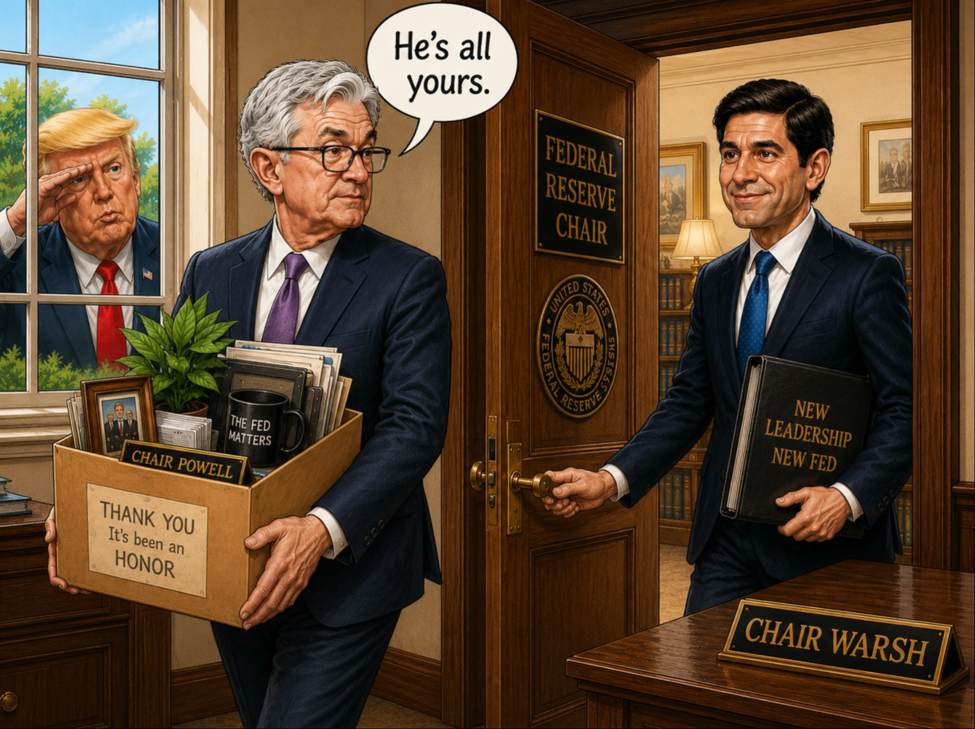
Powell exits amid another bond market surgeJerome Powell is leaving the Fed chairmanship at a time when the bond market is once again under pressure. The 10-year Treasury yield is posting its largest weekly rise since April 2025, climbing 23.5 basis points, or 5.39%, in just one week. After ending 2025 near 4.16%, the yield fell to a low of 3.926% before surging to as high as 4.599% today. The move underscores just how volatile the interest-rate landscape has become — fitting for the close of one of the most turbulent Fed tenures in modern history.The 10-year yield roller coaster during Powell’s tenureWhen Powell officially took over from Janet Yellen on February 5, 2018, the U.S. 10-year Treasury yield was trading near 2.85%. During his tenure, the Treasury market experienced historic swings. The low point came during the COVID panic in 2020, when the 10-year yield collapsed to roughly 0.50%, with some intraday trades briefly dipping below 0.40% as investors rushed into safe-haven assets. From there, yields staged a dramatic reversal, eventually peaking near 5.02% in October 2023 — the highest level since 2007.That means Powell’s tenure saw the 10-year yield travel through a range of more than 450 basis points from the pandemic low to the 2023 high — one of the most volatile interest-rate cycles in modern Treasury market history.Inflation surge became the defining macro storyThe broader U.S. economy experienced equally historic swings under Powell’s watch. Inflation, measured by CPI year-over-year, fell as low as 0.1% in May 2020 during the COVID shutdown recession before surging to 9.1% in June 2022 — the highest inflation reading since 1981. That inflation shock ultimately became the defining macroeconomic event of Powell’s chairmanship and forced the Federal Reserve into its most aggressive tightening campaign since the early 1980s.GDP saw historic collapse and reboundGDP growth also moved through unprecedented extremes. Real GDP contracted at a -31.4% annualized pace in Q2 2020 during the pandemic collapse, only to rebound by +33.8% in Q3 2020 as the economy reopened. Those back-to-back quarters marked the largest contraction and rebound in modern U.S. economic history.Labor market experienced historic extremesThe labor market followed a similarly dramatic path. When Powell took office, the unemployment rate stood near 4.1%. During the COVID shutdowns, unemployment exploded to 14.8% in April 2020 — the highest level since the Great Depression era. Yet the recovery proved equally historic, with unemployment eventually falling to 3.4% in early 2023, the lowest level since 1969. Today, the unemployment rate sits near 4.3%, remarkably close to where it was when Powell first assumed the role.The major policy cycles of the Powell eraLooking back, Powell’s tenure can largely be broken into several major policy and market cycles:2018 tightening cycle: Powell entered office continuing the Fed’s gradual rate-hiking campaign inherited from the Yellen era.
2019 pre-COVID easing: Slowing global growth and trade-war concerns led the Fed to pivot toward rate cuts before the pandemic began.
2020 COVID crisis: The Fed slashed rates to near zero, launched massive quantitative easing programs, and stabilized financial markets during the pandemic panic.
2021–2022 inflation shock: The Fed underestimated the persistence of post-pandemic inflation, delaying aggressive tightening as inflation pressures accelerated.
2022–2023 rapid tightening cycle: Powell then led one of the fastest rate-hiking campaigns in Fed history to regain control over inflation expectations.
2024–2026 higher-for-longer transition: As inflation gradually eased, the Fed shifted toward maintaining restrictive policy before eventually beginning the process toward lower rates.
Powell’s legacy will remain heavily debatedCritics will likely point to the delayed response to post-COVID inflation as Powell’s biggest policy mistake. The Fed initially viewed inflation as “transitory,” only to be forced into an aggressive catch-up tightening cycle once price pressures became embedded in the economy. Supporters, however, will argue Powell successfully navigated multiple once-in-a-generation crises, including the pandemic collapse, banking-sector stress, supply-chain disruptions, and the sharpest inflation surge in four decades.Either way, Powell’s tenure coincided with one of the most volatile and consequential macroeconomic periods ever managed by a modern Federal Reserve chair.
This article was written by Greg Michalowski at investinglive.com.
💡 DMK Insight
The bond market’s surge is a critical signal for traders navigating interest rate dynamics. With the 10-year Treasury yield jumping 23.5 basis points to 5.39%, this marks the largest weekly rise since April 2025, indicating heightened inflation expectations and potential shifts in monetary policy. Traders should be wary of how this impacts equities and risk assets, as rising yields often lead to a rotation out of stocks and into safer bonds. If yields continue to climb, we could see significant pressure on tech stocks and other high-growth sectors that are sensitive to interest rate changes. Keep an eye on the 5.5% level for the 10-year yield; a sustained breach could trigger further sell-offs in equities. On the flip side, this environment could present opportunities in financials, which typically benefit from rising rates. Watch for how institutions react to these shifts, as their positioning could signal broader market trends. As Powell exits, the Fed’s next steps will be crucial—monitor upcoming economic data releases for clues on future rate hikes.
📮 Takeaway
Watch the 10-year Treasury yield closely; a sustained move above 5.5% could trigger a sell-off in equities, particularly in tech stocks.