 Bitcoin
  Ethereum
  Tether
  BNB
BNB  XRP
XRP  USDC
USDC  Solana
  TRON
TRON  Lido Staked Ether
  Figure Heloc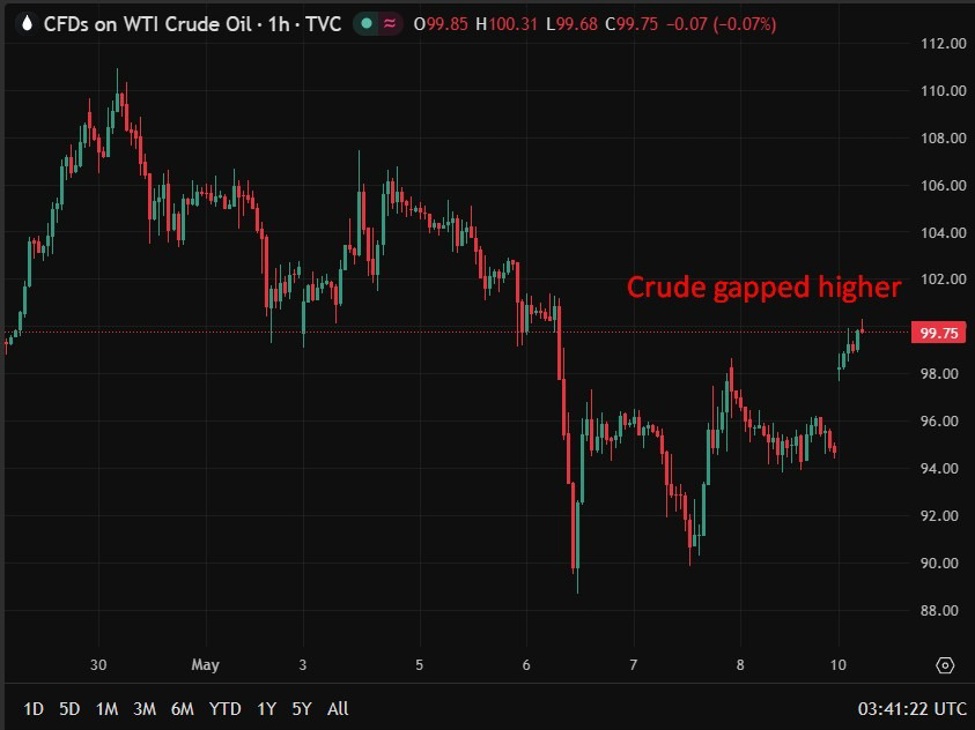
China car sales fall for seventh month as EV exports surge on Iran fuel shockChina’s April inflation data beats across board as energy costs reshape price landscapeJapan’s energy subsidies and yen defence are on a collision courseICYMI – Netanyahu says Iran war not over and refuses to rule out seizing nuclear materialChina April CPI 1.2% y/y (expected 0.8%, prior 0.1%)PBOC sets USD/ CNY reference rate for today at 6.8467 (vs. estimate at 6.7988)WSJ: Rising defaults and redemption pressure push Apollo to weigh $3bn credit fund saleIran oil shock has put Fed rate cuts off the table and hikes back on, Pimco saysUK and France convene 40-nation defence meet on Hormuz as Iran issues war warningTwo tankers slip through Hormuz dark as Gulf oil crisis grinds on. Yeah, two. Yippee.Japanese markets are about to get more active and respond to the US-Iran war of wordsUS futures trade has opened for the new week, oil is higher and equites a bit lowerFutures aren’t open yet, but early FX is pointing to risk off gapIran state media says Iran wants sovereignty over the Strait of HormuzChina’s April exports surge 14.1% as Iran war fear drives global stockpiling rushIran dismisses Trump’s nuclear talks rejection as irrelevant to its negotiating positionMonday open indicative forex prices, 11 May 2026. USD bids.Trump says Iran’s proposals are “TOTALLY UNACCEPTABLE”Iran said to table broad demands covering sanctions, war and security in U.S. talksWeekend:Newsquawk Week in Focus: US Inflation and Retail Sales, Chinese inflation, Trump-Xi meetBitcoin Price Prediction Favors the Bulls Going HigherSummary:Trump rejected Iran’s peace response as totally unacceptable; Iran’s counter-proposal demanded war compensation, Hormuz sovereignty and sanctions relief before nuclear talks can beginIran laid out a three-phase framework with sweeping pre-conditions; the U.S. is demanding nuclear concessions upfront, leaving the two sides fundamentally opposedNetanyahu confirmed removal of Iranian nuclear material remains a war priority; reports indicate Trump told him he wants to go in on Iranian nuclear sitesSaudi Aramco warned a Hormuz reopening would take months to normalise markets; Qatar sent its first LNG cargo through the strait since the war beganChina’s April PPI hit a 45-month high of 2.8%, well above forecasts, ending a 41-month deflationary streak; CPI rose 1.2%, both driven by Iran war energy costsBeijing confirmed Trump’s state visit to China from May 13 to 15 at Xi Jinping’s invitationThe USD strengthened on higher oil prices; the yuan outperformed on firmer trade and inflation dataOil futures pushed higher at the reopen as the U.S.-Iran diplomatic standoff deteriorated sharply, with Trump publicly rejecting Iran’s peace response in a characteristically blunt all-caps post declaring it totally unacceptable, while Tehran’s formal counter-proposal made clear the two sides remain miles apart on the fundamental structure of any potential agreement.Iran’s response rejected any upfront dismantling of its nuclear facilities, instead proposing a three-phase framework that would require Washington to accept a sweeping list of pre-conditions before talks on war-ending terms could even begin. Those pre-conditions include ending the U.S. naval blockade, restoring Iran’s freedom to export oil, lifting sanctions, releasing frozen Iranian assets, recognising Iranian control of the Strait of Hormuz and treating a Lebanon ceasefire as a non-negotiable red line. Iran’s proposal also stressed the need for U.S. war damage compensation and framed nuclear issues as a matter for a separate post-war agreement, not an upfront concession. Washington’s position remains the opposite: nuclear concessions first, everything else second. The gap between the two frameworks is not a matter of detail but of sequencing and principle, leaving markets with little reason to price in an early resolution.The escalation in rhetoric around Iran’s nuclear infrastructure added a further layer of risk. Israeli Prime Minister Benjamin Netanyahu confirmed that the removal of Iranian nuclear material remains an active war priority, and separate reports indicated that Trump told Netanyahu directly he wants to go in on Iranian nuclear sites. Neither claim has been independently verified, but their circulation reinforced the view that the conflict’s trajectory may be toward intensification rather than conclusion.On the supply side, Saudi Aramco provided a sobering assessment of the market’s recovery timeline, warning that even an immediate reopening of the Strait of Hormuz would take months before normal market conditions could be restored, a reminder that the supply damage from the disruption is not simply a tap that can be turned back on. Against that backdrop, Qatar’s first LNG shipment through the strait since the war began offered a rare piece of constructive news, with Pakistan also reported to be in talks with Iran to facilitate further Qatari LNG transits through Hormuz.China’s April inflation data provided the session’s most significant macro development outside the conflict. Producer prices jumped 2.8% year-on-year, a 45-month high that blew past forecasts, while consumer inflation came in at 1.2%, also above expectations. The data confirms the Iran war’s energy cost shock is transmitting directly and forcefully into the world’s largest manufacturing economy. The complication for Beijing is that this is cost-push inflation rather than the demand-pull variety it has been trying to engineer, narrowing the People’s Bank of China’s room for the aggressive monetary easing that policymakers had been hoping to deploy to address persistent domestic demand weakness.Beijing also formally confirmed that Trump will make a state visit to China from May 13 to 15 at President Xi Jinping’s invitation, a development that has been anticipated for some time but now carries added weight given the Iran war’s centrality to global energy and geopolitical risk. In currency markets, the dollar strengthened on the back of higher oil prices, while the yuan outperformed peers, supported by the firmer-than-expected trade and inflation prints released earlier in the day.The USD was higher on the session, here against the euro. Regional equites were mixed, a strong lead from Wall Street butting up against heightened concerns over the Gulf.
This article was written by Eamonn Sheridan at investinglive.com.
💡 DMK Insight
China’s car sales dropping for the seventh consecutive month is a red flag for the broader economy, signaling potential weakness in consumer spending. This trend could impact related sectors, particularly commodities tied to automotive production and sales. Meanwhile, the surge in EV exports, driven by rising energy costs and geopolitical tensions, points to a shift in market dynamics that savvy traders should monitor closely. With Japan’s energy subsidies potentially clashing with yen defense strategies, volatility in currency markets could also be on the horizon. For traders, the key takeaway here is to watch for how these developments affect commodity prices and the automotive sector. If consumer spending continues to decline, it could lead to a broader economic slowdown, impacting everything from oil prices to manufacturing stocks. Keep an eye on technical levels in related assets, especially if they start to show signs of weakness or strength in response to these economic indicators.
📮 Takeaway
Watch for shifts in commodity prices and automotive stocks as China’s car sales decline; monitor key technical levels for potential trading opportunities.