Bitcoin
  Ethereum
  Tether
  XRP
XRP  BNB
BNB  USDC
USDC  Solana
  TRON
TRON  Lido Staked Ether
  Figure Heloc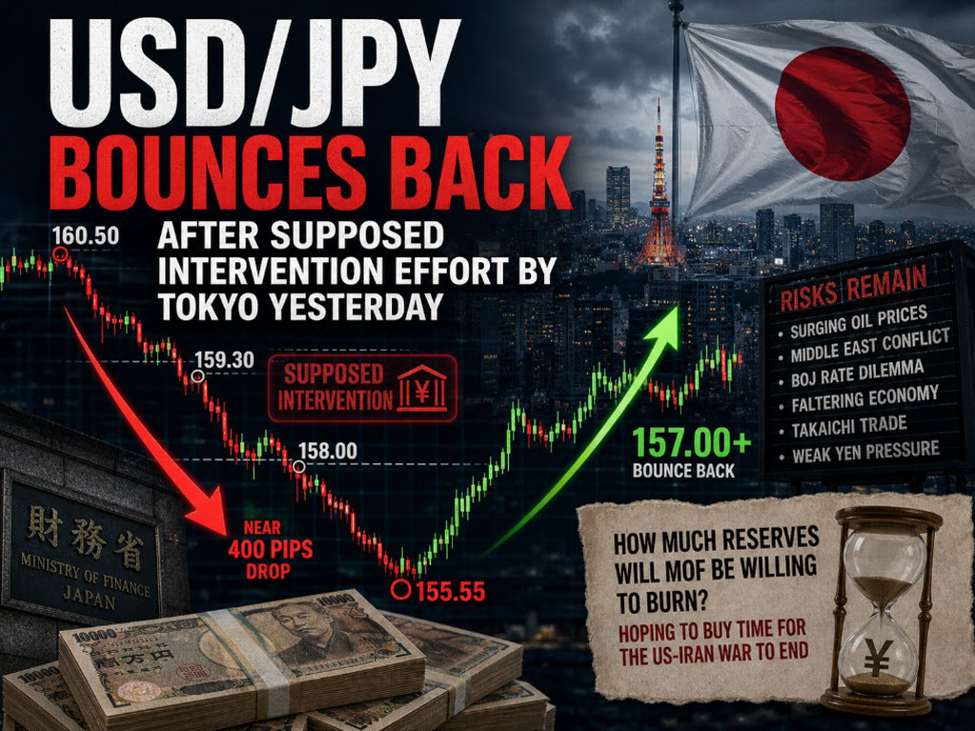
When the drop happened yesterday, I wasn’t convinced that it was actual intervention from Japan’s ministry of finance. I’m sure I was not the only one who felt that way. After Katayama delivered her final warning, we saw USD/JPY initially fall from 160.50 to around 159.30 before tumbling quickly to around 158.00. It took over 20 minutes before the pair broke below the 158.00 level after. So, that was my only gripe in reading the price action above.Typically, previous intervention attempts would see a stronger 200-300 pips drop without much pushback. This one took a bit of time, before the pair tumbled down to 155.55. To be exact, it took a little more than an hour to secure that near 400 pips decline. But evidently, I was wrong it seems and Tokyo did actually intervene.But against a very tough backdrop, the yen is struggling to sustain the tailwind from intervention efforts yesterday. USD/JPY has bounced back up to above 157.00 today as traders push back against the move.As mentioned yesterday, every fundamental factor at the moment is working against the yen currency. In that lieu, the impact of any intervention may not be as effective as it was in the past.”The Takaichi trade is still running in the background and perhaps may even worsen if the government has to compile a supplementary budget to push out more energy subsidies. Adding to that is the BOJ facing up against cost-push inflation now in their efforts to raise interest rates. And that will come against a backdrop of a faltering economy, which is taking a massive hit from surging oil prices. As the Middle East conflict continues to drag on, the situation just becomes even more perilous for the Japanese economy.But unless the fundamental backdrop turns around, Tokyo officials also know very well that any intervention efforts may not be lasting. And that was the case with what we saw back in July 2024, before USD/JPY reversed back higher to cut out the intervention drop by January 2025. And this time around, that turnaround could be even quicker considering the market backdrop and economic landscape.”The question now is how much reserves will the ministry of finance be willing to burn in their battle to keep markets at bay? In essence, they seem to be hoping to buy time for the US-Iran war to end. But with each passing day that the Strait of Hormuz remains closed, Tokyo will need a bigger appetite to stop the continued selling in the yen.
This article was written by Justin Low at investinglive.com.
💡 DMK Insight
The recent USD/JPY drop raises questions about the legitimacy of Japan’s intervention. Traders should be cautious; the initial fall from 160.50 to 159.30 might suggest volatility driven by speculation rather than solid fundamentals. If this was indeed a government intervention, it could signal a more aggressive stance from Japan’s Ministry of Finance, especially if the yen continues to weaken. However, the quick rebound hints at market skepticism—traders are not fully buying into the narrative. Keep an eye on the 159.00 level; a break below could trigger further selling pressure. Conversely, if USD/JPY stabilizes above 160.00, it might indicate that the market is re-evaluating its stance on the yen’s strength. Watch for any statements from Japanese officials that could clarify their position, as this could lead to significant market moves. The real story is whether this is a one-off event or the start of a trend in intervention tactics.
📮 Takeaway
Monitor the 159.00 support level in USD/JPY; a break could lead to increased selling pressure, while stability above 160.00 may suggest a bullish outlook.