Bitcoin
  Ethereum
  Tether
  BNB
BNB  XRP
XRP  USDC
USDC  Solana
  TRON
TRON  Lido Staked Ether
  Figure Heloc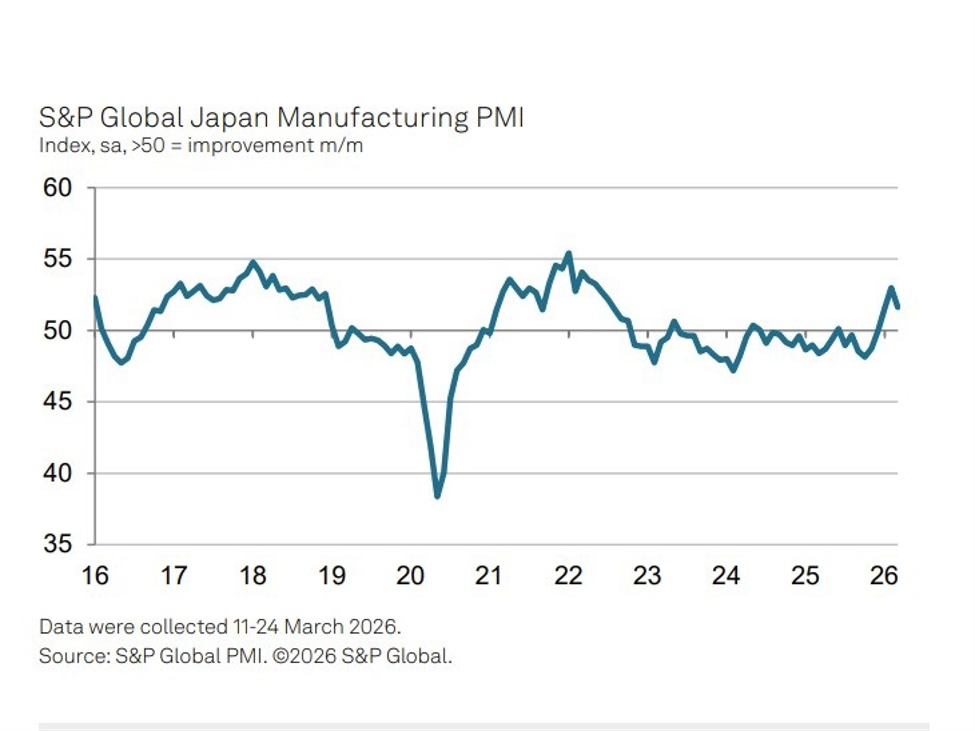
Japan’s manufacturing sector remains in expansion but is losing momentum as cost pressures rise and confidence weakens, with the Middle East conflict feeding through into inflation and uncertainty.Summary:Japan manufacturing PMI eased to 51.6 (prev. 53.0), still in expansion
Growth slowed but remains second-strongest since mid-2022
New orders, output and employment all expanded at softer pace
Input cost inflation surged to fastest in ~19 months, driven by energy
Business confidence weakened amid Middle East war uncertaintyJapan’s manufacturing sector continued to expand in March, though momentum slowed notably as rising costs and global uncertainty began to weigh on activity.The S&P Global Manufacturing PMI eased to 51.6 from 53.0 in February, indicating a slower but still solid pace of improvement. Despite the moderation, the reading remains among the strongest seen since mid-2022, suggesting the sector retains a degree of underlying resilience. The loss of momentum was evident across key components. Growth in output and new orders continued but at a more modest pace, reflecting softer demand conditions. Firms cited continued strength in areas such as semiconductors, AI-related products and automotive demand, though the overall expansion in new business slowed compared to recent months. Export orders also rose, but at a reduced rate.Employment increased for a third consecutive month, but hiring growth also moderated. While firms continued to expand capacity, labour shortages persisted and hiring was not sufficient to prevent a further buildup in backlogs of work.At the same time, cost pressures intensified. Input prices rose at the fastest pace in over a year-and-a-half, driven by higher energy and raw material costs, as well as the impact of a weaker yen. Survey respondents explicitly linked part of the increase to the Middle East conflict, which has disrupted energy markets and supply chains.Firms responded by raising output prices, with selling price inflation accelerating to one of the fastest rates in recent months, indicating ongoing pass-through of higher costs.Business confidence weakened compared to February’s recent highs, as companies expressed concern over the global outlook and the persistence of geopolitical risks. While some firms remain optimistic about demand tied to structural growth areas such as AI and defence, the near-term outlook has become more uncertain.Overall, the data suggest Japan’s manufacturing sector remains in expansion but is increasingly facing headwinds from rising costs and slowing demand, complicating the policy backdrop for the Bank of Japan.
This article was written by Eamonn Sheridan at investinglive.com.
💡 DMK Insight
Japan’s manufacturing PMI drop to 51.6 signals a slowdown, and here’s why that matters: While still in expansion territory, the decline from 53.0 indicates waning momentum, which could impact currency pairs like USD/JPY. Traders should note that rising cost pressures and weakening confidence, exacerbated by geopolitical tensions in the Middle East, could lead to further inflationary pressures. This environment might prompt the Bank of Japan to reconsider its monetary policy stance, especially if the trend continues. Keep an eye on the 50.0 level; a drop below that could signal contraction, triggering a bearish sentiment in the yen. Additionally, related markets like commodities might react as Japan’s demand outlook dims, potentially affecting oil prices given Japan’s status as a major importer. On the flip side, if the PMI stabilizes or rebounds in upcoming reports, it could restore confidence and strengthen the yen. Watch for upcoming economic indicators and geopolitical developments that could sway market sentiment significantly.
📮 Takeaway
Monitor the 50.0 PMI level closely; a drop below could signal contraction and bearish pressure on the yen.