 Bitcoin
  Ethereum
  Tether
  XRP
XRP  BNB
BNB  USDC
USDC  Solana
  TRON
TRON  Lido Staked Ether
  Figure Heloc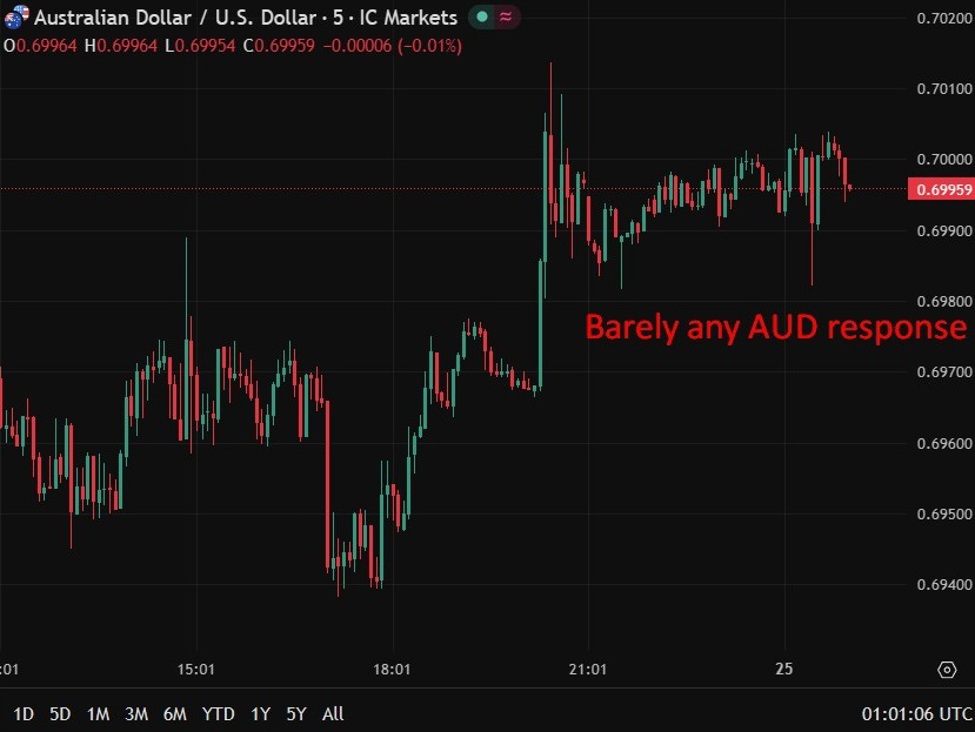
Australia’s February CPI showed modest cooling, but inflation remains above target and the data predates a sharp energy-driven inflation shock, leaving risks tilted to the upside.Summary:Australia February CPI cooled slightly to 3.7% y/y (vs 3.8% prior/exp).
Monthly CPI flat at 0.0% m/m, down from 0.4%.
Trimmed mean came in soft m/m at 0.2% (vs 0.3% exp), y/y at 3.3%.
Inflation still above RBA target band, with non-tradables sticky.
Data pre-dates March energy shock, meaning upside risks remain.Australia’s inflation data for February showed a modest cooling in price pressures, though underlying inflation remains above target and the outlook has been materially complicated by the recent surge in energy prices.Data from the Australian Bureau of Statistics showed headline CPI was unchanged on a monthly basis in February, coming in at 0.0% m/m after a 0.4% rise in January. On an annual basis, inflation eased slightly to 3.7% y/y from 3.8%, coming in just below expectations for an unchanged reading.Core inflation also showed some moderation at the margin. The trimmed mean rose by 0.2% m/m, undershooting forecasts of 0.3%, while the annual pace held at 3.3% y/y following a downward revision to January’s figure. While this suggests some easing in momentum, the level of underlying inflation remains above the Reserve Bank of Australia’s 2–3% target band.The detail of the report points to a still-sticky domestic inflation backdrop. Non-tradables inflation continues to pose a challenge, indicating persistent price pressures in services and other domestically driven components. This reinforces the view that inflation in Australia was already running too high even before the latest external shocks.Importantly, the February data predates the sharp rise in global energy prices seen in March, driven by escalating geopolitical tensions in the Middle East. This timing is critical for policymakers, as it means the current inflation readings do not yet reflect the expected pass-through from higher fuel, electricity and gas costs.The removal of earlier government rebates is also beginning to show through in electricity pricing, suggesting households may face further increases in utility costs in coming months. Combined with rising fuel prices, this points to a likely reacceleration in inflation in the near term.For the RBA, the data presents a mixed picture. While the monthly print was relatively benign and slightly softer than expected, inflation remains above target and forward-looking risks have clearly shifted to the upside. As a result, the report is unlikely to alter the central bank’s tightening bias, particularly given its recent emphasis on energy-driven inflation risks.
This article was written by Eamonn Sheridan at investinglive.com.
💡 DMK Insight
Australia’s February CPI data is a mixed bag, and here’s why it matters now: While the year-over-year inflation rate dipped to 3.7%, the flat monthly CPI signals potential stagnation, especially with energy prices likely to surge soon. Traders should be wary; this data doesn’t fully capture the looming energy-driven inflation shock that could push prices higher. The Reserve Bank of Australia (RBA) might be forced to adjust its monetary policy sooner than expected, which could impact AUD pairs. If inflation continues to rise, watch for the RBA’s response—interest rate hikes could follow, affecting forex markets and potentially leading to volatility in AUD/USD. Keep an eye on the 0.65 level for AUD/USD; a break below could signal bearish sentiment, while a rebound might indicate a bullish reversal. On the flip side, the cooling CPI could be interpreted as a sign that the RBA’s previous tightening measures are having an effect, which might provide temporary support for the AUD. However, the real risk lies in the energy sector’s influence on inflation, making it crucial to monitor oil prices and energy market trends closely. The next few months will be pivotal, so traders should stay alert for any shifts in RBA policy or unexpected inflation data.
📮 Takeaway
Watch the AUD/USD closely around the 0.65 level; a break could signal bearish momentum as inflation risks rise.