Bitcoin
  Ethereum
  Tether
  BNB
BNB  XRP
XRP  USDC
USDC  Solana
  TRON
TRON  Lido Staked Ether
  Figure Heloc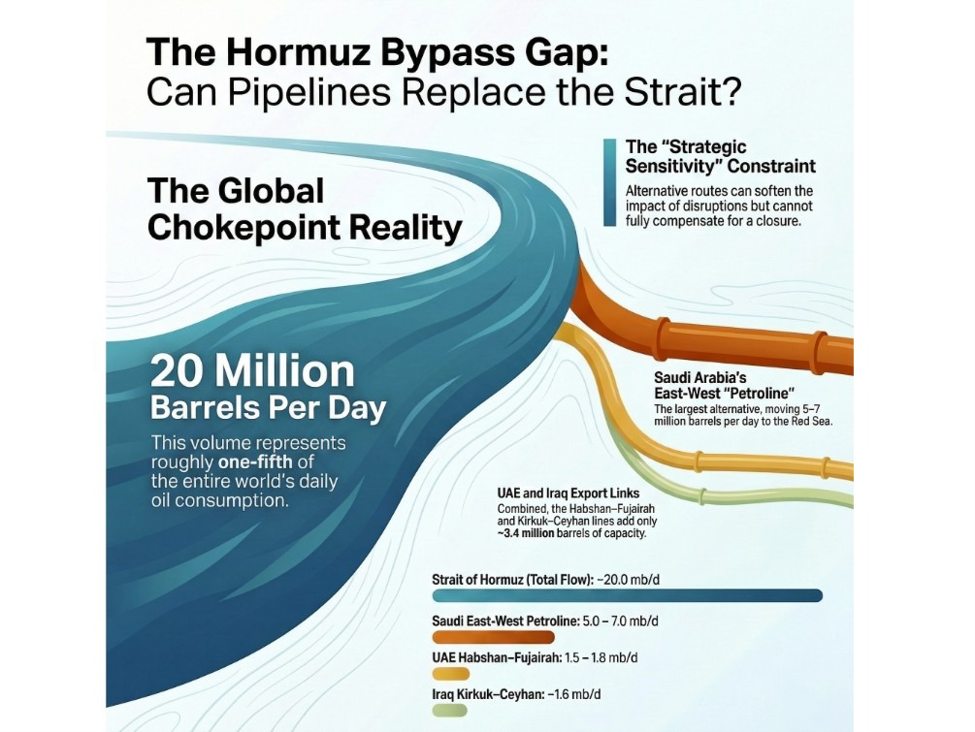
A handful of pipelines can bypass the Strait of Hormuz, but their combined capacity falls far short of replacing the massive volumes of oil normally shipped through the critical Gulf chokepoint.Summary:The Strait of Hormuz carries roughly 20% of global oil consumption.A limited number of pipelines allow exporters to bypass the chokepoint.Saudi Arabia’s East–West pipeline (5–7 mb/d) is the largest alternative route.The UAE’s Habshan–Fujairah pipeline (≈1.5–1.8 mb/d) also avoids Hormuz.Iraq’s Kirkuk–Ceyhan pipeline exports crude to the Mediterranean.Combined bypass capacity is far below normal Hormuz flows.As tensions rise around the Strait of Hormuz, attention in global energy markets often turns to the limited infrastructure that allows oil exporters to bypass the critical chokepoint. The narrow waterway between Iran and Oman handles roughly one-fifth of the world’s oil consumption, making it the most important transit corridor for crude shipments.In periods of geopolitical stress, analysts frequently highlight a small network of pipelines that can move oil around the strait and deliver it to export terminals outside the Persian Gulf. While these routes provide important contingency capacity, they are far from sufficient to replace the volumes that normally pass through Hormuz.The most significant bypass route is Saudi Arabia’s East–West pipeline, often referred to as Petroline. The system connects the kingdom’s major oil fields in the Eastern Province to the Red Sea port of Yanbu. With an estimated capacity of around 5–7 million barrels per day, the pipeline allows Saudi crude to reach global markets without tankers entering the Gulf or passing through Hormuz. Built in the aftermath of tanker attacks during the Iran-Iraq war in the 1980s, the infrastructure remains a cornerstone of Saudi Arabia’s energy security strategy.***The United Arab Emirates operates another key bypass system. The Habshan–Fujairah pipeline transports crude from Abu Dhabi’s oil fields to the export terminal at Fujairah on the Gulf of Oman, outside the Strait of Hormuz. The line can carry roughly 1.5–1.8 million barrels per day, enabling a portion of the UAE’s exports to avoid the strait entirely.***Iraq also has a route that bypasses the Gulf. The Kirkuk–Ceyhan pipeline runs from northern Iraq to Turkey’s Mediterranean port of Ceyhan. With potential capacity of around 1.6 million barrels per day, it allows crude to be shipped to Europe without passing through Hormuz. However, the pipeline handles mainly northern Iraqi production and has faced repeated disruptions due to political disputes and security issues.***Smaller regional links also exist, including the Saudi Arabia–Bahrain pipeline, which primarily supplies Bahrain’s refining system. While useful for regional logistics, it does little to offset large-scale export disruptions.Several additional bypass projects have been proposed over the years, including an Iraq-to-Jordan pipeline to the Red Sea port of Aqaba, though these plans remain under development.Even if all existing bypass pipelines were operating at maximum capacity, they would still fall well short of replacing the roughly 20 million barrels per day of oil that typically flows through the Strait of Hormuz.For global energy markets, the implication is clear: alternative routes can soften the impact of disruptions, but they cannot fully compensate for a prolonged closure of the strait. That reality is why Hormuz remains one of the most strategically sensitive locations in the global oil system.
This article was written by Eamonn Sheridan at investinglive.com.
💡 DMK Insight
The Strait of Hormuz is crucial, carrying about 20% of global oil, and disruptions here could spike prices significantly. With only a few pipelines available to bypass this chokepoint, traders need to keep an eye on geopolitical tensions in the region. Any escalation could lead to supply fears, pushing oil prices higher. Current market sentiment is already sensitive to such risks, and a sudden disruption could trigger a rapid price reaction. Watch for key levels in crude oil futures; a break above recent highs could signal a bullish trend. Conversely, if tensions ease, we might see a pullback. It’s also worth noting that while some may argue that alternative routes could mitigate risks, the reality is that they can’t match the volume of oil typically transported through the Strait. This discrepancy could lead to volatility in related markets, including energy stocks and commodities. Keep an eye on the news cycle for any developments that could impact this critical region.
📮 Takeaway
Monitor crude oil futures closely; any geopolitical escalation could push prices above recent highs, signaling a potential bullish trend.