
 Bitcoin
  Ethereum
  Tether
  BNB
BNB  XRP
XRP  USDC
USDC  Solana
  TRON
TRON  Lido Staked Ether
  Figure Heloc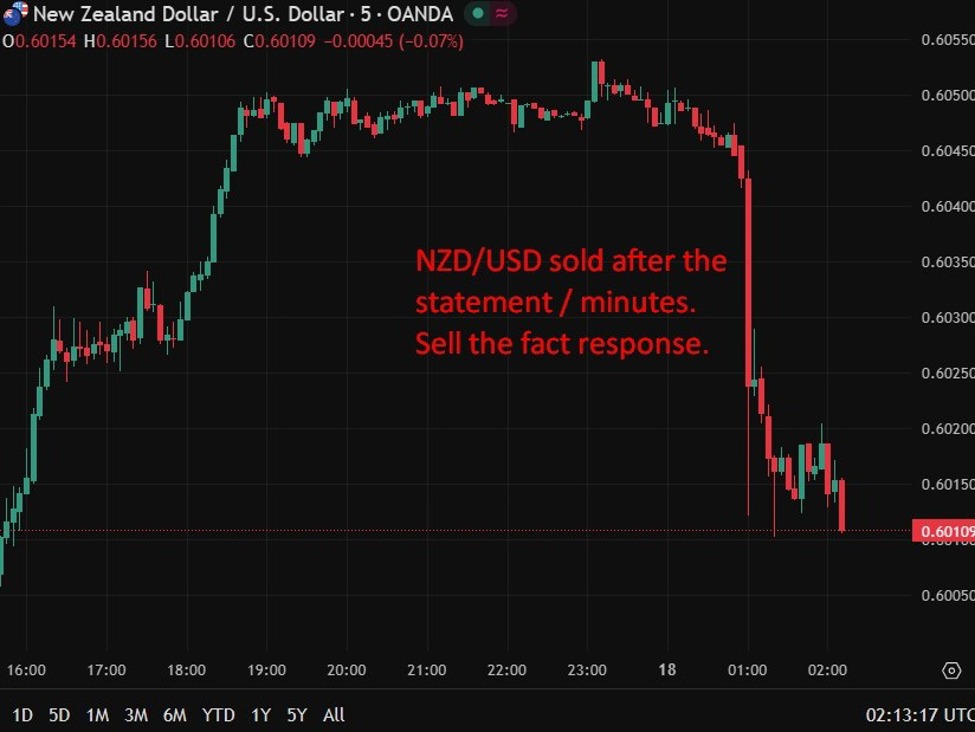
The RBNZ held rates at 2.25% but brought forward the implied timing of its first hike, signalling a slightly firmer outlook than in November while maintaining that policy will remain accommodative for now.Summary:Reserve Bank of New Zealand held the OCR at 2.25%, as expected.Policy still described as accommodative for some time.OCR track now implies a potential hike by late (really late) 2026, earlier than signalled in November.Inflation briefly above target; labour market stabilising but still soft.Markets trimmed near-term hike odds; NZD and front-end rates eased.The Reserve Bank of New Zealand left the Official Cash Rate unchanged at 2.25%, reinforcing a cautious but subtly firmer policy message in its first decision of the year.As widely anticipated, the Committee opted to hold steady, reiterating that monetary policy is likely to remain accommodative for some time while the recovery strengthens and inflation returns sustainably toward the 2% midpoint of its 1–3% target band. Annual CPI had edged slightly above the band at the end of 2025, though policymakers continue to expect inflation to settle back inside target in the current quarter.The shift in emphasis lies not in the hold itself, but in the forward guidance. The updated OCR track now points to the cash rate at 2.38% by the end of this year, implying the possibility of a hike sooner than previously signalled. At the November 2025 meeting, projections had effectively pushed any tightening discussion well into the outer years. The latest profile suggests the Committee is now more open to removing accommodation earlier — though only if the recovery evolves broadly as expected.Minutes underscored that the decision to hold was reached by consensus. While members agreed policy must remain supportive, they also acknowledged risks around inflation persistence and the possibility that stimulus may need to be withdrawn somewhat earlier should activity firm convincingly. That nuance marks a modest recalibration rather than a hawkish pivot.The economic backdrop remains fragile. Output has returned to growth but only after a prolonged downturn. The labour market is stabilising, yet unemployment remains elevated. Housing activity is subdued, with prices still well below their post-pandemic peaks in major centres. Headwinds from weak household spending and softer government demand continue to weigh on momentum.Market reaction reflected the balanced tone. The New Zealand dollar eased modestly and short-term swap rates dipped, as traders pared back expectations of a move, pushing pricing more decisively toward December.In sum, the RBNZ is not rushing toward tightening. However, compared with November, it has edged the conversation forward. The bias has shifted slightly upward, even as the central bank stresses patience.Staying tuned now for press conference.
This article was written by Eamonn Sheridan at investinglive.com.
💡 DMK Insight
The RBNZ’s decision to hold rates at 2.25% while signaling a potential hike sooner than expected is a game changer for Kiwi traders. This move indicates a shift in sentiment, suggesting the RBNZ is becoming more optimistic about economic recovery. Traders should note that while the current rate remains unchanged, the forward guidance hints at tightening, which could strengthen the NZD against major pairs. If the market reacts positively, we might see resistance levels around recent highs being tested. Keep an eye on the 2.30% mark as a potential pivot point for future rate hikes. However, the RBNZ’s commitment to an accommodative stance means volatility could persist, especially if global economic conditions shift unexpectedly. Watch for reactions from institutional players, as they might adjust their positions based on these signals. In the broader context, this could also impact commodity prices, particularly dairy, which is a significant export for New Zealand. If the NZD strengthens, it could affect the competitiveness of these exports, leading to potential ripple effects in related markets. Overall, traders should monitor the upcoming economic data releases closely, especially any inflation indicators that could influence the RBNZ’s next steps.
📮 Takeaway
Watch for the NZD’s reaction around the 2.30% level as the RBNZ hints at earlier rate hikes; volatility is likely in the near term.