Bitcoin
  Ethereum
  Tether
  BNB
BNB  XRP
XRP  USDC
USDC  Solana
  TRON
TRON  Lido Staked Ether
  Figure Heloc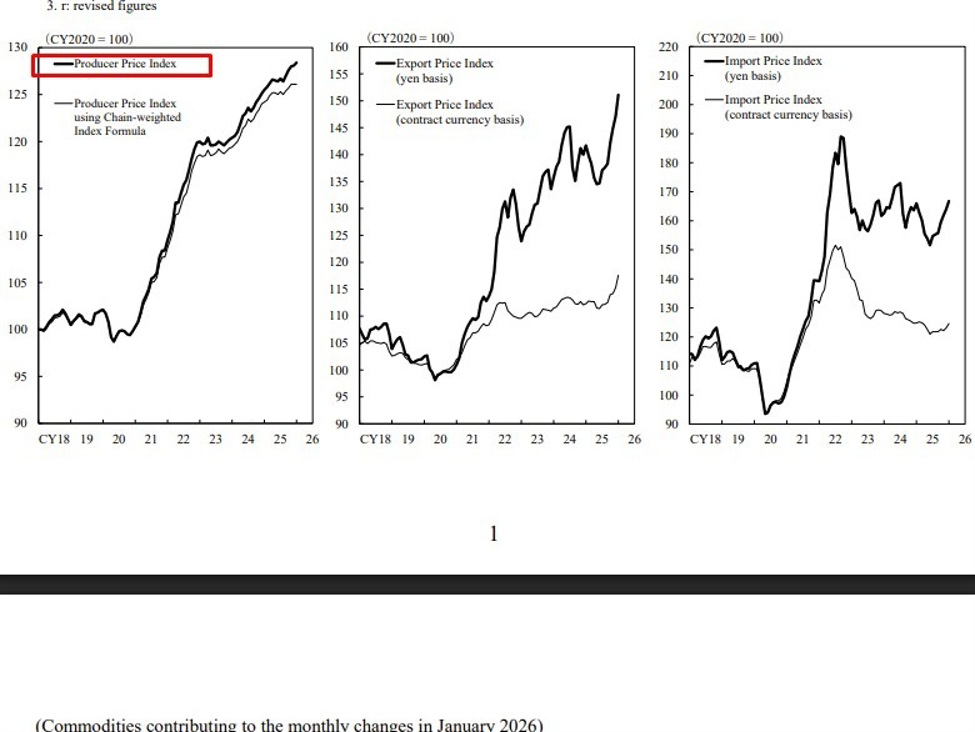
Japan’s PPI is also known as the Corporate Goods Price Index. Its an indicator to ‘wholesale’ inflation. Data post earlier is here ICYMI:Japan January 2026 wholesale inflation. PPI 2.3% y/y (vs. expected 2.3%)Japan wholesale inflation slows, but yen import prices edge higherJapan’s January CGPI rises 2.3% y/y, slowing from 2.4%.In line with market expectations.Yen-based import price index up 0.5% y/y.Weak yen continues to feed cost pressures.Data feeds into BOJ inflation assessment after December rate hike.Japan’s wholesale inflation slowed for a second consecutive month in January, though rising yen-denominated import costs highlight ongoing price pressures linked to currency weakness.Data from the Bank of Japan showed the corporate goods price index (CGPI) rose 2.3% year-on-year in January, easing from 2.4% in December and matching market expectations. The CGPI tracks the prices companies charge one another for goods and services and is viewed as a leading indicator of pipeline inflation.While the moderation suggests producer-level price momentum is gradually cooling, the currency channel remains active. An index measuring yen-based import prices increased 0.5% from a year earlier, following a revised 0.2% rise in December. That uptick underscores how a weaker yen continues to lift the cost of imported raw materials and energy, even as global commodity pressures stabilise.For policymakers, the mixed signals complicate the inflation narrative. The Bank of Japan has been assessing whether underlying price growth is sustainably anchored around its 2% target. In December, the BOJ raised its policy rate to 0.75%, a 30-year high, marking another step away from decades of ultra-loose monetary policy and near-zero borrowing costs.The central bank has indicated it will continue to evaluate whether cost-push pressures are translating into more durable demand-driven inflation. A sustained rise in import prices due to yen weakness could delay the full cooling of producer costs, while the gradual slowdown in headline wholesale inflation suggests that peak pressures may be behind.Markets will likely interpret the data as broadly consistent with the BOJ’s cautious normalisation path, neither forcing immediate tightening nor derailing the case for gradual policy adjustment if inflation dynamics remain firm.
This article was written by Eamonn Sheridan at investinglive.com.
💡 DMK Insight
Japan’s PPI holding steady at 2.3% y/y is a mixed bag for traders right now. While it matches expectations, the slight slowdown from 2.4% signals a potential easing in wholesale inflation pressures. This could influence the Bank of Japan’s monetary policy, especially as the yen’s import prices are on the rise. A stronger yen could impact exporters negatively, which is something to watch if you’re trading Japanese equities or related forex pairs. Look for reactions in USD/JPY, particularly if it approaches key support levels around 140. If the yen strengthens further, it might trigger a shift in market sentiment, leading to increased volatility in both forex and equities. Keep an eye on upcoming economic data releases that could provide more context on inflation trends and the BOJ’s next moves. Here’s the thing: while the PPI data is stable, the rising import prices could lead to a squeeze on margins for Japanese companies, potentially impacting their stock prices. So, if you’re holding positions in Japanese equities, consider how these inflation dynamics might play out in the coming weeks.
📮 Takeaway
Watch USD/JPY closely; a break below 140 could signal a stronger yen and impact Japanese equities.