Bitcoin
  Ethereum
  Tether
  XRP
XRP  BNB
BNB  USDC
USDC  Solana
  TRON
TRON  Lido Staked Ether
  Figure Heloc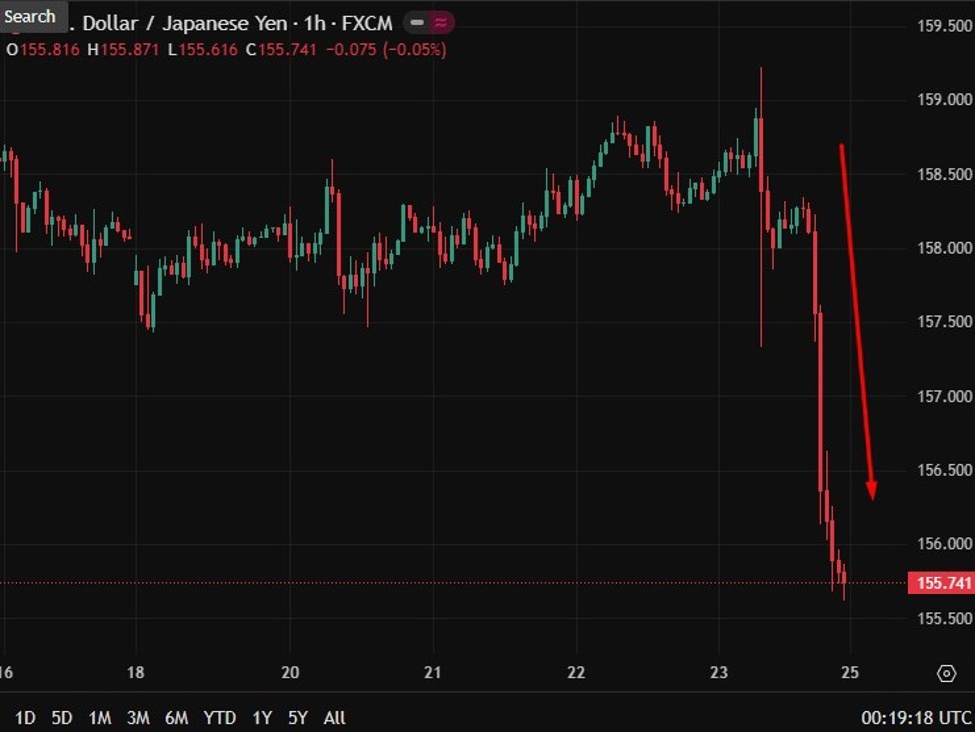
Japan’s intervention risk is back in sharp focus after PM Takaichi warned on Sunday against speculative moves, following a violent yen reversal and rate-check chatter late Friday.Summary:Japan PM Sanae Takaichi warned officials stand ready to act against “speculative and highly abnormal” market moves as the yen weakens and bond yields rise.The remarks follow sharp yen gains late Friday after market chatter of a Federal Reserve rate check, a precursor to actual FX intervention if needed.USD/JPY reversed violently from above 159.20 to below 156.00, a move in Friday (thinning) liquidity.Officials appear to be escalating from verbal warnings to operational signalling, increasing intervention risk into thin-liquidity sessions.Takaichi’s comments ahead of Monday Asia trade reinforce expectations Japanese authorities remain on high alert for disorderly yen moves.Japan has stepped up its warning rhetoric on the yen, with Prime Minister Sanae Takaichi signalling readiness to act against speculative market moves as pressure builds across currency and bond markets.Speaking during a televised debate among party leaders on Sunday, Takaichi said authorities would not hesitate to respond to “speculative and highly abnormal movements,” even as she acknowledged that market pricing itself is not a matter for political direction. While she did not explicitly reference either the yen or Japanese government bonds, the timing of the remarks leaves little doubt over the intended target.The comments follow a dramatic reversal in the yen late on Friday after traders reported that the Federal Reserve Bank of New York had contacted financial institutions to ask about the yen’s exchange rate. This is a ‘rate check’ action that is a precursor to actual intervention (its the next step along from the verbal jawboning we’ve had in recent months) that may follow if the yen continues to weaken. USD/JPY had earlier surged to around 159.22 following the Bank of Japan decision before reversing sharply, falling to the mid-155s into the close.
The late-week timing raised eyebrows, with thin Friday liquidity amplifying the impact of official signalling. While direct intervention was not seen yet, the Fed’s outreach was widely interpreted as groundwork that can precede coordinated action when currency moves are seen as excessive or disorderly.Market participants have long flagged holiday-thinned sessions as attractive windows for Japanese action, given the greater price impact per dollar deployed. While I had focused on Monday’s U.S. holiday (January 19) as a potential flashpoint, Friday’s rate-check chatter confirms officials are willing to act opportunistically as liquidity fades.With Takaichi now reinforcing the message ahead of Asia-Pacific trade on Monday, traders are increasingly wary that Japan is transitioning from prolonged verbal jawboning to more tangible market operations if yen weakness accelerates further. Its not usual for the PM to jump in with verbal intervention, but given its now an election campaign its unusual times.
This article was written by Eamonn Sheridan at investinglive.com.
💡 DMK Insight
Japan’s yen intervention risk just spiked—here’s why that’s crucial for traders right now: PM Takaichi’s warning against speculative moves highlights a growing concern over the yen’s volatility, especially after a sharp reversal late Friday. This isn’t just noise; it signals that the Bank of Japan might step in if the yen continues to weaken, which could lead to significant market shifts. Traders should be on high alert for any intervention announcements, as these can cause rapid price movements. If the yen breaks key support levels, expect a potential surge in volatility across forex pairs, particularly those involving the USD/JPY. But here’s the flip side: if the yen stabilizes without intervention, it could indicate a shift in market sentiment, potentially leading to a stronger yen in the medium term. Keep an eye on the 145 level for USD/JPY; a breach could trigger intervention, while a bounce could signal a recovery. Watch for any upcoming economic data releases from Japan that might influence the BOJ’s decision-making process, as these could provide clues on future intervention timing.
📮 Takeaway
Monitor the USD/JPY around the 145 level—any intervention could lead to sharp price swings, so stay alert for news from Japan.