
 Bitcoin
  Ethereum
  Tether
  XRP
XRP  BNB
BNB  USDC
USDC  Solana
  TRON
TRON  Lido Staked Ether
  Figure Heloc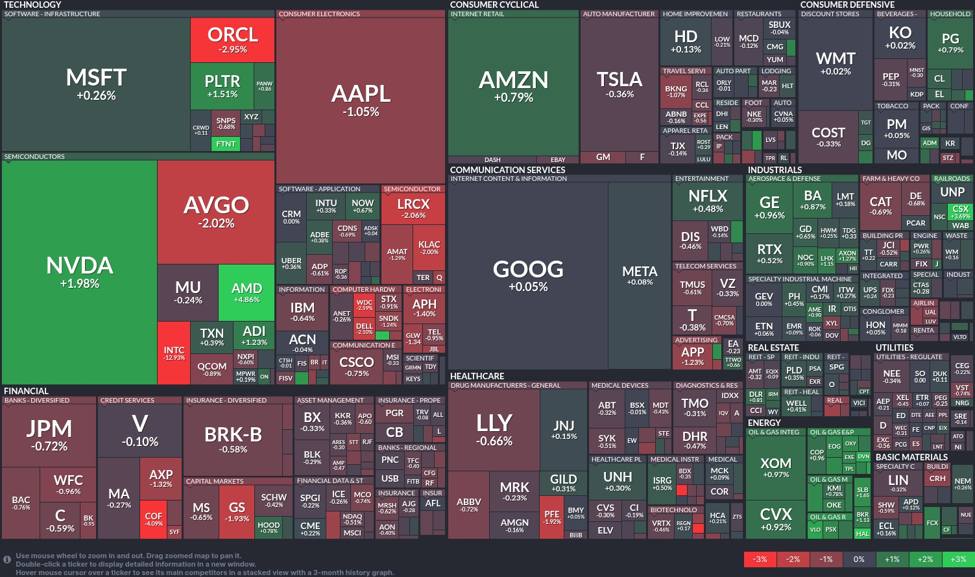
Sector OverviewThe stock market presented a mixed bag of performances today, with noteworthy activity across several key sectors. The technology sector stood out with striking contrasts: while Nvidia (NVDA) surged by 1.98% amid high investor interest, Intel (INTC) faced a steep decline of 12.93%, reflecting challenges or unfavorable news impacting the semiconductor space. Notably, AMD emerged as another strong player, advancing 4.86%.Technology: While Nvidia’s gains underline investor confidence or positive developments, Oracle (ORCL) dropped by 2.95% possibly hinting at concerns in infrastructure software.Consumer Cyclical: The sector saw modest gains with Amazon (AMZN) up by 0.79%, signaling continued consumer confidence in retail giants. Tesla (TSLA) fell slightly by 0.36%.Financials: Mixed emotions mark the financial landscape, with JPMorgan Chase (JPM) dipping by 0.72%, and Bank of America (BAC) declining 0.76%, suggesting cautious sentiment. Market Mood and TrendsThe broader market sentiment today hints at uncertainty and selective optimism. The tech sector’s polarized performance is a vivid example, with investors appearing wary yet opportunistic. Investor anxiety may stem from Intel’s drop, yet the surge in Nvidia and AMD demonstrates confidence in parts of the tech ecosystem. Consumer confidence in retail giants like Amazon could underpin future retail sector strength.Strategic RecommendationsInvestors may want to capitalize on the robust performance of key tech stocks such as Nvidia and AMD while staying cautious around sectors experiencing volatility, like semiconductors. Continuous monitoring of developments in the tech arena and diversification across sectors might optimize portfolio resilience. Consider reallocating resources towards the healthcare sector, where steadiness prevails with stocks like Johnson & Johnson (JNJ) maintaining a positive 0.15%. Navigating this volatile market requires adaptability and attentiveness to real-time data and trends. 🌐 Stay connected with InvestingLive.com for timely insights and updates!
This article was written by Itai Levitan at investinglive.com.
💡 DMK Insight
Nvidia’s 1.98% rise contrasts sharply with Intel’s 12.93% drop, and here’s why that matters: The tech sector’s mixed performance signals diverging investor sentiment. Nvidia’s gains suggest strong demand and confidence in AI and gaming, while Intel’s steep decline raises red flags about its competitive position and operational challenges. Traders should consider how these contrasting movements could influence broader tech indices, especially if Nvidia continues to rally while Intel struggles. Watch for key support levels in Intel around recent lows, as a break could trigger further selling pressure. On the flip side, Nvidia’s momentum could attract more institutional interest, potentially pushing it toward new highs. Keep an eye on earnings reports and guidance from both companies in the coming weeks, as they could provide critical insights into the tech landscape. If Nvidia maintains its upward trajectory, it might pull other semiconductor stocks along with it, while Intel’s woes could lead to a broader sector rotation away from underperformers.
📮 Takeaway
Watch Nvidia’s performance for bullish momentum, while Intel’s support levels are critical to monitor for potential further declines.