 Bitcoin
  Ethereum
  Tether
  XRP
XRP  BNB
BNB  USDC
USDC  Solana
  TRON
TRON  Lido Staked Ether
  Figure Heloc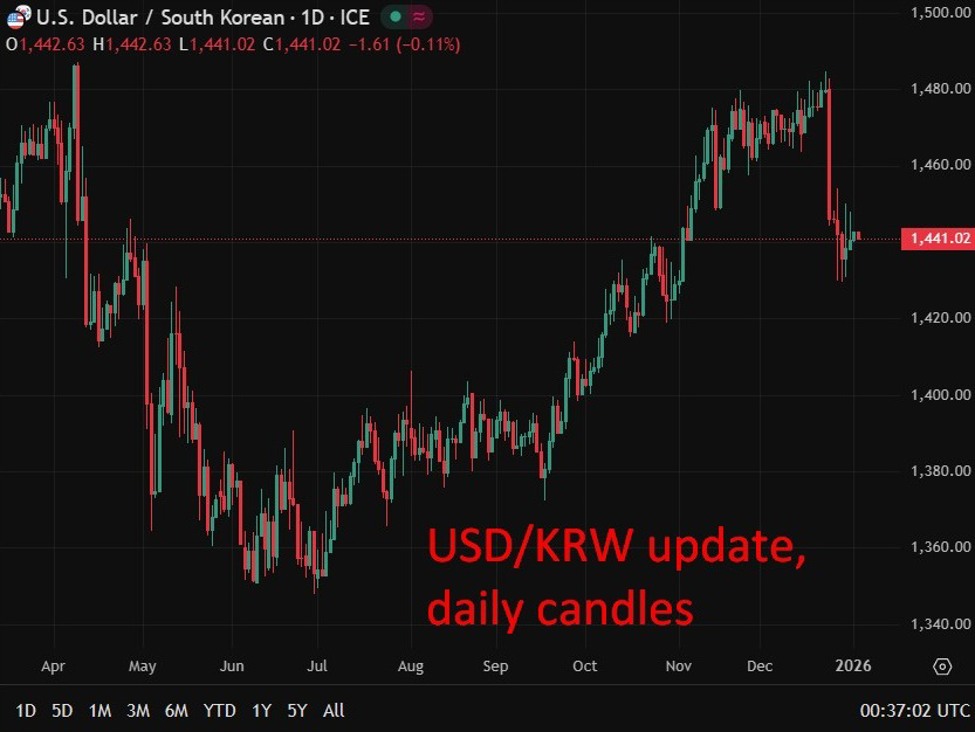
Summary:Bank of Korea Governor Rhee Chang-yong said the central bank will review its forward guidance framework on the future path of interest rates.Rhee warned that excessive won weakness could harm domestic businesses and add to inflation pressures.He said USD/KRW levels above 1,400 appear disconnected from Korea’s economic fundamentals.The BOK will not support U.S.-bound investment decisions that could undermine foreign-exchange stability.Authorities are considering expanding special lending programmes for small businesses.Rhee also called for a comprehensive review of pension funds’ overseas investments, citing FX implications.-The Bank of Korea has signalled growing unease over foreign-exchange volatility, with Governor Rhee Chang-yong warning that the current level of won weakness appears increasingly misaligned with South Korea’s economic fundamentals and risks feeding domestic inflation pressures.Rhee said the central bank will review its forward guidance approach on the future path of interest rates, an indication that policymakers are reassessing how monetary policy signals are being interpreted by markets. While he stopped short of committing to a policy shift, the comments suggest heightened sensitivity to financial conditions, particularly currency moves.Rhee highlighted concerns that a persistently weak won could do more harm than good for the domestic economy. He warned that depreciation may weigh on Korean businesses by raising import costs and squeezing margins, while also amplifying inflationary pressures at a time when price stability remains a key policy focus. The governor added that the USD/KRW exchange rate trading above the 1,400 level seems far from the Korean economy’s fundamentals, reinforcing the message that current FX levels may not be justified by underlying conditions.The BOK chief also drew a clear line on cross-border investment decisions, stating that authorities would not agree to U.S.-bound investments if they threaten foreign-exchange stability. The remarks underscore official concern that large-scale capital outflows — particularly by institutional investors, could exacerbate currency volatility.In that context, Rhee said policymakers see a need for a comprehensive review of pension funds’ overseas investment strategies. South Korea’s large pension funds have steadily increased foreign asset exposure in recent years, a trend that can create structural FX selling pressure during periods of market stress.Beyond FX issues, Rhee said the central bank will review the scope for expanding special lending facilities aimed at supporting small businesses, signalling a desire to balance financial stability concerns with targeted economic support.Taken together, the comments point to a more holistic policy stance from the BOK, with FX stability, capital flows and financial conditions now playing a more prominent role alongside traditional inflation and growth considerations.-Earlier from South Korea, in brief:South Korea’s manufacturing sector returned to expansion in December after two months of contraction, helped by a rebound in export demand.The manufacturing PMI rose to 50.1, back above the expansion threshold after holding at 49.4 in the prior two months.New orders grew for the first time in three months, posting the strongest increase since November 2024, with export orders also recovering.Output remained in contraction, though the pace of decline eased compared with November.Input buying picked up sharply, while inventories of finished goods fell at the fastest pace since May 2025.Business optimism jumped to a 3½-year high, driven by expectations of expansion and new product launches, notably in autos and semiconductors.Input cost inflation accelerated, hitting its fastest pace since mid-2022 due to currency weakness, pushing output prices to a nine-month high.
This article was written by Eamonn Sheridan at investinglive.com.
💡 DMK Insight
The Bank of Korea’s potential shift in interest rate guidance is a big deal for traders right now. Rhee Chang-yong’s comments about the won’s weakness and its impact on inflation signal that the BOK is closely monitoring the USD/KRW exchange rate, especially with levels above 1,400. This could lead to a recalibration of monetary policy if the won continues to weaken, which would affect not just forex traders but also those in equities and commodities linked to the Korean economy. If the BOK decides to intervene or adjust rates, expect volatility in the KRW and related assets. Traders should keep an eye on the USD/KRW pair for any signs of reversal or further weakness, particularly as we approach key economic data releases that could influence market sentiment. Here’s the flip side: if the BOK maintains its current stance without action, it could lead to a prolonged period of won weakness, which might be seen as a buying opportunity for those looking to capitalize on a rebound. Watch for any statements from the BOK in the coming weeks that could provide clarity on their strategy and potential interventions.
📮 Takeaway
Monitor the USD/KRW closely; levels above 1,400 could trigger BOK action, impacting forex and related markets.