Bitcoin
  Ethereum
  Tether
  BNB
BNB  XRP
XRP  USDC
USDC  Solana
  TRON
TRON  Lido Staked Ether
  Figure Heloc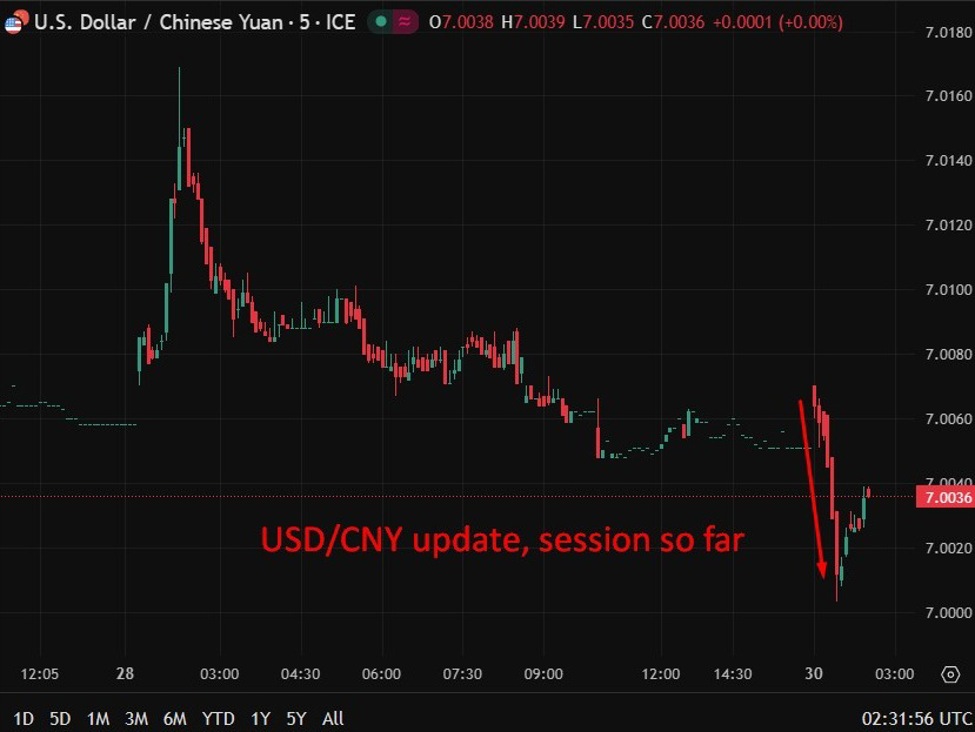
TL;DR summary:China delivered minimal rate cuts despite expectations for aggressive easing.The PBOC has prioritised financial stability and targeted liquidity tools.Fiscal stimulus is expected to carry the bulk of policy support into 2026.China’s central bank has taken a notably restrained approach to monetary easing, defying widespread expectations for aggressive rate cuts as the economy grapples with weak domestic demand, deflationary pressure and structural imbalances. Over the past year, the People’s Bank of China trimmed its policy rate only once, by 10 basis points, the smallest annual reduction since 2021, despite forecasts from major Wall Street banks calling for easing of up to 40 basis points. Info comes via a Bloomberg report, gated.
The caution has surprised markets, particularly after Beijing signalled a shift to a “moderately loose” monetary stance for the first time in 14 years as it prepared for escalating trade tensions with the US. What economists underestimated was the resilience of China’s export sector, concerns over banking-system stability, and the impact of a strong equity-market rally, all of which reduced the urgency for sweeping rate cuts.
Compared with global peers, China’s stance stands out. While advanced-economy central banks have cut policy rates by an average of 1.6 percentage points over the past two years, the PBOC has delivered only a fraction of that. Adjusted for inflation, Chinese interest rates have moved back into positive territory, underscoring Beijing’s reluctance to follow the ultra-loose playbook adopted by the Federal Reserve, European Central Bank and Bank of Japan during downturns.
Instead, policymakers have leaned on targeted and less conventional tools. Liquidity injections through short- and medium-term operations, selective relending programs, support for equity markets and renewed government bond purchases have kept funding conditions loose without slashing benchmark rates. These measures have pushed interbank borrowing costs, such as the seven-day repo rate, to their lowest levels since early 2023. Officials see limited scope for further cuts, with the key policy rate, the 7-day reverse repo, at 1.4% and concerns that deeper reductions could compress bank margins, weaken credit growth and fuel “Japanification” fears. As a result, fiscal policy is set to play the dominant role in 2026, with monetary policy focused on maintaining liquidity and keeping government borrowing costs low rather than driving a demand-led rebound. — The 7-day reverse repo rate, now considered a key policy signal, was cut from 1.5% to 1.4% on May 9, 2025.The 1-year LPR was trimmed to 3.0% from 3.1%, and the 5-year LPR was lowered to 3.5% from 3.6% in May also..
This article was written by Eamonn Sheridan at investinglive.com.
💡 DMK Insight
China’s cautious rate cuts signal a shift in monetary policy focus, and here’s why that matters: The People’s Bank of China (PBOC) is prioritizing financial stability over aggressive easing, which could have significant implications for global markets. Traders should note that this restrained approach may lead to a stronger yuan in the short term, impacting forex pairs like USD/CNY. With fiscal stimulus expected to dominate policy support through 2026, sectors reliant on liquidity may face headwinds. This could also ripple through commodities, especially if demand from China slows due to tighter monetary conditions. Look for key technical levels in the yuan and related assets; if USD/CNY breaks above recent resistance, it could signal a broader risk-off sentiment. Conversely, if the yuan strengthens, commodities priced in USD might face downward pressure. Keep an eye on upcoming economic data releases from China, as they could further influence market sentiment and trading strategies.
📮 Takeaway
Watch USD/CNY closely; a break above recent resistance could indicate a shift towards risk-off sentiment in global markets.