
 Bitcoin
  Ethereum
  Tether
  XRP
XRP  BNB
BNB  USDC
USDC  Solana
  TRON
TRON  Lido Staked Ether
  Figure Heloc
The Middle East turmoil continues and Iran is definitely not toning down on its threats and strikes across the region. It is now being reported across multiple sources that UAE’s Fujairah oil port has been attacked again. The damage is now being assessed but Reuters sources are saying that oil loading has been suspended at the port.The local media office is reporting that no casualties were sustained but there is a fire breaking out in the area after the drone attack.For some context, the port is one that is located approximately 70 nautical miles from the Strait of Hormuz. And it loads crude oil that is transported from the fields of Abu Dhabi, which are then mostly sold to buyers in Asia. With the Strait of Hormuz already in de facto closure, major disruptions here would be another headache for the oil market to deal with.As added background, the UAE is OPEC’s third‑largest crude producer with the Fujairah oil port itself being able to house up to 18 million cubic metres in storage capacity. So, that makes it one of the world’s top hubs for storing crude and fuels as well as blending operations.WTI crude oil is now up over 2% on the day now to $100.81 with Brent crude oil up close to 3% to $106.33 at the moment. This article was written by Justin Low at investinglive.com. 🔗 Source 💡 DMK Insight Oil prices are likely to spike again due to escalating tensions in the Middle East. With the recent attack on UAE’s Fujairah oil port, traders should brace for volatility. This isn’t just a local issue; it could ripple through global oil supply chains, especially with OPEC+ already managing tight production levels. If oil prices break above recent resistance levels, it could trigger a wave of speculative buying. Keep an eye on Brent crude, which has been hovering around key psychological levels. A sustained move above these levels could attract more bullish sentiment and push prices higher. But here’s the flip side: if the damage assessment reveals minimal impact on oil supply, we could see a quick correction. Traders should monitor news closely and be ready to adjust positions based on the evolving situation. Watch for any updates on production levels or further military actions that could sway market sentiment significantly. 📮 Takeaway Watch for Brent crude to break above recent resistance levels; any sustained rise could signal a bullish trend amid ongoing Middle East tensions.

USDJPY trades around intervention levels as Japanese officials remain constrained
FUNDAMENTAL OVERVIEWUSD:The US dollar skyrocketed in the final part of last week as prospects of a quick end to the war faded and oil resumed the rally towards triple digit levels. Traders continue to price out the rate cut bets amid surging energy prices. On Wednesday, we have the FOMC policy decision where the central bank is expected to keep interest rates unchanged with Miran, Waller and Bowman likely dissenting in favour of a rate cut. At this meeting, we will also get the Summary of Economic Projections and the Dot Plot. The Fed is likely to revise growth forecasts lower, while upgrading inflation estimates. The median Dot Plot should remain unchanged with one rate cut expected by year-end. Overall, the central bank is likely to stress patience amid the US-Iran war but maintain an easing bias. JPY:On the JPY side, nothing has changed but it’s interesting to see the lack of strong verbal intervention like we’ve seen back in January. The Japanese Minister of Finance Katayama did warn that they are ready to take decisive steps if needed, but other than that we haven’t got anything of substance. This week, we also have the BoJ policy decision on Thursday, but the central bank is expected to keep everything unchanged given the lack of support from Prime Minister Takaichi and especially from the economic data. A BoJ rate hike in the current context would just exacerbate growth fears and add more pressure on the stock market and economic activity. USDJPY TECHNICAL ANALYSIS – DAILY TIMEFRAMEOn the daily chart, we can see that USDJPY broke above the “intervention” level and it’s now trading at the highest level since 2024. The buyers will likely continue to target the cycle high around the 162.00 handle unless Japanese officials intervene, the BoJ hikes or Trump puts an end to the US-Iran conflict.USDJPY TECHNICAL ANALYSIS – 4 HOUR TIMEFRAMEOn the 4 hour chart, we have an upward trendline defining the bullish momentum. If we get a pullback into the trendline, we can expect the buyers to lean on the trendline with a defined risk below it to keep pushing into new highs. The sellers, on the other hand, will need the price to break lower to pile in for a drop into the 157.00 handle next.USDJPY TECHNICAL ANALYSIS – 1 HOUR TIMEFRAMEOn the 1 hour chart, there’s not much we can add here as the buyers will have a better risk to reward setup around the trendline, while the sellers will need a breakout to open the door for new lows. The red lines define the average daily range for today. UPCOMING CATALYSTSOn Wednesday we have the US PPI report and the FOMC policy decision. On Thursday, we have the BoJ policy decision and the latest US Jobless Claims figures. The focus remains on the US-Iran war, so keep an eye on the headlines, especially those regarding the Strait of Hormuz. This article was written by Giuseppe Dellamotta at investinglive.com. 🔗 Source 💡 DMK Insight The US dollar’s surge signals a shift in trader sentiment as energy prices climb. With oil approaching triple digits, the market is recalibrating expectations for interest rates. The fading prospects for a swift resolution to geopolitical tensions are pushing traders to reconsider rate cut bets. This dynamic could lead to increased volatility in forex pairs, especially those tied to commodities. Keep an eye on the FOMC meeting this Wednesday; any hints about future rate hikes could further bolster the dollar. If the dollar strengthens, it could pressure commodities and emerging market currencies, creating ripple effects across the board. But here’s the flip side: if energy prices stabilize or geopolitical tensions ease unexpectedly, we might see a quick reversal. Traders should watch the dollar index closely, particularly if it breaks above recent resistance levels. A sustained move could signal a longer-term bullish trend for the dollar, impacting everything from gold to equities. Monitor the 100-level in oil as a psychological barrier; a breach could fuel further dollar strength. 📮 Takeaway Watch the dollar index closely this week; a break above recent resistance could signal a bullish trend, especially if energy prices remain elevated.

US, Japan top diplomats set for phone conversation later today – report
It is reported that a call is being arranged between Japan foreign minister Motegi and US secretary of state Rubio for later today, according to sources familiar with bilateral relations. Among what will be discussed is likely the topic of the Strait of Hormuz, after US president Trump has called for ally countries to dispatch warships to the region to act as escorts. I mentioned earlier here why that won’t go down too well.As a reminder, Japan is arguably one of, if not, the most impacted third-party by the US-Iran conflict. And it is in part complicating things domestically, not least with a struggling currency. From earlier: Tokyo intervention looms large as USD/JPY nears 160 markBesides that particular topic, it is reported that Motegi also wants to gauge US intentions ahead of the expected meeting between Trump and Takaichi in Washington later this week. This article was written by Justin Low at investinglive.com. 🔗 Source 💡 DMK Insight So, a call between Japan’s foreign minister and the US secretary of state is on the table, and here’s why that matters: geopolitical tensions in the Strait of Hormuz could impact oil prices and, by extension, forex markets. Traders should keep an eye on how these discussions unfold, especially given the region’s critical role in global oil supply. If tensions escalate or if any agreements are hinted at, we could see volatility in oil futures and related currencies like the Canadian dollar and the Norwegian krone. Look, the real story is that any significant movement in oil prices can ripple through the forex market, affecting everything from commodity currencies to safe havens. If the call leads to a more stable outlook, we might see a dip in oil prices, which could strengthen the dollar against oil-linked currencies. Conversely, if tensions rise, expect a spike in oil prices and a corresponding reaction in the forex pairs. Keep an eye on the $70 level for WTI crude as a potential pivot point. Watch for updates from this call and be ready to adjust your positions based on the outcomes, especially if you’re trading oil or related currencies. 📮 Takeaway Monitor the outcome of the Japan-US call for potential impacts on oil prices and forex markets, especially around the $70 level for WTI crude.

RBA preview: a rate hike is widely expected; policymakers to take a cautious approach next
The Reserve Bank of Australia is widely expected to raise the cash rate by 25 bps, bringing it to 4.10%. These expectations were initially driven by stronger-than-expected economic data, but the US–Iran war has since added another layer of upside risk to inflation. What really cemented expectations for a hike, however, were comments from RBA’s Hauser, who warned that keeping interest rates too low could trigger a damaging rise in inflation expectations. Referring to the oil price shock of 2022, he added that the RBA does not want to repeat that experience and that failing to raise rates to the level needed and allowing inflation to spiral out of control, would be a serious mistake. Hauser also noted that “there will be two sides to the debate,” likely suggesting that beyond March the central bank’s decisions will depend heavily on how the US–Iran war evolves. Markets are currently pricing in around 71 bps of additional tightening by year-end, implying roughly two more rate hikes after the one expected tomorrow. Given such strongly hawkish expectations, the Australian dollar might be at risk of a drop in case the RBA adopts a patient stance or directly signals a pause.The longer the US–Iran war and the disruption in the Strait of Hormuz persist, the greater the drag on the global economy will be. For that reason, markets expect the RBA to bring its rate hike forward to tomorrow, reflecting pre-war economic conditions and new upside risk to inflation. Beyond that, policymakers are likely to adopt more of a “wait-and-see” stance rather than relying on forward guidance. This article was written by Giuseppe Dellamotta at investinglive.com. 🔗 Source 💡 DMK Insight The anticipated 25 bps rate hike from the Reserve Bank of Australia is a pivotal moment for traders, especially given the backdrop of rising inflation risks tied to geopolitical tensions. Stronger-than-expected economic data had already set the stage for this move, but the US–Iran conflict adds a layer of uncertainty that could further fuel inflation. Traders should keep an eye on how this rate hike impacts the Australian dollar, particularly against the US dollar, as it could create volatility in forex pairs like AUD/USD. If the RBA follows through, expect a potential test of key resistance levels around 0.6500 in AUD/USD. Conversely, if the hike fails to materialize or is less aggressive than anticipated, we could see a sharp pullback. Here’s the thing: while the hike seems priced in, the real story is how the market reacts to the geopolitical backdrop. Watch for any shifts in sentiment or economic indicators that could sway the RBA’s future decisions, as these could lead to significant trading opportunities in both forex and related commodities markets. 📮 Takeaway Monitor the AUD/USD pair closely; a confirmed rate hike could push it towards 0.6500, while any surprises might trigger a sharp reversal.
Market outlook for the week of 16th-20th March
It will be a busy week for the FX market in terms of economic events, starting with Canadian inflation data on Monday. Tuesday, the highlight will be the RBA monetary policy announcement while the U.S. will publish pending home sales m/m data. Wednesday brings the BoC monetary policy announcement, the U.S. PPI m/m release and the highly anticipated FOMC meeting. New Zealand will also publish its GDP q/q data. Thursday will be particularly eventful with monetary policy announcements from the BoJ, SNB, BoE, and ECB. Australia will release its employment change figures and unemployment rate; the U.K will publish labour market data, including the claimant count change, average earnings index 3m/y and the unemployment rate; while the U.S. will publish new home sales data. Finally, on Friday, Canada is scheduled to release its retail sales data. The consensus for Canadian CPI m/m is 0.7% versus 0.0% previously. Median CPI y/y is expected to ease from 2.5% to 2.4%, trimmed mean CPI y/y is projected to remain unchanged at 2.4%, and common CPI y/y is forecast to decline from 2.7% to 2.6%. This inflation release comes ahead of the BoC meeting, but it is unlikely to influence the Bank’s decision on Wednesday, as policymakers are in a wait-and-see mode. Headline inflation is expected to edge down toward the 2% target. Analysts at RBC note that recent inflation readings have been somewhat distorted by base effects. Last year’s temporary GST/HST tax holiday lowered prices at the time, while the removal of the consumer carbon tax from energy prices last April continued to suppress year-over-year energy costs. Core inflation measures have cooled to around 2.5%, largely reflecting slower shelter price growth, though services inflation excluding housing was still above 3% in January. Some price pressures persist, with grocery prices rising to almost 5% y/y. Labour market data showed mixed signals after recent job losses and a slight rise in unemployment to 6.7%, although overall conditions remain relatively stable. At this week’s meeting the BoC is widely expected to keep its policy rate unchanged as they wait for more data. Ongoing uncertainty around USMCA-related trade risks is an argument for patience but the tone may shift compared with recent meetings. Even though some analysts argue that additional rate cuts are a possibility due to the recent surge in oil prices, the balance of risks now looks more neutral. Overall higher energy prices tend to be more supportive for Canada when it comes to income and activity, but the concern is that they’re keeping inflation pressure elevated, Wells Fargo analysts said. There’s been progress on inflation with core inflation gradually cooling, but rising energy costs could push headline as well as expectations higher. At the same time, Canada’s energy exposure provides some cushion for growth compared with other advanced economies, reducing downside risks. At this week’s meeting, the RBA is expected to deliver a 25 bps rate hike, lifting the cash rate to 4.10% from 3.85%. Recent remarks from RBA officials suggest that policymakers remain concerned about limited supply capacity and the persistence of domestic inflation. Keeping inflation expectations under control remains a priority, and the recent surge in global energy prices adds another layer of pressure on the RBA to act without delay, Westpac analysts said. If delivered, the March move would likely be followed by another 25 bp hike around May, bringing the total additional tightening to 50 bps and pushing the cash rate back toward its post-pandemic high of around 4.35%. At this week’s FOMC meeting, the Fed is widely expected to keep interest rates unchanged while emphasizing concerns about a potential stagflationary environment. Policymakers will have to navigate a more uncertain outlook, as rising energy costs and persistent inflation risks complicate the case for further rate cuts. Traders will closely watch the updated Summary of Economic Projections, which is likely to reflect a more challenging macroeconomic backdrop. Officials are expected to raise their inflation forecasts, lower their growth projections and slightly increase their unemployment expectations. However, these opposing forces may largely offset each other, leaving the projected path for interest rates broadly unchanged. Wells Fargo analysts still expect two 25 bps rate cuts in June and September. The Fed is also likely to signal a gradual slowdown in the balance sheet runoff, although the impact on longer-term yields is expected to remain limited. That said, Scotiabank notes that a hold decision will likely have dissenters, such as Miran and, possibly, Waller, based on labor market softness. Also markets will wait to see how the change in Fed leadership will play out given Trump’s repeated calls for lower rates. In New Zealand, the consensus for GDP q/q is 0.4% compared to 1.1% previously. Growth is expected to moderate, with the expansion likely to be modest but relatively broad-based across several industries. Analysts at Westpac note that earlier releases were clouded by distortions and volatile data, and this week’s figures should provide a clearer picture of the underlying economic momentum. That said, the data points are a lagging indicator and the outlook has become more uncertain in recent weeks. Rising geopolitical tensions in the Middle East and the associated pressure on energy prices could pose new challenges for the economy just as the recovery was beginning to gain traction. Australia’s February labour market report is likely to show steady but moderate improvement. The consensus for employment change is 20.3K versus 17.8K previously, while the unemployment rate is expected to remain unchanged at 4.1%. While job data was volatile late last year, recent trends suggest hiring is stabilizing as the earlier slowdown in “care economy” roles fades and employment in consumer services, construction and business services gradually strengthens. Overall, job growth appears to be moving off its earlier lows, although the pace remains measured. Business survey indicators also point to a gradual improvement rather than a sharp rebound. Recent declines in the jobless rate have largely been driven by lower participation rather than a strong surge in hiring. With the participation rate likely
Prediction markets watch
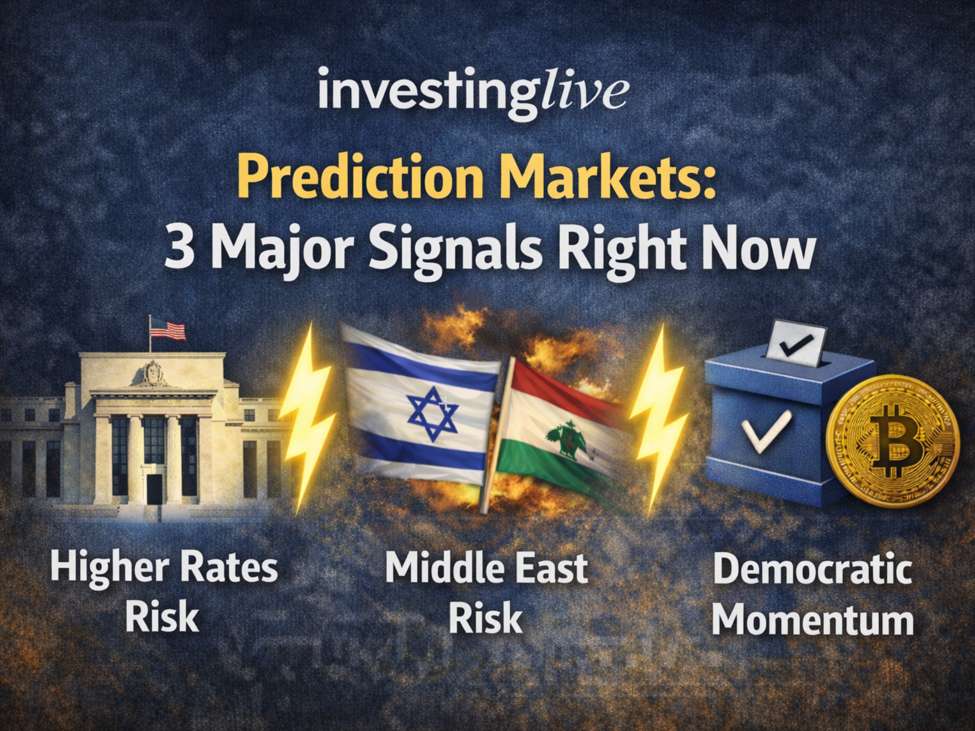
Prediction markets are sending a sharper message than many traditional headlines right nowEditorial note: investingLive covers prediction markets as a sentiment and policy signal. investingLive does not operate a wagering platform or process wagering transactions on this page, nor its website. Advertising and sponsored placements, where present, are separate from editorial content and are clearly labeled. Availability and legality of third-party services vary by jurisdiction.The biggest move is in rates. The market mood has turned more hawkish as energy-driven inflation risk rises, even though many economists were still recently centered on a June Fed cut. That gap matters because it shows how quickly traders are repricing the inflation fallout from the Iran war compared with the slower-moving survey consensus. Reuters reported that both Barclays and Goldman Sachs pushed their first Fed cut call to September, with Barclays now expecting only one 25 basis point cut in 2026. In other words, the market is not fully calling recession as the base case. It is first saying that the inflation shock is changing the rates story faster than economists are willing to move. Read more in report on Barclays pushing back its Fed cut call.That rates repricing is also connected to politics. Rising energy prices are no longer just a macro issue. They are becoming a voter issue. Reuters reported that gas prices rose sharply after the strikes on Iran, adding a fresh affordability problem for Republicans heading into the midterms. That helps explain why political prediction markets have moved faster toward a more Democratic national environment than some traditional seat-by-seat coverage. The map is still tight, and House control could still come down to a small number of competitive races, but markets are increasingly translating consumer stress and national mood into chamber odds. See how higher gas prices are pressuring Republicans and Kalshi’s summary of shifting Senate odds.Geopolitically, traders still look far more skeptical than headline diplomacy might suggest. Even as Reuters reported expected Israel-Lebanon talks aimed at a more durable ceasefire, prediction markets continue to treat negotiations more as crisis management than true de-escalation. The same skepticism carries over to Ukraine, where peace efforts remain stalled and attention has increasingly shifted toward the Middle East. The market takeaway is simple: diplomacy headlines alone are not enough to reverse the risk premium. For context, see more on the expected Israel-Lebanon talks and AP’s broader coverage of the geopolitical backdrop.The sharpest odds-versus-process divergence may be in crypto. Prediction markets still look relatively constructive on major crypto legislation, yet the Washington process story looks much messier.Reuters reported that the Clarity Act has hit a fresh impasse, with banks still objecting to key provisions and the calendar becoming increasingly hostile as campaign season approaches. That makes crypto one of the most interesting areas for editorial monitoring right now: markets are still leaning more optimistic than the legislative plumbing seems to justify, but they are not fully endorsing the more euphoric crypto-native narrative either. Read more on the new crypto bill impasse as we show on investingLive.com that Etherum is the new black in crypto.There is also a deeper second-order story here. The signal itself is becoming political and regulatory. The CFTC has opened a rulemaking process on event contracts and prediction markets, with a focus on manipulation, margin, and whether contracts tied to war, terrorism, or military action should even be allowed. That means journalists, investors, and traders are increasingly using a signal source whose own future rules may change. If that regulatory pressure intensifies, the structure, availability, or credibility of some prediction-market signals could shift quickly over the next quarter. See the CFTC rulemaking process.The bottom line is that prediction markets are flashing three important signals right now. First, higher-for-longer rates risk has become a more urgent market message than the older economist consensus implied. Second, the market is treating diplomacy in the Middle East as a temporary management tool, not yet as proof of de-escalation. Third, political markets have moved faster toward a Democratic-leaning national mood than mainstream seat coverage has fully embraced. The most notable gap remains crypto, where market optimism still looks a bit ahead of Washington reality.For investors and traders alike, that is what makes this space worth watching. Prediction markets are not replacing traditional reporting, polling, or macro analysis. But they are becoming a faster-moving layer of real-time sentiment, one that can sometimes spot a shift before the mainstream narrative catches up.Remember, investors and traders, prediction markets are not a crystal ball. Forecasts and market odds can shift quickly as new information comes in, so please trade and invest at your own risk and make decisions based on your own judgment and risk tolerance. This article was written by Itai Levitan at investinglive.com. 🔗 Source 💡 DMK Insight Prediction markets are currently reflecting trader sentiment more accurately than traditional news outlets, and here’s why that matters. These markets often serve as a leading indicator for price movements, capturing the collective expectations of participants about future events. With volatility in both crypto and forex markets, understanding these signals can give traders an edge. For instance, if prediction markets are heavily favoring a particular outcome, it could lead to significant price adjustments in the underlying assets as traders react to the shifting sentiment. But don’t just take these signals at face value. It’s crucial to analyze the context behind the predictions. Are they based on solid fundamentals, or are they influenced by speculative hype? For example, if a prediction market indicates a high probability of regulatory changes affecting crypto, it might trigger a sell-off or rally, depending on the perceived impact. Traders should keep an eye on key levels and patterns that emerge in response to these predictions, particularly in the daily and weekly charts. Watch for any significant shifts in prediction market sentiment, as these could precede major price movements in related assets like Bitcoin or major currency pairs. Keeping tabs on these indicators could be the difference between a missed opportunity and a profitable trade. 📮 Takeaway

US futures hold slightly higher for now but danger lurks just around the corner
US futures are keeping just a little higher today but is it all some misplaced optimism? US president Trump has signaled for ally countries to come and help alleviate tensions in the Strait of Hormuz. However, will that really work? I outlined earlier why his call to arms will fall on deaf ears and why even if not, it will not help much with the situation in any case.For now at least, US futures are hanging on to some hope that we might see a resolution soon enough. But with Iran continuing to cause chaos across the region, even striking UAE’s Fujairah oil port again, it’s hard to see a meaningful de-escalation in tensions.S&P 500 futures are up 0.3% while Nasdaq futures are up 0.5% on the day. In part, I want to argue that the slight bounce here owes much to a technical one rather than investors seeing scope for optimism to the US-Iran conflict. That as we are meeting some key levels on the charts. Let’s take a look below.Of note, we are seeing the S&P 500 start to close in on its 200-day moving average (blue line). Meanwhile, the Nasdaq itself is already testing the key level on Friday but arguably not securing a firm break just yet. That as the November lows near 22,000 is still very much in play as well currently.As such, tech shares have a momentous week up ahead in trying to find support from the key levels above. For some context, the last time we saw US indices broke below both the key daily moving averages was back in March to May last year.That indicates the kind of upside momentum that we have come to associate US stocks, or more specifically tech shares, with in the past year or so.So if there is to be a material shift in the technical momentum, that could lead to a major corrective call in price action in the short-term. And one can argue amid the whole AI rally that perhaps we are overdue one. It’s sort of the volatile trigger selling in gold and silver that we saw towards the end of January. Yup, that sort of thing.Taking that into consideration, the charts look to be what may point to the next momentum shift in US stocks – more so than what the US-Iran conflict might be telling. However, there is no doubt that tensions in the Middle East and oil prices are also key factors in driving sentiment at this stage. So, it’s all connected and part of the playbook as we get into the new week.Besides that, just be wary that this will also be a big week as the central bank bonanza returns. And that will kick off with the RBA tomorrow. This article was written by Justin Low at investinglive.com. 🔗 Source 💡 DMK Insight US futures are slightly up, but here’s the catch: geopolitical tensions in the Strait of Hormuz could flip the script. Trump’s call for allies to step in might seem like a stabilizing move, but history shows that such interventions often lead to more uncertainty. Traders should keep an eye on oil prices, as any escalation in the region could spike volatility. If tensions rise, we could see a significant impact on energy stocks and commodities, especially if crude oil breaks above key resistance levels. Watch for any shifts in sentiment that could push futures lower, particularly if the market reacts negatively to news from the region. The real story is whether this optimism is sustainable or just a temporary blip before reality sets in. 📮 Takeaway Monitor oil prices closely; any escalation in the Strait of Hormuz could trigger volatility in US futures and energy markets.

USDCAD trades near a key resistance following the bleak Canadian jobs data. What's next?
FUNDAMENTAL OVERVIEWUSD:The US dollar skyrocketed in the final part of last week as prospects of a quick end to the war faded and oil resumed the rally towards triple digit levels. Traders continue to price out the rate cut bets amid surging energy prices. On Wednesday, we have the FOMC policy decision where the central bank is expected to keep interest rates unchanged with Miran, Waller and Bowman likely dissenting in favour of a rate cut. At this meeting, we will also get the Summary of Economic Projections and the Dot Plot. The Fed is likely to revise growth forecasts lower, while upgrading inflation estimates. The median Dot Plot should remain unchanged with one rate cut expected by year-end. Overall, the central bank is likely to stress patience amid the US-Iran war but maintain an easing bias. CAD:On the CAD side, the economic data has been surprising to the downside, and last Friday we got a very weak jobs report. In such a case, we would see traders pricing in rate cuts for the BoC but given the US-Iran war and the surging energy prices, the market is expecting almost two rate hikes by the end of the year. On Wednesday, we have the Bank of Canada policy decision where the central bank is expected to keep interest rates unchanged amid the geopolitical uncertainty. The BoC might dismiss market-based interest rates expectations given the risks to growth though, which could weigh on the CAD.Today, we get the Canadian CPI report. As usual, the focus will be mainly on the Trimmed Mean CPI Y/Y which is expected at 2.3% vs 2.4% prior. The data might not change much for the market given the focus on the US-Iran war.USDCAD TECHNICAL ANALYSIS – DAILY TIMEFRAMEOn the daily chart, we can see that USDCAD has been trading in a wide range since February and the price recently surged all the way back to the resistance around the 1.3750 level. This is where we can expect the sellers to step in with a defined risk above the resistance to position for a drop back into the 1.3550 support. The buyers, on the other hand, will look for a breakout to increase the bullish bets into the 1.39 handle next.USDCAD TECHNICAL ANALYSIS – 4 HOUR TIMEFRAMEOn the 4 hour chart, we have a mid-range support around the 1.3630 level. That should be the first target for the sellers. If the price gets there, we can expect the buyers to step in with a defined risk below the support to position for a rally back into the 1.3750 resistance next. USDCAD TECHNICAL ANALYSIS – 1 HOUR TIMEFRAMEOn the 1 hour chart, we can see the price is breaking below the upward trendline that was defining the bullish momentum on this timeframe. From a risk management perspective, the sellers would have a better risk to reward setup around the downward counter-trendline to keep targeting the 1.3630 support. The buyers, on the other hand, will want to see the price breaking above the counter-trendline to position for a breakout above the 1.3750 resistance next. The red lines define the average daily range for today. UPCOMING CATALYSTSToday we get the Canadian CPI report. On Wednesday, we have the BoC policy decision, the US PPI report and the FOMC policy decision. On Thursday, we get the latest US Jobless Claims figures. The focus remains on the US-Iran war, so keep an eye on the headlines, especially those regarding the Strait of Hormuz. This article was written by Giuseppe Dellamotta at investinglive.com. 🔗 Source 💡 DMK Insight The US dollar’s recent surge signals a shift in trader sentiment as geopolitical tensions and rising oil prices reshape expectations. With the FOMC meeting on Wednesday, traders are recalibrating their outlook on interest rates. The fading hopes for a swift resolution to the ongoing conflict have led to a stronger dollar, as investors seek safety in the currency amid uncertainty. Rising energy prices, pushing towards triple digits, are also fueling inflation concerns, making rate cuts less likely in the near term. This environment could lead to increased volatility in forex pairs, particularly those involving the dollar. Traders should keep an eye on key technical levels for the dollar index. If it breaks above recent highs, it could signal further strength, while a failure to maintain momentum might lead to profit-taking. Watch for the FOMC’s tone on interest rates, as any hawkish signals could further bolster the dollar against other currencies, especially the euro and yen, which are already under pressure from their own economic challenges. 📮 Takeaway Monitor the dollar index for a potential breakout above recent highs, especially ahead of the FOMC meeting on Wednesday.
SNB expected to keep key policy rate at 0% through the year – poll
Of note, all but one of 29 economists from major houses expect the SNB to keep its policy rate unchanged throughout the year. The lone exception is Barclays, who forecasts that the Swiss central bank is to cut interest rates to -0.25% in Q2 2026 and hold that until year-end.And that means all 29 economists are expecting the SNB not to make any changes to monetary policy later this week. That is very much well expected even if the US-Iran conflict has complicated things for policymakers.In essence, a return to deflation is what the SNB wants to avoid. But amid a stronger franc currency, that will continue to weigh down price pressures in the Swiss economy. And that’s one key challenge that the central bank is facing up against right now.In light of that, 14 out of 15 economists who responded to an extra question said that the SNB should step up currency interventions to address further strengthening in the franc. I would say that is to no one’s surprise with EUR/CHF having already tested waters below 0.90 early last week.That rather than leaning towards unconventional monetary policy to try and solve the problems in Switzerland.Julius Baer notes that:”For the SNB, sharp Swiss franc appreciation is the most immediate concern. We continue to view foreign exchange interventions as the SNB’s primary tool to counter such sharp, safe-haven-driven CHF appreciation.” This article was written by Justin Low at investinglive.com. 🔗 Source 💡 DMK Insight The consensus among economists suggests stability from the SNB, but Barclays’ forecast hints at future rate cuts that could shake things up. For traders, this means the current Swiss franc strength might be tested if Barclays’ prediction materializes. If the SNB does indeed hold rates steady, expect the franc to maintain its position against major currencies in the near term. However, if market sentiment shifts towards anticipating a rate cut, we could see increased volatility in the forex markets, particularly against the euro and dollar. Watch for any comments from SNB officials that might signal a change in outlook, as these could provide critical clues for positioning. Keep an eye on the 1.10 level for EUR/CHF; a break below could indicate a bearish trend for the franc if rate cuts loom on the horizon. 📮 Takeaway Watch the EUR/CHF at the 1.10 level; a break could signal shifts in sentiment towards potential SNB rate cuts.

The Indian Rupee hovers near record lows amid risk aversion and dollar strength
FUNDAMENTAL OVERVIEWUSD:The US dollar skyrocketed in the final part of last week as prospects of a quick end to the war faded and oil resumed the rally towards triple digit levels. Traders continue to price out the rate cut bets amid surging energy prices. On Wednesday, we have the FOMC policy decision where the central bank is expected to keep interest rates unchanged with Miran, Waller and Bowman likely dissenting in favour of a rate cut. At this meeting, we will also get the Summary of Economic Projections and the Dot Plot. The Fed is likely to revise growth forecasts lower, while upgrading inflation estimates. The median Dot Plot should remain unchanged with one rate cut expected by year-end. Overall, the central bank is likely to stress patience amid the US-Iran war but maintain an easing bias. INR:In the big picture, the Indian Rupee remains on a bearish structural trend against the US dollar. More recently, the bearish momentum increased due to risk aversion in the markets amid the US-Iran war. The longer this war drags on, the greater the negative impact will be on the global economy. This would keep the USDINR underpinned into new record highs.A de-escalation could give the INR a boost in the short-term which will likely be a good opportunity for traders to buy the dip in the USDINR pair as the main uptrend will likely remain intact. USDINR TECHNICAL ANALYSIS – DAILY TIMEFRAMEOn the daily chart, we can see that USDINR is approaching the upper bound of the rising channel. If the price gets there, we can expect the sellers to step in with a defined risk above the top trendline to position for a drop back into the lower bound of the channel. The buyers, on the other hand, will want to see the price breaking higher to increase the bullish bets into new highs.USDINR TECHNICAL ANALYSIS – 4 HOUR TIMEFRAMEOn the 4 hour chart, the recent price action formed a rising wedge pattern. This is generally a signal of weakening momentum. The buyers will likely lean on the bottom trendline with a defined risk below it to keep pushing into the upper bound of the channel. The sellers, on the other hand, will look for a break lower to pile in for a drop into the 91.63 level next. USDINR TECHNICAL ANALYSIS – 1 HOUR TIMEFRAMEOn the 1 hour chart, there’s not much we can add here as the buyers will have a better risk to reward setup around the bottom trendline, while the sellers will look for a breakout to open the door for new lows. A break above the top trendline though, could increase the bullish momentum following the recent wedge-type consolidation. In that case, we can expect the buyers to pile in to ride the rally into the upper bound of the channel. UPCOMING CATALYSTSOn Wednesday we have the US PPI report and the FOMC policy decision. On Thursday, we get the latest US Jobless Claims figures. The focus remains on the US-Iran war, so keep an eye on the headlines, especially those regarding the Strait of Hormuz. This article was written by Giuseppe Dellamotta at investinglive.com. 🔗 Source 💡 DMK Insight The US dollar’s surge signals a shift in market sentiment, and here’s why that matters: As traders recalibrate their expectations for interest rate cuts in light of rising energy prices, the dollar’s strength could impact various asset classes. The fading prospects of a quick resolution to geopolitical tensions, particularly in oil-rich regions, are driving up crude prices, which in turn affects inflation expectations. If oil prices push toward triple digits, we could see the Fed maintain a more hawkish stance, making rate cuts less likely. This environment could lead to increased volatility in equities and commodities, as investors reassess their positions. Keep an eye on the FOMC meeting this Wednesday; any hints of a prolonged tightening cycle could further bolster the dollar and pressure risk assets. On the flip side, if the Fed signals a more dovish approach despite the energy price surge, it could create a short-term pullback in the dollar. Traders should monitor the dollar index closely, particularly around key resistance levels, as a break above these could trigger further buying pressure. Watch for oil prices and their correlation with the dollar’s movement, as this relationship will be crucial in the coming days. 📮 Takeaway Watch the dollar index closely this week; a break above key resistance could signal further strength as energy prices rise.